


Sliding Lid vs Hinged Lid Cigar Box: Quick Comparison
| Decision factor | Sliding lid | Hinged lid | Buyer implication |
|---|---|---|---|
| Opening movement | Panel travels along guides | Lid rotates around its hinge axis | Approve the open position, not just closed dimensions |
| Required space | Withdrawal path plus hand access | Swept space above and, depending on geometry, behind the box | Check nearby shelves, walls and work items |
| Separate components | Panel may be removable or retained | Lid normally stays attached | Decide whether a loose lid is acceptable |
| Loading access | Depends on panel travel and remaining coverage | Depends on opening angle and support position | Try the actual loading sequence |
| Finished contact | Panel edges and guide surfaces | Lid edges, hinge alignment and closure fittings | Review rubbing, catching and final seating |
| Quotation detail | Guides, panel fit and retention arrangement | Hinges, installation, supports and closure arrangement | Compare complete specifications |
Plan the Space Needed to Open the Box
A closed-box drawing leaves the most important comparison unanswered: where does the lid go during use? Ask for a second view showing the usable open position and the direction of movement. Include the position of the operator’s hands and the route used to load or remove the contents.
For example, a box below a low shelf may suit a sliding panel if there is enough clear space in front of it. The same panel can become awkward when another object blocks that withdrawal path. On a shallow counter with open space above, a hinged lid may suit the layout better, provided its backward movement does not hit a wall.
These are layout examples, not universal size rules. Sliding travel depends on the panel and required opening; hinged clearance depends on the pivot, lid dimensions and opening angle. If the box has to be pulled out or turned before opening, include that step in the comparison. A small closed footprint does not necessarily mean convenient access.
Decide Whether the Sliding Panel Comes Off
Write “fully removable” or “retained during normal use” into the specification. The term sliding lid does not settle this question. A retained panel also needs a defined travel limit and enough exposed opening for the intended loading operation.
A removable lid can clear the top of the box, but it becomes a separate part to handle. Allocate a place for it at the packing station. Check which surface rests on the table, whether the visible finish touches that surface, and how the operator returns the panel to the guides. Where several boxes are open together, decide how lids stay with the intended boxes.

For a retained design, try loading the item nearest the covered end first and last. If either sequence requires forcing a wrapper or tilting the contents awkwardly, the opening may be insufficient. More travel, a different opening direction or a removable panel may resolve the issue; the appropriate change depends on the layout.
Also review artwork in both positions. A graphic on a removable lid may leave the viewing area when the box is opened. Approve the actual panel orientation and viewing direction instead of assuming that a closed-pack rendering explains the open presentation.
Specify What the Hinged Lid Must Do When Open
An attached lid avoids a separate panel, but “hinged” is not a complete functional requirement. Distinguish three actions: allowing rotation, limiting the opening angle and holding the lid open. The packing routine determines which of these is needed.
Hardware can incorporate particular functions. For example, Brusso’s stop-hinge product documentation describes a built-in opening stop. That describes the named hardware, not every box hinge or an unspecified XRX component. For a fuller explanation of hardware choices, see our guide to box hinge types for wooden packaging.
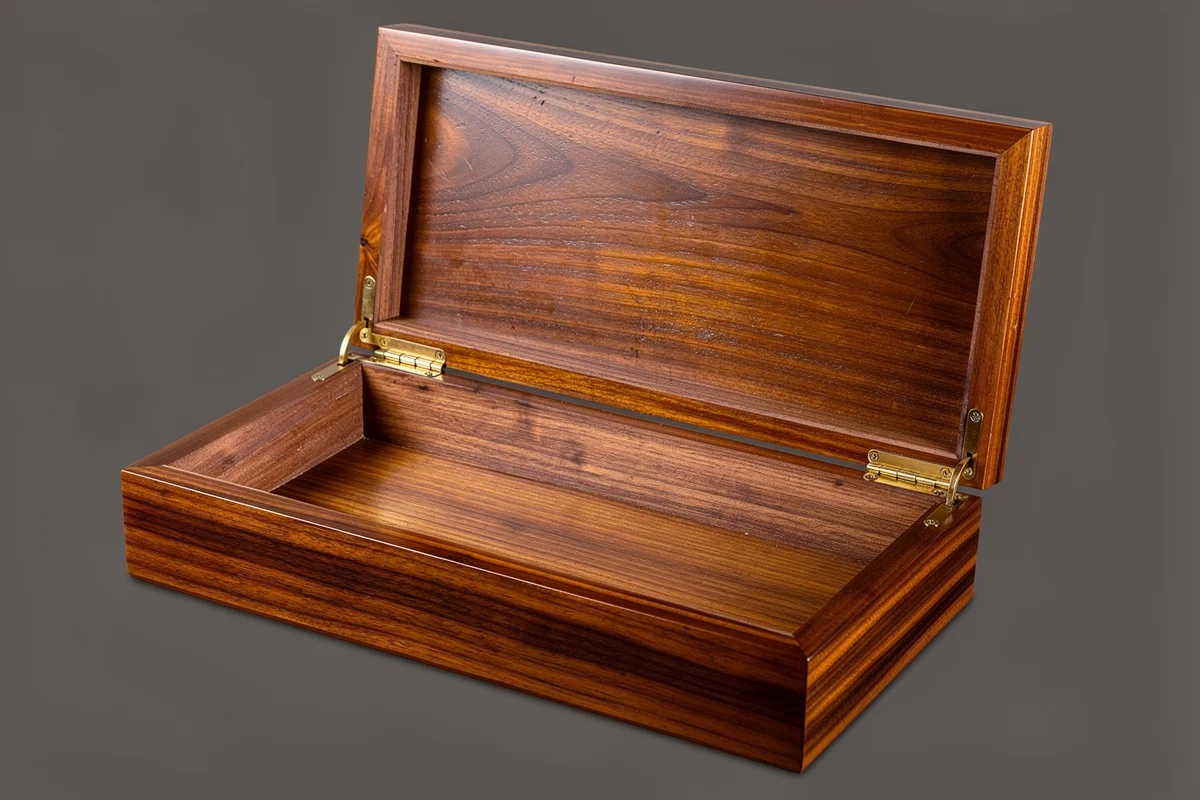
If both hands are needed to load the box, ask how the lid remains clear of the work. A ribbon may limit backward travel without preventing forward closing. Review the selected hinge and support arrangement on the finished sample, including whether a ribbon or stay crosses the loading path.
The inside lid face also stays with the box. If it carries artwork or an information panel, review legibility at the approved opening position. Check any added panel thickness against the closed contents, rather than approving artwork and structural fit separately.
Compare Finished Movement, Not Bare-Wood Fit
A practical procurement judgment is to approve the moving surfaces after the specified finish has been applied. A bare panel that moves freely does not show how the completed guide surfaces will behave. Likewise, a hinged shell without its final lining or closure fittings does not represent the completed closing action.
Wood movement is another reason to avoid a universal “tightest possible fit” requirement. The USDA Forest Products Laboratory’s Wood Handbook, Chapter 4 explains moisture-related dimensional change and the variation associated with grain direction and other factors. It does not provide a ready-made clearance specification for these boxes. The material construction and agreed use conditions still need to inform the supplier’s fit proposal.
For sliding samples, note any point where movement catches, requires a change of hand position or marks an exposed surface. Inspect the leading edge and guide contact areas after handling. For hinged samples, check alignment, edge contact and whether the lid seats without having to shift the base or press one corner down.
Repeat the closing check with the intended packed format, including its wrapper, sleeve or other specified components. A protruding edge can interfere with either motion. Agree the handling sequence, conditions and acceptance criteria with the supplier; do not invent a universal clearance, opening force or cycle count.
Compare Complete Quotations and Packing Steps
Sliding designs may omit hinges, but guide machining, panel fitting, finishing and any retention feature still require work. Hinged designs add the selected hardware and installation, plus any separate support or closure fittings. Neither mechanism is automatically the cheaper finished option.
Request comparable quotations using the same usable capacity, material construction, finish, artwork and quantity. Ask each supplier to identify what is included in the lid arrangement. Otherwise, a simple sliding shell can be compared unfairly with a hinged design that includes extra hardware and decoration.
Then compare the packing sequence. With a removable slider, include taking off, placing, retrieving and refitting the panel. With a hinged design, include opening, positioning any support and keeping the lid clear while loading. Observe the sequence on samples if packing efficiency matters; the number of visible components alone cannot establish labor savings.
Which Lid Should Buyers Choose?
Choose a sliding lid when the withdrawal path is available, the required opening can be achieved and handling a removable or retained panel fits the workflow. Resolve where a loose panel goes before approving this option.
Choose a hinged lid when keeping the lid attached is useful and the opening arc fits the intended location. If loading requires both hands, make the open-position support a specific approval item.
Reconsider the layout when both options collide with their surroundings or obstruct loading. Repositioning the box or changing the opening direction may be more useful than selecting a mechanism from appearance alone. The broader wooden cigar box packaging overview can help place this choice within the complete box specification.
Keep humidity requirements separate. Neither a close-fitting slider nor a hinged closure proves that the complete box functions as a humidor. See cigar box vs humidor before assigning a storage-performance requirement.
What to Confirm Before Ordering
- Opening drawing: show travel direction or opening arc, the usable open position and surrounding clearance.
- Lid handling: state removable or retained for a slider; state the required opening stop and holding function for a hinged lid.
- Loading trial: use the intended packed contents and include the items nearest guides, hinges or supports.
- Finished closing: check movement, surface contact and complete seating with all specified interior components installed.
- Approved reference: record the selected construction, hardware, finish and operating sequence so later changes can be reviewed against the same requirements.
To discuss a box project, send XRX your packaging brief with the packed format, preferred opening direction, available workspace, lid-handling requirement, finish and quantity. Those details make the comparison concrete enough for a drawing and sample review.
Frequently Asked Questions
Which is better for limited opening space: a sliding lid or a hinged lid?
Choose by the available opening path. A sliding lid needs room in its withdrawal direction, while a hinged lid needs clearance through its opening arc. Check the finished box in the intended location, including space for hands and loading.
Can a sliding lid remain attached to the box?
Yes, a sliding lid can be designed with a travel stop or retention feature. Specify whether the panel must stay attached and how much of the interior must be accessible. Do not assume that every sliding lid is removable or retained.
Does a hinged lid stay open by itself?
Not necessarily. Opening rotation, maximum opening angle and holding the lid open are separate requirements. Confirm the selected hardware and any support on the finished sample; a ribbon that limits backward travel does not necessarily prevent the lid from closing.
Is a sliding lid cigar box always cheaper than a hinged box?
No. Compare complete quotations for the same size, materials, finish and quantity. Sliding designs involve guide machining and panel fitting; hinged designs involve hardware, installation and any supports or closure fittings. Neither lid type guarantees a lower finished cost.
Does either lid type make a cigar box a humidor?
No. A sliding or hinged lid describes an opening mechanism. Humidity performance must be specified and verified for the complete product; it cannot be inferred from the lid style or a close-fitting appearance.