

 العربية
 Français
 Deutsch
 Italiano
 日本語
 한국어
 Português
 Español
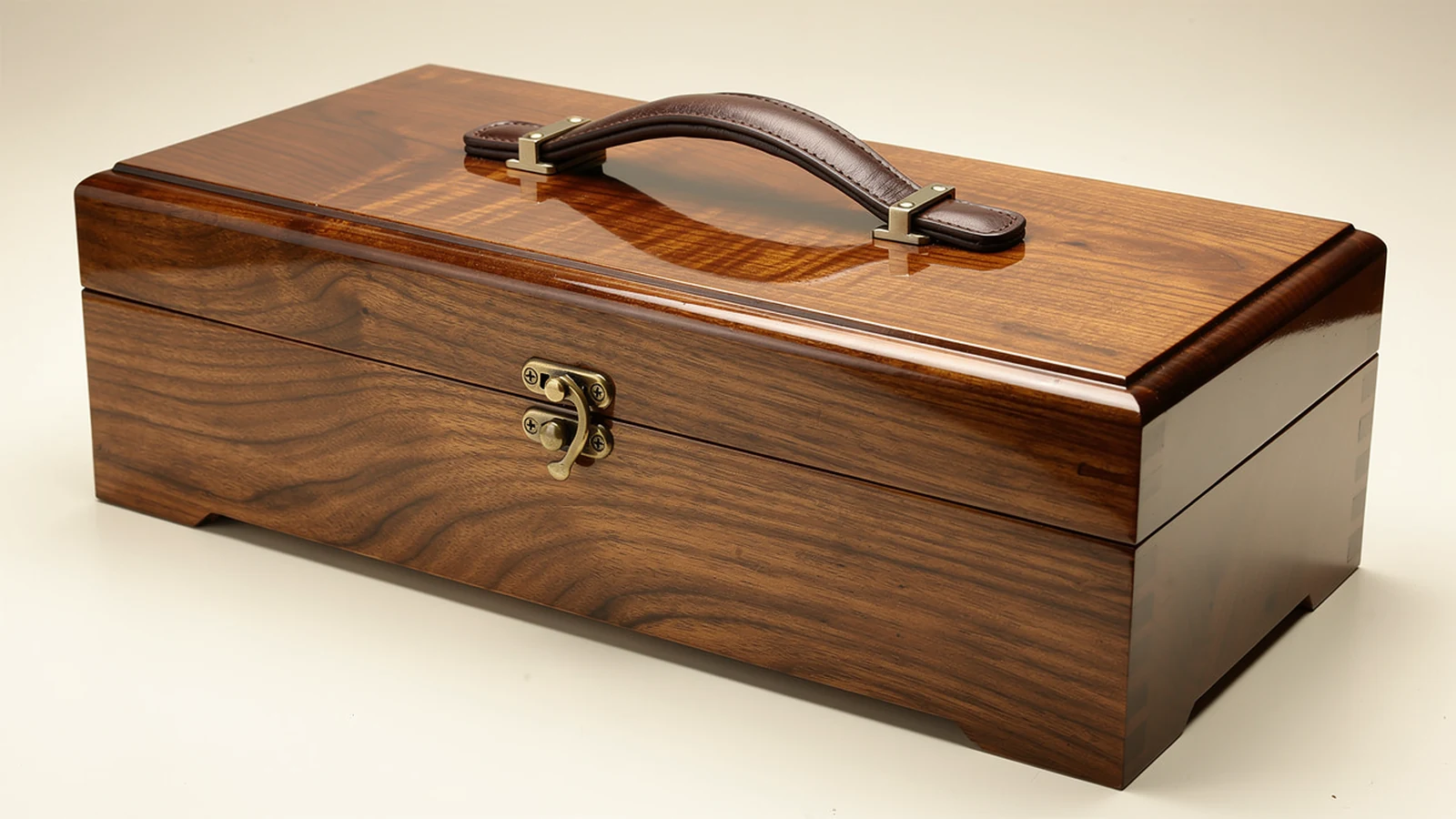

For a brand buying a presentation case, the decision is whether the handle supports the intended handover and use sequence. A box carried briefly from a counter may need a different arrangement from a demonstration case opened and moved repeatedly. Start with that task before choosing the metal color or leather finish.
Define the carrying task before choosing the handle
Write down the complete contents, their arrangement and the total loaded mass, including the wooden box and insert. A photograph of the products is useful, but it does not tell the supplier how much the finished pack weighs or where that weight sits. Identify the heaviest item and whether the box will also be used with some compartments empty.
Next, describe the carrying orientation. Will the box stay horizontal, or turn upright like a briefcase? A handle on a long side may look natural when the box lies on a table, yet carrying by that handle changes which direction the contents face. The insert and closure need to suit that movement.
Also state who will carry it and where. Include any relevant gloves, repeated opening at a sales counter, or tight storage shelves. These are design inputs, not reasons to prescribe a universal grip dimension. Ask for a sample that lets the intended user try the actual sequence.
Within a wider custom wooden packaging project, a carrying feature should be agreed before the box structure is frozen. Adding it after appearance approval can change mounting details, lining space and the outer packing dimensions.
Compare carry handles for custom wooden boxes by location
Use the mounting location to identify what needs review. Descriptions such as “top handle” and “side handle” are incomplete without a drawing showing which component receives the fixing.
| Arrangement | What it changes | Buyer’s approval question |
|---|---|---|
| Handle attached to the lid | The lid-to-body connection becomes part of the carrying arrangement | How are the loaded base and contents retained when lifted? |
| Handle attached to a body wall | Carrying force enters the body through that mounting area | Does the local panel and attachment suit the intended orientation? |
| Handles on opposite body walls | The user must reach and coordinate both grips | Can the loaded box be picked up and set down as intended? |
| Folding or flexible handle | The grip has both a carrying position and a resting position | Does either position interfere with the finish, closure or packing? |
A lid-mounted handle deserves particular attention to the complete closure. A magnet that keeps a lid neatly aligned on a table should not simply be assumed to retain a suspended loaded base. Ask the supplier to explain the proposed carrying arrangement and the evidence supporting it.
Body-mounted handles do not remove the need to review the box. The handle may load a thin panel, sit close to a joint or require fixings behind the lining. Opposite handles also should not be described as automatically sharing the load equally; the user’s grip and the contents layout can differ.

Review the attachment as part of the wooden structure
Ask for an attachment detail showing the handle, fixing method, receiving material and any backing component. Identify the actual substrate behind a visible veneer. A wood-grain exterior tells you about appearance; it does not identify what the screw or fitting is anchored into.
The USDA Wood Handbook chapter on fastenings explains that wood-joint design must account for the material’s properties along and across the grain, as well as dimensional changes associated with moisture. This supports checking the receiving structure rather than treating a fixing as independent of its material. It does not supply a universal capacity for a small veneered presentation box.
Keep the discussion specific to the proposed construction. Ask which parts are concealed after lining and how their installation will be controlled. A neat exterior can hide an attachment detail that was never included in the approval drawing. Conversely, a visible screw head is not by itself evidence of poor construction.
Specification insight: record the handle and its attachment detail as one approved configuration. Matching the handle’s external dimensions on a later order does not prove that a different fixing or receiving panel performs the same way.
Avoid choosing an arbitrary screw length or safety factor from an unrelated example. The supplier or qualified engineer should select the construction and validation appropriate to your loaded case. Your purchasing brief should make the intended use and evidence requirement clear.
Check grip, balance and the resting position
A useful sample review begins with the box on the surface from which it will normally be picked up. Confirm that the grip can be reached and held without fingers being pressed against a latch, sharp edge or adjacent handle bracket. Include the fully finished surface and actual hardware because a simplified wooden mock-up may omit those obstructions.
Observe whether the loaded box rotates unexpectedly as it leaves the surface. An off-center contents arrangement can change how the case hangs. Treat that observation as a reason to review placement and retention, rather than assuming that a visually centered handle must be functionally centered for every pack-out.
Review set-down as carefully as pick-up. A folding handle may drop against the side, while a flexible grip may settle across a seam. Inspect the locations where it can contact the clear-coated wood. Ask whether the resting position is repeatable and whether the intended sleeve or protective wrap keeps those parts from rubbing during shipment.
Appearance approval still matters. Compare the handle brackets with the hinges and clasps on the same sample, using an agreed reference for wooden box hardware finishes. Matching a color name alone is less useful than seeing the actual components together.
Specification insight: include both the deployed and resting handle positions in the drawing or photographs. The resting position can determine the space needed in an outer carton even when the grip is compact during use.
Separate carrying evidence from shipping evidence
A handle supplier’s rating is useful only when its scope is understood. Ask which component was tested, how it was mounted, the loading direction and the conditions behind the stated value. Do not copy that number onto the completed wooden box without evidence covering the relevant assembly.
For the finished case, agree a project-specific review with the supplier or testing provider. Define the loaded configuration, intended handling sequence, assessment conditions and what counts as unacceptable change. Depending on the design, observations may include attachment movement, panel damage, closure separation, contact marks or shifted contents. The appropriate test loads and repetitions need to come from that assessment, not a generic blog checklist.
Shipping protection is a separate question. ISTA’s guidance on designing and testing packaged products emphasizes representative product and packaging samples, selection around the actual distribution environment, and acceptance criteria established before testing. Its guidance does not turn a presentation handle into a certified carrying system.
If the wooden case ships inside cushioning and a corrugated carton, identify that complete shipping configuration when discussing distribution testing. A successful carry assessment does not establish parcel performance, and a shipping result should not be quoted as a handle rating unless that claim is actually supported.

Put the approval conditions into the order
The approval sample should match the proposed box substrate, finish, handle, attachment, lining and closure. Use the intended contents or a representative load whose limitations are recorded. A substitute with the correct total mass but a different layout may not reproduce the way the case hangs.
Keep a short record of what was approved. Include a drawing revision, handle part reference, mounting detail, loaded configuration and photographs of the carrying and resting positions. Record the results of the agreed evaluation separately from visual approval. A signed photograph should not silently become a load-performance certificate.
For example, consider a two-bottle gift case whose buyer later replaces one bottle with a heavier accessory. The exterior may remain unchanged, but the total mass and its distribution have changed. Review the affected carrying and retention requirements before accepting the previous sample as evidence. This is a planning example, not a reported factory test.
The same approach applies if the supplier proposes a different handle, substrate, fixing or clasp. Ask what changes, which earlier approvals remain applicable and what must be reassessed. Preserve the reference sample and connect the revised specification to your golden sample approval record.
When requesting a quotation, send the overall dimensions, contents layout, loaded mass, carrying orientation, preferred handle style, finish direction, quantity and packing requirements. Include any required assessment or documentation in the enquiry so quotations cover the same scope. Contact XRX with that brief to discuss the custom wooden box configuration and sample requirements.
Frequently asked questions
Can a handle be added to any custom wooden box?
It should be reviewed against the box construction and intended loaded use. Adding a handle can affect the receiving panel, attachment, lining, closure and packing. Approve those details together instead of treating the handle as a purely decorative addition.
Does the handle’s load rating equal the box’s carrying capacity?
No. A component rating applies within its stated conditions. The finished wooden box also includes attachment points, panels, joints and closures. Any carrying-capacity claim needs evidence appropriate to that complete configuration.
Is a body-mounted handle better than a lid-mounted handle?
Neither arrangement is automatically best. A lid-mounted handle requires the lid-to-body connection to retain the loaded base, while a body-mounted handle still needs a suitable receiving structure. Choose around the carrying orientation, contents and validated construction.
What should a buyer check on a folding handle?
Review grip clearance, movement, attachment and both deployed and resting positions. Check whether the handle contacts the finished wood, interferes with closure or changes the space needed for protective packaging.
Does a successful carry check replace shipping testing?
No. Carrying and distribution expose the assembly to different conditions. Define the evidence needed for the intended carrying task and separately assess the complete shipping pack for its distribution route.