

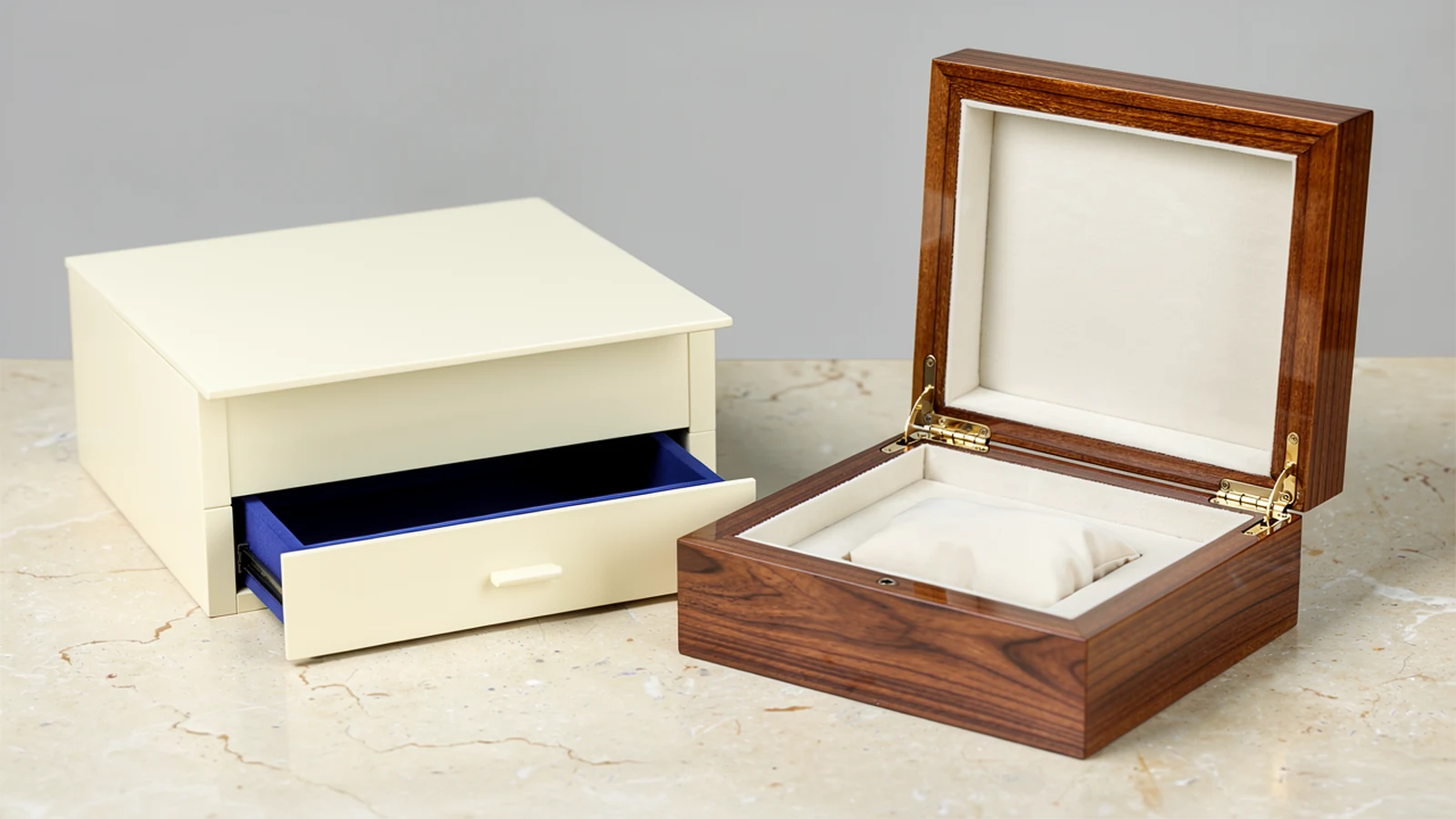

For custom wooden packaging, start with the same product, presentation task and handling conditions. Then ask for the structure that supports that use. A drawer can provide a gradual reveal without a lid rising above the box. A hinged lid can expose the base from above while remaining attached. Neither description proves that the finished package is easier to use or better protected in transit.
Here, a drawer means a tray that pulls out of a surrounding housing. It is different from a sliding lid that moves across the top of a stationary box.
Compare drawer vs hinged lid wooden boxes in their actual setting
Put the intended counter or presentation area into the brief. Record the available space in front, above and behind the box, plus nearby signage, shelves and display items. Include the direction from which the user approaches.
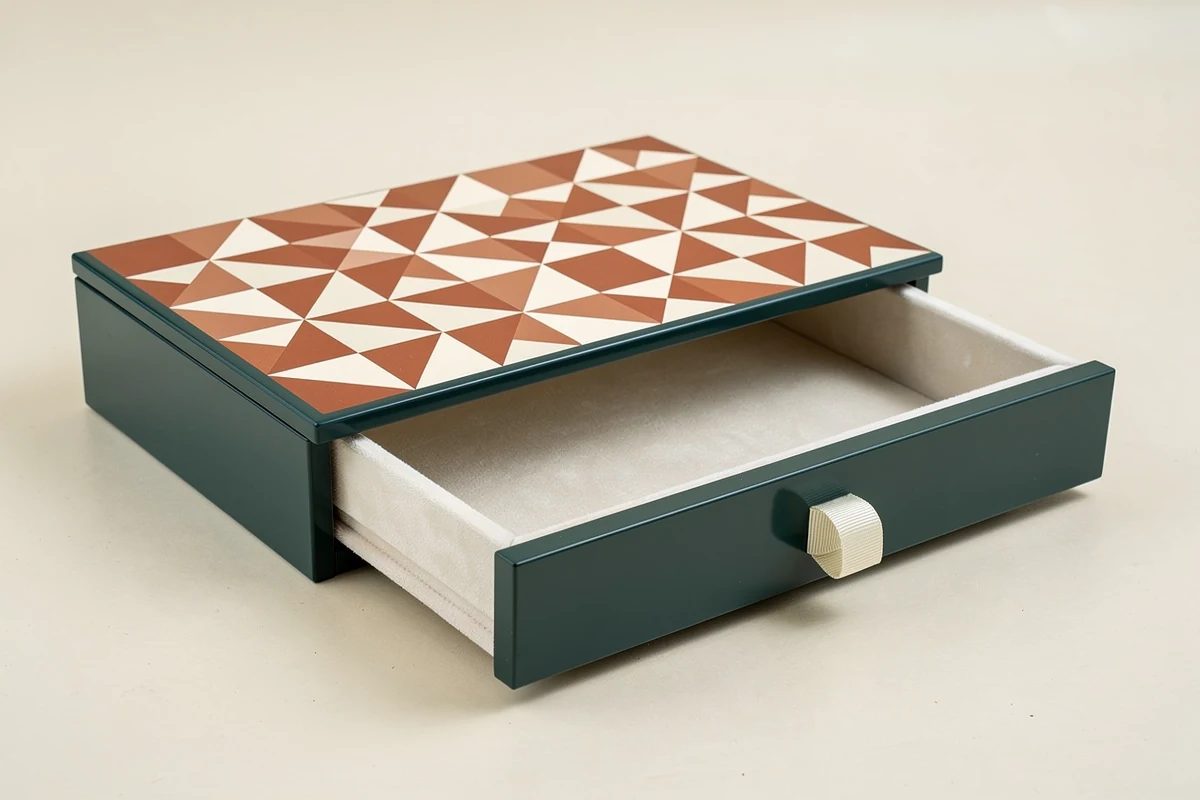
For a drawer, show the travel needed to expose the product, rather than merely the maximum possible extension. A partially opened drawer may reveal the item without providing enough room to grip it. The housing might need to be held while the drawer is pulled; confirm whether that is acceptable for the intended interaction.
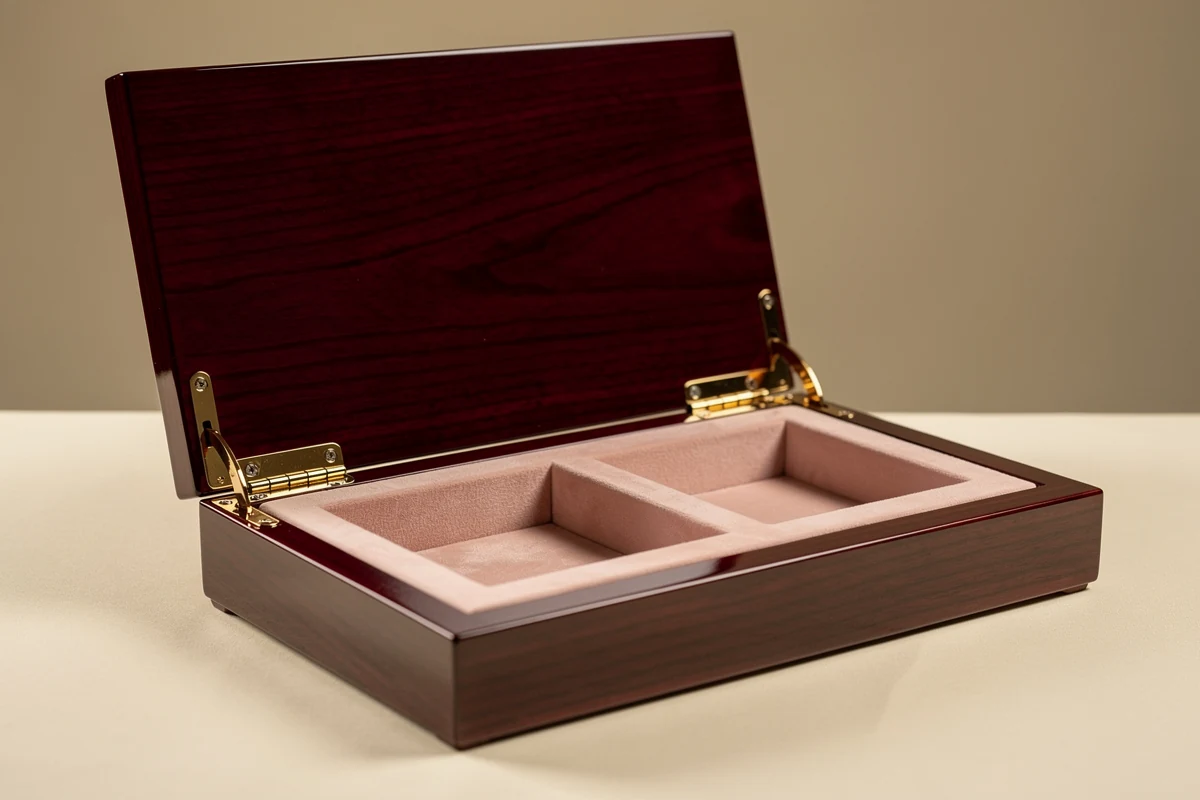
For a hinged lid, check the complete opening arc and the final position. An upright lid might act as a backdrop, obstruct a sightline or occupy space beneath a shelf. The result depends on the actual lid geometry and hinge arrangement.
| Decision point | Drawer format | Hinged-lid format |
|---|---|---|
| Opening area | Forward travel plus room for the hand and product | Lid swing plus the space needed to reach into the base |
| Product reveal | Product becomes visible as the tray emerges | Product becomes visible as the lid rises |
| Moving assembly | Drawer, insert and contents move together | Lid moves while the base insert normally stays in place |
| Position control | Define extension, removal and closed retention | Define opening position, lid control and closure |
| Approval evidence | Loaded drawer operated through its intended travel | Loaded box opened and closed in the intended setting |
Treat the table as a set of review questions, not a ranking. A well-resolved version of either structure can support a premium presentation; the details determine whether it fits your project.
Check the open footprint, not only the closed dimensions
Consider a hypothetical drawer box with a closed front-to-back depth of 180 mm and a required forward drawer extension of 140 mm. If the housing stays in place, its occupied depth becomes 320 mm. A usable counter zone only 300 mm deep is already 20 mm short, before allowing space for the user’s hand.
That does not mean every drawer box needs 320 mm. It shows why the closed depth alone is insufficient. The proposed extension must come from the actual product-access requirement, and the calculation assumes the drawer moves straight forward from a fixed housing.
Possible responses include changing the package orientation, revising the product arrangement or choosing another opening format. Reducing the drawer travel only works if the product can still be removed properly. Moving the housing backwards only works if space remains behind it.
A hinged alternative needs its own check. Trace the lid’s swept area and the product-removal path on the proposed layout. Do not assume it fits simply because it avoids the drawer’s forward extension.
Include the display location in sampling where possible. A working sample on an empty desk does not resolve an obstruction caused by the actual retail shelf or presentation stand.
Separate drawer retention from insert and product retention
A drawer stop controls travel or removal. A closed-retention feature controls whether the drawer stays shut. Those are different jobs. A drawer may stop correctly at full extension yet move outward when the closed package is handled.
Ask which behaviour is intended. Is the drawer permanently retained, deliberately removable, or removable only after a separate release action? A removable design can be appropriate, but the user should not discover it accidentally while supporting the box with one hand.
Next, check whether the insert stays in the drawer. Finally, check whether the product stays correctly positioned in that insert. A firmly seated insert does not, by itself, establish secure product retention. Review each interface using the actual contents and the handling conditions in the brief.
For a hinged box, make the equivalent distinctions between hinge attachment, open-lid control, closure and product support. Hinges keep the lid connected; they do not automatically establish a stable open position or secure closed retention.
Use the guide to hinge types for wooden packaging when the hinged format is selected. At the format-comparison stage, define the required behaviour before choosing hardware by appearance.
Follow the product through the opening
A drawer travels horizontally, but its contents may still need to be lifted vertically. Check the space above the product as it moves beneath the housing and the access available once the drawer reaches its intended position.
Include the tallest part of the loaded assembly: the product, its cap or other projection, the insert and any accessory placed above it. Check that a loose ribbon or booklet cannot move into the travel path during ordinary loading. Describe what you observe rather than assuming that matching the drawer’s floor dimensions establishes clearance.
For a hinged box, check whether the lid clears the contents throughout opening and closing. Look at the user’s grip as well. A product can fit inside its recess yet remain difficult to remove if the fingers cannot reach the intended grasping area.
If the package contains several items, perform the complete sequence. Remove the main product, reach the accessories, replace everything and close the box. This is especially useful when the design is intended for repeated demonstrations rather than a single unboxing.
Record any need to tip the box, lift the insert or hold the lid. These actions are not automatically defects; they should match the agreed use and instructions.
Review the final finish and lining on the moving assembly
Approve operation after the selected lining, surface finish, decoration and hardware have been applied. If a material change alters the space or contact along the travel path, the earlier unlined sample may no longer represent the finished drawer.
Where solid wood forms part of the moving construction, moisture-related movement also deserves attention. The USDA Wood Handbook explains that below fibre saturation, wood can swell or shrink as its moisture content changes, with direction-dependent movement. This is a material principle, not a prescribed drawer clearance. See the USDA chapter on moisture relations and physical properties.
Ask the manufacturer to review the selected construction and intended storage or use conditions. Do not copy a generic furniture clearance or assume that a material label alone predicts operation. The required allowance and verification method belong to the actual design.
During sample review, note where rubbing, catching or visible marks appear. Identify whether the observation involves the drawer side, housing opening, lining edge, pull attachment or another contact point. That location gives the supplier something specific to investigate.
Agree any repeated-operation evaluation and its acceptance criteria before testing. A few opening demonstrations can reveal an immediate problem, but they do not establish a service-life rating.
Compare quotations against the same functional brief
Hold the product, quantity, appearance target and use scenario constant when requesting alternatives. Ask each proposal to identify its construction, moving parts, insert, surface treatment, retention method and protective packing.
The exterior dimensions need not be identical if that would prevent one structure from performing the task. Instead, state which dimensions are fixed constraints and ask the supplier to explain the space needed by each proposal. Compare usable capacity and operation alongside the closed footprint.
Do not assume that a drawer always costs more because it has a moving tray, or that a hinged design is cheaper because it looks familiar. Ask what each quotation includes. A price excluding the required stop, lining or closure is not pricing the same brief.
Choose the preferred direction after reviewing the working samples and the stated differences. Keep photographs of the closed, partly open, accessible and product-removal positions. Add the accepted sequence and observations to the wooden-box sample approval record.
For custom wooden packaging boxes, structure selection should connect the presentation idea with the product and its use. You can send XRX your product dimensions and opening-space constraints to discuss a drawer or hinged-lid proposal before sampling.
Frequently asked questions
Is a wooden drawer box the same as a sliding-lid box?
No. In a drawer box, a tray moves out of a surrounding housing. In a sliding-lid box, the lid moves across the top while the main product compartment stays in place. Specify which component moves when sending a reference or drawing.
Which format needs less display space?
That depends on the complete opening movement. A drawer needs forward travel and access space, while a hinged lid needs clearance for its swing and final position. Compare both with the actual product and counter layout instead of using closed dimensions alone.
Does a drawer stop keep the box closed during transport?
Not necessarily. An extension stop controls how far the drawer travels or whether it can be removed. Closed retention is a separate requirement. Confirm both behaviours and evaluate the complete packed configuration for the intended shipment.
Can the same insert be used in both formats?
Only if its fit, support and access work in each design. A drawer insert moves beneath the housing and must clear it with the product loaded. A hinged-box insert has a different relationship with the lid. Verify both configurations rather than assuming interchangeability.
Are drawer wooden boxes more expensive than hinged boxes?
There is no reliable price ranking from the opening style alone. Compare the quoted construction, finish, hardware, lining, retention features, quantity and packing against the same functional brief. Ask the manufacturer to identify exclusions and design differences before comparing totals.