
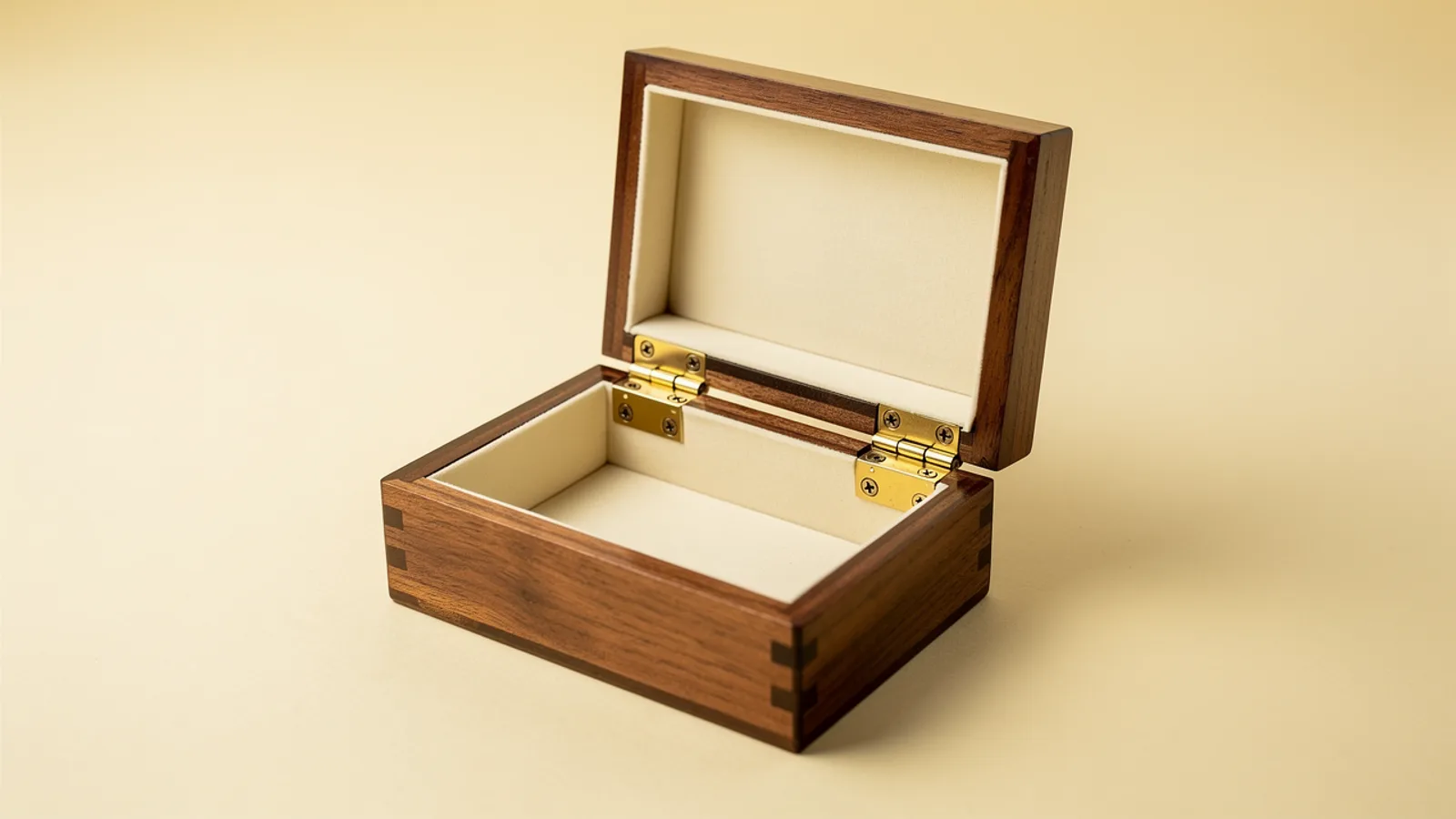

Box Hinge Types at a Glance
This guide focuses on small wooden gift, jewelry, watch and presentation boxes. The table is a starting point for a design discussion, rather than a specification for cabinet doors, heavy chests or load-bearing equipment.
| Type | How to recognize it | Main buyer decision |
|---|---|---|
| Butt hinge | Two leaves joined around a pivot pin. | Whether the mounting detail and visible knuckle suit the box. |
| Continuous / piano hinge | A long hinge along the joint, rather than separated short hinges. | Whether a continuous hardware line fits the design and assembly. |
| Concealed barrel hinge | Linked cylindrical bodies fitted into drilled holes. | Whether the box has enough suitable material for the specified installation. |
| Quadrant hinge | A box hinge with a curved arm traveling into a recess. | Whether the arm, recess and opening behavior fit the lid and interior. |
| Stop hinge | A hinge incorporating a mechanical opening limit. | Whether its defined open position meets the display requirement. |
These labels are not a perfectly separate taxonomy. “Butt” describes a construction; “stop” describes a function that can be built into a hinge. Likewise, “concealed” tells you about visibility, not whether a lid stays open. Ask for a model reference or drawing when a name could mean more than one thing.
How the Main Hinge Designs Differ
Butt hinges: a straightforward pivot with a visible joint
A butt hinge has two leaves connected at a pin. A mortised installation seats the leaves in recesses; other mounting arrangements depend on the hardware design. Confirm what remains visible when the box is closed and what the customer sees when it opens.
Brusso’s butt-hinge range illustrates full-mortise construction and distinguishes a freely swinging butt hinge from its stop-hinge products. For a buyer, the practical question is whether the proposed hinge only provides rotation or also includes another specified function.
Continuous hinges: one long hinge line
A continuous hinge, also called a piano hinge, extends along the joint instead of using several separated short hinges. Sugatsune’s piano-hinge overview describes this format.
Consider it when a long hardware line is acceptable to the design. Ask to see the ends, fixing layout and closed rear edge on the actual box. Do not choose it simply because a longer hinge appears stronger: the selected part, fasteners and mounting material still require review.
Concealed barrel hinges: hardware hidden in the material
Concealed barrel hinges use cylindrical bodies installed in bored holes, with links allowing movement between them. They can suit a brief that values a clean exterior, but the drilling envelope becomes part of the box design.
SOSS’s barrel-hinge documentation shows the construction, dimensions and application restrictions. SOSS specifically excludes vertical or load-bearing applications for that range. This is a useful reminder to check the named product’s limitations instead of assuming that all concealed hinges are interchangeable.
For a small box, ask the manufacturer to confirm bore position, depth and remaining material around the fitting. Concealment alone is not a reason to approve hardware in a thin wall.
Quadrant hinges: allow space for the moving arm
A quadrant design includes a curved arm that moves into a recessed area as the lid operates. Brusso’s quadrant-hinge description explains the arm’s travel through a mortise in the box wall and the importance of that fit.
Review the space below and around the hinge, including the lining and insert. The arm’s path matters even if most of the hardware disappears when the box closes. Ask the supplier to demonstrate the intended open position without binding or interference.
Stop hinges: an opening limit built into the hardware
A stop hinge restricts how far the lid opens. The angle and behavior belong to the selected design, so avoid copying an angle from a different hinge into the purchase specification.
Choose this route when a defined fully open position suits the presentation. Confirm that the complete box remains stable in that position and that its lid behaves as intended. A mechanical end stop does not, by itself, establish controlled closing or the ability to hold the lid at intermediate angles.
Separate Rotation, Holding and Soft Closing
A brief such as “use a premium hinge” leaves the most important behavior undecided. State what the customer should be able to do:
- Rotate the lid: open and close it through the required path.
- Stop at a limit: prevent it from traveling beyond the agreed open position.
- Hold a position: leave it open as required without the user continuously supporting it.
- Control closing: slow the closing movement with a suitable damping mechanism.
Friction or torque hinges provide resistance for position control; the selected torque must suit the application. Sugatsune’s torque-hinge guide explains this principle. It is a functional option to evaluate, not a guarantee that an industrial hinge will fit a compact gift box.
Soft closing is a separate requirement. Sugatsune’s lid-stay guide distinguishes soft-close, free-stop and lift-assist motions. A product may combine functions, but a stiff-feeling hinge should not be described as soft-close without confirmation of its mechanism and behavior.
The front closure is another decision. Specify how the lid is retained when closed, separately from how it pivots at the back. Do not expect the hinge description to settle latch or catch requirements.
What Changes When the Hinge Goes into a Wooden Box?
Review the finished lid, not just the bare panel. Hardware selection guidance considers weight, dimensions and mounting arrangement. Any mirror, decorative plate or other component attached to the lid belongs in that review. Have the supplier evaluate the complete lid geometry and operating requirement rather than select by box width alone.
Check the space that the installation consumes. On a drawing, mark the hinge recess or bore, fasteners, lining edge and nearby insert. Our recommendation is to resolve these interfaces together: moving the hinge later may change the rear gap or intrude into the product space.
Check movement after finishing. Ask to see the box open and closed with its final coating and lining. Look for rubbing at the rear edge, uneven closing, lining caught in the mechanism or contact between the moving hardware and the contents. These are proposed sample checks, not reported XRX defect statistics.
XRX supports custom wooden box structures, hardware selection and lining. The exact hinge model, mounting design and operating performance remain project-specific. The custom wooden packaging guide provides the broader context for coordinating those choices.
Choose by the Opening Experience You Need
For a simple presentation box, begin with a suitably sized butt-hinge arrangement and define how the fully open lid is supported or limited. Additional motion features are worthwhile when they solve a stated requirement.
For a clean exterior, investigate a concealed design after confirming installation space and product restrictions. For a display box with a defined open position, discuss a stop or quadrant arrangement. For adjustable lid positioning, ask about an appropriately selected torque or holding mechanism.
For a slow closing experience, specify the motion explicitly and request a compatible solution. Do not use “luxury,” “heavy-duty” or “strong hinge” as substitutes for the behavior to be approved.
Compare these choices on the same box format from the custom wooden product range. Changing both the box and the hinge at once makes it harder to identify what caused a difference in use.
A Focused Hinge Sample Check
Ask the supplier to identify the hardware model, material and finish, quantity, mounting arrangement, opening limit and any holding or damping function. Then review the complete sample:
- Closed: check the rear joint, lid alignment, visible hardware and closure engagement.
- During opening: check the movement path, clearance and operating feel.
- At the required open position: check the intended holding behavior and whole-box stability.
- During closing: check for rubbing or trapped lining; assess damping only if specified.
- After the agreed operation checks: inspect fixings, alignment and any change in movement.
A few sample openings are a useful functional review, not proof of a particular service life. If durability matters to the project, agree the test conditions and acceptance criteria separately. Record the accepted hardware with the approved box sample, so a visually similar substitute is not silently treated as equivalent.
To discuss a project, send XRX the box drawing and desired lid behavior, including any lid-mounted components and preferred hardware appearance.
Frequently Asked Questions
What are the main box hinge types for wooden packaging?
Useful starting points include butt hinges, continuous or piano hinges, concealed barrel hinges and quadrant hinges. Stop hinges add a defined opening limit. These names can describe either construction or function, so confirm the exact model rather than treating every type as mutually exclusive.
Does a stop hinge make a box lid soft-close?
No. A stop limits opening travel. Soft-close requires a mechanism that controls closing motion. A hinge can combine functions, but the supplier must confirm them for the specified model and finished lid.
Will a concealed hinge keep the lid open?
Concealed describes visibility, not holding behavior. If the lid must remain open, specify the required position and ask for a suitable holding mechanism. Verify it on the complete box with its final lid components.
How many hinges does a wooden box need?
There is no universal count. Select the arrangement using the hinge maker’s guidance, finished lid weight and geometry, mounting space, and the box material. Do not approve the quantity from a reference photograph alone.
Can the hinge be changed after a box sample is approved?
Treat a hinge substitution as a design change. Compare the pivot position, mounting pattern, opening limit, finish and operating behavior, then recheck the affected parts of the assembled box before approving the replacement.