
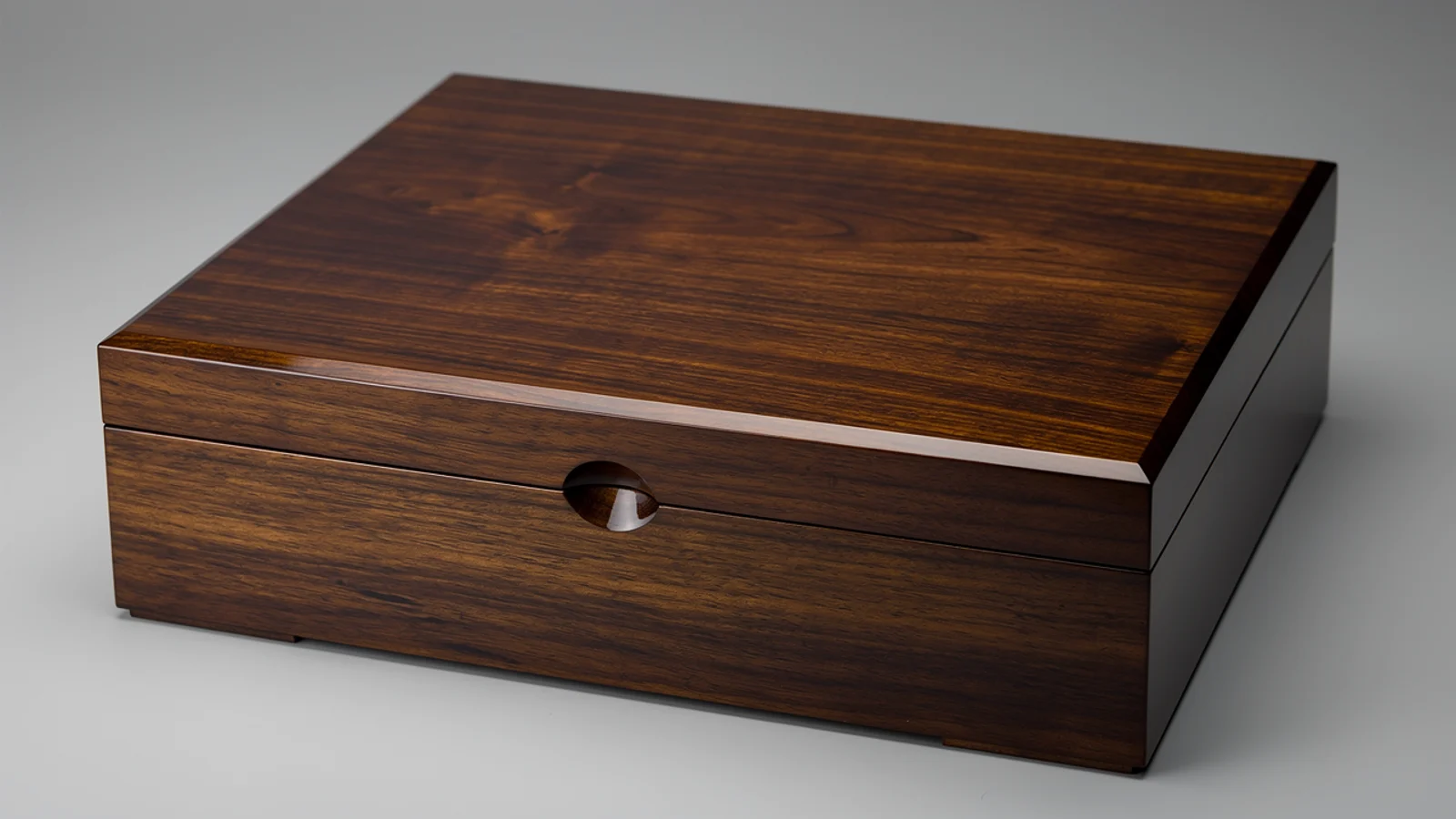

Choose magnets for wooden boxes by the closing experience
Begin with a short description of normal use. Will the box sit on a counter while someone lifts the lid? Should one hand steady the base? Is there a finger recess, an overhanging lip or another intended grip? These questions give the supplier a clearer target than “strong magnetic closure.”
A magnetic catch holds the lid in its closed position. The hinge controls its path, and any lid support or damping function needs its own specification. Our guide to box hinge types explains those separate motion choices.
For this article, the application is a small finished wooden presentation box. Cabinet examples can help explain magnetic principles, but their hardware sizes and opening-force judgments should not be copied directly into a gift-box drawing.
Decide what meets across the closure line
Small neodymium discs or cylinders are one option for an inset closure. K&J Magnetics demonstrates magnets recessed into wooden boxes, including faces positioned at the surface and the possibility of concealment below it. This is an example of a construction approach, not a standard magnet size for every box.
| Arrangement to discuss | What to identify | Buyer decision |
|---|---|---|
| A magnet in the lid and an attracting magnet in the base | Both component references, magnetization direction and installed orientation | Whether the pair suits the available space and finished gap |
| A magnet facing a steel counterpart | Magnet reference plus the counterpart’s material, dimensions and position | Whether the complete pairing gives the required closing behavior |
| A packaged magnetic catch assembly | Housing, counterpart, fixings and mounting envelope | Whether visible hardware and installation space suit the presentation design |
Do not substitute a steel piece for a second magnet and assume the original sample approval still applies. K&J’s closure design examples distinguish these arrangements and show why component spacing matters. Compare the intended pairing at the intended separation, rather than ranking options from unmatched catalog numbers.
If the design uses two magnets, their installed poles must produce attraction. Record the orientation in the assembly information and have it checked before the components are covered. “Two identical magnets” does not, by itself, tell an assembler which face should point toward the other.
Include veneer, lacquer and clearance in the gap
A concealed closure can leave the exterior visually clean, but concealment introduces a design tradeoff. Any material covering the two magnetic faces contributes to their separation, as does clearance between the closed lid and base. K&J’s closure example shows attraction decreasing as its magnet pair moves farther apart; its numerical results belong to that particular setup.
For a wooden box, ask for a section drawing through the closure. It should identify the magnet seating positions, any cover layers and the intended closed joint. A picture of the exterior cannot show whether the magnet is directly at the surface or buried beneath a decorative layer.
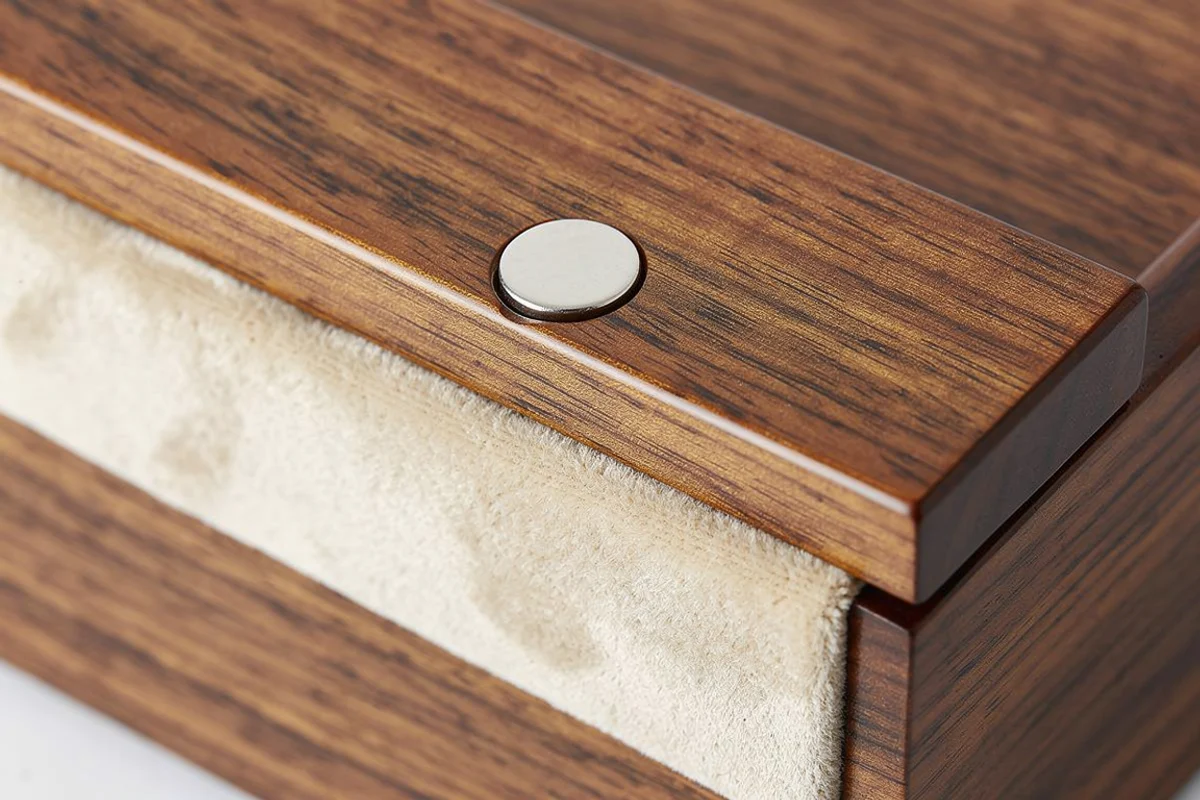
Specify the finished condition. A bare shell may help review the recess location, but it does not represent a later veneer cover, coating or lining edge. If the approved design is concealed, review it concealed. If the faces remain visible when the box opens, approve their appearance and seating too.
A practical design recommendation: keep the closure section drawing with the finish specification. A later request to hide a visible disc is a change to both appearance and spacing, so it deserves an affected-function check rather than being treated as a purely cosmetic revision.
Separate catalog pull force from opening feel
In K&J’s magnet-strength testing description, the magnet-to-steel benchmark uses a large, suitable steel surface, minimal gap and a straight pull. The company also distinguishes a test with two attracting magnets. These conditions explain what a catalog value represents; they do not reproduce the movement of every box lid.
The buyer implication is to use component data for screening, then assess the assembled box. A hinged lid rotates, and the user applies force at a particular grip point. Hinge resistance, rubbing surfaces and how the base is supported can also affect the perceived effort. The box-specific recommendation here is an engineering judgment, not a measured conversion from catalog force.
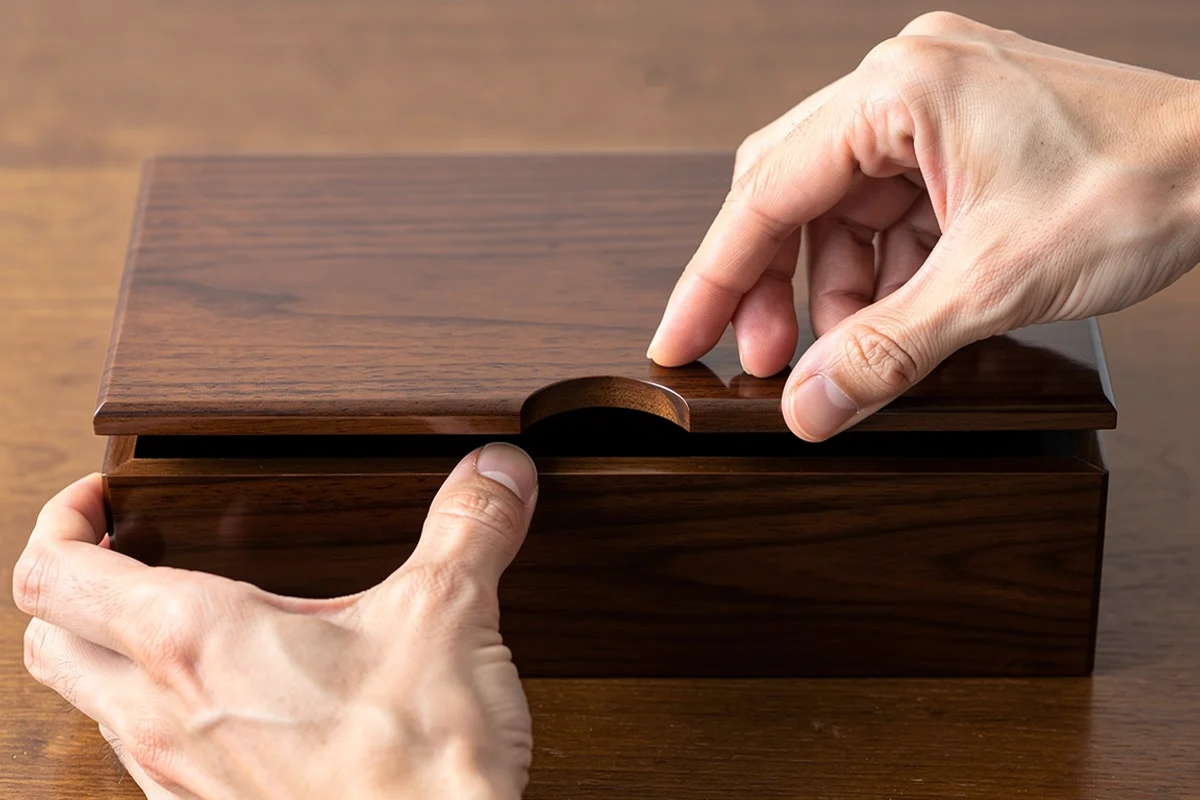
If the sample is hard to open, first check whether the user can grip it as intended. Then separate magnetic engagement from other resistance. A stronger magnet will not solve poor access; a weaker magnet will not correct an edge that binds.
When comparing candidate closures, keep the box construction and opening method the same. Record what changed between samples. If a numeric opening-force requirement is needed, agree the measurement point, direction, setup and acceptance range with the supplier; avoid borrowing a number without its method.
Review mounting and product space together
The attraction between two components and their retention in the box are different questions. Ask how each magnet or counterpart is secured, what the recess leaves around it and how the proposed assembly sequence fits the finishing process. A neat circular face does not reveal the attachment underneath.
For an adhesive-mounted component, ask the supplier to identify a suitable attachment process for the actual contacting surfaces. Do not prescribe a universal glue or copy an installation method intended for another substrate. The completed sample should also be checked for movement of the fitted components under the agreed handling conditions.
Mark the relationship between closure hardware, the insert edge and the packed product. Confirm that the intended contents fit without propping the lid open or pressing into the closure area. If the product owner has restrictions on magnetic components near the contents, include those in the brief before selecting a design.
XRX supports customization across box structure, materials, finish, hardware and lining. The specific magnet model, fixing method and performance remain project-dependent; the wooden packaging box range provides the broader product context.
Approve the closure as a finished assembly
Request a representative sample with the intended finish, hinge, lining and contents. Review the closing experience in a defined sequence:
- Approach: close the lid normally and check alignment without forcing it into position.
- Engagement: confirm attraction, the intended closed joint and absence of trapped lining or product interference.
- Opening: use the intended grip and base support; note awkward access, unwanted base lifting or binding.
- After the agreed operation checks: inspect fitted components, adjacent finish and any change in closure behavior.
Agree the amount and conditions of checking for the project. A few manual openings provide observations about the sample; they do not establish a rated service life or prove transport suitability.
Record the accepted magnet and counterpart references, quantity, orientation, mounting positions, cover construction and opening requirement. Keep those details with the approved golden sample. Review substitutions by their effect on the complete closure, even when the replacement component looks identical.
A simple magnetic catch should not be specified as a security lock. Likewise, whether a filled box remains appropriately closed in distribution is a separate question for the complete packing configuration.
To discuss a design, send XRX the box drawing and intended opening experience, including the closure area, finish and contents. That gives the supplier a useful basis for proposing a sample configuration.
FAQ
What magnets are used for wooden box closures?
Small neodymium disc or cylinder magnets are one option for inset closures. The design may use an attracting magnet pair or a magnet with a suitable steel counterpart. Specify the complete arrangement and evaluate it on the finished box rather than choosing by shape alone.
How strong should magnets for wooden boxes be?
There is no universal pull-force value for every box. The required closure depends on the gap, counterpart, position and intended opening method. Ask the supplier to propose a configuration and approve its behavior on a representative finished sample.
Can magnets be hidden beneath wood veneer?
They can be considered for a concealed design, but the covering adds separation between the magnetic components. Include the complete cover and finish thickness in the design review, and confirm closure behavior after finishing.
Why can a magnetic box be difficult to open?
The closure may be too strong for the available finger access, but rubbing edges, hinge resistance or internal interference can also affect opening. Check these separately before changing the magnet specification.
Does a magnetic closure make a wooden box secure for shipping?
A normal opening-and-closing check does not establish transport performance. Evaluate the complete packed configuration for its distribution conditions, and specify any additional restraint separately. A simple magnetic catch should not be treated as a security lock.