
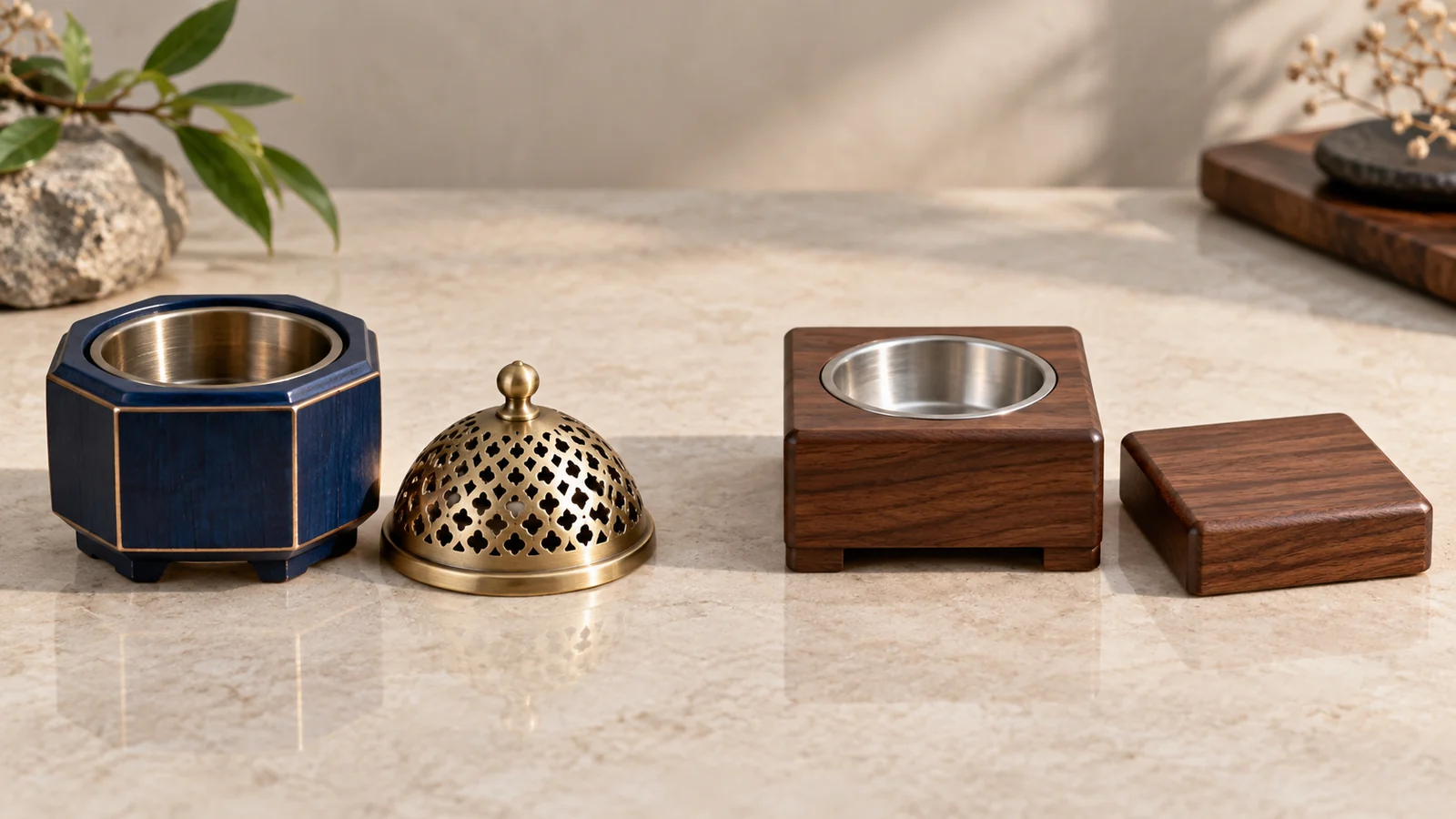

Whether to use an incense burner lid on or off depends on the exact product’s instructions. A removable cover may be decorative, intended for a specified operating configuration, or part of an appliance assembly. Holes, a handle or a close fit do not establish its purpose. For a bakhoor purchase, ask the supplier to identify the lid’s function and permitted position before approving the product or its instruction card.
This distinction matters when a buyer selects a burner from a photograph. The closed shape may be the presentation the brand wants, while the operating configuration is different. The wooden bakhoor burner page outlines XRX’s woodwork scope; the cover still needs a defined role within the complete proposed product.
Incense Burner Lid On or Off: There Is No Universal Rule
Two supplier descriptions illustrate why a general answer can mislead. The Oud Company’s Premium Teardrop Burner has a perforated removable cover, but its description says that cover is decorative and must not be used during burning. In contrast, Smell of Dubai’s listed incense burner is described as usable with or without its lid.
These are instructions for two particular products, not independent safety testing or permission to use another burner the same way. They also show why perforations alone cannot settle the question. If the supplied instructions do not clearly identify the cover’s permitted use, contact the maker before operating the product.
For a custom project, put the decision into the specification. “Removable lid included” describes a component in the carton; it does not tell the user whether to remove it before use, keep it fitted, or leave it aside until the product is cold.
Identify Which Part the Supplier Calls the Lid
Start with a component picture or drawing. A complete product might have a decorative outer cover, an inner vessel, a grille and a separate packaging lid. Calling all of them “the top” creates an avoidable instruction problem.
| Part being discussed | What must be clarified | What its appearance does not prove |
|---|---|---|
| Decorative outer cover | Whether it is removed before use and when it may be refitted | That holes make it an operating cover |
| Cover specified for operation | Exact compatible burner and permitted configuration | That it filters emissions or makes hot parts safe to touch |
| Inner grille or vessel component | Its identified role and whether the user may remove it | That it is interchangeable with a decorative lid |
| Electric appliance cover | Model-specific fitting, opening and maintenance instructions | That instructions for a non-electric burner apply |
| Gift-box lid | Its role in packaging the cold product | That the presentation case can enclose an operating burner |
Use the supplier’s terminology consistently after agreeing the part names. If the drawing uses “outer cover,” the instruction card should identify the same component rather than switching to an ambiguous “cap” in one step.

Write Down the Cover’s Position at Each Stage
A buyer can ask for a simple state table. Have the responsible product supplier complete it for the actual model; do not fill missing instructions by borrowing a routine from a similar-looking burner.
| Product stage | Question for the supplier |
|---|---|
| Before use | Which cover or part is removed, fitted or checked before the product is operated? |
| During the intended operating cycle | What is the permitted lid position, and what must the user avoid touching or changing? |
| Shutdown or extinguishing | What procedure applies, and does the cover have any specified role? |
| Cooling | Which parts must remain undisturbed, and when may handling resume? |
| Cold storage and packing | When can the cover be refitted and the product returned to its packaging? |
The value of this table is exposing unanswered questions. It is not an operating manual by itself. If two documents disagree about the lid, resolve the conflict with the supplier and approve one consistent instruction set before delivery.
Do not assume that closing a decorative lid is an extinguishing method. Nor should a handle, knob or magnetic attachment be treated as a promise of safe handling while hot. Follow the exact product’s instructions and do not improvise adjustments during operation.
Keep Performance Claims Separate from the Cover Design
An enclosed-looking shape can encourage claims that the burner contains all hazards or filters the smoke. Do not make those claims from the design alone. The CPSC’s carbon monoxide guidance identifies burning charcoal as a potential carbon monoxide source. A cover is not evidence that this hazard has been removed, and charcoal must not be burned indoors or in enclosed spaces.
For development work, changing a cover means the proposed assembly has changed. A different material, pattern or opening arrangement should go back to the responsible designer for review before the buyer treats it as an equivalent decorative revision. The wooden burner design article discusses the broader relationship between the housing and the heat path.
Avoid inventing a standard hole count, opening percentage or clearance from a photograph. Ask for the design basis and the assessment appropriate to the exact assembly. Appearance approval and operating approval should remain separate decisions.
Review the Cold Sample as a Matched Assembly
With the sample unused and fully cold, identify the body and cover by the drawing reference. Confirm that the supplied parts match the proposal and that the intended seating position is clear. Look for unintended rocking, interference, visible damage or a fitting method that differs from the drawing, and return discrepancies to the supplier.
This is a fit-and-identity review, not a hot-use test. It cannot establish surface temperatures, emissions behavior or safe handling during operation. Any performance assessment should cover the specified complete configuration rather than only the detached lid.
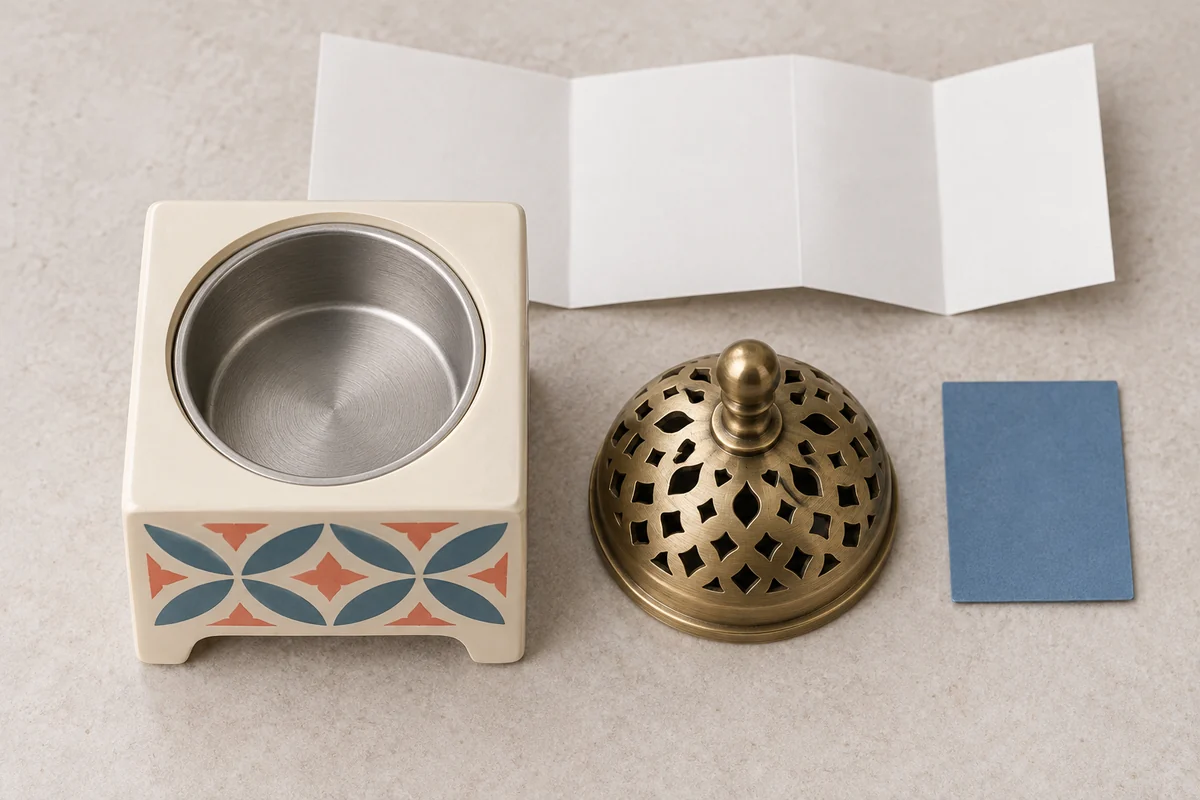
If several designs share a similar silhouette, assign each cover a compatible model or revision reference in the purchasing record. A spare that appears to fit is not automatically approved for that assembly. Request confirmation before substituting a different material, finish or perforation pattern.
For the final packing sample, show whether the cold cover travels fitted or separately supported, and ensure the instructions refer to the parts actually in the set. Detailed retention and transport decisions belong in the gift-set packing specification; the lid decision here is its identity and permitted role.
What to Put in the Purchase Brief
Include the complete burner reference, cover drawing, material and finish, intended heating configuration, permitted lid position, instructions and supply responsibilities. State who approves operating requirements and who reviews the decorative woodwork. Mark any unresolved point as a question for development, rather than silently treating it as approved.
XRX’s confirmed customization scope includes wooden structure, finish and branding. That capability does not establish the operating function of a newly proposed lid. Send XRX the housing and cover brief with the intended configuration and supplier responsibilities identified so the woodwork can be reviewed against a clear product specification.
FAQ
Should a bakhoor burner lid stay on during use?
Only if the exact product’s instructions permit that configuration. Some removable lids are decorative and must be removed before burning. If the instructions are missing or unclear, ask the maker before operating the product.
Do holes in the lid mean it can be used while burning?
No. A perforated cover can still be decorative. Its intended role must be established by the instructions and specification for the actual burner, not inferred from the pattern or number of openings.
Can closing the lid extinguish the charcoal?
Do not assume so. Follow the product’s specified extinguishing procedure. A decorative cover should not be treated as an extinguishing device or evidence that charcoal is fully out.
Can a replacement lid be used if it fits the burner?
Fit alone is insufficient. Confirm the replacement’s compatibility with the exact model and revision, including its material and construction. A different lid should not be substituted solely because it seats on the opening.
What lid information belongs in a custom burner order?
Specify the part’s function, drawing reference, material, finish, compatible assembly and permitted positions during use, cooling and storage. Include the approved instructions and identify who is responsible for the complete product assessment.