

This guide is for B2B buyers specifying a custom product. It does not certify a burner or replace the fire-safety, electrical or conformity assessment required for the destination market and final fuel configuration.
1. Freeze the intended fuel before you freeze the shape
“Bakhoor burner” can describe more than one configuration. A buyer may be specifying resin placed over charcoal, an electric fragrance heater, incense sticks, or a decorative housing that is never intended to contain a hot source. Those use cases do not create the same heat path, ash load, ventilation assumption or cleaning routine.
Write the intended configuration into the RFQ first:
- charcoal plus bakhoor resin;
- electric heating element plus a specified fragrance medium;
- incense sticks or cones;
- decorative display only, with no hot use.
Do not ask a factory to quote one generic structure and decide the fuel later. A late change from electric heating to charcoal can change the inner vessel, shielding, openings, base, instructions and validation plan. The practical procurement question is not simply “Can this wooden burner hold bakhoor?” It is “Which fuel, heat source and refill pattern does this exact assembly support?”
Charcoal also changes the safety conversation. The U.S. Consumer Product Safety Commission charcoal safety warning addresses grills rather than incense burners, but it shows why charcoal combustion and carbon monoxide cannot be treated casually. It does not provide a burner specification or prove that a particular incense product is safe indoors.
2. Treat wood as the decorative housing, not the unverified hot zone
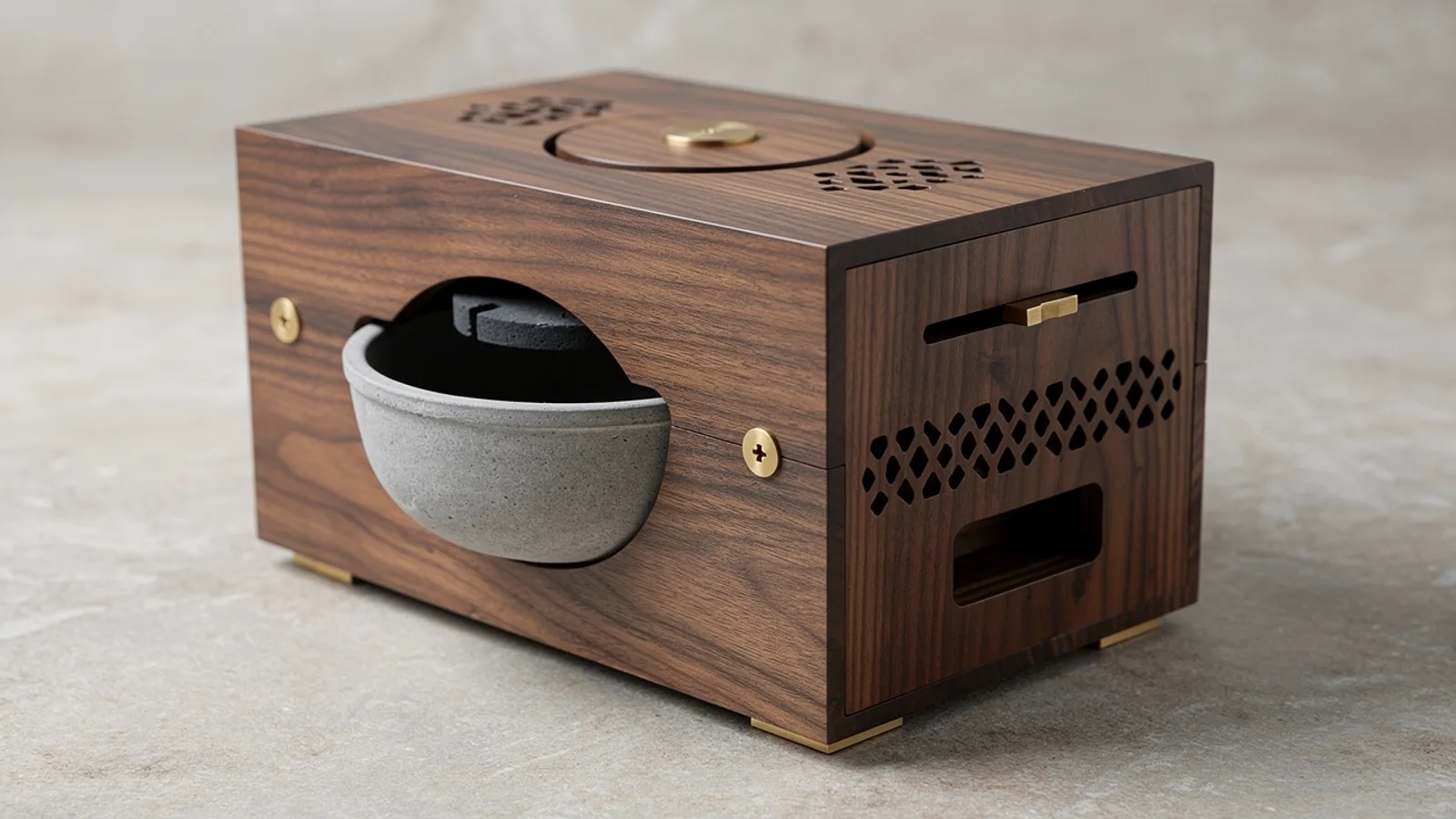
For a charcoal or hot-resin concept, the buyer should show the heat path in a drawing. Identify the charcoal or heating source, the inner bowl or cup, any mineral or heat-shield layer, the surrounding air space, and the nearest wooden surface. The purpose is not to add impressive technical language. It is to make every heat-transfer assumption visible before a sample is approved.
A useful RFQ asks for:
| Design item | What the buyer should specify | What must be verified at sample stage |
|---|---|---|
| Fuel and source | Charcoal/resin, electric heater, sticks/cones or display-only | The actual fuel and refill method match the sample |
| Inner assembly | Removable metal or other specified heat-resistant vessel | Fit, retention, cleaning access and separation from wood |
| Outer housing | Wood species or veneer, finish, openings and access panel | No unintended contact with the hot source; finish matches the approved sample |
| Base and ash path | Stable footprint, ash-catching route and removable residue area | The loaded unit remains stable and residue stays within the intended area |
| Instructions | Fuel, placement, ventilation, supervision and cooldown wording | The supplied copy matches the approved configuration |
The need for a heat-resistant holder and separation from combustible surroundings is supported by fire-safety guidance, but the sources do not prescribe a universal wooden-burner architecture. Therefore, “inner metal cup” and “heat shield” should be recorded as design requirements or engineering proposals until they are tested for the specific assembly. A metal liner can still transmit heat; its presence alone is not a safety certificate.
XRX makes custom wooden incense and bakhoor burners, with options for custom size, structure, material, finish and hardware. This manufacturing capability supports a design-review conversation; it should not be read as a universal heat rating or a third-party safety approval. Buyers can compare the product range at the Wooden Bakhoor Burners pillar page.
3. Design airflow and ash containment as one system
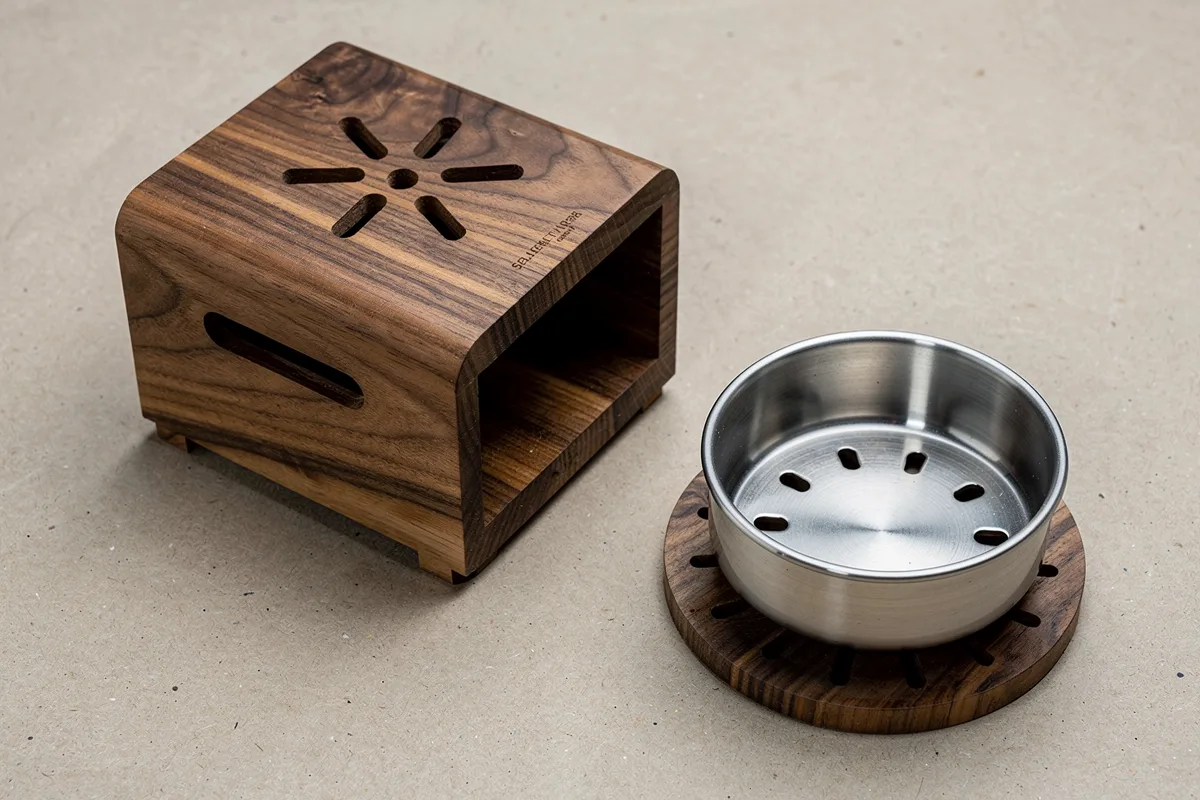
Ventilation is not a decorative pattern added after the box is complete. Openings influence smoke movement, oxygen availability, draft sensitivity, ash escape and the temperature around the wood. A lidded or partially enclosed form needs a particularly clear airflow diagram: where air enters, where smoke leaves, and what prevents loose ash or embers from being pushed toward the housing or surrounding textile.
The Greater Manchester Fire and Rescue Service ceremonial-burning guidance is an official fire-service source that addresses ventilation and combustible surroundings. During this research run, the page was accessible through the research result but returned a Cloudflare 403 to the direct client, so it is recorded as official indexed/access controlled rather than direct live access. It should be read as general use guidance, not as a product test or design standard.
For the RFQ, ask the supplier to document:
- the location and purpose of each ventilation opening;
- whether openings are part of the hot cavity or only the outer decorative shell;
- how ash is retained during normal placement and removal;
- whether the inner vessel can be removed without scraping residue across finished wood;
- how the design is placed on a stable, heat-resistant, non-flammable surface;
- what happens if the product is moved before it has cooled.
Do not write “fully ventilated,” “zero ash escape” or “safe in any room” unless a defined test protocol supports the exact claim. Good airflow may help with smoke management, but it does not compensate for an unsuitable heat path or unattended use.
4. Separate appearance approval from hot-use approval
A polished sample can pass an appearance review while the heat path remains unresolved. Keep two approval tracks, even when they use the same physical sample.
Appearance and fit approval should record the wood or veneer, color, sheen, carving, logo method, dimensions, hardware, lid or access movement, inner-vessel fit and packaging presentation. XRX’s verified manufacturing guidance already treats structure, material, finish, logo, hardware and lining as items to align before bulk production.
Hot-use review should record the intended fuel, the exact inner assembly, contact and separation points, airflow, stability, ash containment, cleaning access and user instructions. The hot-use review is not complete merely because the finish looks correct. It also should not be described as a certification unless an appropriate test has actually been performed and documented.
| Review track | Approval question | Release status |
|---|---|---|
| Appearance | Does the outer housing match the approved design and finish? | Appearance approved / revise |
| Fit and assembly | Do the inner vessel, access parts and hardware fit the approved drawing? | Fit approved / revise |
| Intended use | Does the written fuel and use boundary match the physical configuration? | Use scope approved / revise |
| Hot-use review | Has the buyer-defined heat, stability, ash and cleaning review been completed? | Approved for specified review / not approved |
| Production release | Are the sample, artwork, instructions and packing version frozen? | Release / hold |
If the buyer intends more than one fuel type, treat each configuration as a separate review unless competent evidence shows that one validation protocol covers both. One attractive sample does not validate every fuel path.
5. Put the buyer’s decision into the RFQ
A useful RFQ should make assumptions answerable. Instead of requesting “a luxury wooden bakhoor burner,” ask for the following fields:
- intended fuel and whether charcoal is included;
- inner bowl or cup material and whether it is removable;
- outer wood species, veneer, substrate and finish system;
- drawing of the heat path and ventilation openings;
- base footprint and stability requirements;
- ash-catching and residue-removal method;
- cleaning instructions and cooldown wording;
- logo, carving, color and packaging requirements;
- destination market and any required labeling or conformity review;
- sample quantity, approval owner and version-control method;
- changes that require a new sample rather than a digital approval only.
Do not fill missing fields with universal numbers. Exact temperature limits, air gaps, burn times, charcoal loads and clearance distances depend on the finished assembly, fuel, materials and test method. If a supplier provides a number, ask what was measured, on which configuration, under what conditions, and whether the result belongs to the proposed production version.
The existing Arabic incense burner use article serves a different role: it addresses use guidance. This article adds the pre-production questions that should be frozen before a custom structure is approved.
6. Avoid claims the evidence cannot support
Without a product-specific report and validated operating protocol, avoid the following wording in listings, packaging and images:
- fireproof, heatproof or fully insulated;
- safe for every charcoal or every type of bakhoor;
- smoke-free or carbon-monoxide free;
- safe for children or safe when unattended;
- no ash escape or self-extinguishing;
- certified, lab-tested, approved or compliant;
- safe in any room or suitable without ventilation;
- improves air quality or is suitable for people with a medical condition.
The safer alternative is precise scope: “decorative wooden housing with a specified inner burner assembly,” “for the fuel configuration shown,” or “concept design pending product-specific review.” Images should not show readable test values, certification marks or flames that imply a completed safety test. A concept image can explain the relationship between the wooden shell and the inner bowl; it cannot prove performance.
FAQ: Wooden Bakhoor Burner Design
Is a wooden bakhoor burner automatically heatproof?
No. Wood selection, thickness and finish do not by themselves establish heat resistance. For a charcoal or hot-resin configuration, specify the inner heat-contact assembly and the separation from the decorative housing, then review the complete product under a defined protocol.
What should the inner bowl do in a custom burner?
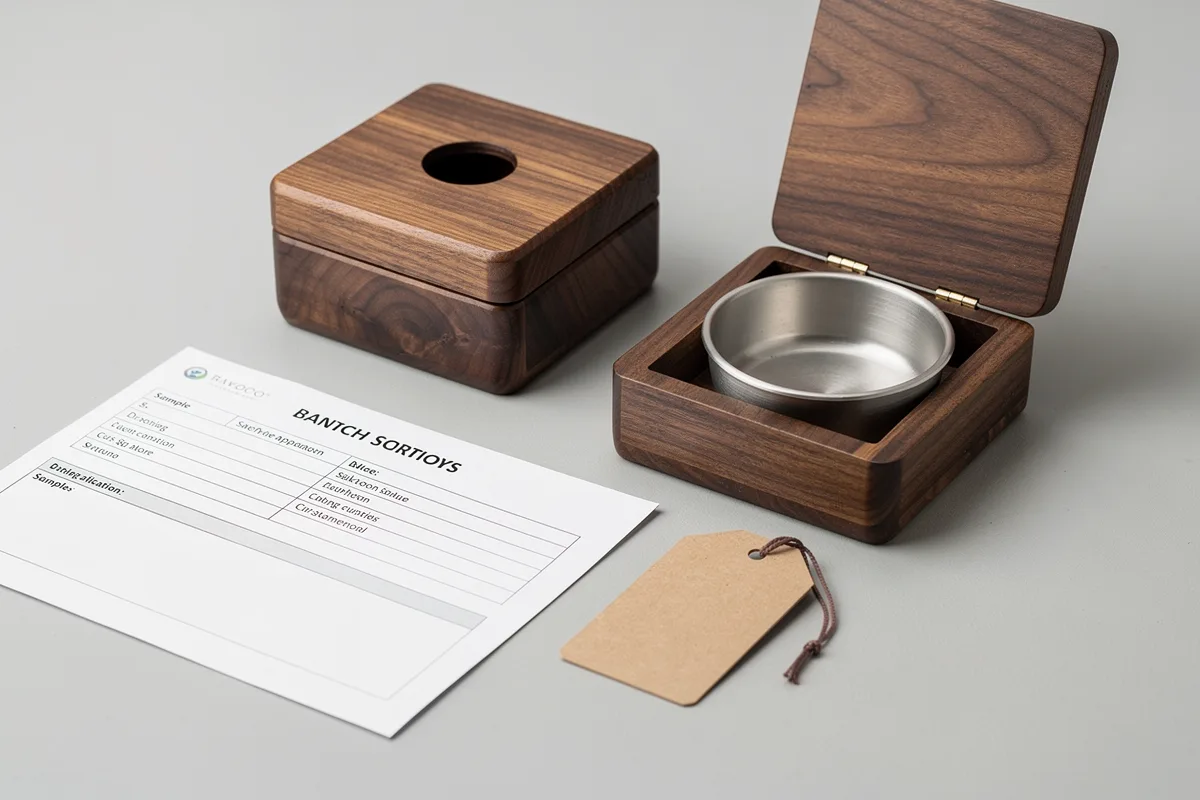
It should contain the intended fuel and residue while remaining compatible with the approved heat path, airflow and cleaning method. A removable metal bowl may be an appropriate design proposal, but its presence alone does not prove that the surrounding wood stays within a safe temperature range.
Can one sample approve charcoal, electric and stick-incense versions?
Not automatically. Those configurations have different heat, smoke, ash and electrical assumptions. Record the intended fuel on the sample approval and treat a materially different heat path as a new review item.
What ventilation information belongs in an RFQ?
Specify the location and purpose of openings, whether the design is open or partially enclosed, how smoke exits, and how ash is retained. Do not use a generic “well ventilated” label as a substitute for reviewing the actual structure and intended room use.
What should the buyer ask for before bulk production?
Ask for a dimensioned drawing, inner-vessel details, fuel and use instructions, appearance sample approval, fit and stability review, ash and cleaning review, packaging version and a record of who approved each item. Any claimed certification or performance result should be tied to the exact production configuration.
Can XRX make a custom wooden bakhoor burner?
XRX makes custom wooden incense and bakhoor burners, with options for custom size, structure, material, finish and hardware. Final material availability, construction, labeling and any safety or conformity assessment remain project-specific. Use the Contact page to submit the intended fuel, drawing and approval requirements.