
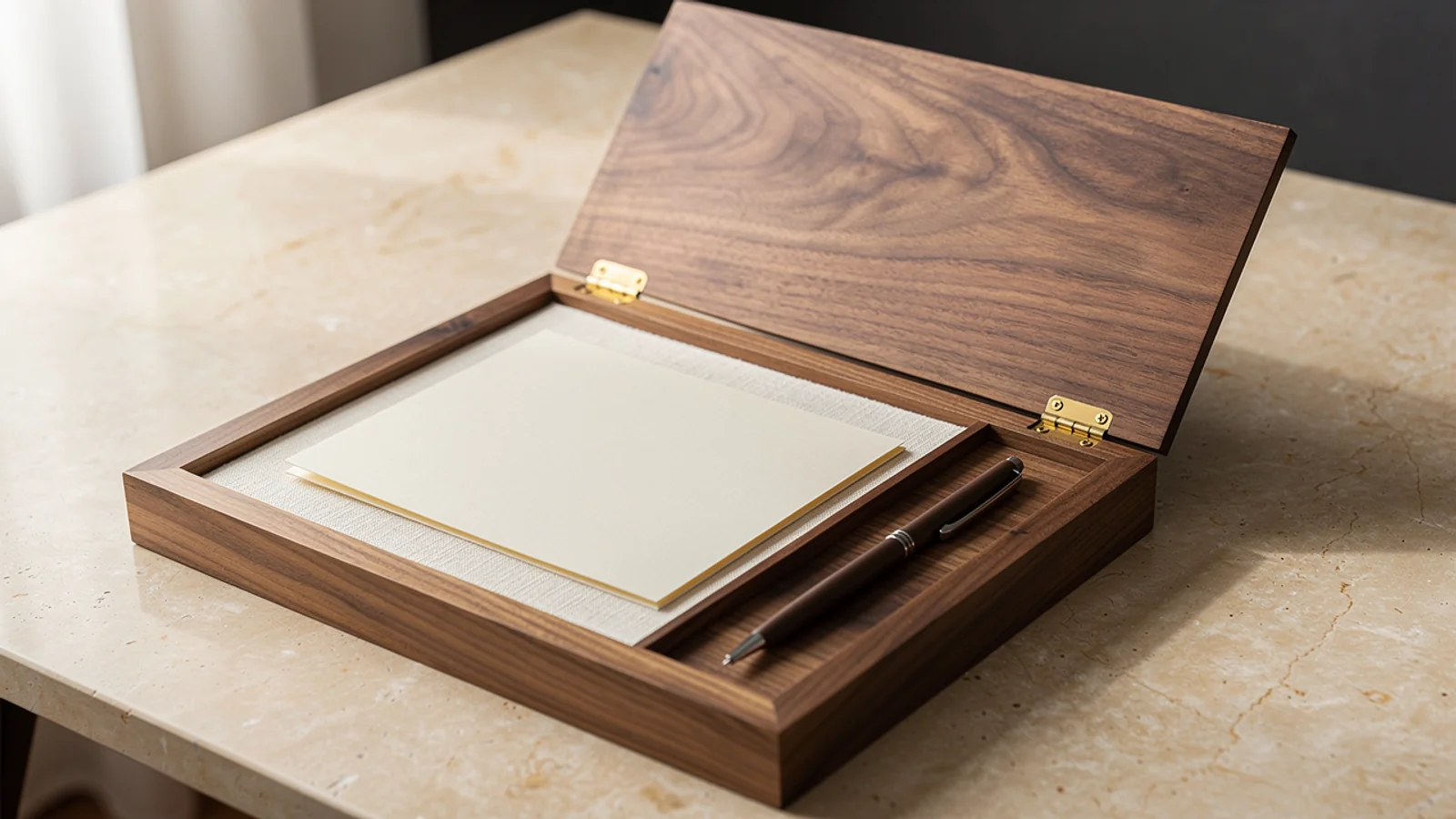

This guide helps event agencies, corporate procurement teams and gifting companies turn a design concept into a clear manufacturing brief. The seven checks below focus on wooden outer packaging, not gift selection or event marketing results.
1. Start Event Gift Box Design with the Handover
Write one sentence describing who receives the box, where they open it and what they remove first. That sentence should guide the structure.
A mailed invitation needs protection beyond its presentation finish. A registration-desk kit needs a practical way to identify and distribute the right version. An award box needs an opening action that works during the presentation, with the contents oriented toward the intended viewer.
| Event use | Design priority | What to check in the sample |
|---|---|---|
| VIP invitation | Card visibility and a manageable opening sequence | Card removal, closure and outer shipping protection |
| Conference welcome kit | Contents arranged for the actual handover | Item access, kit identification and carrying arrangement |
| Award presentation | Controlled opening and clear presentation | Lid position, award orientation and removal without awkward handling |
These are planning scenarios, not universal rankings of which format is more demanding. A complex invitation program may need more coordination than a simple conference kit.
For available structures and finishes, use the wooden gift boxes capability page as the commercial starting point. This article addresses the decisions needed to release that design for an event.
2. Separate Permanent Branding from Changeable Information
Decide which information belongs on the wooden shell and which belongs on a replaceable component. The host’s stable brand mark may suit engraving, printing or a metal logo plate. An agenda, room assignment or sponsor list that is still changing may be better placed on an approved card.
This is a production choice, not a rule that printed cards look less premium. Consider the likelihood of change alongside the desired appearance. Approve the logo’s size, position, orientation and process on the selected surface, rather than only viewing it on a white digital background.
Manufacturer insight: XRX’s approved production approach aligns structure, material, finish, logo, hardware and lining before bulk production. Applied to an event brief, this means a changed logo on a finished lid should trigger a review of the affected operation; approval of the original box does not automatically approve the revision.
Medium-density fiberboard (MDF), veneered construction and solid wood are project options. Specify the actual substrate and finish in the quotation. A woodgrain appearance alone does not identify the construction.
Keep an artwork release record containing the filename, revision, placement drawing and approver. Agree whether the factory, a local printer or an event fulfillment partner supplies and inserts the changeable card. A removable component still has its own printing, checking and packing deadline.
3. Give Each Kit Version Its Own Packing Specification
A single total quantity is insufficient when standard, speaker and VIP kits contain different items. Define quantities by version and explain which components are shared.
For example, two kits might use the same wooden shell but different internal layouts. That is a design proposal to confirm, not an assurance that one shell will fit everything. Submit the actual enclosed items, including any retail sleeves or protective covers, for fit review.
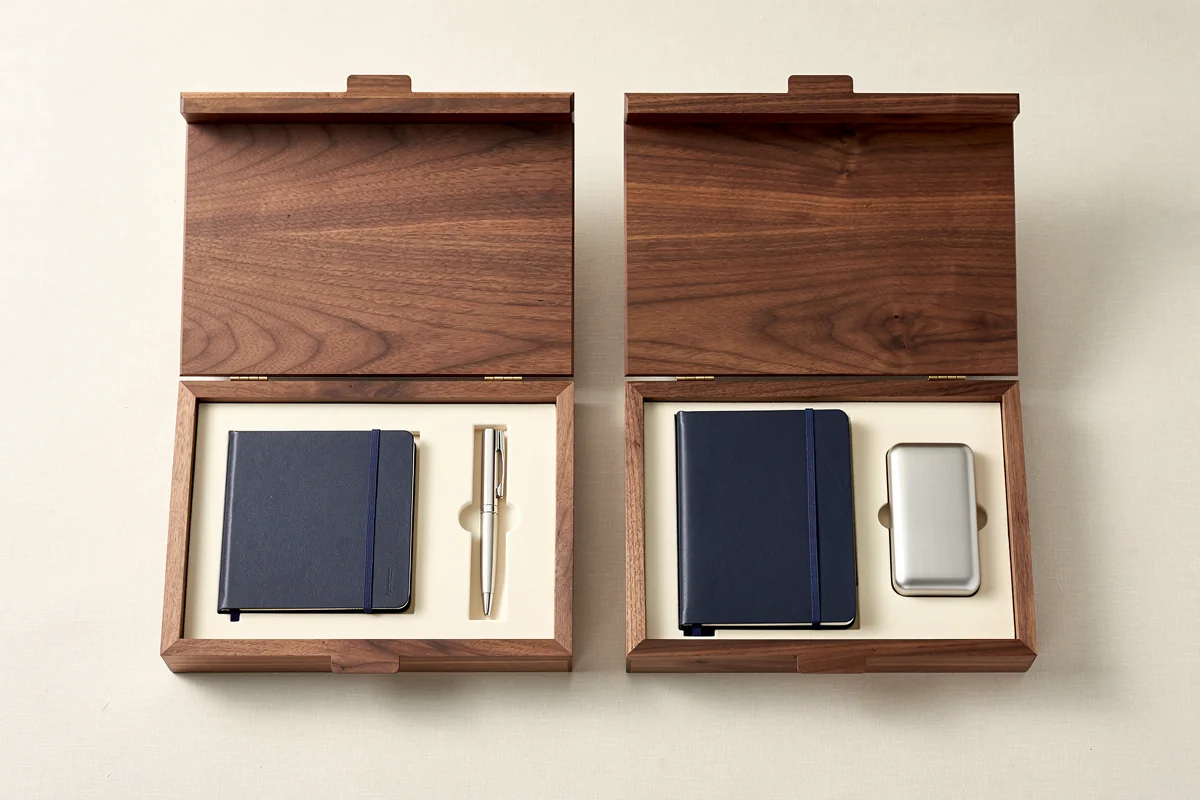
Create a short packing specification for each version: shell reference, insert reference, contents list, card version, quantity and destination. Separately map each recipient to that kit reference. Check both records: the right total quantity can conceal an incorrect allocation between versions, and a correct physical sample cannot reveal a name assigned to the wrong kit.
Show an approved packing photograph or layout with the order in which items are placed. Do not rely on a vague instruction such as “pack the premium gifts in the premium boxes.”
Manufacturer insight: Insert selection is part of the whole box design, not an independent decoration. A changed notebook, keepsake or invitation bundle can alter occupied space and access even when the outer dimensions remain unchanged. Check the new combination rather than assuming the earlier sample covers it.
The logo and insert customization options provide the relevant manufacturing background. In the event brief, the important output is a confirmed configuration for each kit.
4. Approve Recipient Names Separately from the Box
A correct physical sample and a correct recipient list are different approvals. Nominate one person on the buyer’s team to authorize the final personalization file.
Use an internal recipient identifier with the exact text to be reproduced and the assigned kit version. Keep a distinction between the recipient’s name, the words displayed on the gift and the shipping address. The party engraving lids may not be the party distributing individual parcels.
Before release, check spelling, accents, non-Latin characters, capitalization and unusually long entries. Use representative placeholder text for early layout trials, then review the actual production text through the agreed approval channel.
The UK’s Information Commissioner’s Office identifies data minimisation and accuracy among the UK GDPR data protection principles. As a practical application, avoid sending a complete event-registration export when the packaging operation only needs approved personalization text. This is workflow guidance, not a determination of your legal obligations.
Agree who can access the final file, how corrections are authorized and how the data will be handled after the order. Do not assume that an email attachment named “final” is the only current version. Once personalization begins, a replacement name requires a confirmed change instruction and an assessment of the affected pieces. Keep superseded files out of the active production folder, while retaining the agreed revision history; do not simply send an additional spreadsheet without saying which file it replaces.
5. Plan Backward from the Receiving Window
The event date is not necessarily the receiving deadline. A venue, hotel, warehouse or fulfillment partner may have separate acceptance windows and delivery instructions.
For example, the AHR Expo shipping overview distinguishes advance-warehouse receiving from direct convention-center deliveries scheduled under a target move-in plan. Its event-specific rules illustrate why a shipping address and opening date alone are not enough; they are not delivery rules for every event.
Obtain the actual receiving instructions for your shipment before fixing the production schedule. Confirm the receiving contact, permitted arrival window, labeling requirements, storage arrangements and who moves the cartons to the handover area.
Use the following backward-planning sequence as a proposed coordination tool. Fill it with dates confirmed by the responsible parties, not a generic countdown.
| Work backward from | Information needed | Responsible party to confirm |
|---|---|---|
| Event handover | Kits ready at the correct location | Event operations |
| Receiving and local preparation | Acceptance window and unpacking or distribution work | Venue or fulfillment partner |
| Transport | Route, booking cutoff and customs arrangements if applicable | Logistics provider |
| Final packing and release | Version counts, carton identification and inspection scope | Agreed packing and inspection parties |
| Bulk production | Approved configuration and confirmed production slot | Box manufacturer |
| Sample approval | Physical sample review and any corrections | Buyer and manufacturer |
XRX’s usual sample time is 7–15 days and bulk production is usually 35–65 days, depending on structure, finish and quantity. These are company planning ranges, not an end-to-end delivery promise. Transit, buyer review, revisions and any separately arranged kitting must be considered.
Agree a latest acceptable receipt within the permitted window and an explicit contingency allowance with the relevant parties. If kits are packed locally, schedule arrival of both the wooden boxes and the gifts at that packing location before onward delivery. Neither stream should be treated as already included in the other’s lead time.
If the plan does not fit, discuss reducing unresolved variants or changing the scope before committing. Faster freight cannot correct unfinished artwork or a missing approval.
6. Release a Defined Sample, Not a General Impression
“Looks good” is an incomplete manufacturing instruction. State exactly what has been approved and what remains outside that approval.
The following matrix is a suggested buyer workflow, not an industry certification or a claim about a particular customer order.
| Approval item | Evidence to retain | Change requiring review |
|---|---|---|
| Shell, finish and logo | Sample reference and artwork revision | Material, color, placement or process changes |
| Actual contents and insert | Confirmed items and fit layout for each kit | Added, substituted or resized items |
| Card copy | Approved text and layout file | Sponsor, language or event-detail changes |
| Recipient personalization | Authorized file and layout checks | Name corrections or reassigned kit versions |
| Shipping identification | Agreed carton marks and packing list | Destination, allocation or receiving-rule changes |
Assign an owner to each item and record the release date. A shared document can work if it clearly identifies the approved files and the factory acknowledges the same revisions.
Review materially different configurations physically. Where variations only involve text, agree the proofing scope with the supplier; it need not mean manufacturing a complete sample for every name. Do not use that distinction to skip fit checks when the contents change.
Before production release, reconcile the sample, quotation, purchase order and packing specifications. For a wider quotation checklist, see the custom wooden box RFQ checklist.
7. Check Distribution and the Box’s Life After the Event
A finished gift box must reach the correct recipient, not merely pass a visual inspection. Agree how different kits will be separated, counted and identified without requiring staff to open every presentation box.
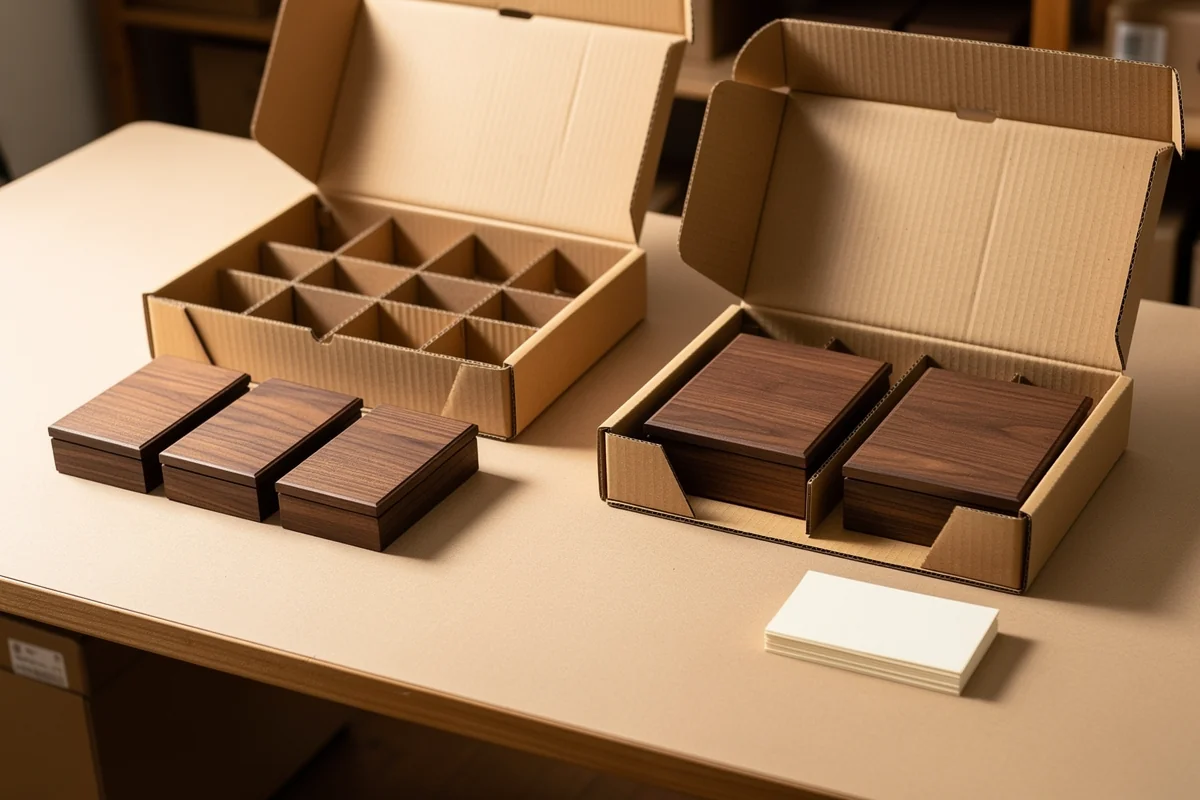
Include the kit reference and quantity in the agreed outer-carton identification, alongside the destination’s required information. Plan how any approved spare units are counted and kept separate. A spare unnamed shell is not automatically a usable replacement for a personalized, fully packed kit.
Use the quality control capability page to discuss inspection scope. For event work, supplement appearance and construction checks with a reconciliation of kit versions, personalization instructions and the packing list. An attractive box can still be the wrong box for its recipient.
Also consider whether permanent dates or names suit the intended after-event use. A removable event card may leave a more flexible keepsake, but usefulness should be assessed for the actual design.
Do not turn that possibility into an unsupported sustainability claim. The US Federal Trade Commission’s Green Guides summary cautions against broad, unqualified environmental benefit claims. Describe specific, supportable features rather than assuming a wooden box makes an entire event environmentally beneficial.
Frequently Asked Questions
What should an event gift box design brief include?
Include the handover context, box dimensions, material, finish, logo method, actual contents, insert layout, quantities by kit version and receiving instructions. Identify who approves the physical sample, personalization file and packing specification.
Can one wooden box design serve standard and VIP kits?
Potentially, if both configurations fit the shared shell and meet the opening requirements. Confirm the insert and contents for each version. A common outer box does not mean the internal layouts or packing instructions are interchangeable.
Should recipient names be engraved on the lid or printed on a card?
Choose according to the intended presentation, stability of the recipient list and production schedule. Engraving creates a lasting personalized element; a replaceable card separates variable information from the wooden shell. Both need an approved text file and checking process.
How early should wooden event gift boxes be ordered?
Build a project schedule backward from the confirmed receiving window. Include sampling, revisions, bulk production, any separate personalization or kitting, transport and local preparation. XRX’s usual production ranges are planning inputs, not a guaranteed arrival date.
Does approving one sample approve every kit version?
No. Approval should identify the configuration it covers. Different contents or structures need appropriate physical review, while text-only variations need an agreed proofing process. Record the scope rather than treating a single sample as unrestricted approval.
Can sponsor artwork change after sample approval?
Request a change review before further work on affected components. The supplier should confirm which pieces, operations, costs and dates are affected. A card revision may leave the wooden shell unchanged, but it still needs approval and must be included in the packing plan.
Prepare an Event Brief the Factory Can Review
Gather the handover description, actual contents, dimensions, preferred material and finish, artwork status, version quantities, personalization scope and receiving window. XRX’s regular minimum order quantity is 500 pieces; confirm how the proposed variations affect the quotation. Use Contact to review feasibility and sampling before treating the design as ready for production.