
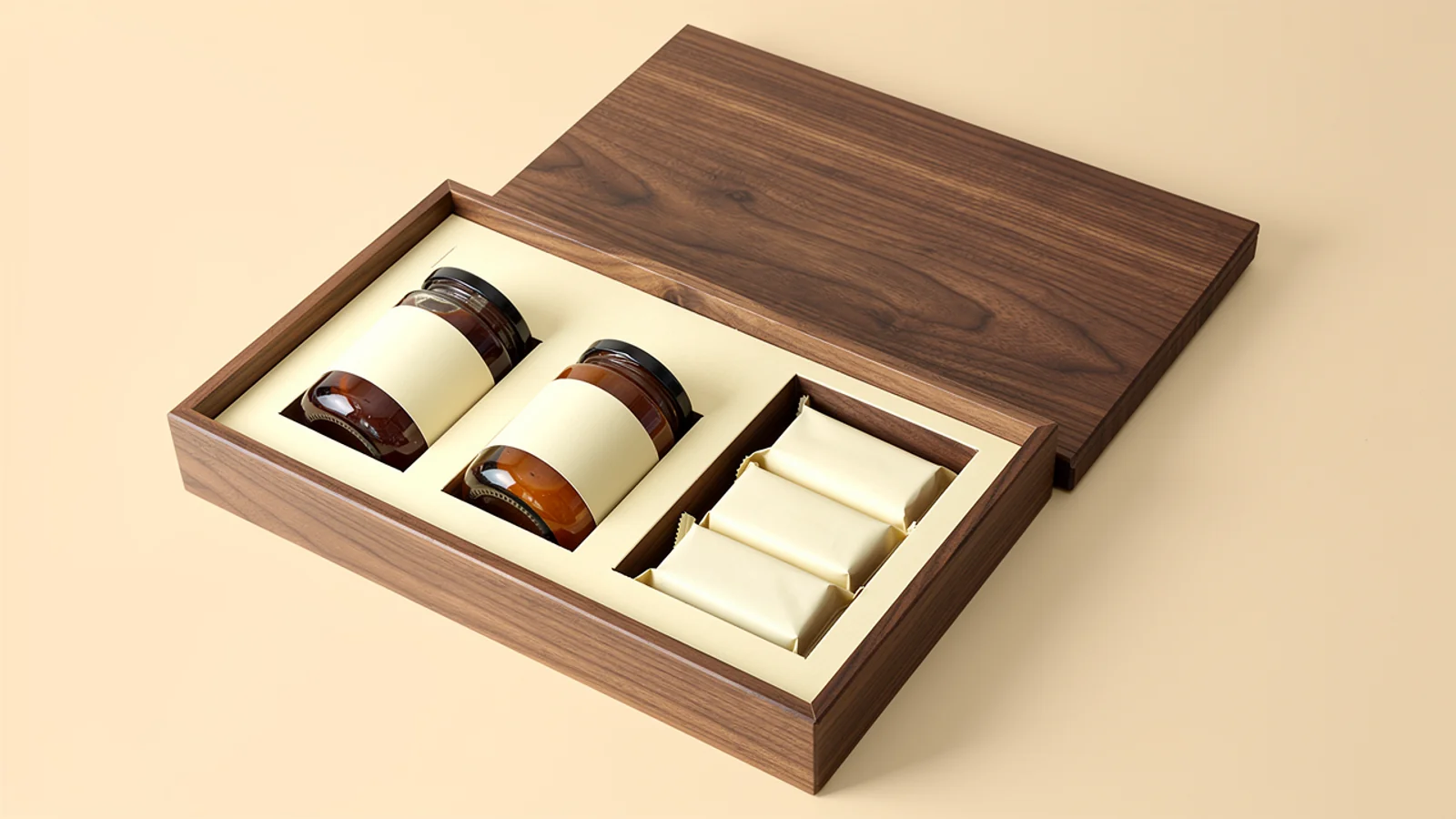

Start with the Contact Points, Not the Color of the Insert
Put the intended filled products on a table before choosing an interior material. Record the outside dimensions and filled weight of each closed jar, bottle or wrapped pack. Identify the cap, label seam, glass shoulder and sealed wrapper edges that should not become unintended support points.
Then ask a simple question for each component: what is carrying its weight? A jar may rest on the box base through an insert, while a lightweight bar sits on a separate platform. If the bar is underneath the jar or helps prop it upright, the arrangement needs another look.
Do not judge fragility by weight alone. A light pack can contain brittle confectionery; a substantial glass jar can have a vulnerable lid or projecting shoulder. Describe those concerns in the brief rather than assigning all light products to an unprotected bay.
| Product format | Information to provide | First layout question |
|---|---|---|
| Sealed glass jar | Filled weight, largest outside profile and cap details | Does it have its own support and separation from other glass? |
| Closed oil or condiment bottle | Full height, body shape, closure and intended orientation | What limits body movement without loading the cap? |
| Individually wrapped treats | Actual pack dimensions and vulnerable seams | Can they be removed without folding or trapping the wrapper? |
| Mixed assortment | Positions, quantities and differences between variants | Can a heavier item move into the lighter-product space? |
The outer structure can be developed through XRX’s wooden food packaging boxes. The insert brief should describe the contents as precisely as the wooden shell.
Choose Food Gift Box Inserts by the Job They Must Do
Dividers, shaped inserts and trays are not interchangeable names for the same component. A divider creates a boundary. A shaped insert locates an item using its profile. A tray provides a surface or removable layer. A mixed gift set may combine them.
A partition can be a useful starting point when several packs need distinct spaces. However, a shallow boundary may leave the upper part of a bottle free to lean. A fitted recess can improve positional control, but its edge must not grip a cap or scrape a label during removal. A removable tray can organize light products while adding another part that must seat securely.
| Interior approach | Useful design role | Check before approval |
|---|---|---|
| Fixed or removable dividers | Separate adjacent products into defined spaces | Check attachment, height and movement in the closed box |
| Shaped insert or cradle | Locate a jar or bottle around its actual profile | Check support, contact points and access with the filled pack |
| Separately supported tray | Present lighter wrapped products on their own surface | Check the tray support and clearance above and below it |
| Hybrid layout | Combine glass supports with a lighter-product compartment | Confirm one section cannot shift or load the other |
The table is a design starting point, not a tested specification. No universal foam density, cavity gap or partition height can be selected from a product photograph. XRX’s logo and insert options should be reviewed against the actual pack and chosen box construction.
Keep Heavy Glass from Using Light Products as Support
Consider an illustrative gift set with two filled preserve jars and three individually wrapped bars. A visually balanced layout might put them side by side. The structural question is whether they remain separate when the closed package is handled.
Give each jar an identified base support and check what stops it moving sideways. Provide the bars with their own supported space. If a divider is removable, inspect how it stays seated; being removable should not mean that it can drift freely into another compartment.
For a layered arrangement, establish what supports the upper tray. The lower food packs should not become improvised posts beneath it. Review the tray with all intended items present, then inspect whether removing one component changes how the remaining parts are supported. These are proposed design checks, not evidence that a particular divider or tray has passed a load test.
Manufacturer insight: approve the base, dividers and insert together. A well-finished divider is not enough if its attachment or the material beneath it has not been considered. The load path—the route by which the contents’ weight reaches the box base—should be understandable before the finish is signed off.
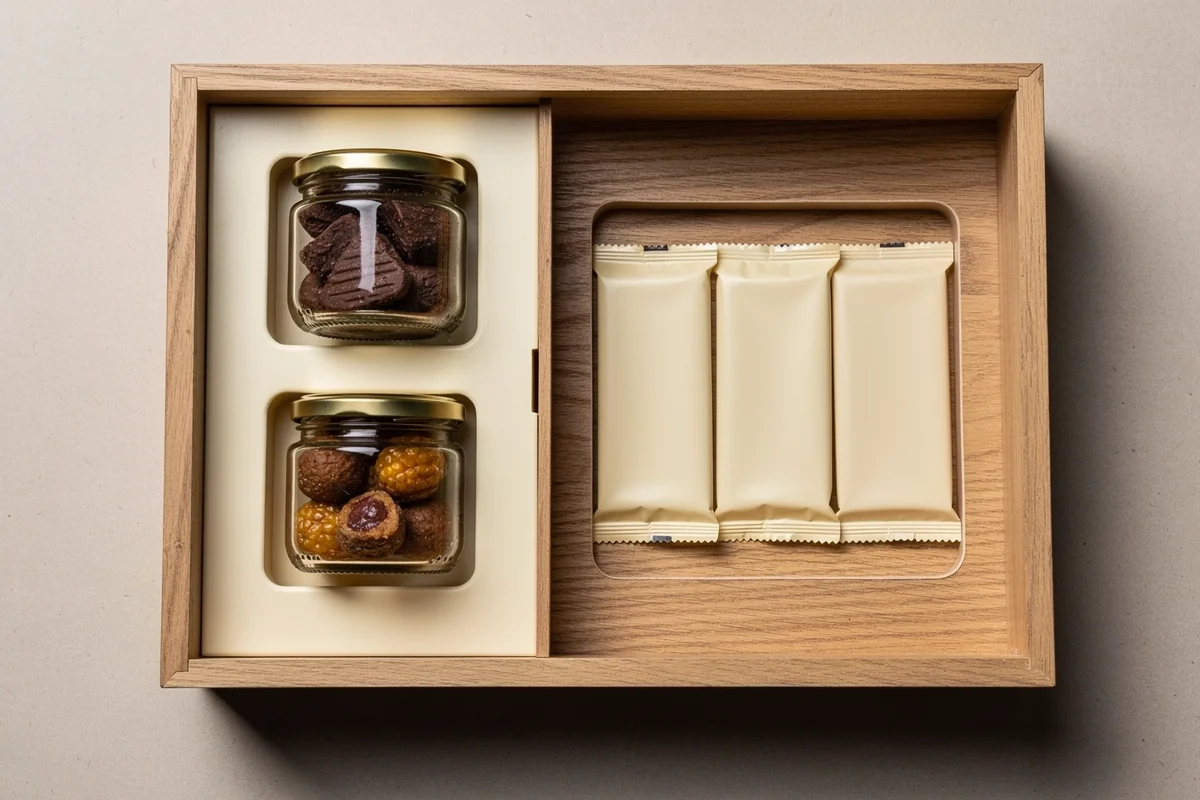
FLUX-generated concept showing distinct jar and wrapped-food spaces. It illustrates layout only, not tested load capacity, food-contact suitability or an approved customer order.
Loose decorative fill can still have a presentation role. If it is expected to cushion or restrain the contents, specify and evaluate that role rather than approving an unspecified handful. Adding more fill is not a reliable way to correct an unsupported tray or an item that can cross a partition.
Make Removal Possible Without Disturbing the Whole Set
A cavity that looks exceptionally neat may be awkward to use. Check whether fingers can reach the container body and whether a neighboring item must be removed first. Avoid a design that encourages pulling on a seal, wrapper end or unsecured lid because there is nowhere else to grip.
Review the loading path as well as the final resting position. A jar may pass through an opening at an angle, then sit correctly once inside. That does not establish that packers can load it repeatedly without catching the label. Similarly, a wrapped bar can fit in a rectangular bay while its sealed ends rub against the edge every time it is lifted.
Use the final primary-pack samples whenever possible. A rigid dummy can demonstrate general shape but not the behavior of a thin wrapper or applied label. Mark a fit decision as provisional if those parts are still changing.
For a removable tray, check the lifting feature with the tray loaded. A ribbon intended to lift a lightweight layer should not silently become a way to lift the entire jar-filled set. Define the intended action in the sample brief and inspect it rather than assuming the same feature suits every load.
Select the Wood and Lining Without Inventing a Food-Safety Claim
In XRX’s current order mix, MDF is the most frequently selected substrate for custom wooden-box projects. Painted MDF or a veneered construction can therefore be a reasonable starting point for a premium gift-box discussion. The interior still needs its own material and use review; the outer finish does not establish the suitability of everything inside.
FDA’s food-contact substance overview explains that packaging components can include substances such as adhesives and colorants, and that safety assessment considers intended use and potential migration. For a US-bound project, ask the appropriate packaging or regulatory reviewer what evidence is needed for the actual materials and configuration. “Sealed food” and “natural wood” are not blanket approvals for any lining.
For this brief, food remains inside suitable primary packaging selected for the product. Do not replace a wrapper with velvet or treat a paper-covered insert as proof of a functional barrier. Also avoid describing compartment separation as allergen control, leakage containment or added shelf life without the relevant evidence.
Manufacturer insight: coordinate the lining, adhesive, finish and insert construction before the sample is approved. Changing only the visible fabric can still alter thickness, fit or the assembly method. Specify the material version and check the finished sample for loose fibers, sharp edges, residue and objectionable odor; a visual or odor check does not prove regulatory compliance.
Treat the Gift Box and Shipping Pack as Separate Design Layers
A wooden presentation box is not automatically a parcel-ready shipping system. Its attractive surface may itself need protection, and a fixed retail display orientation should not be the only condition considered.
FedEx’s guidance for packing breakables calls for weight-appropriate outer packaging, cushioning, movement control and individual protection for fragile products. It also discusses double-boxing. These are shipment-level recommendations; do not turn the carrier’s general cushioning measurements into a universal cavity allowance inside every wooden gift box.
For your project, identify the outer carton, protection around the wooden box, closure method and number of gift sets per shipping unit. Ask how the completed package will be evaluated for the intended distribution route. A single gift set sent by parcel and several sets moved together require their respective configurations to be considered.
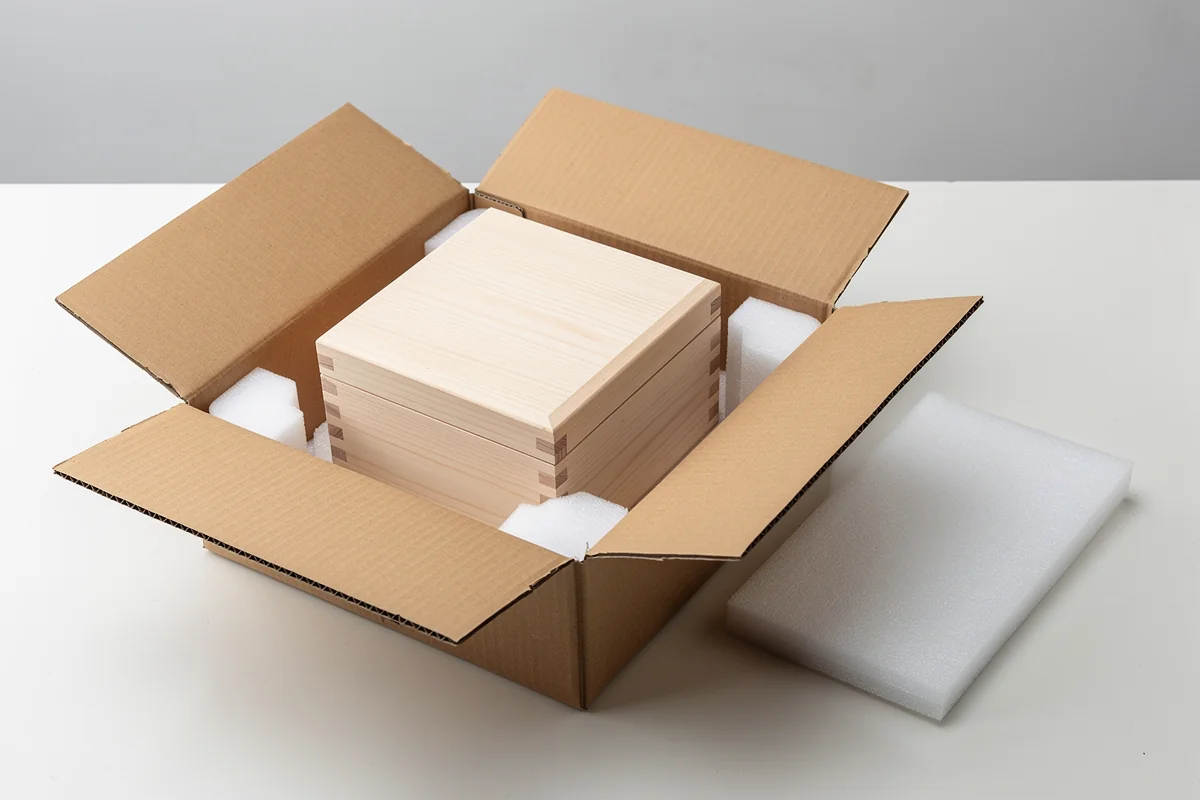
FLUX-generated concept showing a wooden presentation box and separate transport-protection layers. Cushioning dimensions and shipment performance have not been validated by this image.
The International Safe Transit Association’s design and testing guidance emphasizes understanding the distribution environment, using representative products and packages, and defining damage criteria before testing. It also notes that parcel orientation is not guaranteed. Ask the test provider to select the appropriate current procedure rather than choosing one simply because another gift box used it.
A tabletop fit review is useful for identifying problems, but it is not a substitute for a transport test or grounds for a certification claim.
Give Sample Approval Two Clear Outcomes
Separate “presentation approved” from “distribution evaluation completed.” This prevents a signed color sample from being treated as approval of glass protection, closure performance and shipping configuration.
| Review stage | What to examine | Record the outcome |
|---|---|---|
| Filled presentation sample | Support, separation, removal, lid clearance and finish | Note approved parts and any remaining provisional items |
| Packing rehearsal | Loading sequence, trapped wrappers, tray seating and closure | Record the agreed method and any handling difficulty |
| Complete transport configuration | Actual contents, wooden box, outer protection and carton | Record the evaluation method and agreed acceptance criteria |
For the presentation review, photograph the loaded and unloaded interior so the supporting parts are visible. Close the lid normally; do not force it down over a tall cap or additional filler. Inspect any unintended contact marks after the agreed handling review. Keep this exploratory opening and inspection separate from a formal test sequence, which should follow the selected procedure without improvised interruptions.
For transport evaluation, agree what counts as unacceptable before the work starts. A broken jar is an obvious concern, but a crushed wrapped product, damaged seal or badly scuffed gift-box finish may also matter to the buyer. Define the criteria with the relevant product and packaging teams.
If the jar supplier, filled weight, insert material or shipping arrangement changes, reopen the affected approval rather than relying solely on the previous photograph. Keep the current drawings, material references and approved configuration together. XRX’s quality-control overview provides context for the manufacturing checkpoints.
Frequently Asked Questions
Can a wooden gift box hold jars and wrapped confectionery together?
Yes, a layout can combine them using dedicated glass supports and a separate space for the lighter packs. Approve the actual filled arrangement so the jars do not depend on confectionery packs for support or move into their compartment.
Are dividers enough to protect glass jars?
Not necessarily. Dividers establish separation, but the design also needs suitable support and movement control. Evaluate the filled containers, closed box and intended transport packaging rather than approving a divider only from its appearance.
Can shredded filler replace a fitted insert?
It should not be assumed to do so. If filler is expected to support, cushion or restrain products, define and evaluate that function. Decorative fill alone does not demonstrate that a heavy jar will stay separated from a light wrapped product.
Does the tightest possible cavity give the best fit?
No. The fit must allow loading and removal without unwanted pressure on the container, label or seal while controlling movement as intended. Choose the clearance through the actual material and sample review, not a universal number.
Can the wooden box or lining touch unwrapped food?
This guide does not specify direct food-contact use. Keep foods in suitable primary packaging. Any proposed direct-contact application needs a separately defined material and use assessment; the appearance of wood or lining is not evidence of suitability.
What should we provide for an insert quotation?
Send samples or dimensions of the final primary packs, filled weights, quantities, layout direction and distribution requirements. Include the wooden-box material, finish, logo, target order quantity and which sample details remain provisional.
Prepare the Interior Brief Before Requesting a Quote
A useful brief names the products, shows their support points and separates presentation approval from shipping evaluation. It also makes clear whether XRX is supplying empty wooden packaging or another specifically agreed scope. Contact XRX with your sealed-pack details, preferred layout and order quantity to discuss the box construction, inserts and sampling requirements.