
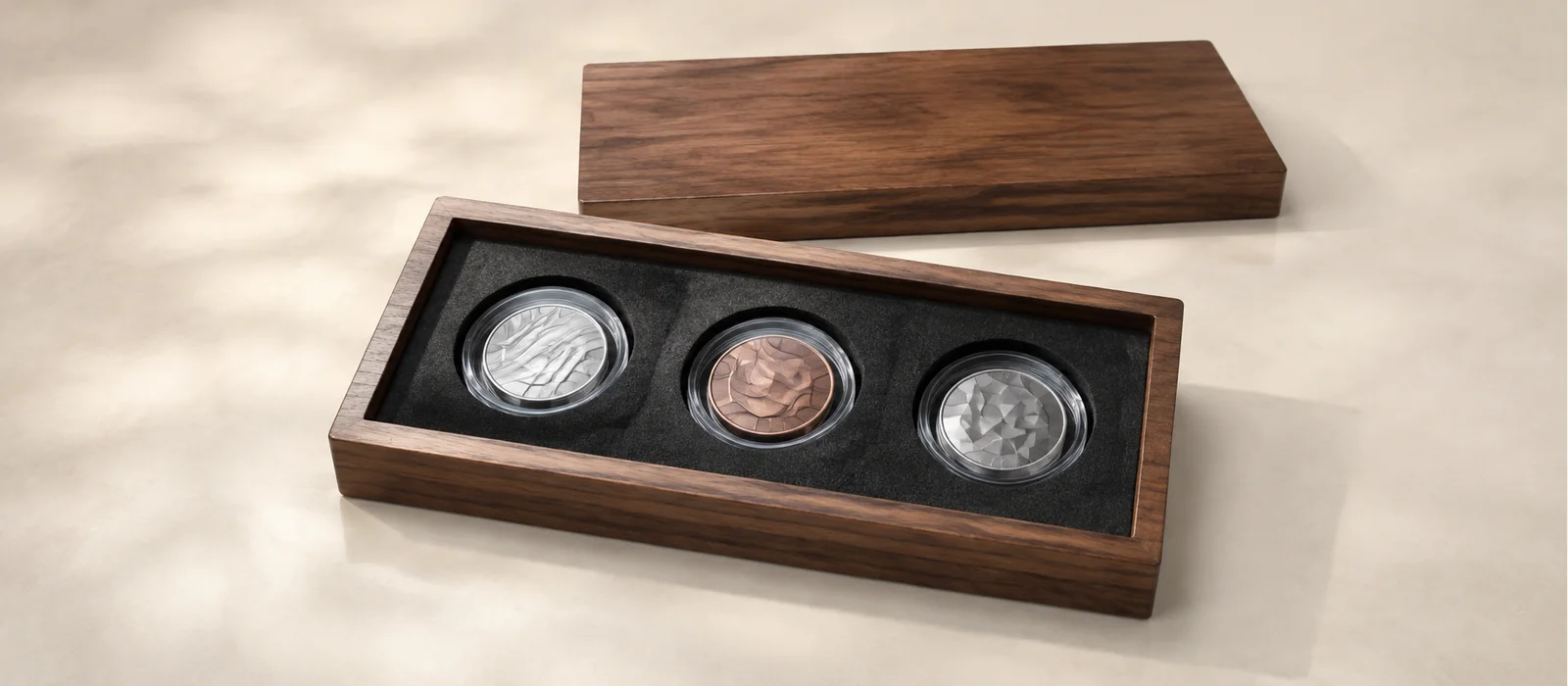

Two Different Parts Are Called an Insert
An insert inside a capsule centers the coin within its protective holder. An insert inside a wooden box supports that complete holder. Those parts may both be described as foam inserts, yet their dimensions and contact surfaces are different.
Write the scope clearly in the request: “outer presentation-box insert for closed capsules supplied by the buyer,” for example. State who supplies the capsules and who fits the coins into them. Otherwise, a supplier may quote the wooden box assuming that the holder has already been selected, while the buyer assumes holder selection is included.
For existing collectible coins, do not remove original holders merely to make a presentation layout work. The U.S. Mint’s coin-care guidance recommends retaining original cases and capsules for modern coins and sets, and identifies sealed graded-coin holders as slabs. It also advises keeping accompanying documentation. Design the new outer presentation around what should remain intact.
Choose Coin Box Inserts by Holder Format
The first useful comparison is not velvet versus foam. It is what the insert will touch and what the recipient needs to see or lift.
| Contents presented | Insert specification starts with | Approval priority |
|---|---|---|
| Closed round capsule | Actual outside diameter, closed thickness and rim profile | Stable seating and access to lift the complete capsule |
| Rectangular graded holder or slab | Full external outline, corners, thickness and label position | Holder removal without obscuring the identification area |
| Bare medal or challenge coin | Actual outline, relief, finish and approved contact requirements | Suitable contact surfaces and an agreed handling method |
For a round capsule, the transparent rim may extend beyond the metal coin inside. For a slab, a rectangular recess must accommodate the complete holder rather than a circle around the visible coin. Retaining features should not cover the label area that the buyer expects to read.
Bare medals need a separate decision. A decorative fabric that looks appropriate beneath a closed holder should not automatically be approved for contact with an unprotected metal surface. If the item is historically significant, delicate or intended for conservation storage, obtain specialist requirements before selecting the presentation material.
A mixed collection can use different cavities in one tray. For example, a round capsule and a rectangular slab should each have their own approved support outline; enlarging every opening for the largest holder would leave the smaller ones with a different fit.
Specify the Finished Holder, Not Its Nominal Coin Size
Request a holder reference, drawing and representative closed sample. Record the dimensions of the actual assembly planned for packing, not just the coin it can accommodate.
For circular holders, distinguish the internal coin space from the outside diameter. For rectangular holders, record length, width, thickness and any projecting features. Record which face is uppermost and whether orientation matters when the box is opened.
The capsule’s closed thickness also matters. A recess can fit across its width yet leave the holder too high beneath the lid. Conversely, a deep recess can hide the gripping surface and make removal awkward.
Describe three things separately on the drawing:
- The surface that supports the holder.
- The finished recess outline and depth.
- The space and action needed to remove the holder.
Do not specify “tight fit” without explaining the intended result. The buyer may mean no visible movement during presentation; the supplier may interpret it as a compressive fit. Those are not the same requirement. Agree an insertion and removal check using the finished materials.
There is no universal clearance given here. A rigid recess and a fabric-covered compressible insert need different design consideration. Any allowance must account for the approved holder and finished construction, not a generic percentage or an arbitrary reduction from the capsule diameter.
Balance Seating, Visibility and Removal
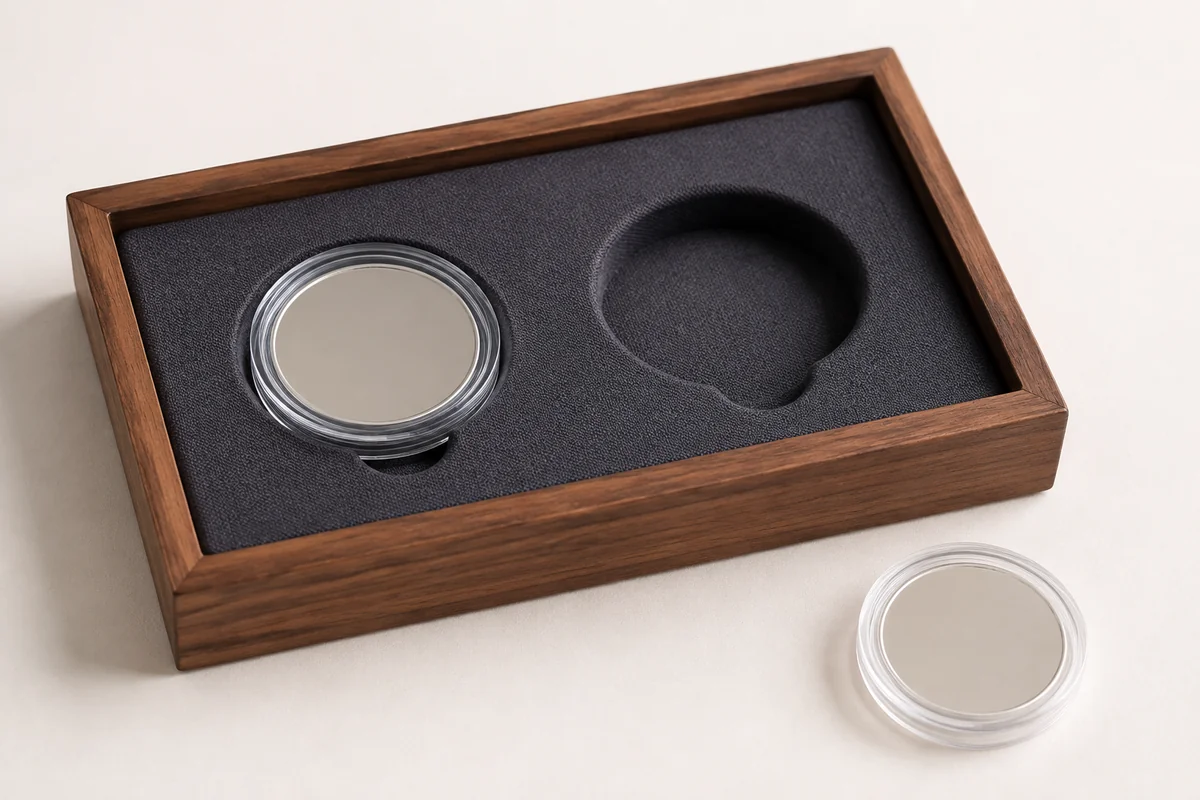
AI-generated concept illustrating recess and finger-access options; not a dimensional drawing or tested sample.
A successful recess needs more than the right outline. Check where the holder rests, how much of it is visible and how the recipient can lift it.
A shallow presentation may expose more of the capsule but needs a deliberate retention method. A deeper recess may conceal its edge. A finger scallop or a lift tab can be considered where it provides access, but should be tested with the actual holder rather than added only as a decorative detail.
Try lifting the complete closed capsule without pulling at its opening seam. For a slab, check whether the available grip requires pressing against the label window or levering a corner. Stop and revise the design if ordinary removal requires a tool or threatens to open the holder.
Also decide what “aligned” means for the collection. Different holders can have different thicknesses, so equal recess depths will not necessarily produce equal display heights. Mark the intended visual result on the sample brief rather than asking for identical depths everywhere.
Close the box with every holder in place. Examine the relationship with the lid lining, any certificate pocket and closure hardware. Do not assume that a lid which closes has acceptable clearance, or that a soft lining can absorb any interference.
Separate the Support Material from the Contact Layer
“Velvet insert” describes appearance but leaves important construction questions unanswered. Ask what forms the support beneath the fabric, how the covering is attached and which surfaces contact the holder.
XRX’s available insert options include EVA, sponge and velvet lining. Here, EVA means ethylene-vinyl acetate. These are options for project development, not universal specifications for coin conservation. Confirm the actual material, covering and construction for the intended contents.
From a manufacturing perspective, the finished assembly needs to be approved together. Adding a covering after approving a bare recess can change the usable opening and edge detail. Similarly, approving the outer box’s color does not approve the contact material hidden beneath the coin holder.
Use logo and insert customization to coordinate the support, covering, branding and wooden structure. MDF, veneer or solid wood can be considered for the outer presentation, but none of those names determines the correct inner fit.
For preservation-sensitive projects, request a documented material review rather than relying on “PVC-free,” “acid-free” or “premium velvet” alone. The Canadian Conservation Institute’s guidance for metal collections calls for reviewing fabrics, adhesives, coatings and other enclosure materials. It also warns that ordinary paints and varnishes are generally not effective barriers against wood emissions. A decorative finish is not evidence of a suitable conservation barrier.
Give Every Cavity a Holder Reference
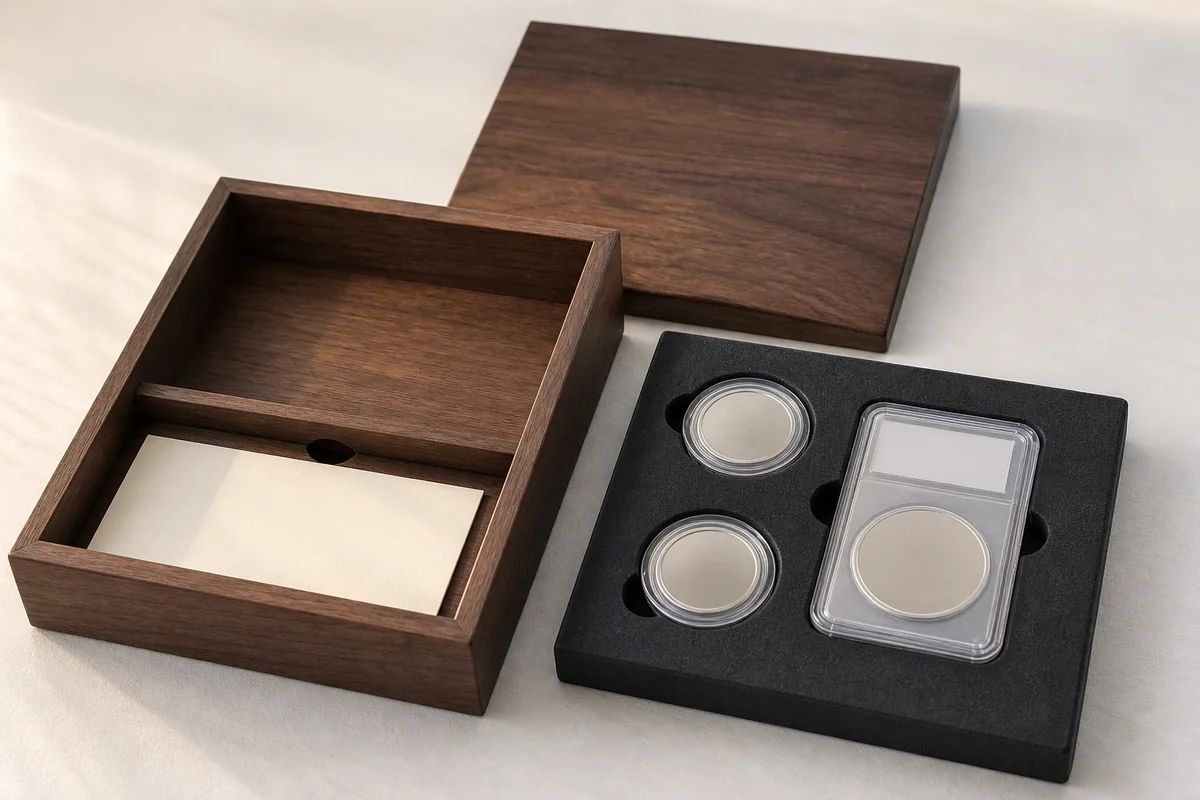
AI-generated mixed-holder concept. Holder shapes, card placement and tray construction require project-specific confirmation.
For a multi-coin release, use a simple cavity schedule alongside the drawing. This keeps the collection order connected to actual components rather than to an informal description such as “three assorted coins.”
The following is an illustrative specification format, not a standard layout:
| Position on drawing | Approved contents reference | Check tied to that position |
|---|---|---|
| A | Round capsule, reference A, current revision | Complete capsule seats and lifts as agreed |
| B | Round capsule, reference B, current revision | Display height matches the approved presentation |
| C | Rectangular holder, reference C, current revision | Label remains visible and corners are accessible |
| Document space | Buyer-supplied card, current revision | Card fits separately without bearing on holders |
Attach the relevant holder drawings and samples to those references. If two positions share exactly the same holder, say so. If they only contain the same nominal coin size, do not assume they share the same recess.
For a removable tray, distinguish a decorative insert panel from an assembly intended to be lifted with contents installed. Confirm its support and removal method. Do not treat a loose foam panel as a load-bearing tray without reviewing how it will be used.
Decide when the certificate should be seen: immediately on opening, after lifting the tray or separately from the coin display. A dedicated card space can simplify that sequence. Use the real card size and thickness; do not assume a generic certificate format.
For a future release, check the holder reference before reusing the old layout. A different capsule supplier, thicker closed assembly or changed slab outline may require an insert revision even when the coin artwork is the only visible product change.
Approve a Sample Without Confusing Fit with Preservation
Evaluate a complete sample with representative holders. Where valuable contents are involved, agree suitable non-valuable sample contents or approved dummies with the buyer; do not improvise tests using collectible coins.
A practical review can follow this order:
- Identify: check that every holder matches the reference assigned to its cavity.
- Seat: place each closed holder into the finished recess without forced assembly.
- View: confirm the coin face, labels and intended collection order are visible.
- Remove: lift and replace each holder using the agreed action; note snagging or changes to the closure.
- Close: review lid clearance with all contents and documents present.
- Record: photograph the approved arrangement and record holder, insert and drawing revisions.
Specify any repeated handling check with the supplier, including what counts as unacceptable movement or visible marking. Do not add a made-up cycle count merely to make the approval sheet appear technical.
Review shipping separately: will the wooden box travel loaded, or will the recipient add the holders later? A tabletop fit check does not validate the complete distribution pack.
Long-term preservation is a different question again. The Canadian Conservation Institute’s coin and medal care notes do not recommend wooden storage cabinets and warn that wood display cases can emit acidic vapors harmful to metals. Do not assume that adding a capsule makes any wooden enclosure suitable for indefinite storage. Ask a qualified conservator to specify the system where preservation is a requirement; an appearance sample cannot establish archival or anti-tarnish performance.
Frequently Asked Questions
Are capsule inserts and wooden coin box inserts the same?
No. A capsule insert supports the coin inside its holder. A wooden box insert supports the complete holder, or a bare item only under separately agreed contact requirements.
Should the recess match the coin diameter?
For an encapsulated coin, use the approved capsule’s external shape and closed thickness, not the coin diameter alone. Confirm the finished recess and removal method with a representative sample.
Can one tray hold capsules and graded coin slabs?
Yes, a layout can use separate cavities for each approved holder. Check each external outline, label position, display height and removal action rather than assuming the holders are interchangeable.
Is a tighter foam insert always better?
No. Retention must be balanced with insertion and removal. Confirm the actual support and covering; reject a fit that requires forced handling or risks opening or damaging the holder.
Does a velvet-lined wooden box prevent tarnishing?
Not by itself. Velvet describes a lining, not the preservation performance of the complete enclosure. Material compatibility and storage conditions need separate assessment; an attractive sample is not an anti-tarnish guarantee.
Can we reuse the insert for next year’s release?
Only after confirming the approved holder and layout still match. Changes to capsule dimensions, slab outline, closed thickness or document arrangement should trigger a fit review before reuse.
Prepare the Insert Brief Before Requesting a Box Quote
Bring together the holder references, cavity schedule, intended handling sequence, finish direction, quantity and packing plan. Note any preservation requirement explicitly rather than leaving the supplier to infer it from the word “collector.”
You can review commemorative coin product concepts for presentation directions, then send XRX your coin-box insert brief for a structure and sampling discussion. The useful starting point is the approved holder and the job the insert must perform—not a universal hole size.