

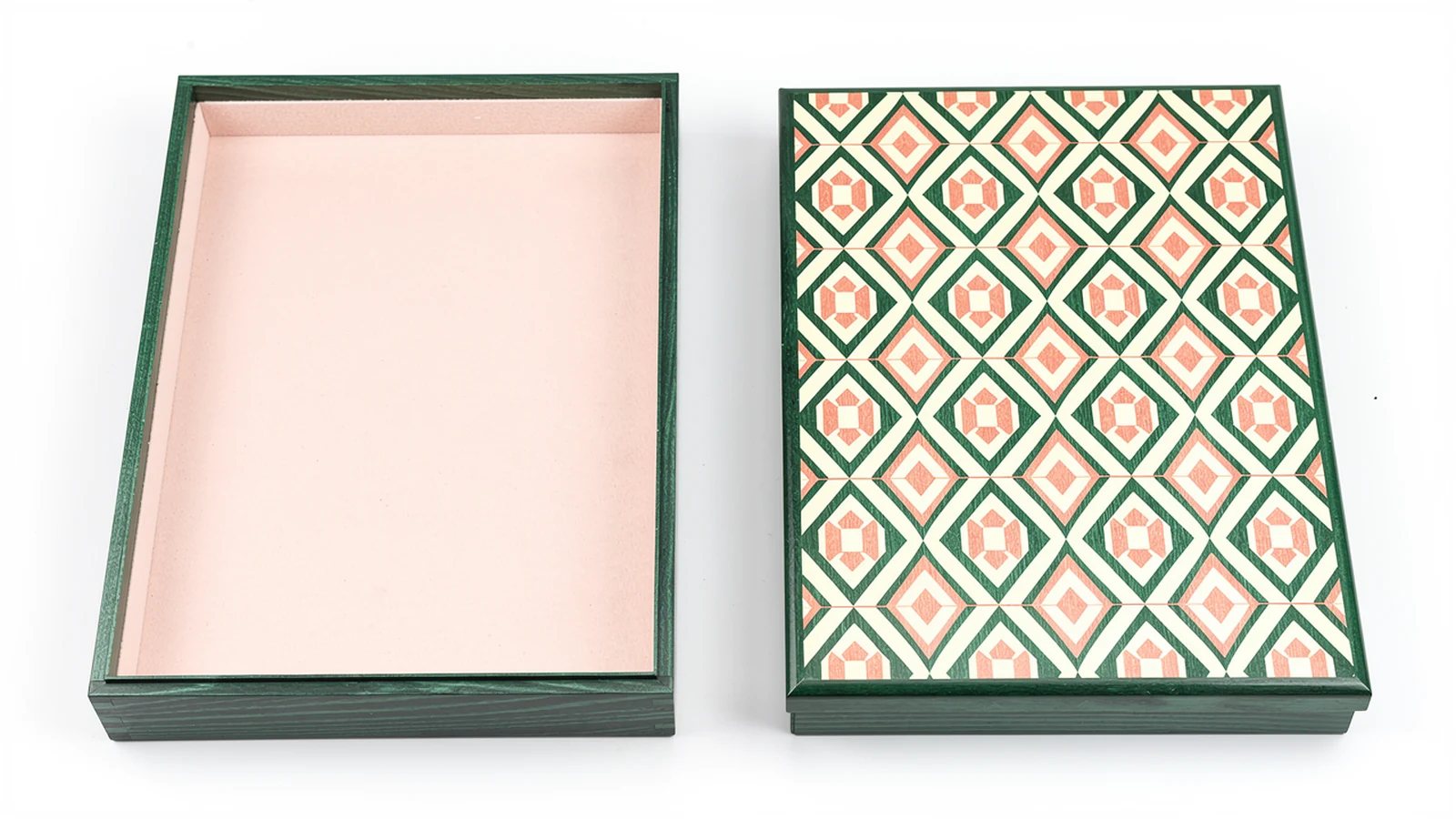

This format can give a presentation box an unobstructed open view without an attached lid standing behind the product. The tradeoff is that the user must handle a separate piece. For a brand or packaging buyer, the key decision is whether that complete interaction suits the product and its setting.
Define the removable-lid construction in the drawing
The term lift-off lid describes how the box opens, not one standardized joint. A lid may locate over an outer shoulder or use a rim on its underside that enters the base opening. State which surfaces guide the lid and which surfaces stop it at the intended closed height.
Distinguish those locating features from any added retention feature. A lip that centers the lid does not automatically hold the loaded base during lifting. If a magnet or other closure is proposed, identify its separate purpose and confirm the complete opening behavior on the sample.
Show the closed seam, the underside of the lid and the base opening in the drawing. Include the finished lining boundary where it approaches the locating area. A closed rendering may hide all of these details while still looking convincing.
Specification insight: define the finished mating surfaces, not just the outside length and width. Two boxes with the same exterior dimensions can have different rim positions, lining returns and seating depths. Use the wooden box dimensional tolerance guide for documenting the relevant limits without assuming that nominal size establishes fit.
Evaluate lift off lids for custom wooden boxes through the opening sequence
Start with the box in the place where the recipient or retail staff member will open it. Check whether the lid can be grasped without fingers pressing against a delicate decoration or slipping onto the lower box. A visually discreet seam is not useful if the intended user cannot identify a practical grip.
Lift the lid through its required path and watch where the base moves. Does the user need to hold the base? Does one corner catch when the lid is lifted unevenly? Does the lid clear the contents before it is moved sideways? These observations turn “opens smoothly” into a specific sample discussion.
| Stage | Buyer’s observation | Decision to record |
|---|---|---|
| Grip | Accessible edges or another intended hand contact | How the user starts opening |
| Release | Lid separates without unintended base movement or catching | Accepted removal behavior |
| Clearance | Locating features clear the rim and contents | Required opening space |
| Resting | Detached lid has a stable, clean place to go | Intended placement and contact face |
| Reclosing | Lid returns in the intended orientation and seats correctly | Alignment and pairing requirements |
The checklist does not prescribe one universal opening force or clearance. A small jewelry case and a larger presentation set have different geometry and handling requirements. Agree criteria that describe the intended use, and have the supplier confirm how they will be checked.
Where the presentation area is constrained, compare the removable-lid interaction with an attached or sliding assembly. Compare those alternatives through the same opening sequence. A removable lid avoids an attached opening arc, but it still needs clearance during removal and space after removal.
Check the locating rim after lining and finishing
A sample shell can demonstrate the basic shape before it demonstrates the final fit. Clear coating, painted surfaces, lining returns and assembly details all belong in the completed configuration. Specify which state the approval sample represents so an unfinished trial is not mistaken for production approval.
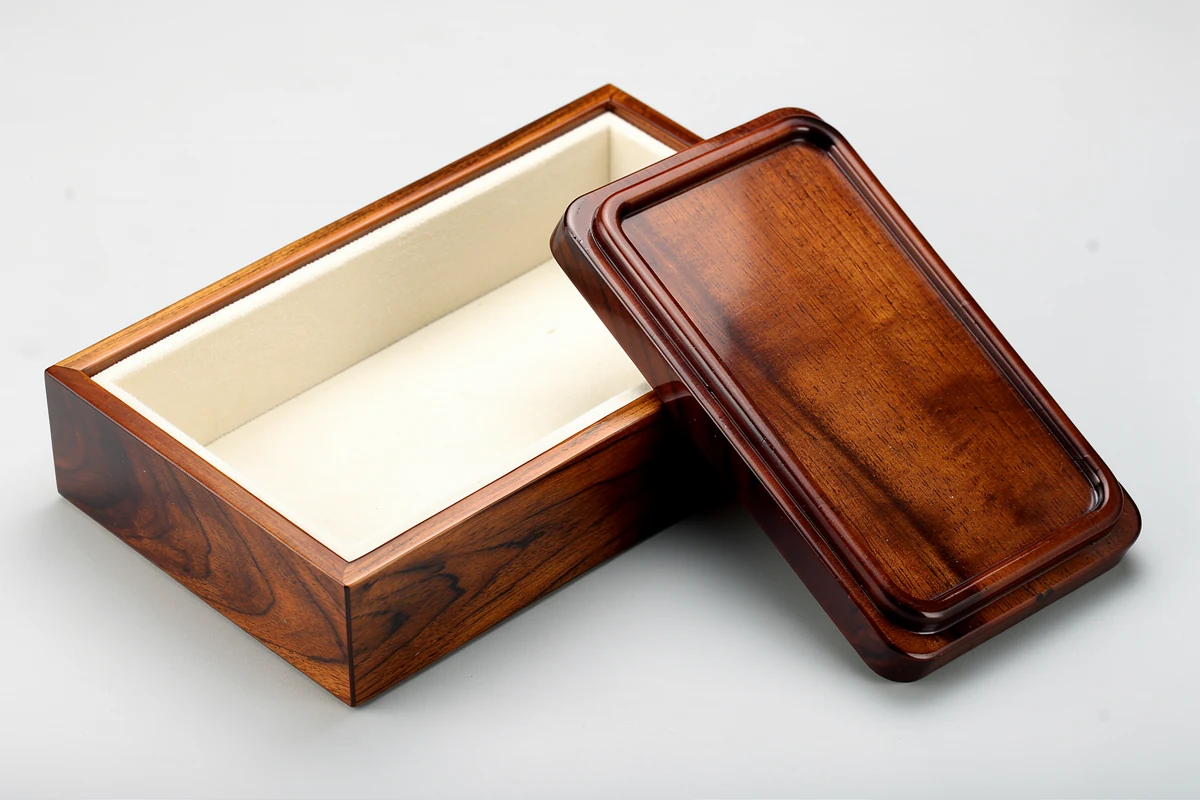
Inspect the full perimeter where the lid locates. Look for a lining edge entering that path, a raised fold near a corner or a seating surface that contacts earlier than intended. Confirm that the lid reaches its designed closed position without using the contents as a stop.
For example, consider a hypothetical sample that closes correctly as an empty shell. After lining is added, a fabric return extends into one corner of the locating area. The lid stops unevenly even though the outside dimensions remain unchanged. The useful response is to inspect that interference against the drawing and revise the affected detail, not to call every part of the box too large.
This is a proposed diagnostic example, not a reported factory incident. It also explains why checking the actual loaded assembly matters: a correct empty fit does not establish clearance around a taller product or a changed insert.
Account for material behavior without inventing a clearance
For solid wood, moisture-related movement belongs in the fit discussion. The USDA Forest Products Laboratory’s Wood Handbook chapter on moisture and physical properties explains that wood exchanges moisture with its surroundings and changes dimension as moisture content changes below fiber saturation. Movement also differs with grain direction.
That principle does not supply a single gap for every lid. The actual construction, materials, geometry and expected conditions matter. Do not apply a solid-wood shrinkage figure directly to an entire veneered panel box or use it to guarantee the performance of a completed lid assembly.
Ask the manufacturer to state the conditions under which critical dimensions and operation will be assessed. If the project requires evaluation under other conditions, agree that scope before approving the order. Record the measurement references and sample state so later inspection can compare like with like.
Avoid treating a tighter fit as an automatic sign of higher quality. The useful outcome is the agreed balance between location, appearance and removal. A fit that looks precise but needs prying or unpredictable force may not suit the recipient’s experience.
Decide where the lid rests after opening
A detached lid needs a destination. On a retail counter, that might be a clear area beside the base; during a gift presentation, it may be held briefly and then set down. Make the intended action visible in the sample review rather than assuming that any nearby space will work.
Identify the surface that contacts the table when the lid is parked. A decorative top, an inner lining and a locating rim are different contact surfaces. Check whether the chosen position is stable and whether it exposes a surface that should remain clean. Do not assume a shallow lid can stand safely on its edge without a supporting design.

Specification insight: include a photograph of the open base and the parked lid in the approval record. A closed-box photograph cannot show whether the product remains accessible once the lid occupies part of the available counter.
If the design is intended to let the base sit inside the inverted lid, state that explicitly and check the finished dimensions and contact surfaces of that second arrangement. It is an additional fit requirement, not an automatic benefit of every two-piece wooden box. The arrangement must also leave the product accessible and stable.
Choose a pairing rule before production
Decide whether each lid will stay with its own base or whether lids must be interchangeable across an identified group. These are different requirements. An individually approved pair does not establish that its lid fits every other box of the same nominal size.
If interchangeability matters, tell the supplier before sampling. Define the relevant model or size group, the permitted orientations and the checks needed to demonstrate that requirement. Do not wait until packing to mix components and discover that the approval only covered matched pairs.
Appearance can also create a pairing requirement. A continuous printed design or a selected grain relationship may need the lid to return to a particular orientation even if another orientation physically fits. Mark the intended front on the approval drawing and agree any discreet identification method that production needs.
Keep those details with the golden sample approval record. A later change to the rim, lining, finish or artwork can affect only part of the approval, but that affected part should be reviewed rather than silently carried over.
Separate closure appearance from retention and sealing
A close-fitting lid is not evidence that the box is airtight, humidity-controlled or tamper-resistant. Those are performance claims with separate requirements. For an ordinary presentation box, describe the removable construction and the behavior actually approved.
Likewise, support the base when moving the complete box. Do not rely on incidental friction between the lid and base as a carrying system. If the intended interaction requires lifting the entire package by a top feature, ask for a design and evaluation that address that load path specifically.
State how the lid is held in position during packing and delivery if that matters to the project. Product retention inside the box, closed-lid retention and protection of the exterior are separate responsibilities. A sample that opens well at the counter has not, by itself, established the packed set’s transport performance.
Prepare a complete removable-lid brief
Start with the product dimensions and presentation layout, then provide the desired outside size, material direction, finish, lining and quantity. Add the lid construction, expected opening setting and any pairing or orientation requirement. Include artwork that crosses the seam, because its relationship may influence approval.
Ask the supplier which details are confirmed by the drawing and which need a physical trial. The sample should include the intended contents or an identified substitute with known limitations. Review opening, parking and reclosing before freezing the final configuration.
Compare the proposal with the broader custom wooden packaging box options while keeping the removable-lid task explicit. To discuss a project, send XRX your wooden box and lid requirements with the contents, use setting and expected handling sequence. This gives the sample a practical purpose beyond looking attractive when closed.
Frequently asked questions
Is a lift-off lid the same as a hinged lid?
No. A lift-off lid separates from the base, while a hinged lid remains attached during normal opening. The removable format needs a suitable grip, removal path and place for the detached lid to rest.
How much clearance should a removable wooden box lid have?
There is no universal clearance for all wooden boxes. Define the finished mating surfaces, materials, lining and assessment conditions, then agree limits and verify the completed assembly. Outside dimensions alone do not establish the fit.
Can all lids of the same box size be interchanged?
Not unless interchangeability is an agreed and verified requirement. Nominally equal dimensions do not establish identical locating features or finished fit. Specify whether production uses matched pairs or interchangeable lids within a defined group.
Can the removed lid be used underneath the box as a base?
Only if that arrangement is designed and checked. Confirm the fit, stability and contact surfaces of the base inside the inverted lid. A two-piece construction does not automatically make that second arrangement suitable.
Can a close-fitting lid support the box during carrying?
Do not rely on a removable lid’s incidental friction to carry the loaded box. Support the base unless the design includes a retention and lifting arrangement evaluated for that purpose. Close fit alone is not evidence of carrying capacity.