
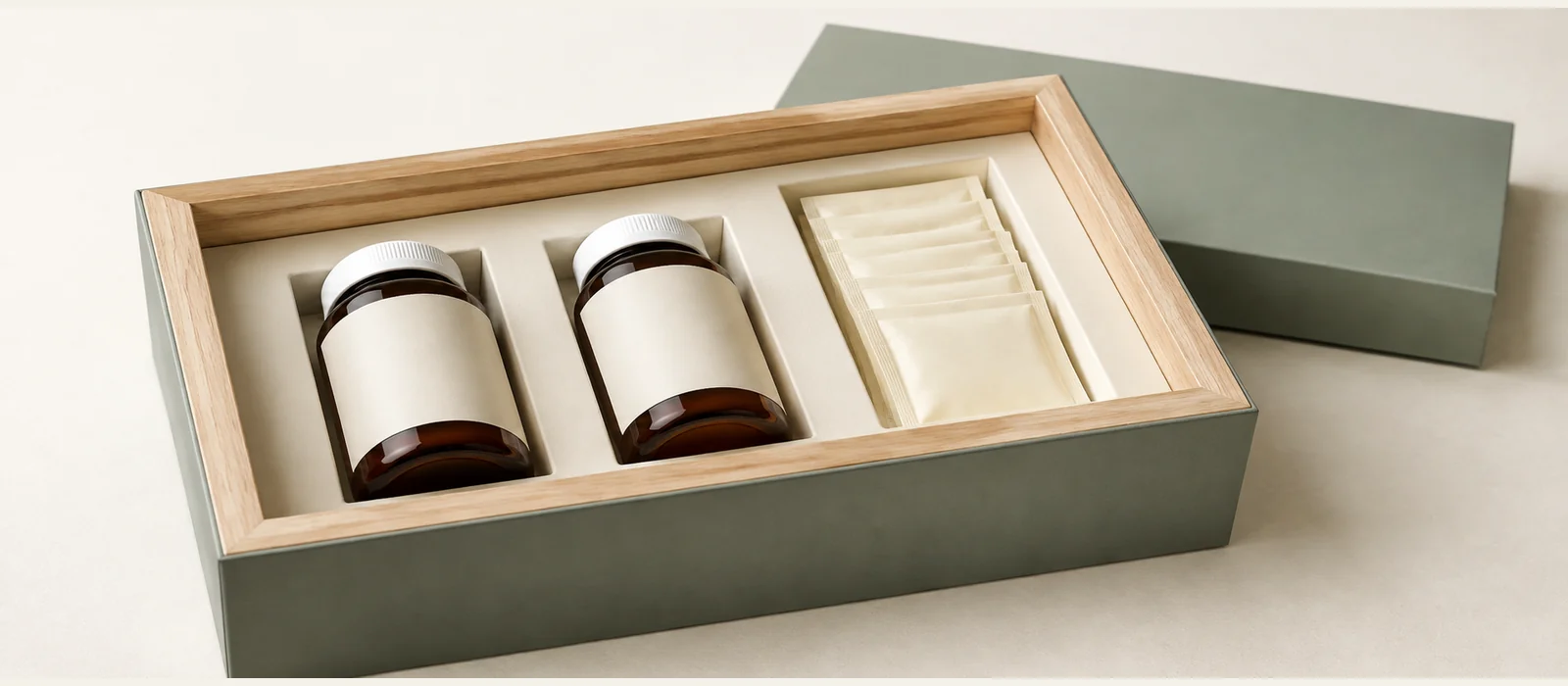

This guide is for supplement brand owners, packaging buyers and gifting teams specifying a wooden outer box around finished primary packs. It covers secondary packaging design—not supplement formulation, dosing instructions or a regulatory approval process. The aim is to make a premium presentation easier to assemble, review and reorder without confusing a good-looking sample with a fully approved product.
Start Supplement Packaging Design with the Actual Selling Unit
“Two bottles and some sachets” is not a usable specification. The bottles may contain different products, use identical-looking labels or change size between suppliers. A sachet bay may look full with several different quantities. Start with the exact assortment that a customer will receive.
Create a kit component list with a distinct identifier for each product, its quantity, the packaging version and any accompanying card. Record whether the wooden box is a one-time launch set, a gift assortment or a shell intended to accept specified future replacement packs. None of these automatically determines how densely the insert should be filled.
For example, a one-time gift still needs comfortable removal. A refillable set still needs positive identification of its approved contents. The distinction matters because a reusable shell may outlast artwork, bottle suppliers and product combinations.
| Decision to confirm | Information to provide | Design consequence |
|---|---|---|
| Assortment identity | Individual product codes and quantities | Assign a location to each component, not just each bottle shape |
| Selling format | Retail set, promotional gift or specified refill system | Review the outer presentation and instructions for that actual use |
| Future compatibility | Named replacement formats, not “all refills” | Decide whether the insert should be replaceable |
| Packing location | Brand facility, contract packer or another agreed party | Establish who supplies, assembles and checks the finished contents |
For available outer-box constructions, see XRX’s wooden supplement boxes. The design work below turns that general packaging direction into a specific sample brief.
Review the Closed Box, Open Box and Removed Bottle
A front-facing logo is only one part of the information layout. Review three views: the closed selling unit, the opened gift set and each primary pack after removal. A deep tray can display a brand name while concealing other information on the same label.
FDA’s general dietary supplement labeling guidance distinguishes the principal display panel from the information panel and explains placement of required statements. Have the brand’s qualified labeling reviewer assess the actual selling configuration, including an opaque outer box. Do not assume that a correctly labeled bottle automatically makes every outer-box arrangement acceptable, or that a decorative insert card replaces required labeling.
For the physical mockup, use applied labels at their intended size rather than a logo pasted onto a rendering. Check whether the bottle can be removed without rubbing the print against a tight edge. Give the artwork reviewer images of all relevant faces, not only the presentation view.
Keep a distinction between “easy for the customer to read after opening” and “approved for the intended market and sale.” A wood-box supplier can help with the first; the second needs the appropriate product-label review.
Fit the Finished Primary Pack, Including Its Vulnerable Edges
Nominal bottle capacity does not define the outside envelope. The same stated volume can appear in different bottle shapes, and the cap may extend beyond the bottle body. Specify the finished pack with its actual closure, applied label and any existing seal or shrink band.
For an upright bottle, review full height and the underside of the closed lid. For a horizontal bottle, review the neck, shoulder and cap as well as the body. A shallow recess that looks clean in a photograph may need another retention approach once the filled pack is handled.
Sachets need a separate check. Use a stack of the intended count and thickness. Arrange it without forcing sealed edges into a narrow corner or folding a pack simply to make the bay look tidy. Confirm that the first and last sachets can be removed without dragging their edges against the insert.
Manufacturer insight: approve the bottle, insert and closed lid together. A cavity sample by itself cannot reveal contact with the lid or an obstruction along the loading path. These are sample-review questions, not universal clearance numbers. Ask the manufacturer to propose a fit based on actual items, then inspect the agreed loaded sample. Do not open primary packs or transfer loose contents into wooden compartments.
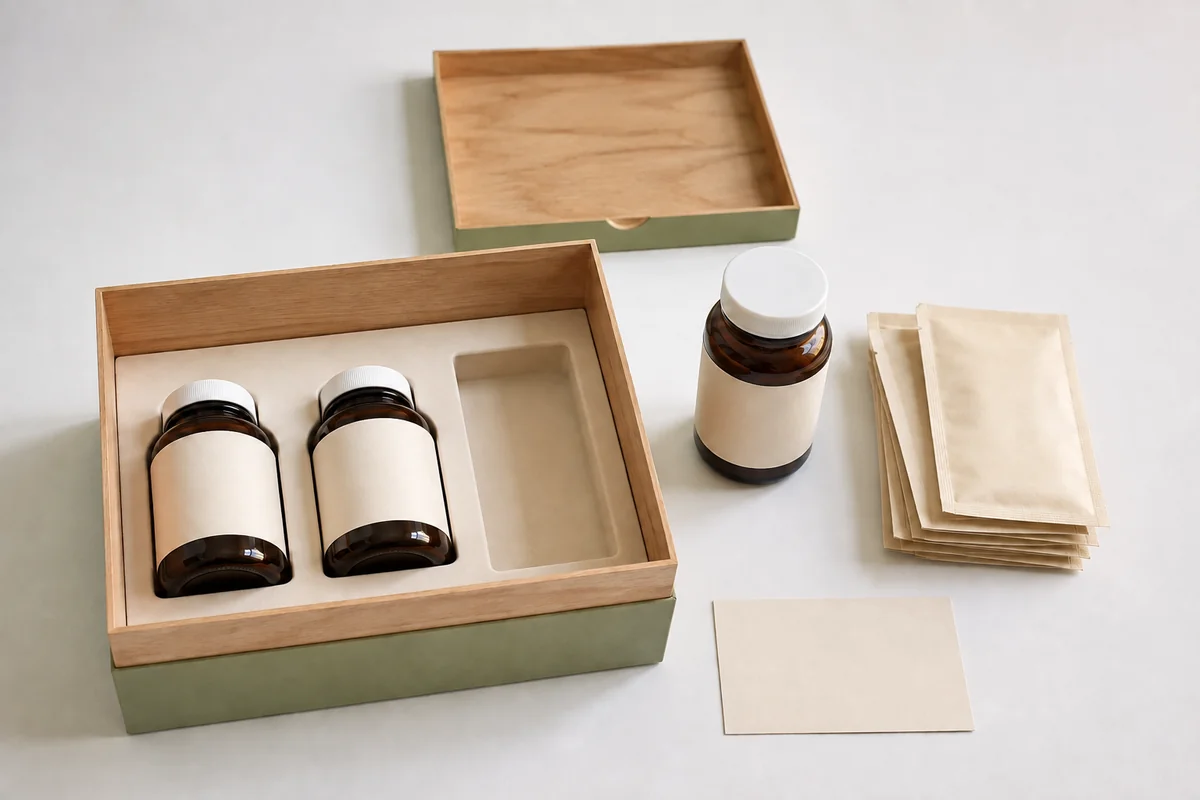
AI-generated concept illustration showing an insert and separate components for layout discussion. Blank labels are illustrative, not a compliant labeling template; the scene is not a verified packing specification.
Make Kit Completeness Visible Before the Lid Closes
A rendering cannot tell a packing operator which similar-looking bottle belongs in a cavity. Neither can it confirm the number of sachets hidden beneath the top pack. Add a practical verification step to the design brief.
The following is an illustrative component list, not a product recommendation or serving schedule. Product A and Product B represent different sealed items chosen by the brand.
| Component | Quantity in this example | Check before closing |
|---|---|---|
| Sealed bottle A | 1 | Match its identifier to the approved component list |
| Sealed bottle B | 1 | Confirm it is B, not a second copy of A |
| Sealed sachet C | 6 | Confirm identity and count before stacking |
| Information card | 1 | Match the approved version and assigned location |
Photograph an approved arrangement and pair it with the component list. The photograph explains placement; the list explains identity and quantity. If a card sits beneath a removable tray, specify when it is added and when its presence is checked. A hidden location needs a check before it becomes hidden.
A total-weight check, if used by the packer, is not a substitute for component identification. Different combinations can have similar weights. Likewise, two filled cavities do not prove that the correct two products were selected.
This is a proposed design-review aid. It does not replace the packer’s applicable operating procedures or the brand’s quality requirements. Agree who performs final kitting and who approves the finished assortment rather than assuming that the wooden-box order includes those services.
Separate Long-Life Branding from Changeable Product Information
MDF is used more frequently across XRX’s overall order mix than solid wood. For a painted gift set, it is a practical starting point to discuss alongside veneer or solid-wood details. Material choice should follow the desired finish, box structure and budget rather than an assumption that the heaviest shell is the best design.
Then divide the artwork into two groups. Long-life elements might include an approved brand mark or decorative pattern. Changeable elements might include the assortment name, product count, variant references or campaign-specific content. The brand should decide what belongs on permanent surfaces after reviewing its intended sales and labeling configuration.
Manufacturer insight: freeze the intended permanent artwork before approving the finishing sample. Moving a logo or changing its application method later can reopen the surface review even when the box dimensions stay the same. A removable sleeve or replaceable card can make some updates easier, but neither is automatically an acceptable location for every required statement. Confirm both the physical placement and the information requirements before choosing engraving, printing or an applied label.
For the interior, consider whether a replaceable tray is worth the added parts and handling. It may let an existing shell accept a newly approved layout, but it also creates another item to identify correctly during assembly. Specify how the tray is seated, lifted and distinguished from alternative versions. Review the available logo and insert options as a coordinated system.
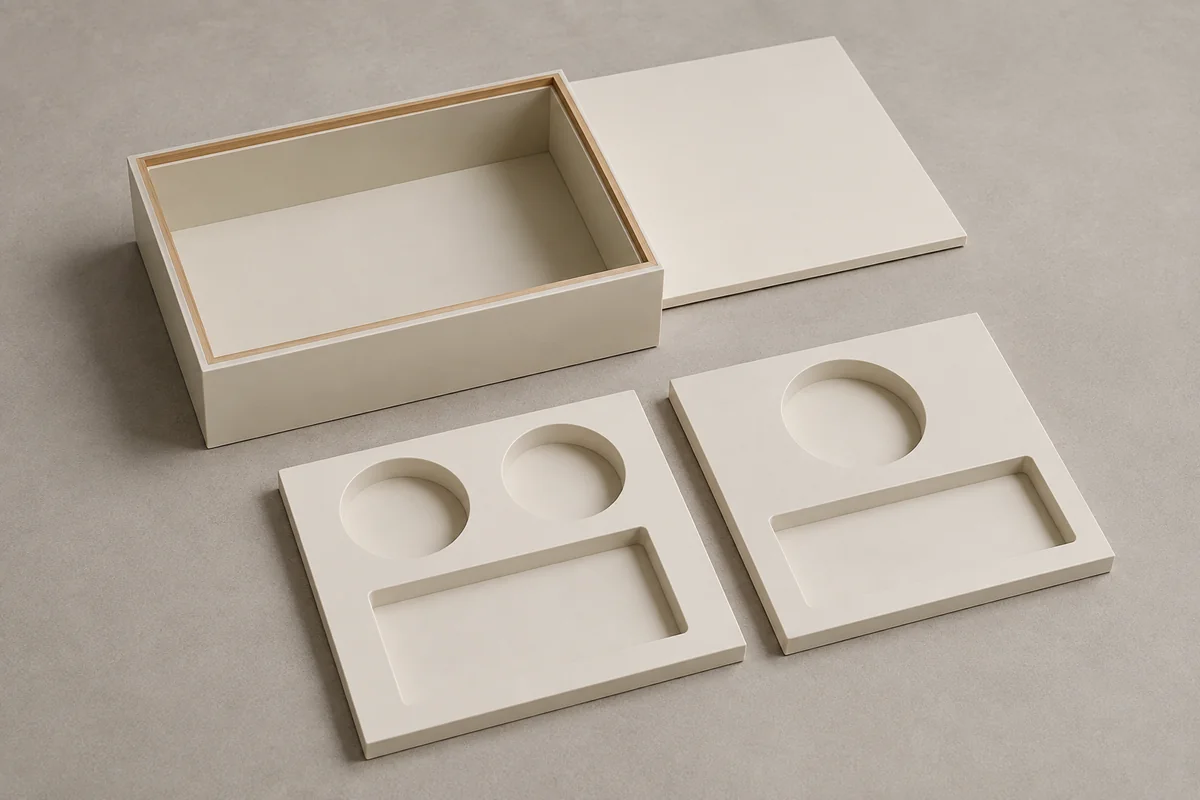
AI-generated concept showing alternative insert layouts. Each layout would require its own dimensional and loaded-sample approval; this does not demonstrate universal refill compatibility.
Recheck the Set When a Refill Changes
“Same bottle” should not be the only release criterion for a new refill. A revised label can alter the intended display face. A taller cap can interfere with the lid. More sachets can change both fit and the assortment described to the customer.
| Proposed change | Physical review | Brand or information review |
|---|---|---|
| New applied label | Check thickness, seams, rubbing and visible orientation | Approve the correct artwork version and placement |
| Different cap or seal | Check total envelope, loading path and lid clearance | Review any affected pack descriptions or imagery |
| Different sachet count | Recheck stack height, access and retention | Update the component list and relevant count references |
| Different product in the same container | Confirm actual pack dimensions and filled weight | Review product identity, statements and assortment records |
If the brand uses GS1 identification and sells a qualifying predefined assortment, composition changes also need an identifier review. Section 2.9 of the GS1 GTIN Management Standard says that changing, adding or replacing a trade item in such an assortment requires a new GTIN. Ask the brand’s inventory owner to review the change; do not simply reuse an old barcode because the wooden shell is unchanged. This is a conditional GS1 rule, not a claim that every gift box everywhere must have a GTIN.
Keep an approved configuration record that connects the shell, insert revision, component list and artwork version. A photograph of a previous gift set is useful context, but it should not authorize a different assortment by itself.
Approve the Loaded Sample Without Adding Unsupported Claims
Before production, walk through the sample in the same order that it will be packed and opened. Confirm the shell and finish, load the specified sealed items, check the component list, add the approved card and close the lid without forcing it. Open it again and inspect removal access and visible contact marks.
Document any changes on the sample record. A substitute bottle used to demonstrate color should not silently become the dimensional reference. If the final primary pack is unavailable, identify what remains provisional rather than calling the whole set approved.
Keep presentation approval separate from shipping validation. A wooden gift box and fitted tray are not automatically a complete shipping system. Agree the intended outer shipping pack and any distribution checks for the finished configuration. XRX’s quality-control page explains the broader manufacturing review points.
Finally, keep claims within the evidence. FDA explains in its dietary supplement questions and answers that it does not approve dietary supplements before marketing. A premium wooden presentation is not a basis for an “FDA-approved” badge. Nor should an untested wooden shell be described as providing child resistance, moisture-barrier performance or extended shelf life.
Frequently Asked Questions
Is this wooden box intended to hold loose supplements?
No. This design approach is for an outer presentation box around finished, sealed primary packs. It does not propose placing loose capsules, powders or other supplement contents directly into wood or an insert.
Can bottles and sachets share one insert?
Yes, a layout can provide separate locations for both. Approve it using the actual closed bottles and the intended sachet stack, including removal access and sealed-edge clearance, rather than relying only on nominal dimensions.
Does a visible bottle logo settle the labeling review?
No. A visible logo does not establish that all relevant information is placed correctly for the selling configuration. Have the brand’s qualified reviewer assess the closed outer box and primary packs as they will actually be supplied.
Does one compartment represent one serving?
No. A compartment is a packaging location, not a serving instruction. Do not derive usage frequency or serving quantity from the number of cavities; any product-use information must come from the brand’s approved information.
Can a reusable wooden box accept every future refill?
No. Compatibility should be limited to specified, approved packs and insert layouts. A change in cap, label, sachet count or product combination can require another physical or information review even if the shell is unchanged.
What should accompany a wooden gift-box quotation request?
Provide the component list, quantities, finished pack dimensions, photographs or samples, target order quantity, finish direction and artwork requirements. State who will perform kitting and identify any dimensions or primary-pack details that are still provisional.
Prepare a Clear Gift-Set Brief
A useful brief connects the visual concept to one identifiable assortment. Send XRX the sealed-pack details, preferred outer-box style, expected quantities and any planned replacement formats. Mark unresolved artwork or container decisions clearly so the quotation and sample review address the same configuration. Contact XRX to discuss the wooden shell, insert layout and sample requirements.