
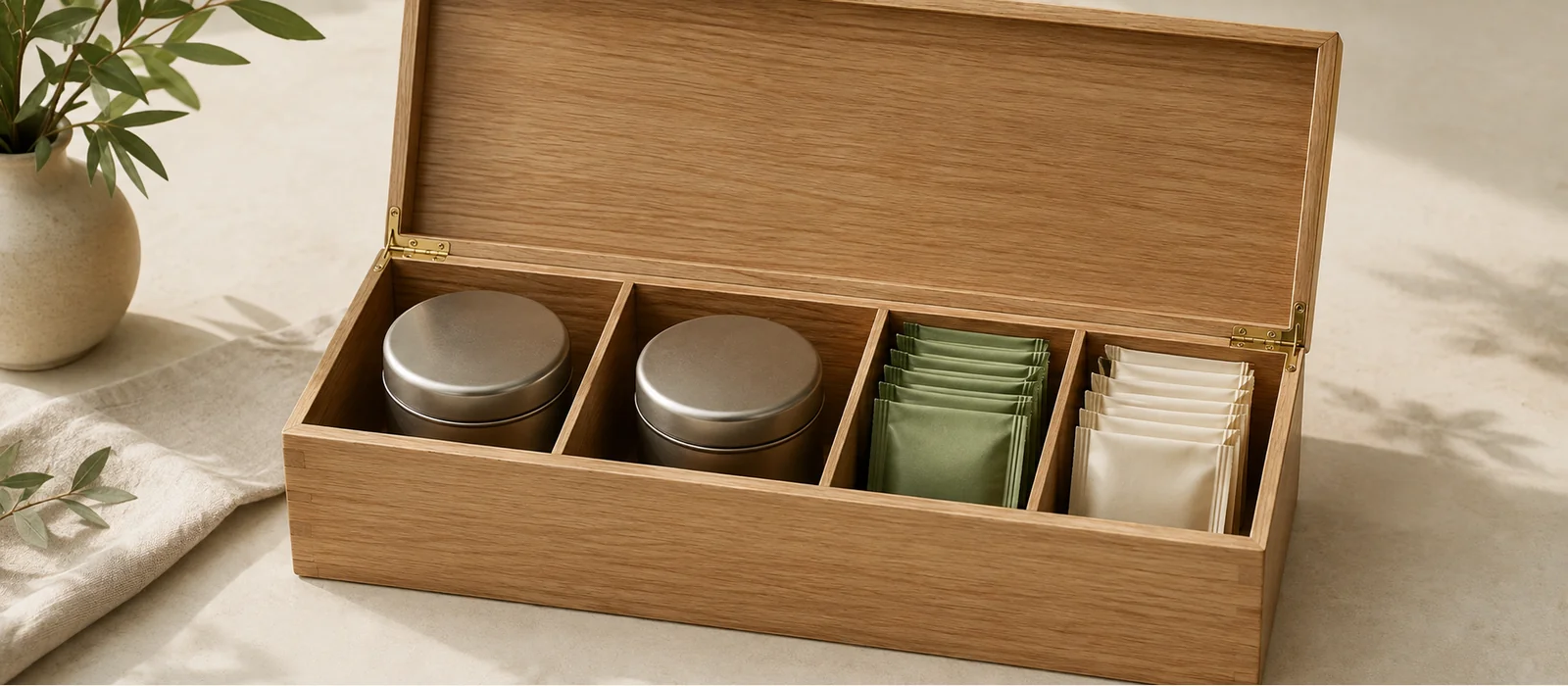

Define Which Tea Box Dimensions You Mean
Three measurements belong on the drawing. The finished package dimensions describe the sachet or closed tin. The clear compartment dimensions describe the usable space inside each cell after dividers and any lining. The outer dimensions describe the completed box, including relevant projecting hardware.
These measurements are not interchangeable. A nominal internal width can still include space occupied by the dividers. Similarly, a quoted box height does not tell you how much room remains beneath the closed lid.
Specify units and orientation on a sketch: width left to right, depth front to back, and usable height from the finished support surface to the nearest obstruction. Identify whether the supplier’s drawing uses those same conventions.
The GS1 Package and Product Measurement Standard provides a framework for communicating nominal package measurements. Its scope is measurement data, not the engineering clearance needed for a custom wooden compartment. Agree the latter through drawings and physical samples; do not turn a data-measurement tolerance into a manufacturing fit allowance.
Plan for the Refill Routine, Not Just the Opening Photograph
A retail gift set and a hospitality tea chest can contain similar sachets but need different layouts. A gift set may have a fixed assortment assembled once. A hotel box may be opened repeatedly, replenished unevenly and used with only a few packets remaining.
| Use case | Layout priority | Question to resolve before sampling |
|---|---|---|
| Fixed retail assortment | Keep the intended set orderly during presentation | Will the buyer remove one item or lift out the complete assortment? |
| Hospitality refill box | Make selection and replenishment straightforward | Which flavors need more capacity, and how will staff identify their positions? |
| Mixed tins and sachets | Give each package format suitable space | Can users grip the tin body without disturbing the adjacent sachets? |
Do not automatically allocate one identical cell to every flavor. If the buyer expects a popular tea to be replenished more often, two cells for that flavor may be more useful than six equally sized flavor positions. This is an operating decision to confirm with the buyer, not a consumption pattern the box manufacturer should invent.
Also check where the box will stand. Record the available counter footprint, room behind an open lid and any shelf-height restriction. A box that fits when closed may still be unsuitable at its intended service location.
Measure the Actual Sachets and Closed Tins
Request production-representative packages, not only artwork or an unfilled wrapper. For sachets, record the finished outline including sealed edges and the intended display orientation. A folded seam or filled portion may behave differently from a flat packaging drawing.
Then load the proposed quantity into a temporary space. Record how much room the row occupies without forcing the packets together. Do not calculate capacity by multiplying the thickness of one compressed sachet: the filled stack, seams and natural spacing must be checked together.
For tins, measure the closed assembly, including a projecting lid rim or any decorative feature. A label stating 50 g or 100 g describes contents by mass; it does not define a universal tin diameter or height. Request the actual tin specification and samples for every format in the assortment.
Mark each reference with a revision or sample identifier. If the tea brand later changes its pouch supplier, closure or tin shape, compare the revised package with the approved compartment before assuming that the old layout still works.
Avoid prescribing a universal extra millimeter allowance. A sensible gap depends on package variation, the intended grip, divider finish and whether the item must remain upright. Record the agreed clear space and acceptance check instead of relying on “a little loose.”
Work Out the Divider Footprint Before the Outer Size
Consider a hypothetical rectangular grid with three columns and two rows. Assume each finished clear cell is 80 mm wide and 60 mm deep, with 4 mm dividers between cells.
The required internal footprint, including those internal dividers, is:
- Width: 3 × 80 + 2 × 4 = 248 mm
- Depth: 2 × 60 + 1 × 4 = 124 mm
These numbers illustrate the calculation only. They are not recommended tea-sachet dimensions or proof that a particular packet will fit. They assume no separate perimeter frame or other intrusion within that footprint.
Now keep the 248 mm internal width but request four columns instead of three. With three 4 mm dividers, each equal clear cell becomes 59 mm wide: (248 − 3 × 4) ÷ 4. More compartments have reduced usable width; they have not created free capacity.
The manufacturer must then develop the shell around the agreed grid. Wall construction, joints, a removable grid’s perimeter frame and any lining can alter the result. Height requires a separate section drawing showing the base, contents and closed-lid clearance. Do not derive it from the footprint calculation.
If exterior size is fixed by a gift sleeve or shelf, start with that constraint and work inward. Be prepared to change the assortment, packet orientation or compartment count rather than quietly reducing every clearance.
Test Full, Half-Empty and Last-Packet Access
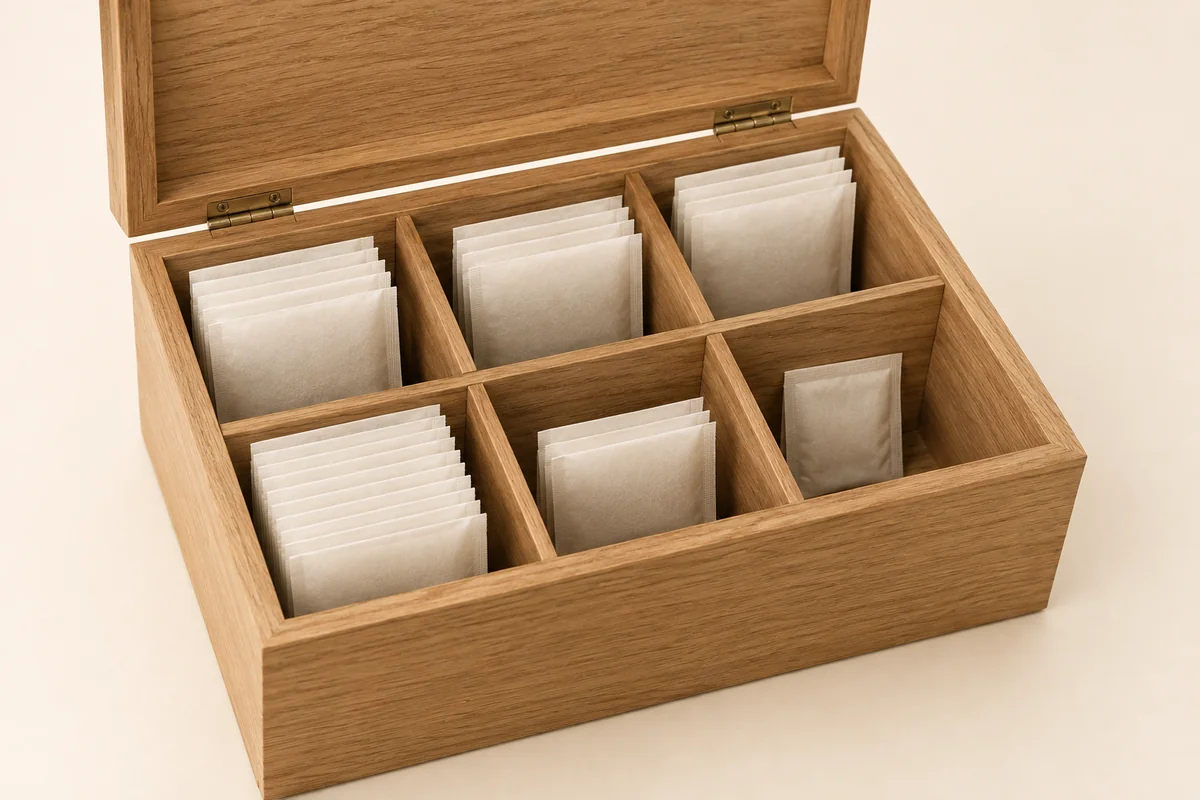
AI-generated design concept showing different fill levels; not a tested capacity specification.
A fully loaded sample answers only one handling question. Remove packets until each cell is half full, then leave a single packet. Check whether the remaining packet can still be recognized and lifted without pinching it against a divider.
| Sample condition | What to try | What to record |
|---|---|---|
| Full intended load | Remove and replace a packet from the middle of a row | Crowding, seam snagging or neighboring packets lifting together |
| Half-full cell | Select a packet after gently repositioning the box as intended | Whether packets lean below the visible edge or migrate between spaces |
| Last packet or tin | Lift the item using the intended grip | Finger access, reachable edges and any need to pull on a removable tin lid |
Repeat the check with adjacent cells occupied. Finger space that exists in an empty demonstration box may disappear when a neighboring tin is installed.
Close and reopen the lid with the complete assortment in place. Check the nearest parts of the hinge, lid lining and closure—not only the center of the lid. Identify any contact or compression that the buyer considers unacceptable, and write that criterion into sample approval.
A low divider can improve access but may provide less separation for tall packets. A taller divider can organize rows but obscure short packets. Resolve that trade-off with the actual assortment rather than choosing divider height solely for visual symmetry.
Choose Fixed or Removable Dividers Deliberately
Fixed divisions suit a layout intended to remain consistent. A removable grid can help when the buyer needs to empty the box, inspect its interior or replace the whole layout. It is not automatically the better specification.
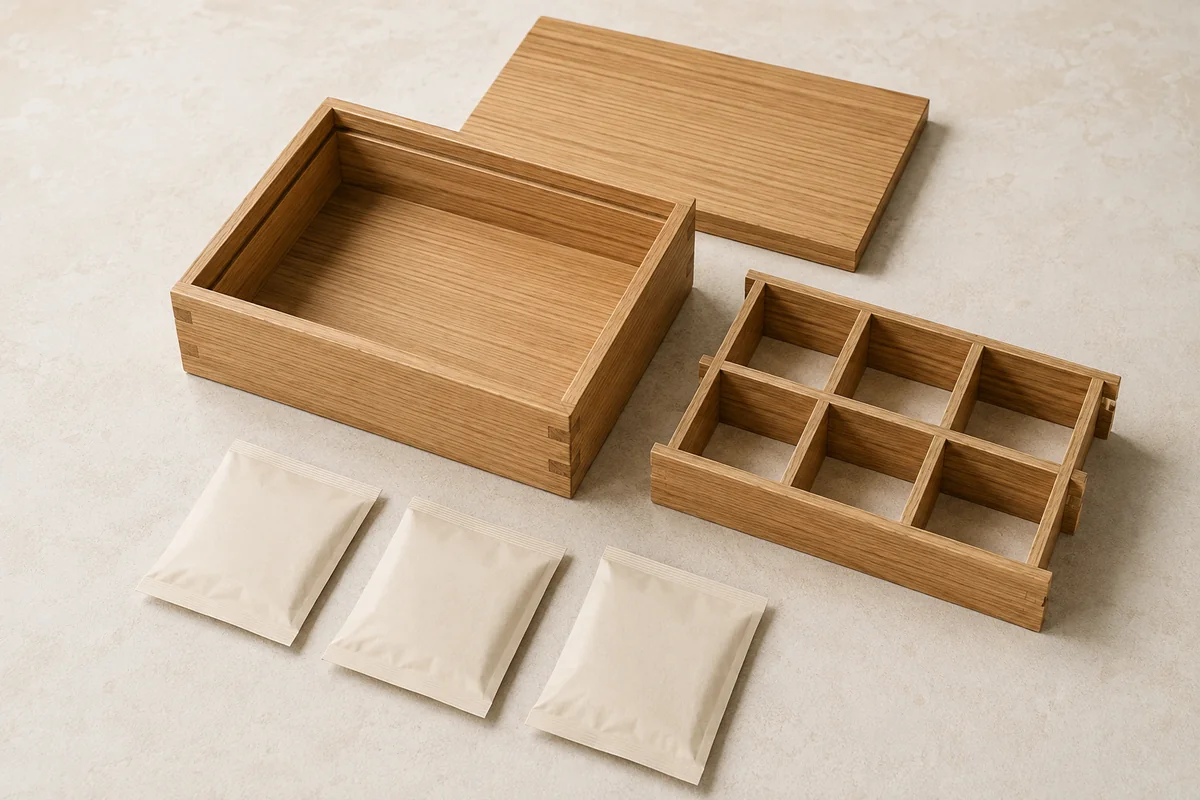
AI-generated removable-grid concept; final joints, locating features and fit require engineering confirmation.
Ask whether the grid lifts out as one assembly or separates into individual pieces. These are different user experiences. For a hospitality project, loose pieces that must be reassembled in a particular order may add an unwanted operating task.
During approval, empty the contents first, remove the grid and reinstall it. Check its orientation, stability and fit in the finished box. If alternate layouts are required, test every approved configuration; “removable” alone does not mean compatible with different tins.
XRX can discuss MDF, veneer and solid-wood constructions alongside divider and finish choices. Select the combination for the agreed appearance, structure and use—not because a material name supposedly guarantees a particular fit. Lining thickness, covered edges and finish build should be represented in the sample rather than added after a bare grid has been approved.
Where a project needs covered inserts, shaped supports or coordinated branding, review logo and insert customization alongside the compartment drawing. Keep logos and labels out of areas that become hidden by the intended contents.
Separate Presentation, Food Contact and Transport Approval
A well-fitting wooden box is not evidence that tea will remain fresh. Ask the tea brand to confirm the performance and intended use of its primary packages. A closed tin or sealed-looking sachet should not be assumed to provide a verified aroma or moisture barrier.
Likewise, “MDF,” “velvet” or “lacquer” is not a food-contact approval. For US applications, the FDA’s guidance on food-contact material components considers substance identity, specifications and conditions of use. Establish the actual contact arrangement and applicable requirements with the responsible packaging specialist; this layout guide does not establish compliance.
Handling approval is also separate from distribution performance. Confirm how the finished set will be packed for shipment. Where an existing ISTA-based test program is used, assess whether a changed package, product or process warrants retesting, consistent with ISTA’s retesting guidance. A successful tabletop retrieval check is not a substitute for transport evaluation.
Send a Layout Brief That Can Be Approved
Provide the manufacturer with a marked sketch, representative closed packages and the intended quantity per cell. Identify both non-negotiable limits and dimensions that may change. This makes a proposed adjustment easier to evaluate.
Include these items in the brief:
- Intended use: gift presentation, hospitality service or another defined routine.
- Package references, revisions and orientation for every sachet and tin.
- Compartment count, assortment allocation and target refill quantity.
- Clear cell dimensions, or permission for the manufacturer to propose them.
- Maximum outer footprint and available lid-opening space.
- Fixed or removable construction, finish and lining requirements.
- Full, partial-load and retrieval checks required for sample approval.
Use the custom wooden box RFQ checklist for the wider quotation requirements. Keep the tea layout drawing as a separate, identifiable attachment so its revision cannot be confused with an older assortment.
Frequently Asked Questions
Is there a standard size for a wooden tea box?
There is no single size that fits every tea assortment. Specify the finished sachets or closed tins, quantity, clear compartments and intended use before agreeing the outer box dimensions.
How do I calculate space for a compartment grid?
Add the clear widths of the cells and the thicknesses of the dividers between them. Calculate depth separately, then account for any perimeter frame, lining and shell construction.
Does a six-compartment box need six different teas?
No. Compartments can hold repeated flavors or different package formats. Allocate space according to the intended assortment and refill routine rather than assuming one equal cell per flavor.
Are removable tea box dividers always better?
No. Removable dividers suit some refill or layout-change needs, while fixed divisions keep a consistent arrangement. Test removal, reinstallation and stability with the proposed finished construction.
Can tea tin weight determine the compartment size?
No. A gram weight does not define tin diameter, shape or closed height. Use the actual finished tin specification and confirm its fit and retrieval with representative samples.
Does a wooden tea box keep tea airtight?
Not by default. Presentation-box dimensions and a closed lid do not prove barrier performance. The tea brand should confirm the suitability of its primary packaging and any claimed storage performance.
Turn Your Tea Assortment into a Workable Layout
Send your sachet and tin references, intended count and available display space to XRX for a tea box layout discussion. We can review the wooden structure, divider arrangement and sample requirements around the actual assortment, so approval covers daily handling as well as presentation.