
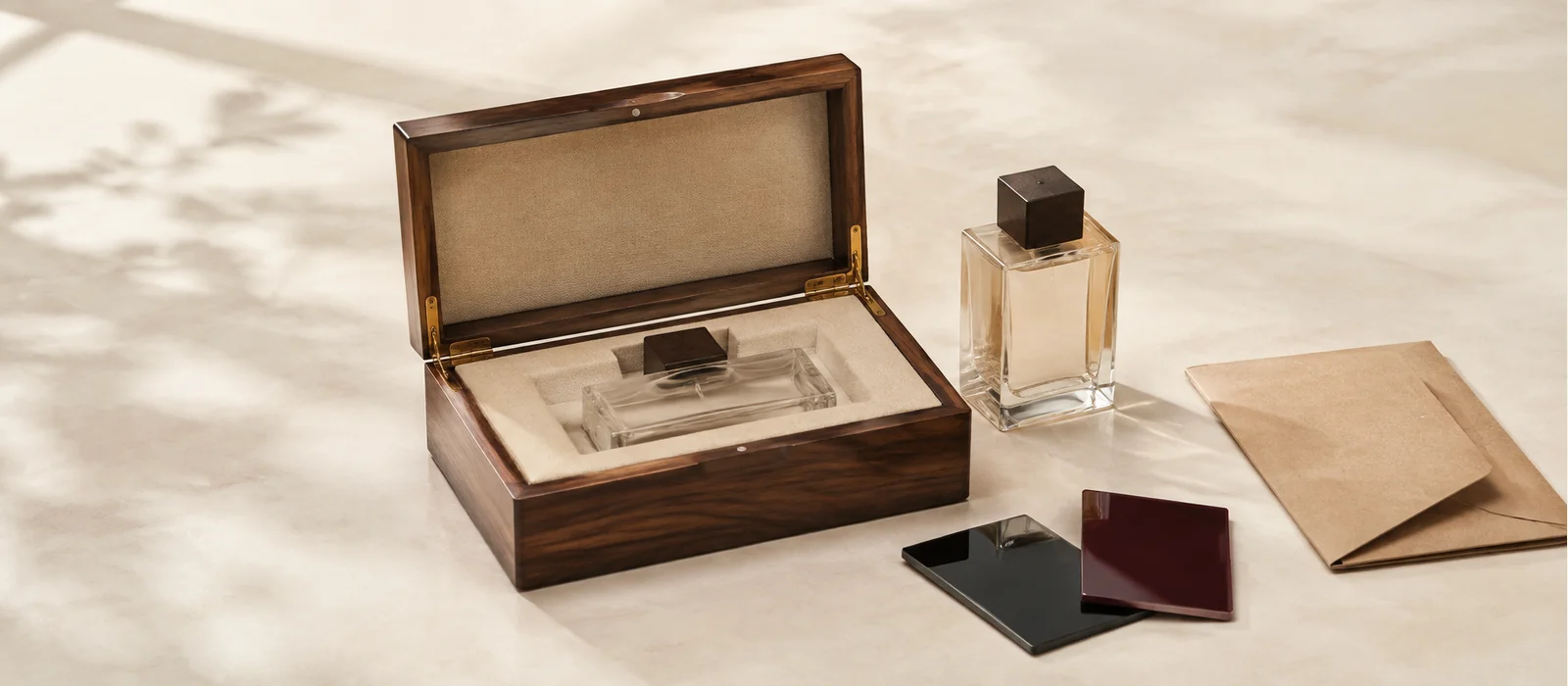

This guide focuses on empty wooden presentation packaging. It does not cover perfume formulation, bottle manufacture or filling. For available box styles and manufacturing options, start with our wooden perfume boxes.
Start Your Custom Wooden Perfume Box Quote with a Scope Statement
Write one sentence that separates the wooden packaging from the fragrance product:
“Please quote empty wooden presentation boxes with fitted inserts for buyer-supplied, capped perfume bottles; bottle supply and filling are excluded.”
Then identify any requested extras: a travel-spray compartment, printed sleeve, booklet space or individual protective carton. Ask whether each is included, optional or outside the supplier’s scope. An illustration showing a bottle inside a box is not confirmation that the bottle is supplied.
Also distinguish the presentation box from the outer shipping pack. Empty boxes delivered to your filling partner and completed fragrance sets shipped onward to retailers are different packaging situations. Specify which journey the quotation covers.
A paperboard perfume carton price is not a reliable shortcut to a wooden-box estimate. The structures, materials and finishing work differ. Compare like-for-like specifications rather than using an unrelated listing as a target.
Decide How Much Certainty You Need Today
You do not need final production drawings to start a useful conversation. You do need to identify the unknowns.
For an early budgetary estimate, send reference images, approximate capped-bottle dimensions, quantities by configuration and a material or finish direction. Mark unfinished decisions explicitly: “cap supplier not selected” is more useful than an apparently final measurement that may change.
For a production quotation, ask the supplier to reference the agreed box drawing, component versions, finish reference, artwork and packing specification. Any remaining assumption should be visible beside the price.
These are practical purchasing stages, not universal legal definitions. Ask each supplier how it describes its offer, how long it remains valid and which changes require review. Do not assume that a document headed “quotation” has resolved every technical detail.
Identify the Bottle Version, Not Just the Milliliters
Nominal capacity does not define the space a bottle occupies. For example, Stoelzle’s standard collection lists its Cube 50 ml, article 534494, at 54.9 mm high with a 46 × 46 mm footprint. Verescence’s Sphere catalogue lists the 50 ml FEA 15 version, reference 13656 01, at 60 mm high and 56.8 × 56.8 mm.
Those are catalogue glass-bottle dimensions, not approved measurements of your complete capped product and not recommended box dimensions. They illustrate why “fits 50 ml perfume” is insufficient for quoting.
Send the assembled bottle’s maximum width, depth and height, its filled weight, and the drawing or sample revision used. Include the final cap, decorative collar and any protruding feature. If the closure is still under development, say so.
Assign one person to release the component files. When a cap changes, send a short change note identifying the old and new versions. Ask the box supplier whether the insert, lid clearance, exterior dimensions, price or sample schedule needs review. A change does not automatically mean a new box is necessary, but it should not pass unnoticed.
For detailed support and removal considerations, use our separate guide to wooden perfume box inserts.
Split the Collection into Packaging Configurations
A fragrance SKU and a box configuration are not necessarily the same thing. Two fragrances may use identical bottles and identical packaging, differing only in the liquid inside. Another fragrance may introduce a larger cap or a travel spray and require a different layout.
Give the supplier a short allocation table. The following is a hypothetical planning example, not an XRX order or price commitment.
| Configuration | Planned quantity | What the supplier should evaluate |
|---|---|---|
| A: single capped bottle | 500 boxes | Base shell, insert and one lid logo |
| B: different capped bottle | 500 boxes | Whether A’s shell can work with a revised insert |
| C: bottle plus travel spray | 500 boxes | Separate cavity layout and possible shell change |
The total is 1,500 boxes, but it is not automatically one production configuration. Request prices for the actual split, not only a 1,500-piece headline rate.
Ask for two routes where appropriate: separate fitted boxes for each configuration, and a shared outer shell with configuration-specific inserts. Sharing a shell may simplify some operations, but it can also leave unnecessary space around smaller bottles or increase packed volume. The supplier should assess the trade-off; do not assume a fixed saving.
If the bottles and all packaging details truly match, identify that too. Avoid paying for unnecessary design distinctions merely because the fragrance names differ.
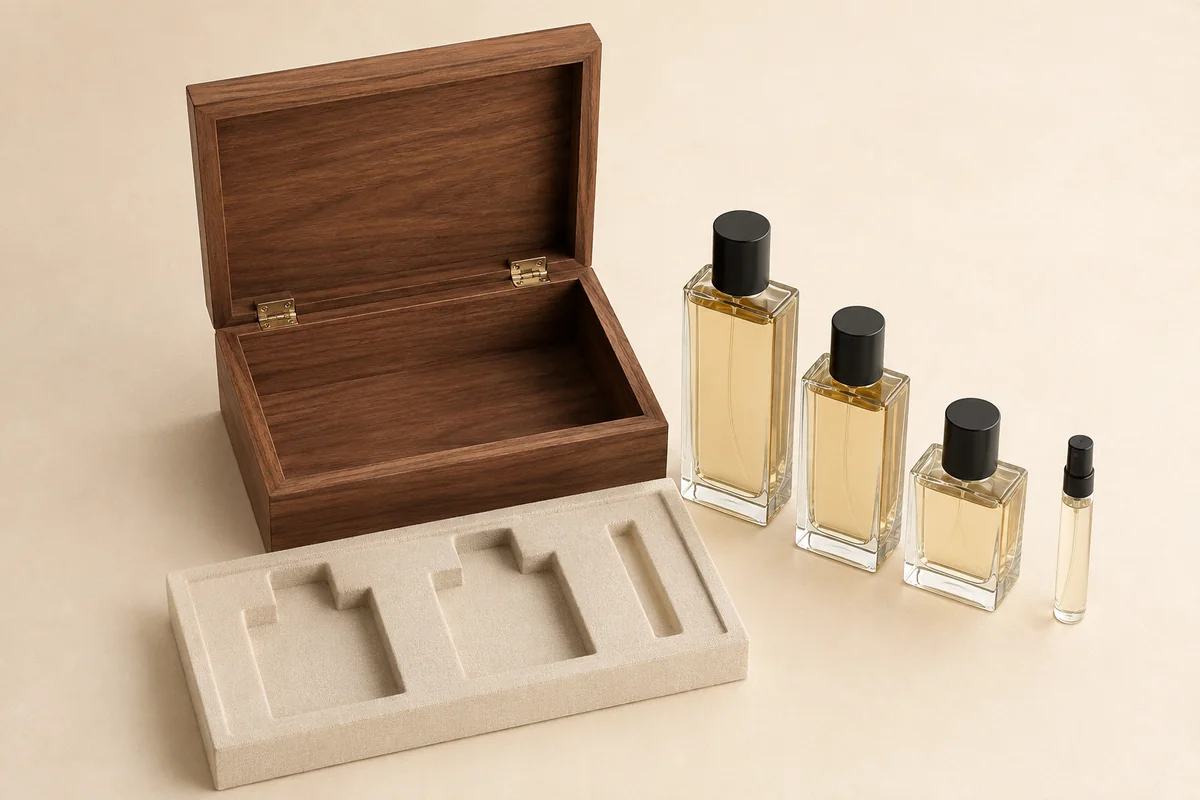
AI-generated design concept illustrating component variation; not a confirmed universal-fit insert or customer order.
Turn “Luxury Finish” into an Approvable Reference
For quotation purposes, “luxury” needs a more specific description. State the substrate, visible surface, finish direction, hardware tone, lining color and logo method.
At XRX, MDF is used more frequently across the current order mix. It can be discussed for painted or veneered packaging, while solid wood remains a project-specific option. A walnut appearance does not, by itself, specify solid walnut: identify whether the requested construction is walnut veneer over MDF or solid wood.
For color-critical work, supply the relevant physical reference as well as the color code. Pantone’s physical-sample guidance emphasizes checking real-world color against a current, unfaded standard rather than relying solely on digital appearance.
For the wooden box, agree the final appearance on the proposed substrate and finish sample. A screen image cannot establish the tactile finish or acceptable grain variation.
Submit artwork with its version, intended size, position and application method. Mark whether lid branding, inside-lid branding and any metal plaque are separate options. If two finishes are still under consideration, request separately labeled alternatives instead of allowing suppliers to interpret one vague brief differently.
Compare the Included Package Before Comparing Unit Prices
Ask suppliers to fill the same comparison schedule. They do not need to disclose confidential factory costing; an all-in unit price with clearly stated inclusions can be perfectly usable.
| Quote element | Information to record | Ambiguity to remove |
|---|---|---|
| Finished box | Material, dimensions, finish and hardware | A bare shell versus a complete box |
| Insert and lining | Layout revision and assembled or loose supply | Insert omitted from the headline price |
| Branding | Method, locations and artwork version | One logo location versus several |
| Optional components | Sleeve, card space or other agreed extras | Optional additions treated as included |
| Individual and shipping pack | Protective packing and carton assumptions | Display packaging confused with transit packing |
| Development charges | Samples, setup and any tooling charges | Costs hidden in, or added twice to, unit rates |
| Commercial terms | Currency, quantity split, validity and delivery basis | Offers based on different assumptions |
Separate initial development charges from recurring order costs. Ask whether a setup fee is charged once, once per design or again on each production run. Sample credits, repeat-order charges and tooling ownership should be confirmed rather than assumed.
For internal comparison, add the configuration subtotals, agreed development charges and non-duplicated packing or freight amounts. Keep exclusions visible. A missing freight figure is “not yet quoted,” not zero.
Our custom wooden box cost guide explains broader cost drivers; this comparison schedule keeps the perfume project’s specific scope aligned.
Ask What Each Sample Is Intended to Approve
Instead of requesting “a sample” without qualification, agree what decision it should enable. The following sequence is a suggested buyer workflow; the supplier may combine stages where appropriate.
A structural sample checks the proposed dimensions, opening mechanism and component arrangement. Use the current physical bottle and cap. Record what is provisional, especially if the sample lacks the final lining or coating.
A finish or decorated sample addresses appearance: surface, color, logo placement, hardware tone and lining. If it uses a temporary bottle or unfinished insert, those elements remain unapproved.
Before production release, bring the agreed structure, components and appearance together in the approval reference. Confirm that the quotation and drawings describe that same configuration. Record the sample identifier, approval date, outstanding exceptions and person authorizing release.
A fit or appearance approval is not transport validation. If your project uses ISTA testing, its retesting guidance requires reassessment through testing when product, packaging or process changes may affect performance. Agree any distribution evaluation separately; this article does not claim XRX certification or a completed test.
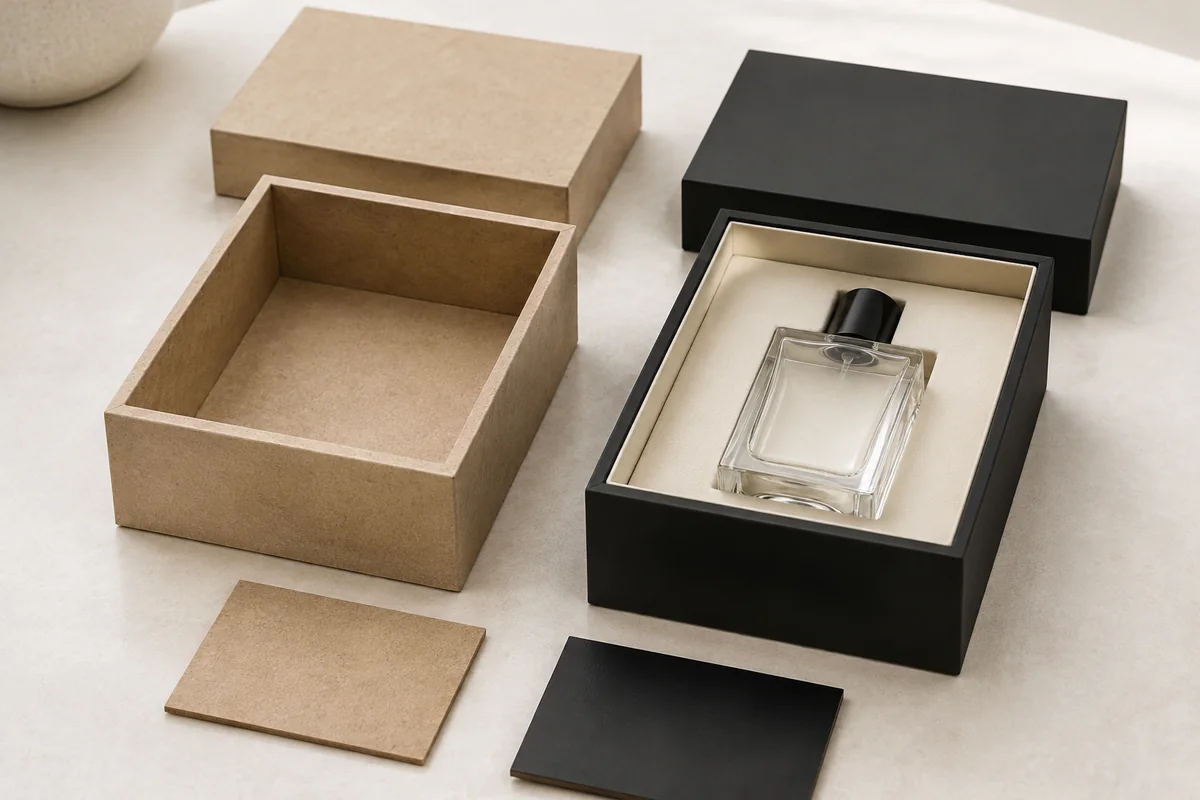
AI-generated comparison of structural and decorated sample concepts; not inspection or testing evidence.
Specify Where the Empty Boxes Must Arrive
Name the receiver: your fragrance filler, consolidation warehouse or another agreed destination. Include the country and precise delivery location when requesting a delivered quotation.
Where Incoterms are used, record the chosen rule, named place or port, and version. ICC’s guidance on commercial contracts explains why these details matter and distinguishes the rules’ allocation of responsibilities, costs and risk from other contract terms. The abbreviations are not merely interchangeable freight-price labels.
Ask which transport, handling and packing costs are included, without adding them again to your comparison total. Confirm payment terms and quote validity separately.
For timing, distinguish sample dispatch, buyer approval, production completion and arrival. XRX’s usual sample reference is 7–15 days and bulk production reference is 35–65 days, subject to structure, finish, quantity and project confirmation. These are not arrival guarantees. A late bottle revision or delayed approval needs a fresh schedule check.
Send a Brief That Makes the Next Reply Useful
A concise first email can contain the scope sentence, configuration table, capped-bottle files, finish direction and destination. Attach only the current versions, and list what is still undecided.
Close with specific requests: “Please identify assumptions, quote each configuration, separate sample/setup charges and confirm which reference is needed before production pricing can be finalized.”
If you have only a visual concept, say that the request is exploratory. If components are ready, provide the release versions and ask for the next sampling step. The aim is a clear decision, not a larger attachment folder.
To discuss your project, send XRX your perfume packaging brief. We can review wooden-box material, structure, finish and insert options against the information available.
Frequently Asked Questions
Can I request a quote before the perfume bottle is final?
Yes. Request a budgetary estimate and identify provisional bottle, cap, finish and quantity details. Ask what must be confirmed before production pricing is finalized.
Does a wooden perfume box quotation include bottles and filling?
Do not assume so. State that the request is for empty wooden packaging and ask the supplier to list included components, optional extras and exclusions.
Can several fragrances share the same wooden box?
Possibly, if their physical components and presentation requirements allow it. Ask the supplier to compare a shared shell with different inserts against separate fitted boxes.
Why should I provide quantities for each configuration?
Different inserts, dimensions, finishes or artwork can require different work. The total order quantity alone does not establish the price or minimum quantity for every configuration.
Is a Pantone code enough to approve the finish?
No. Use it as a color reference, then agree the appearance on a physical sample with the intended substrate and finish. A screen view alone is insufficient.
What happens if the cap changes after sample approval?
Send the new component revision for review. The supplier should assess fit, lid clearance, insert layout, price and timing before you authorize any affected production work.