

This guide is for wineries, importers and gift buyers developing custom wooden presentation packaging. It is not a size chart for bag-in-box wine or a woodworking cutting plan. The aim is a dimensional brief that your purchasing, packaging and logistics teams can interpret the same way.
What Do Wooden Wine Box Dimensions Actually Describe?
A supplier’s “330 × 100 × 100 mm” is incomplete information unless it identifies the measurement level and direction. That number might describe an empty interior, a finished exterior or one individual compartment. Treat these as separate drawing entries:
| Measurement level | What it includes | Buyer decision |
|---|---|---|
| Bottle envelope | Maximum occupied size of the closed, decorated bottle in its intended orientation | Which bottle variants must fit? |
| Clear bottle bay | Available space after fixed dividers and lining are installed | Can the bottle be loaded, supported and removed? |
| Complete interior | Space inside the shell, including areas occupied by dividers and other internal components | How is the set arranged? |
| Finished exterior | Closed box, including relevant projections from hardware or handles | Will it fit the shelf, gift bag or outer pack? |
| Packed carton | The sealed shipment after cushioning and outer packaging are added | What will logistics measure and weigh? |
Ask for a labeled top view and section. Do not assume every supplier uses length, width and height in the same direction, especially when a horizontal layout is wider than it is long along the bottle.
Choose one controlling unit, such as millimetres. If inches are also shown, identify them as reference conversions rather than maintaining two independently rounded specifications.
Start with a Specific Bottle, Not “Standard 750 mL”
Capacity is not an external dimension. Even two bottles in the same broad style can require different space.
For example, the original glassmaker’s catalog lists these two 75 cl bottles:
| Specific bottle model | Published glass height | Published body diameter |
|---|---|---|
| Saverglass TRADITION 2, reference 7654 | 296.00 mm | 81.00 mm |
| Saverglass DIANE, reference 3556 | 311.50 mm | 88.90 mm |
These values come from the technical sections for TRADITION 2 and DIANE. Both are cataloged as Burgundy bottles. They are examples of model variation, not universal dimensions for that bottle family.
The published glass dimensions also do not replace a finished-bottle check. Confirm the actual closure, capsule, wax, decoration and any sleeve supplied with the product. Request the glass supplier’s current drawing and permitted dimensional variation; do not infer a production tolerance from the number of decimal places in a catalog.
Record the tallest and widest approved variants separately. They may not be the same bottle. A box sized around a large shared envelope may accommodate the larger models but leave smaller ones insufficiently supported. That becomes a layout or interchangeable-insert decision, not simply a reason to enlarge every compartment.
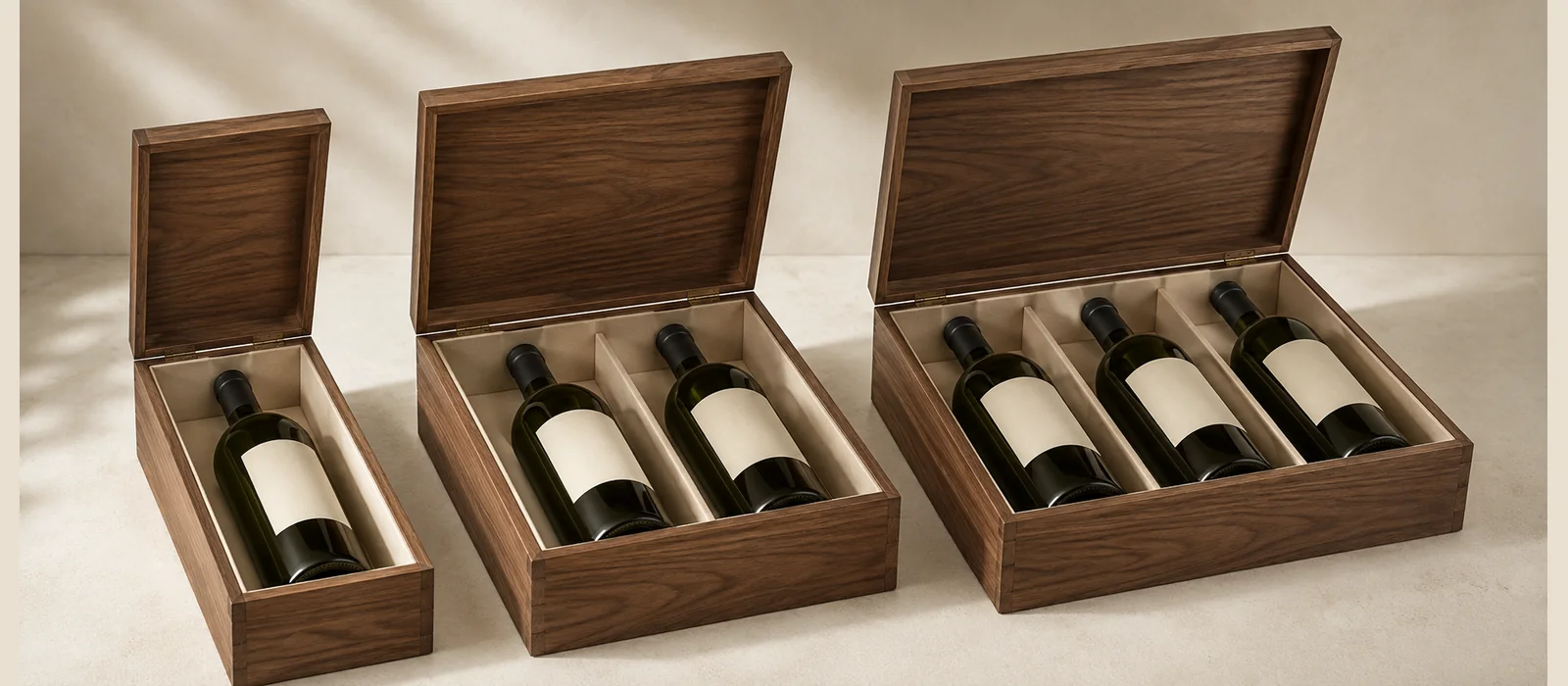
Plan Single-, Double- and Three-Bottle Layouts
For a horizontal single-bottle box, the dimension along the bottle follows its closed overall height. The crosswise space follows its maximum width, plus the selected lining and handling arrangement. Interior depth depends on the bottle’s position above the base and clearance beneath the closed lid.
For two or three bottles placed parallel beside each other, the bottle-length direction does not multiply by the bottle count. Instead, the crosswise width increases to include each bay and the dividers between them. Putting two bottles end-to-end is a different layout and should be drawn as such.
Accessories can change the dominant dimension. A corkscrew compartment beside a single bottle may make a wider shell necessary; a booklet in the lid can consume clearance that appears available in an empty-box drawing. Include every permitted gift-set configuration, including optional accessories when the package is expected to accommodate them.
From XRX’s manufacturing perspective, size, structure, finish, hardware and lining should be reviewed together before bulk production. Choosing a finish after freezing an unfinished interior measurement can leave the dimensional brief incomplete. Specify whether critical measurements apply before or after the internal surfaces are finished.
For the separate decision about support materials and contact points, use the wine box insert and divider guide. Here, the task is to account for the space those components occupy without counting it twice.
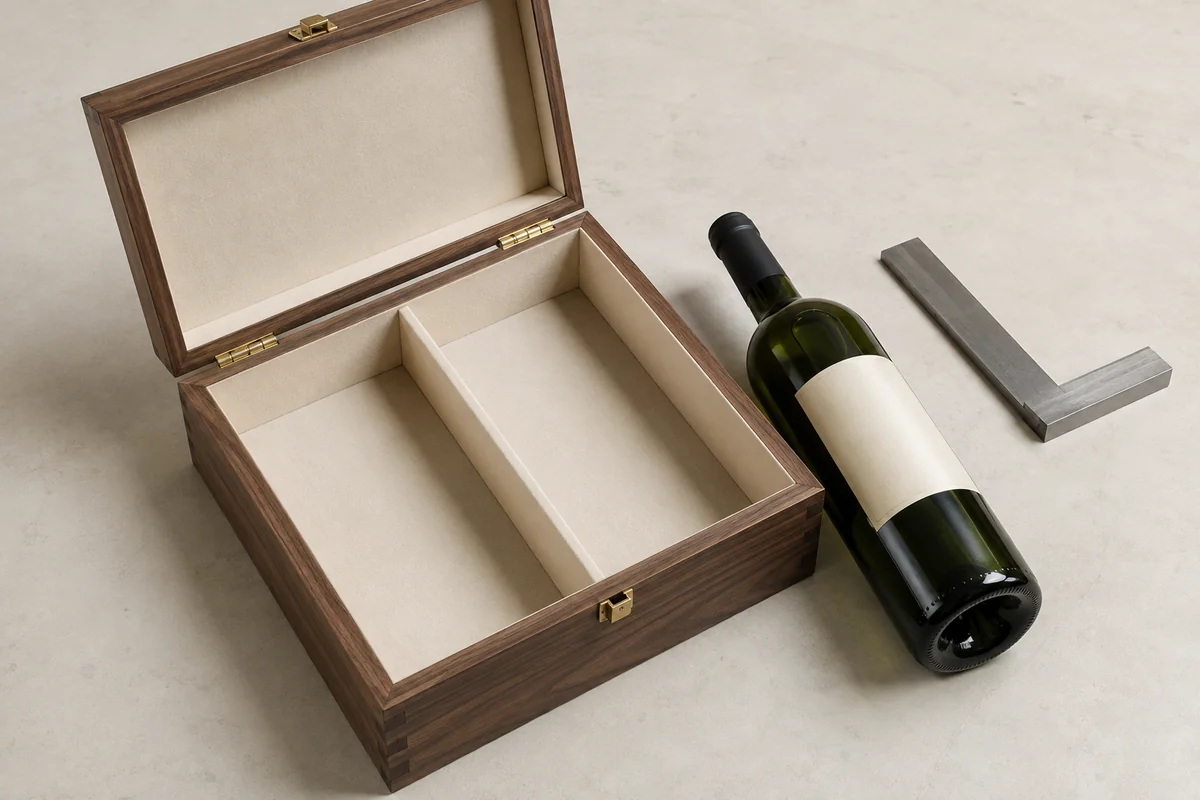
AI-generated design concept. Clear compartment size and overall box size are different measurements; this image is not a scaled production drawing.
A Worked Dimension Example—Not a Standard Size Chart
The following simplified example shows the calculation method. Every allowance and panel thickness is hypothetical, chosen for arithmetic clarity rather than recommended fit, strength or manufacturing tolerance.
Assume a closed bottle envelope of 310 mm along its axis and 80 mm maximum diameter. For a single horizontal layer, choose:
- 10 mm of planning allowance at each bottle end, giving a 330 mm clear length;
- a 90 mm clear bay width, giving 5 mm on each side of an 80 mm bottle;
- 6 mm finished dividers between bays;
- 8 mm finished perimeter walls;
- 100 mm clear interior depth, including an assumed 8 mm support layer below the bottle and 12 mm above it;
- a 6 mm base and an 8 mm flat lid, both applied outside that clear interior depth.
Side-lining thickness is already accounted for in the finished bay, divider and perimeter-wall measurements used here. Do not add it again. Real recessed bases, lid frames, joints and hardware can require a different calculation.
For n parallel bottles in one row:
- Clear length along the bottles = 310 + 10 + 10 = 330 mm.
- Complete internal width = n × 90 + (n − 1) × 6.
- Exterior along-bottle dimension = 330 + 8 + 8 = 346 mm.
- Exterior crosswise dimension = complete internal width + 8 + 8.
- Closed exterior height = 100 + 6 + 8 = 114 mm, excluding projecting hardware.
| Horizontal layout | Complete internal size, mm | Simplified closed exterior, mm |
|---|---|---|
| One bottle | 330 × 90 × 100 | 346 × 106 × 114 |
| Two parallel bottles | 330 × 186 × 100 | 346 × 202 × 114 |
| Three parallel bottles | 330 × 282 × 100 | 346 × 298 × 114 |
The order in this table is along bottle × across row × depth/height. These are fixed drawing directions, not a claim that the first number must always be the longest side.
Notice that the double box is 202 mm across, not twice the single box’s 106 mm. Two separate boxes have four perimeter walls across their combined width; one shared box has two outer walls and a center divider.
Use this method to challenge unclear quotations, not to place an order from these numbers. The assumed gaps do not establish restraint, finger access, cushioning performance or a fit approval. Replace them with the actual design and confirm the resulting sample.
Six Bottles: Choose Orientation Before Comparing Sizes
“Six-bottle wooden box” can describe substantially different products. Agree the arrangement before asking suppliers to match a footprint.
| Six-bottle arrangement | Main dimensional consequence | Presentation trade-off |
|---|---|---|
| Six horizontal bottles beside each other | Broad, relatively shallow footprint; width includes six bays and five dividers | All labels can face upward, but the lid and counter space become larger |
| Six upright bottles in a two-by-three grid | Footprint follows the bottle cross-sections; height follows closed bottle height | Bottle tops are accessible; tall walls and neighboring bottles can hide labels |
| Two horizontal layers of three | Footprint follows one three-bottle layer; height includes two loaded layers and their separation | Lower bottles are hidden until the upper contents or tray are removed |
A layered horizontal box does not need twice the bottle’s overall length as its height. Its stacked height follows the bottles’ cross-sections, supports, separator and access arrangement. This distinction matters when comparing sketches that use different orientations.
Check the open-box footprint as well as the closed dimensions. A sliding lid needs room to withdraw; a hinged lid needs opening space; a removable loaded tray needs somewhere to be placed. A compact closed box may still be inconvenient on a narrow tasting counter.
The bottles themselves contribute the same weight across layouts if the contents are identical, but the complete loaded boxes need not weigh the same. Shell panels, trays, dividers and hardware differ. Have the actual loaded configuration weighed rather than deriving a handling claim from bottle count.
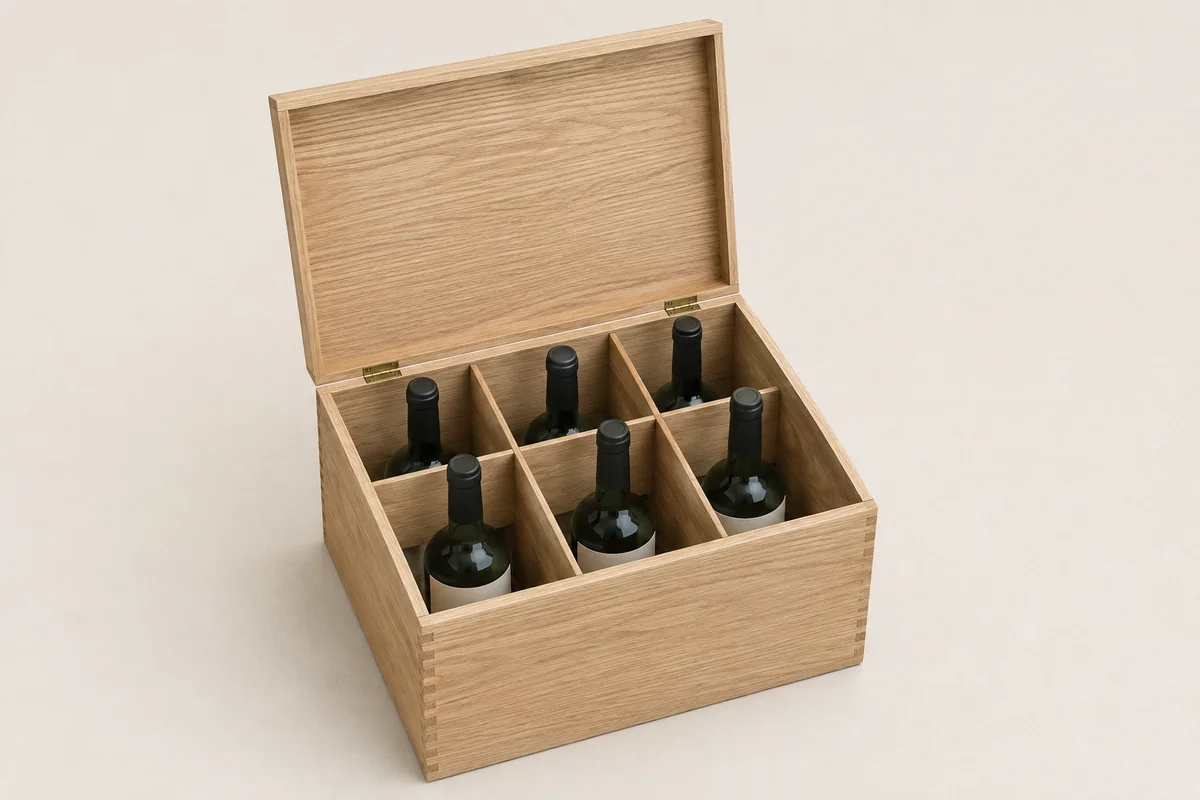
AI-generated design concept showing an upright six-bottle arrangement. Dimensions, access and the complete shipping pack require project-specific approval.
Check the Exterior Against the Actual Shipping Pack
The wooden box is not necessarily the item whose dimensions appear on the freight quotation. It may sit inside a protective sleeve, cushioning and a corrugated carton, or several empty boxes may be consolidated for delivery to the bottling location.
Specify whether XRX is shipping empty packaging or whether the later distribution leg carries filled, closed bottles inside the packaging. These are different contents and handling duties. A successful empty-box shipment does not validate the customer’s filled gift set.
Measure the final sealed parcel. For irregular shapes, FedEx’s parcel-measurement guidance describes measuring the smallest enclosing box. This is why projecting components and the outer packaging cannot be ignored.
FedEx also explains that dimensional-weight pricing compares package space with actual weight. Obtain a quote using the actual service, route, packed dimensions and weight; this guide does not prescribe a universal divisor or promise savings from a particular layout.
Keep dimensional approval separate from transport evaluation. ISTA’s 2018 selection guidelines explain that understanding the distribution environment helps identify hazards and select an appropriate laboratory protocol. The reference supports that planning principle, not a claim that these example boxes have passed a test or meet current carrier acceptance requirements.
Turn the Measurements into an Approval Brief
Before sampling, send a dimension schedule with these entries:
- Contents: bottle model or drawing revision, approved variants, closure, decoration and accessories.
- Arrangement: bottle count, orientation, row/layer layout and required label visibility.
- Fit dimensions: finished clear bays, complete interior and how internal components consume space.
- External limits: closed size, projections, shelf restrictions and space needed to open the box.
- Construction inputs: material, finish, lining, base/lid arrangement and hardware.
- Distribution scope: empty or filled delivery, units per carton and relevant outer-pack restrictions.
- Approval controls: which dimensions are critical, permitted variation to agree with the supplier, and drawing/sample revision.
State which constraints cannot change. If an existing carton imposes a maximum exterior but the bottles require more interior space, the supplier must resolve that conflict openly. Quietly reducing a bay or removing protection is not an acceptable dimensional adjustment.
A useful second manufacturing consideration is to approve the finished assembly, not only unfinished cut parts. XRX’s confirmed production approach aligns structure, material, finish, logo, hardware and lining before bulk production; the size record should describe that same assembly.
During sample review, load the intended variants, close and reopen the box, remove the contents and check any accessory configuration. Compare the measured result with the drawing. When a bottle, lining, panel or closure changes, review the affected dimensions rather than assuming the old approval still applies.
Use the wooden wine box capability page and Wine & Spirits product collection to establish a structural direction. Then send the bottle data and dimensional constraints for a project-specific review.
Frequently Asked Questions
Is there a standard size for a wooden wine box?
Treat a listed size as specific to that design, not as proof that every bottle of the stated capacity will fit. Confirm the intended bottle model, orientation, finished clear interior and closed exterior before ordering.
What dimensions should I provide for a 750 mL bottle?
Provide its closed overall height, maximum width or diameter, relevant shoulder profile, decoration and permitted dimensional variation. Include the actual closure and accessories. A current bottle drawing and representative samples are more useful than capacity alone.
Is a double-bottle box twice as wide as a single-bottle box?
Not necessarily. A shared box usually replaces two adjacent outer walls with a divider, while bay size and construction may also change. Calculate both bays, the divider and the two perimeter walls rather than doubling an exterior measurement.
How should six wine bottles be arranged in a wooden box?
Choose between a horizontal row, an upright grid or separated horizontal layers according to display space, label visibility, removal access and shipping needs. Specify the orientation explicitly because each arrangement produces a different footprint and height.
Do external dimensions tell me whether my bottles will fit?
No. External measurements include the shell and may include projections. Bottle fit depends on the finished clear interior after dividers, lining, supports and lid components are installed.
Does a correctly sized wooden gift box qualify as a wine shipper?
Not automatically. Dimensional fit does not establish transport protection or carrier acceptance. Review the complete packed system, actual contents, route and applicable service requirements separately.