


Choose the closed-box presentation first
Write one sentence describing the intended presentation. For example, a collector should see the arranged items while the box stays closed, or a gift recipient should first see the decorated exterior and then reveal the contents. Those are different design briefs even when the outer box dimensions are identical.
A window makes the interior part of the closed-box appearance. Product orientation, empty spaces, lining seams and any paperwork visible through it need deliberate positions. Decide whether the whole collection must be visible or whether a smaller window should frame one feature. Neither objective requires the largest possible opening.
An opaque lid separates exterior and interior presentation. It can carry a continuous illustration, visible wood grain or another approved finish, while the product is revealed when opened. The inside still needs a considered layout; hiding it when closed does not excuse poor fit or unfinished details.
| Buyer requirement | Glass or window lid | Opaque panel lid |
|---|---|---|
| See the actual contents before opening | Plan a clear view of the intended items | Requires opening or a separate product image |
| Use a continuous exterior illustration | Allocate artwork around or on the agreed window area | Offers a continuous panel for the composition |
| Keep supporting documents out of the first view | Locate them outside the visible area | Keep them within the planned opening sequence |
| Approve the closed presentation | Check reflections, frame coverage and interior arrangement | Check exterior finish, artwork and lid alignment |
| Specify the finished construction | Identify window panel, frame and retention details | Identify panel construction, finish and edge details |
Use this table to select a direction, then request a drawing for that direction. A photograph of another box can communicate appearance, but it does not define the dimensions or construction of your custom order.
Separate outer dimensions from the viewing opening
The outside lid size is not the visible window size. Ask the wooden-box manufacturer to show the outer dimensions, the clear opening and the position of the product inside. The clear opening means the unobstructed area through which the contents can be viewed, rather than the full size of the transparent panel hidden partly under the frame.
Consider a simplified, hypothetical top view. A lid measuring 240 by 180 mm has a frame extending 30 mm inward on each side. Its clear opening is therefore 180 by 120 mm. A centered product footprint measuring 190 by 100 mm extends 10 mm beyond the opening’s width in total, or 5 mm on each side. It could fit inside a sufficiently large box while still being partly hidden by the frame.
These numbers illustrate the difference between fit and visibility. They are not recommended frame widths or manufacturing clearances. The actual frame, panel retention and interior construction must be designed for the selected box.

Also review the view from the customer’s likely position. A straight-down drawing cannot show every obstruction caused by a thick frame, raised contents or an angled sightline. For a counter display, examine the closed sample from the front and above. For a gift presentation, check it while held in the intended orientation.
Mark which features must remain visible: a watch face, a coin design, a bottle label or the arrangement of a coordinated set. Give these features priority over a generic instruction to make the window bigger. Keep the detailed fit requirements in the wooden-box dimensional tolerance guide and use the viewing drawing to answer the separate appearance question.
Name the transparent panel instead of ordering “clear”
A clear-looking panel in a reference image does not identify its material. If the brief calls for glass, state that explicitly and ask the supplier to identify the proposed type, thickness, edge treatment and retention method. If a plastic alternative is proposed, treat it as a separately identified option rather than an invisible substitution.
The Canadian Conservation Institute’s guidance on glazing materials distinguishes glass from plastic glazing and discusses properties such as reflections and ultraviolet filtering separately. Its subject is framing works on paper, not wooden packaging. The useful purchasing distinction is that transparency alone does not specify those additional properties.
For your box, ask which characteristics are required and how they will be confirmed. These might include the accepted tint, appearance of reflections, visible edges and any specifically requested optical treatment. Do not copy a picture-framing thickness into a wooden-box drawing without a construction review.
Record how the panel sits in the wooden frame and what is visible from inside the open lid. Agree whether retaining parts, joints or adhesive lines may be visible and where. Request care instructions for the actual panel and surrounding finish, rather than choosing a cleaner from the generic word “glass.”
If the supplier offers two panel materials, compare complete samples or clearly scoped sample stages. A loose sheet can help assess its appearance, but it cannot demonstrate the finished frame, attachment or lid operation.
Treat light control as a separate product requirement
Choose the window because you need visibility, not because “glass” sounds like a preservation specification. The Canadian Conservation Institute explains that ultraviolet filtering does not remove the need to control visible-light exposure for light-sensitive collections. That is a limited preservation principle, not a test result for the contents of your wooden box.
If your product has particular light-exposure requirements, obtain them from the responsible product specialist and include them in the brief. Then ask for evidence relevant to the proposed panel and completed arrangement. A statement that the panel filters ultraviolet light does not answer every question about the product’s display conditions.
An opaque lid removes the direct view through that panel when closed. It still does not establish the box as an airtight, humidity-controlled or long-term preservation system. Keep those requirements separate from the visual decision and avoid putting unverified protection claims on the packaging.
Allocate the artwork before fixing the frame
For a window lid, decide where the brand message belongs: on the wooden border, another exterior face, the interior lining or an agreed decoration area on the panel. If a mark is placed over the window, show how much of the product it obscures. A large logo and a fully visible product can compete for the same area.
For an opaque lid, use the full composition deliberately. A continuous print, a restrained mark over coated wood grain and an inset decorative detail create different effects. Confirm the intended coverage and relationship to the opening seam rather than describing all of them as “premium branding.”
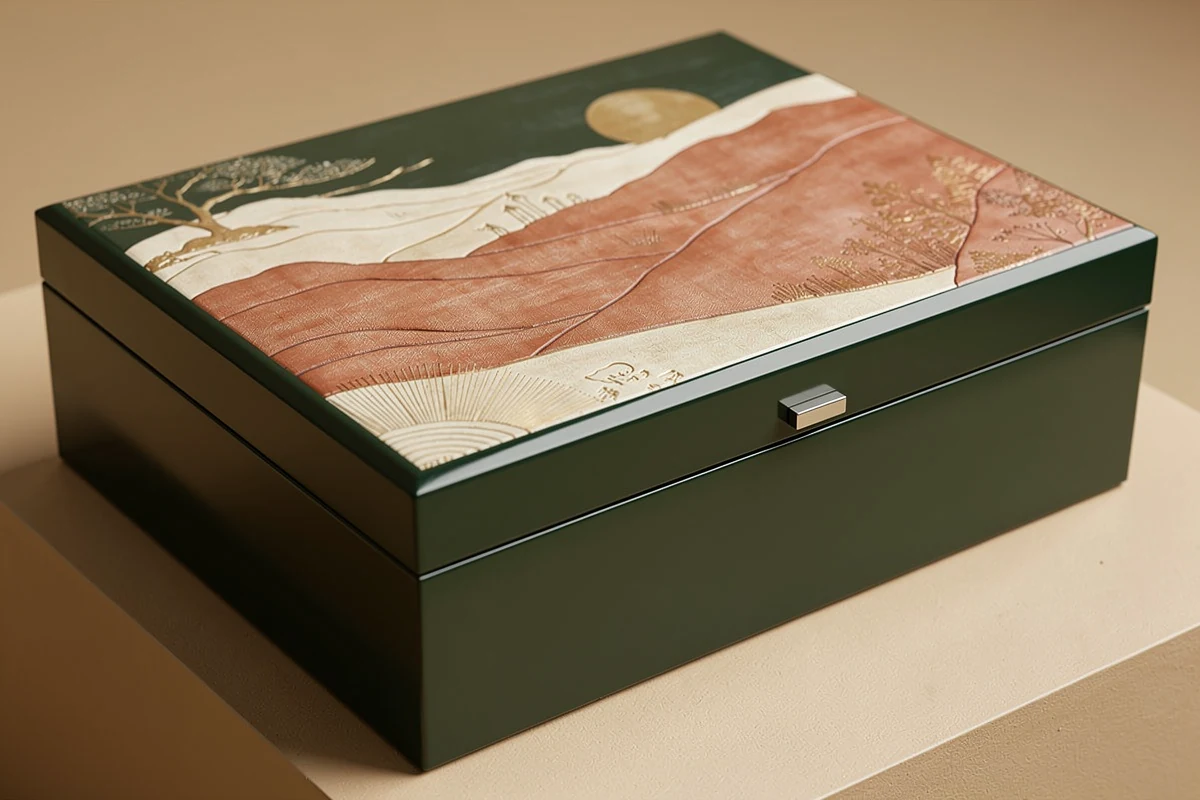
At XRX, custom wooden-box projects bring structure, material, finish, branding, hardware and lining into the same specification. For this lid decision, that means reviewing the frame and artwork alongside the interior layout instead of approving each from unrelated reference images.
Neither format is automatically more expensive or more luxurious. Ask for comparable quotations covering the proposed construction, panel, decoration, lining, hardware, quantity and packing. A plain window design and a heavily decorated opaque lid are different scopes, so their prices do not isolate the cost of the window alone.
Approve the lid as part of the finished wooden box
Changing an opaque lid to a framed window is an assembly change. Ask the manufacturer to review the frame, panel retention, hinge arrangement, opening support and closure with the proposed materials. Do not assume hardware selected for an earlier lid remains suitable merely because the outside dimensions match.
Use a short three-view review for the sample:
- Closed and viewed from above: confirm the intended visible area, artwork, frame alignment and product arrangement.
- Closed and viewed from the intended customer position: check whether reflections or the frame obscure important features.
- Open and used as intended: review access, lid movement, visible retention details and clearances around the contents.
Record which product or representative dummy was used and how it was positioned. Check the empty and loaded configurations where each matters. A neat empty box does not demonstrate the intended view of the actual product.
Agree acceptance observations before approval. Identify the areas to examine for marks, visible residue, unwanted gaps or finish differences, and record the approved reference. If a sample needs correction, connect the correction to the affected drawing or specification rather than approving an unexplained replacement photograph. The golden sample checklist provides the broader approval record.
Keep transport requirements separate from this appearance review. Neither a closed lid nor a successful opening demonstration establishes the performance of the packed shipment. If distribution protection is required, define the complete packing arrangement and the evidence needed for it.
For an inquiry, combine the chosen lid direction, viewing drawing, product layout, surface references and sample requirements with the custom wooden packaging brief. When you contact XRX, identify any unresolved choice so alternatives can be reviewed before the specification is fixed.
Frequently asked questions
Does a solid lid mean the box must use solid wood?
No. Here, solid lid means an opaque panel without a viewing window. Specify its actual substrate, visible surface and finish separately; the phrase alone does not identify solid timber, MDF or another construction.
Is the glass panel size the same as the visible window size?
Not necessarily. Part of the panel may sit behind the frame or retaining details. Ask the drawing to identify the clear viewing opening separately from the panel and outside lid dimensions.
Can a glass lid be assumed to protect the contents from light?
No. Identify any required panel treatment and the product’s exposure requirements separately. Transparency does not establish ultraviolet filtering, and ultraviolet filtering does not eliminate every effect of visible light.
Can the same hinges be used after changing the lid design?
Have the manufacturer review the complete revised assembly. Confirm frame construction, panel retention, movement, support and closure rather than assuming that equal outside dimensions make the lids interchangeable.
Which lid should carry a large exterior illustration?
An opaque lid offers a continuous panel, while a window lid requires deliberate allocation of artwork around or over the viewing area. Choose by how the finished box should look and what must remain visible, then approve the assembled sample.