
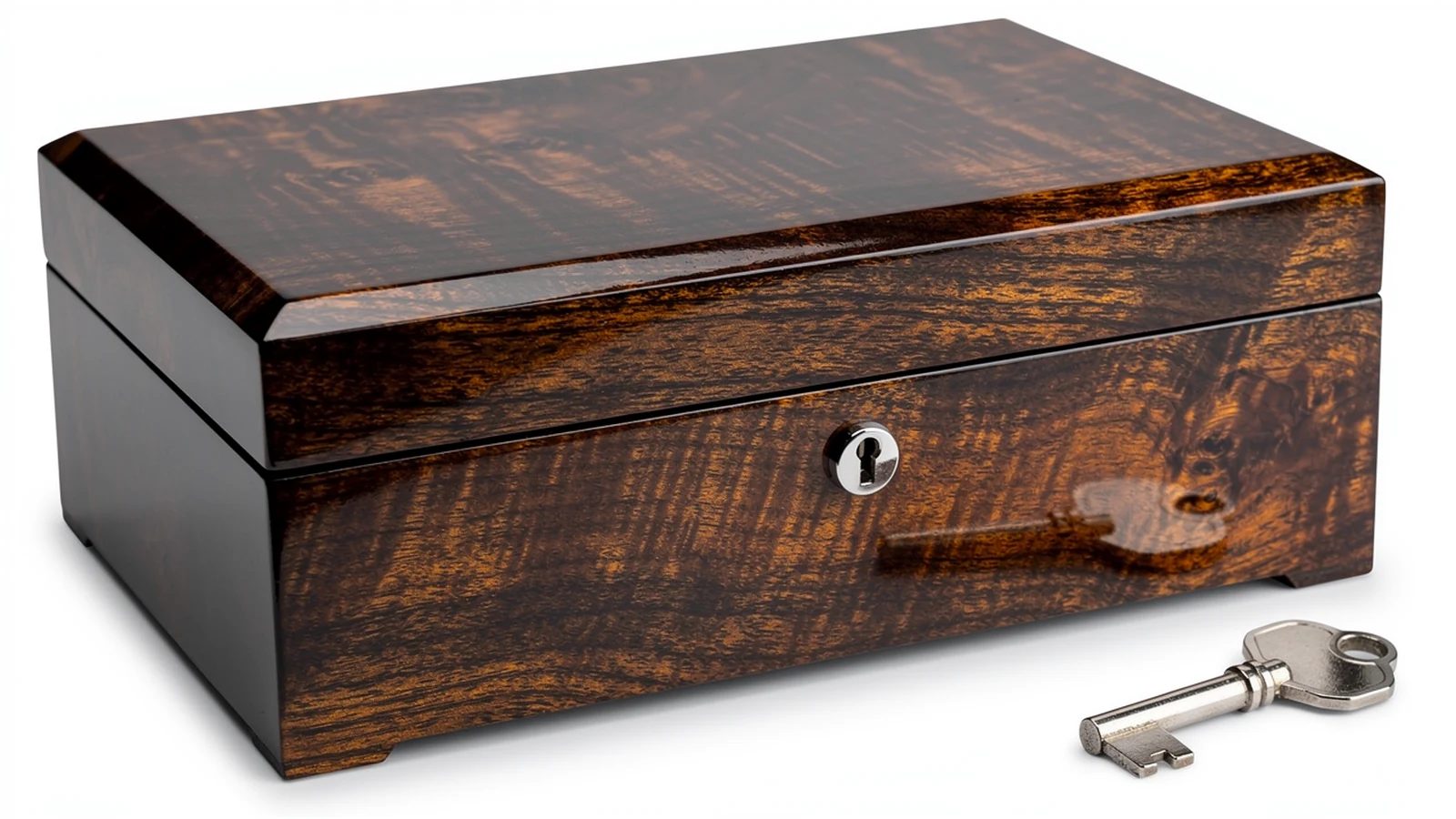

Decide whether the order needs a lock or a non-locking closure
Start with the intended opening action. Should anyone receiving the box be able to open it immediately, or should opening require the supplied key? Is the key part of the gift presentation, retained by store staff, or assigned to a particular recipient? Put that requirement ahead of the hardware photograph.
A non-locking clasp can retain a lid without providing keyed access. A clasp incorporating a lock is a different configuration, so avoid treating every clasp as either automatically lockable or purely decorative. Ask the supplier to identify what the selected fitting actually does. Likewise, a magnet closure is not a key system; the wooden-box magnet guide covers that separate closure decision.
If theft resistance is an essential requirement, define it separately and request applicable product-level evidence. UL’s anti-theft testing overview describes standards-based evaluation for security equipment, including burglary-resistant safes. A keyhole on a wooden presentation box does not establish that the complete box has passed such evaluation.
Keep the product description consistent with the evidence. You can specify a key-operated closure and demonstrate its intended operation without calling the box a safe, tamper-evident container or child-resistant package. Those additional claims need their own applicable evidence and should not arise from the appearance of the hardware.
Define the key arrangement in plain language
Write which boxes one key should open. The terms keyed alike and keyed different can then label the requirement rather than substitute for it.
The glossary in the National Bureau of Standards’ report on locking-device terminology, issued in 1982, distinguishes locks operated by the same key from locks or groups requiring different keys. It also distinguishes keyed-alike arrangements from master keying. This is a terminology reference, not a current wooden-box specification or a rating for a proposed lock.
For a custom order, define the scope of the arrangement:
| Intended arrangement | What the buyer specifies | What the supplier confirms |
|---|---|---|
| One key operates the whole defined batch | Identify the batch and intended common key group | Selected components can provide that arrangement |
| Each box has its own assigned key | Identify the boxes that must differ within the order | Available arrangement, limitations and verification scope |
| Boxes share keys within separate groups | List the boxes in each group and intended separation | Group allocation and how keys will be identified |
| An additional key should open multiple groups | State the required access relationship explicitly | Whether the selected system supports it and what is supplied |
Do not infer that a key is unique across every lock ever produced from a phrase such as “keyed different.” Ask what difference is being promised within your defined order and what limitations apply. Also state whether any additional common or master key is requested, prohibited or still under review.
Check the lock’s space inside the finished wooden box
Ask for the selected lock reference and a drawing that shows its relationship to the box wall, lid and mating part. The mating part, often called a keeper or strike, is the part with which the lock engages. Its identity and position belong in the same assembly review as the visible key opening.
Confirm the finished material and thickness at the mounting location, including the proposed surface treatment where relevant. A nominal board description does not show every recess, lining or decorative feature around the fitting. Let the manufacturer confirm the compatible mounting details for the actual construction rather than placing a generic hardware dimension into the purchase order.
Inside the box, review the space occupied by the lock body, moving parts, fixings and keeper. Keep this space separate from the usable product cavity. A drawing that shows a clean rectangular interior but omits projecting hardware can leave the insert designer working from the wrong envelope.
Outside, check access to the key opening. The key and the user’s hand need a practical approach without an adjacent trim, deep recess or decorative feature obstructing normal operation. Identify the position relative to the opening seam and artwork, then check the finished sample in the intended orientation.
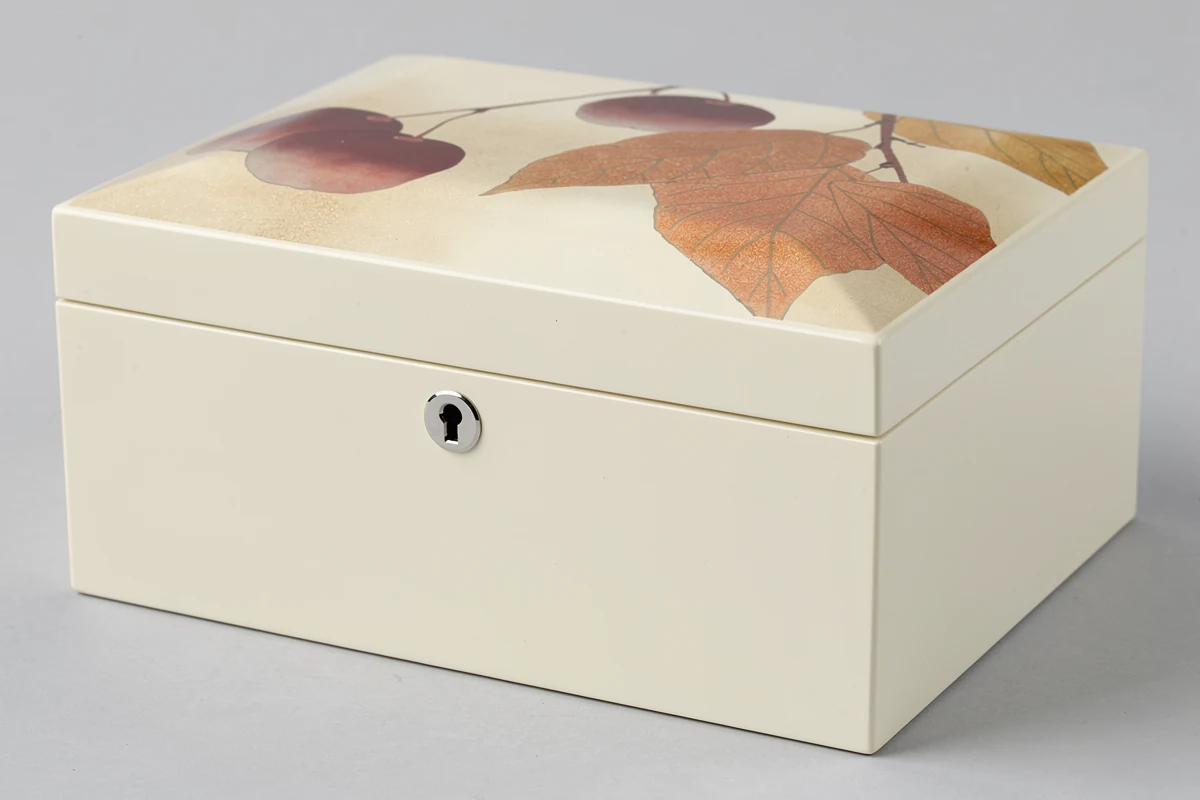
Ask the supplier to resolve these interfaces for the actual box; compatibility with one design does not establish fit in another.
Approve the appearance without guessing the material
Separate the visible finish from the component’s material specification. A gold-colored fitting does not, on its own, establish a solid-brass construction. Ask the supplier to identify the component material and finish when those details matter to the order.
Review the lock face alongside the hinges, trim and any metal logo plate. Decide whether the fittings should match or deliberately contrast, and retain an agreed appearance reference. Avoid approving each item from a separate screen photograph and expecting those photographs to define one physical finish.
Also look at the interior presentation when the lid is open. State which fittings may remain visible and whether a cover or lining treatment is proposed. Do not approve a decorative cover that leaves the working relationship unresolved; the finished configuration must still be checked with the contents in place.
XRX custom wooden-box projects coordinate structure, finish, branding, hardware and lining. For a locking box, the useful purchasing step is to include the lock assembly in that coordinated brief from the beginning.
Count physical keys separately from key groups
An order quantity, a number of key groups and a number of supplied keys are different fields. Keep all three visible in the purchasing schedule.
For example, imagine twelve presentation boxes divided into three groups of four. Within each group, the intended arrangement allows the same key to open its four boxes; the groups are intended to differ. If the order also requires two physical keys with every box, the packing requirement is twenty-four keys, not three. Three describes the planned groups, while twenty-four describes the supplied pieces. This is a hypothetical allocation example, not a statement about an available XRX key system.
Write group membership using buyer-controlled identifiers, then ask the supplier to map those identifiers to the proposed key arrangement. Do not depend on box color as the only identifier if several designs could later share a finish. Keep actual key codes and recipient records in the controlled order documentation rather than public product artwork.
A simple acceptance matrix records whether the assigned key opens the intended sampled box and whether the agreed separation from other groups is maintained. Define the sample coverage with the supplier before testing; a few successful demonstrations do not establish every relationship across an unexamined batch. This is a functional allocation check, not a forced-entry test.

Confirm the key count per box, any separately supplied spares, the recipient of those spares and the identification method. An instruction to include “extra keys” leaves quantity and ownership unresolved. Treat later replacement-key availability as a commercial question to confirm, not an automatic promise.
Review the complete sample in its intended use
Use the proposed finished lock, keeper, surface treatment and lining in the approval sample where those elements are being approved. Record any substitute parts and the limits they place on the review. An unfinished shell fitted with temporary hardware cannot silently become the reference for every detail of the finished order.
Work through a nondestructive functional check:
- Identify the sample, lock reference and assigned keys before starting.
- Close the lid in the intended way and operate the supplied key without forcing the assembly.
- Confirm that engagement and release occur as intended and that the lid can then open normally.
- Repeat the review with the specified contents and interior components in place.
- Check the agreed key arrangement, visible finish and key-access area against the approval record.
Do not accept a sample that works only while someone presses the lid into an undocumented position. Record the observation and ask the manufacturer to resolve it. Equally, avoid inventing a universal operating-force or cycle threshold: agree the method and requirement for the selected design if measured durability or force is part of the brief.
Record appearance and operation separately. Link the result to the golden sample approval record, including any remaining conditions before bulk production.
Put key delivery and changes into the order
Decide whether the boxes ship locked or unlocked, where the operating keys will be packed, and who must be able to open them at receipt. In particular, do not put the only opening key inside a box that will arrive locked unless a separate accessible opening arrangement is explicitly provided.
Protect loose keys from contacting decorative surfaces and preserve the agreed box-to-key identification during packing. Specify whether keys accompany individual boxes or are delivered as a controlled group to the buyer. The chosen arrangement should suit both receiving and the final handover to the recipient.
Record which changes require review, including a different lock model, keeper, mounting location, wall construction or key arrangement. A replacement with the same visible finish is not automatically equivalent in fit or operation. Revisit the affected sample checks before accepting the substitution.
For an inquiry, attach the lock purpose, key schedule, relevant drawing, finish reference and sample requirements to the custom wooden packaging specification. When you contact XRX, distinguish fixed requirements from options the factory should propose. That makes the lock part of a defined wooden-box order rather than an unresolved hardware request.
Frequently asked questions
Does adding a lock make a wooden presentation box a safe?
No. A key-operated closure does not establish burglary resistance for the complete box. If rated security is required, specify the applicable performance and request evidence for the actual product rather than relying on the lock’s appearance.
What does keyed alike mean for a custom wooden-box order?
It means the same key is intended to operate a defined group of locks. Identify exactly which boxes belong to that group and confirm the proposed arrangement with the supplier before approval.
Does keyed different mean every key is globally unique?
Do not assume that. Define which boxes must differ within the order and ask the supplier to confirm the available arrangement, limitations and verification scope. The phrase alone does not establish worldwide uniqueness.
Can the lock be changed after the wooden-box sample is approved?
Review the effect on mounting, internal space, keeper alignment, appearance and key allocation before accepting a substitute. Matching color or a similar front plate does not prove that the replacement is equivalent.
What should the key-delivery instructions include?
State the physical key count, assigned boxes or groups, spare-key recipient, identification method and packing location. Also confirm whether boxes arrive locked and how the receiving team will access the correct opening key.