
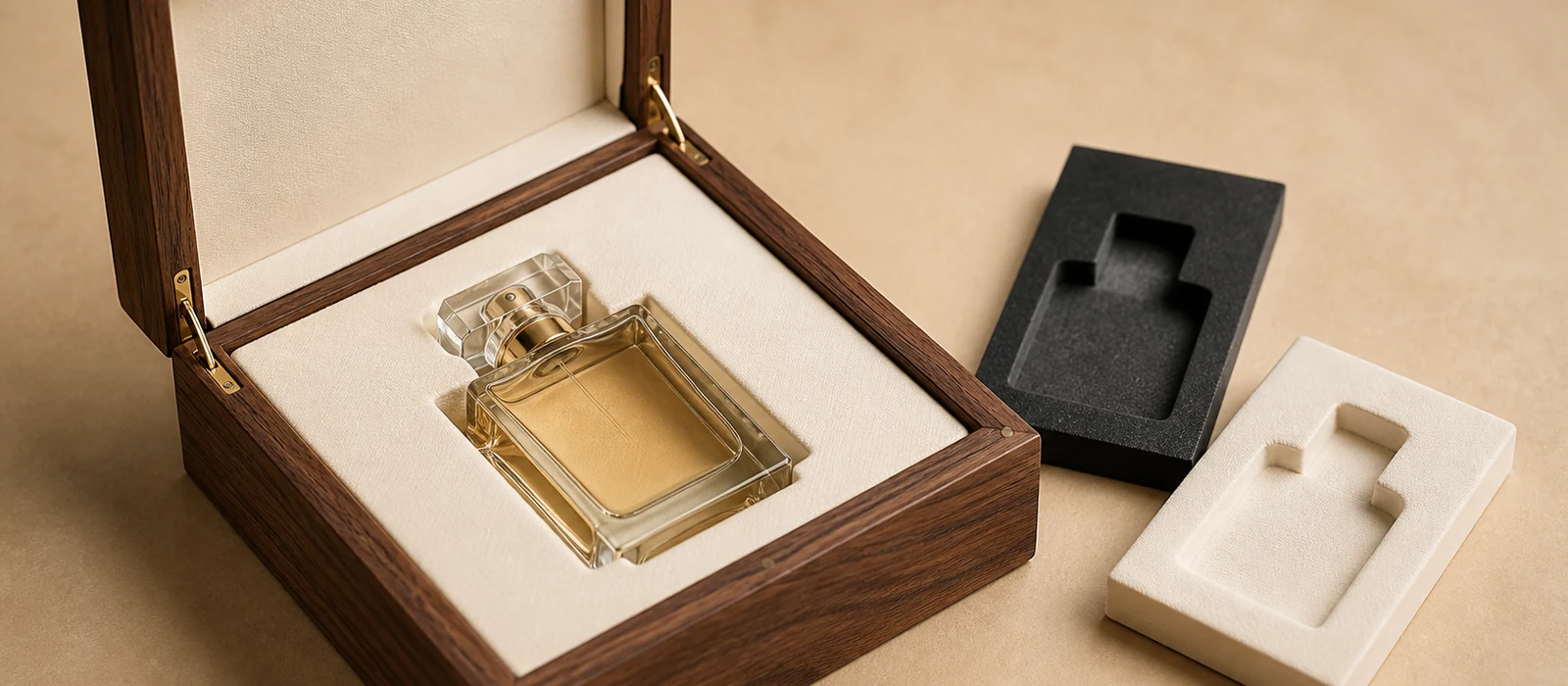

Measure the Complete Perfume Bottle
Perfume bottles often combine several shapes in one object: a heavy glass base, curved or faceted body, shoulder, crimp collar, pump, and removable cap. Height and width alone do not describe the space the assembled product occupies.
Give the insert supplier a production-representative filled bottle whenever possible. Accompany it with a controlled drawing or measurement sheet that records:
- overall height with the approved cap installed;
- maximum width and depth, including non-round corners or projections;
- base footprint, punt, raised features, and bottom decoration;
- shoulder height and the widest transition point;
- collar, pump, actuator, and cap dimensions;
- filled weight and approximate center-of-gravity position;
- label, coating, metallization, printing, frosting, embossing, or decorative zones that should not contact the cavity edge;
- intended front face and presentation orientation; and
- the smallest and largest approved variants if one box serves more than one bottle.
Photos are useful for orientation but should not substitute for dimensions. If the bottle is supplied with a protective film, sleeve, pouch, or removable cap separator, include that layer in the approved pack-out because it changes the occupied envelope.
Control the Bottle Without Loading the Cap
The glass body and base are usually more stable reference areas than a decorative cap, spray actuator, or collar. The cap can help visually locate the product, but it should not automatically become the only restraint point or carry pressure from the closed lid.
For an upright bottle, review the base seat, side contact zones, headroom, and how the lid approaches the cap. For a horizontal display, identify where the body can be supported without concentrating pressure on a label edge, coating, raised logo, or sharp facet.
The cavity also needs a deliberate removal route. Common options include a finger recess, pull ribbon, removable tray, or accessible bottle shoulder. Test the chosen method with the actual product: a cavity that prevents movement but requires the user to pull the pump or scrape the decoration is not an acceptable fit.
Match the Insert Construction to Its Job
A perfume bottle packaging insert may combine a structural core with a decorative surface. Buyers should approve those layers separately because each affects fit and appearance.
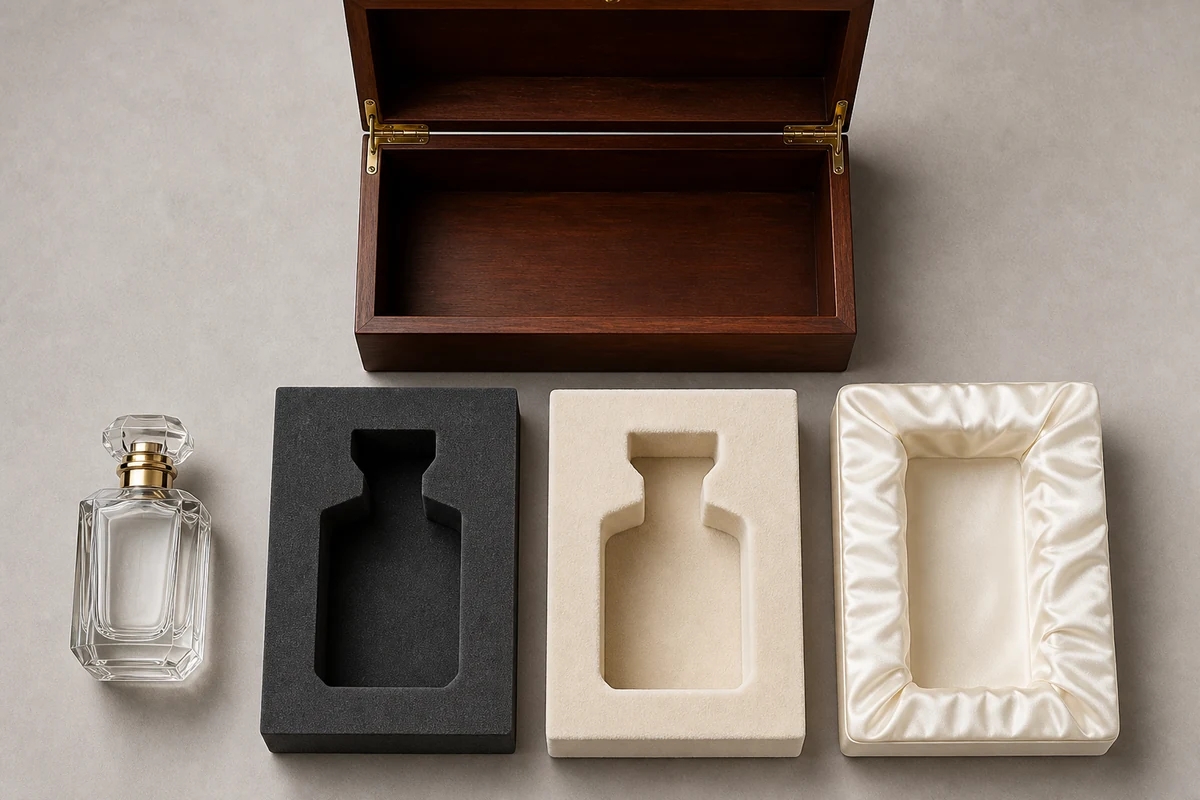
| Insert construction | Appropriate role | Approval focus |
|---|---|---|
| Die-cut EVA or other closed-cell foam | Shaped positioning and repeatable cavities for bottles or accessories | Cavity geometry, compression, odor requirement, exposed edges, color, and removal access |
| PU foam with fabric covering | Softer presentation surface and shaped support | Compression, fabric tension, wrinkles, seams, adhesive visibility, and contact with decoration |
| Velvet- or microfiber-covered insert | Premium visual and tactile finish over a formed support | Pile direction, color consistency, dust, edge wrapping, and surface contact |
| Satin-covered pad or lining | Decorative presentation where another component provides restraint | Wrinkling, sliding, seam placement, and whether structural support is still required |
| Paperboard, molded fiber, or formed tray | Removable organization where the design permits a separate tray | Retention points, finish quality, assembly, and fit inside the wooden shell |
An EVA insert for a perfume box is not defined by the word “EVA” alone. Foam formulation, thickness, compression behavior, covering material, cavity shape, and attachment all affect the result. Do not copy a density or cavity allowance from another project without confirming the intended bottle and duty.
Design Multi-Product Gift Sets as Separate Zones
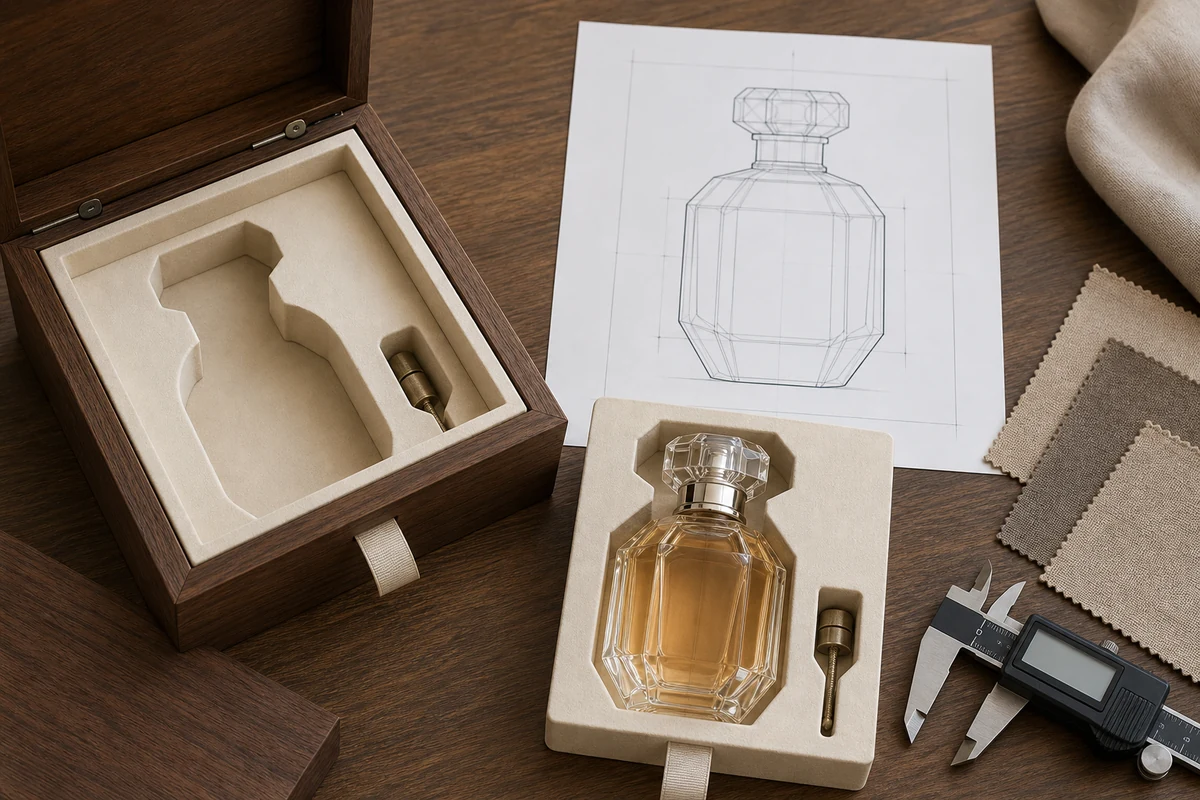
A single-bottle box mainly needs controlled bottle positioning and removal. A perfume gift set may also contain a travel spray, refill, cream jar, funnel, booklet, or decorative accessory. Each component should have an approved zone so it cannot move against the glass bottle or hide the intended presentation face.
Start with the hierarchy of the unboxing view. Position the main bottle first, then arrange accessories around it without weakening the bottle cavity or placing hard components above fragile decoration. Check the set with the lid closed and in the handling orientations expected during gift presentation.
For multiple glass components, separation becomes especially important. DHL’s glass-shipping guidance recommends dividers and movement control so glass items do not contact one another during transit. That shipping advice does not certify a presentation insert, but it reinforces a useful design boundary: glass-to-glass contact should not be left uncontrolled.
Set Fit Criteria Instead of Copying a Generic Gap
There is no universal clearance that suits every custom perfume box lining. A rigid, faceted bottle in a covered foam cavity behaves differently from a round bottle in a satin-lined tray. The approved fit must account for product variation, liner thickness, foam compression, assembly variation, protected surfaces, and the loading direction.
Define outcomes rather than an unsupported fixed number:
- the largest approved bottle loads without forcing the cap, pump, label, or decoration;
- the smallest approved bottle remains within the agreed presentation movement limit;
- the lid closes without contacting the cap or accessories;
- exposed cavity edges do not scrape coated, printed, frosted, or metallized surfaces;
- the intended front face stays aligned after normal presentation handling;
- the product can be removed using the approved finger recess, ribbon, or tray; and
- the lining remains acceptably smooth after the agreed sample loading checks.
The approved sample should record which bottle revision and dimensional range were used. If the brand changes the glass mold, cap supplier, pump, decoration build-up, or accessory layout, review the fit again rather than automatically extending the old approval.
Separate Presentation Fit from Shipping Protection
A wooden perfume presentation box is not automatically the complete parcel-shipping system. FedEx’s general packaging guide advises individually cushioning fragile items, centering them away from other items and container surfaces, controlling voids, and using an appropriate outer container.
For a project that requires distribution performance, specify the complete configuration: perfume bottle, cap, insert, wooden box, protective wrap, outer carton, cushioning, pack quantity, orientation assumptions, route, and acceptance criteria. ISTA explains that knowledge of the real shipping, handling, and storage environment is critical when selecting and interpreting a transport test.
This means a successful showroom fit check cannot be converted into a universal shock, drop, vibration, or breakage claim. Presentation approval and transport validation answer different questions and should be documented separately.
Send an RFQ That Defines the Insert Clearly
To obtain comparable proposals, give suppliers the same controlled information:
- bottle drawing, maximum dimensions, filled weight, photos, and physical sample availability;
- bottle revision, cap, pump, collar, decoration, and protected no-contact zones;
- quantity and orientation of bottles and accessories;
- required duty: presentation, gift handling, distribution, or a defined combination;
- preferred perfume box foam insert, fabric-covered construction, removable tray, or other concept;
- visible lining material, color, texture, pile or grain direction, seams, and edge treatment;
- loading and removal method;
- outer wooden box structure, internal dimensions, lid clearance, hardware, finish, and branding;
- separate outer shipping-pack and test requirements, when applicable;
- sample approval checklist and acceptable product range; and
- change-control requirements for later bottle, cap, material, or geometry substitutions.
The wooden perfume box customization page provides outer structure and finish context, while the perfume product archive shows relevant format references. Neither replaces project-specific bottle data.
Approve the Sample and Control Later Changes
Review the sample with the intended filled bottle and every component in the set. Check identity and revision first, then evaluate:
- bottle alignment, contact zones, base support, cap clearance, and removal access;
- cavity edges, exposed substrate, fabric seams, wrinkles, adhesive marks, dust, fibers, and odor requirement;
- accessory separation and lid clearance;
- loading with the smallest and largest approved bottle variants;
- movement after closing and lifting the presentation box in agreed handling orientations; and
- the separate outer pack when distribution protection is required.
When comparative packaging measurements depend on environmental exposure, define conditioning rather than testing samples in uncontrolled states. The public significance statement for ASTM D4332-22 notes that temperature and relative humidity can change packaging-material properties, especially for cellulosic materials, and that specified conditioning supports meaningful, reproducible measurements.
Change control is equally important. ISTA’s retesting guidance identifies changes in product size, weight, center of gravity, package configuration, interior packaging, materials, and closures as factors that can require renewed testing. Even when no formal transport claim is involved, the same principle supports a practical rule: review insert fit whenever a relevant product or package component changes.
Once the controlled bottle data and approval criteria are ready, buyers can send a fit-focused project brief for insert development.
Frequently Asked Questions
What measurements are needed for wooden perfume box inserts?
Provide overall height, maximum width and depth, base footprint, shoulder position, cap and pump dimensions, filled weight, center-of-gravity information, protected decoration zones, presentation orientation, and the approved dimensional range. Send a production-representative bottle when possible.
Is EVA always the best insert for a perfume box?
No. EVA can provide shaped positioning, but material choice also depends on bottle geometry, weight, surface sensitivity, presentation target, removal method, appearance, and shipping duty. Approve the complete construction rather than selecting by material name alone.
Should the insert hold the perfume bottle by its cap?
Not automatically. A cap can help locate the product visually, but the bottle body and base should be evaluated as primary support areas. Do not load the cap, pump, or collar unless that contact has been intentionally designed and approved.
How tight should a perfume bottle insert be?
There is no universal clearance. Approve fit using the smallest and largest allowed bottles, liner thickness, foam compression, loading effort, protected surfaces, movement limit, lid clearance, and removal access.
Does a fitted wooden perfume box protect the bottle during shipping?
Not by itself. A presentation insert may position the bottle, but a shipping claim applies to the complete packed system, including the wooden box, outer carton, cushioning, route, conditions, and test method.
What changes require the perfume box insert to be reviewed again?
Review the fit after relevant changes to the bottle mold, dimensions, weight, cap, pump, decoration, accessories, insert material, cavity geometry, outer box, closure, or distribution system. Transport testing may also need to be repeated when such changes can affect performance.