
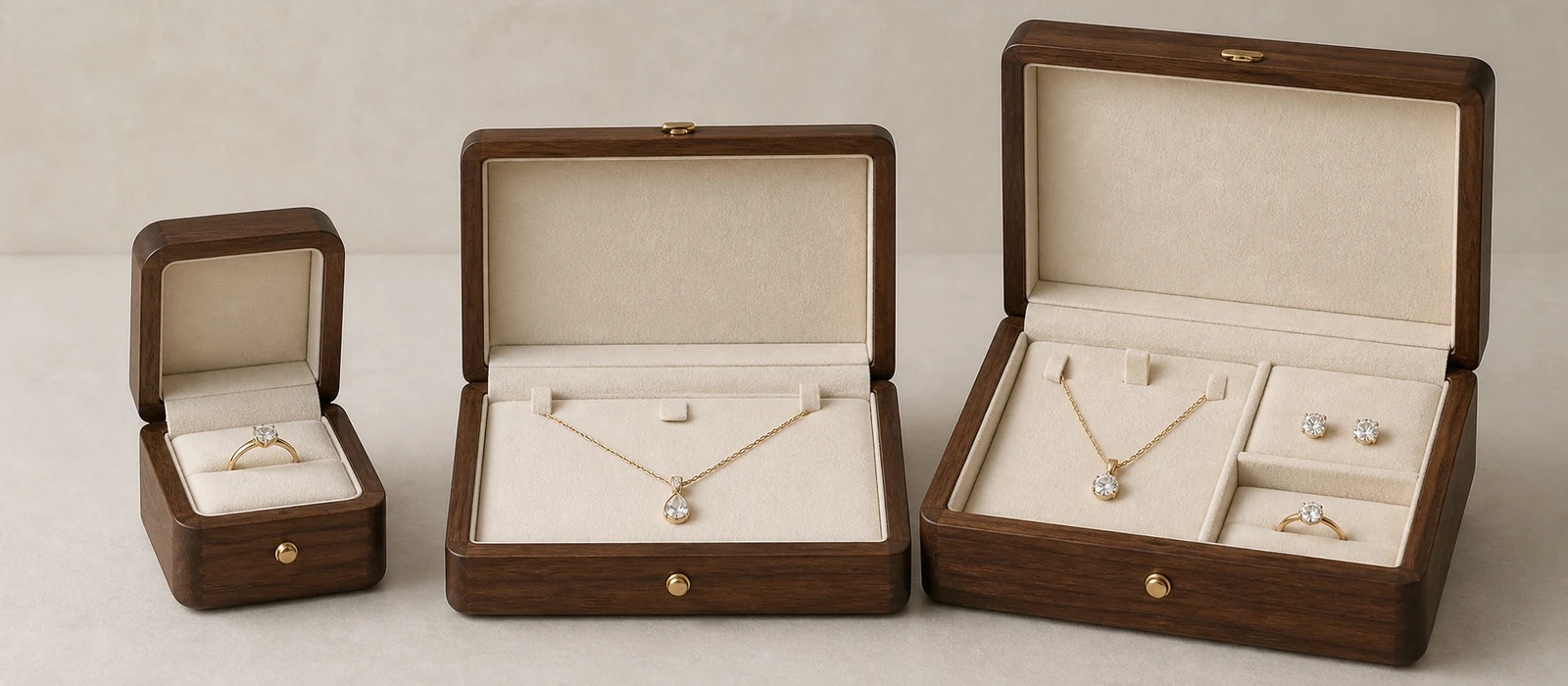

The right choice among custom jewelry box types depends on what must be displayed, protected, removed, sold, and shipped. A ring box usually presents one compact item vertically; a necklace box controls a long chain and pendant across a flat area; a jewelry set packaging box coordinates several products without allowing them to touch. Brands should select the internal architecture first, then choose the opening style, exterior dimensions, finish, and branding system.
The category name alone is not enough. A high-set engagement ring, a fine chain with a heavy pendant, and a coordinated necklace-and-earring set create different clearances, contact risks, and unboxing sequences.
Start with the Jewelry and the Selling Moment
Before choosing a box format, define the exact product and how the customer will encounter it. Record:
- jewelry type, dimensions, weight, and the smallest and largest approved variants;
- raised stones, prongs, clasps, hinges, sharp projections, or flexible sections;
- surfaces that should not rub against fabric edges, clips, ribbons, or adjacent pieces;
- preferred display face and viewing angle;
- how the product will be loaded and removed;
- whether the box is used at a retail counter, handed over as a gift, shipped through e-commerce, or retained for storage; and
- whether one exterior design must serve a broader collection.
A physical sample is preferable. If that is unavailable, provide controlled drawings, clear photographs, weight, and the approved product range. Do not ask a supplier to infer cavity size from a lifestyle image.
Choose a Ring Box for Compact Vertical Presentation
Wooden ring box packaging is usually the smallest format, but the insert still needs more than a generic slit. A plain band can sit lower than a solitaire or cluster setting. A raised stone changes the vertical envelope and may require additional lid clearance even when the shank diameter is unchanged.
The insert should support the shank at controlled points and present the ring at the intended angle. Prongs, stones, halos, and decorative shoulders should not become uncontrolled load-bearing surfaces. Check whether the ring remains centered, whether the lid approaches the setting, and whether the user can remove it without twisting against the slot.
For paired rings, decide whether the presentation calls for two parallel slots, a shared cushion, or separate removable holders. A compact double-ring arrangement can look balanced, but it should not allow the two pieces to rub when the box is closed or lifted.
Ring boxes work well when the sales moment focuses on one or two small items, portability matters, and the product benefits from an elevated reveal. They are less suitable when a long chain, large bracelet, documentation, or several coordinated products must be displayed together.
Choose a Necklace Box for Flat Layout and Chain Control
A wooden necklace box normally uses a wider, flatter presentation area. The key design problem is not only pendant size; it is the complete chain path from the upper retention points to the pendant and the controlled location of the remaining chain.
A practical layout may include two upper hooks or tabs, a shaped pendant recess, and a covered pocket or channel for excess chain. The design should keep the pendant facing forward without placing a clip on a delicate decorative surface. It should also prevent loose chain from appearing across the presentation face when the lid opens.
Measure pendant width, height, thickness, weight, bail position, chain length, clasp size, and any adjustable extension. Then check the loaded presentation with the lid closed. A thin box can still fail if the pendant projects into the lid lining or the clasp forms an unexpected high point.
Bracelets and bangles may use a related flat format, but they should not simply inherit a necklace insert. Their diameter, stiffness, clasp, curvature, and removal motion may require a cushion, shaped recess, or removable platform.
Build a Jewelry Set Box Around Separate Product Zones
A jewelry set box must create a hierarchy across several pieces. The main product should be visually dominant, while earrings, rings, bracelets, accessories, certificates, and care cards occupy defined secondary zones.
| Box type | Best suited to | Critical approval points |
|---|---|---|
| Ring box | One ring, paired rings, cufflinks, or very small pieces | Setting clearance, slot geometry, display angle, centering, and removal |
| Necklace box | Necklace, pendant, chain, or some bracelet formats | Chain path, pendant recess, clasp storage, lid clearance, and flat alignment |
| Jewelry set box | Coordinated multi-item presentation or gift collection | Product hierarchy, separate zones, accessory control, spacing, and loading order |
Multiple items should not share uncontrolled space. The Canadian Conservation Institute recommends separating metal objects with padding to reduce contact, nicks, and scratches during movement. For commercial packaging, that supports a practical principle: give each jewelry piece its own controlled position and keep hard clasps, posts, or accessories away from adjacent surfaces.

Choose the Opening Structure After the Layout
The interior layout should guide the opening mechanism rather than being forced into a fashionable shell.
- Hinged lid: creates a familiar presentation reveal and can support an interior lid panel, but hinge geometry and lid depth must be checked against raised jewelry.
- Magnetic lift-off or book-style lid: offers clean exterior surfaces and flexible proportions, but magnet placement, opening force, and loose components need approval.
- Drawer box: separates exterior opening from the display tray and can work well for collections, but the tray must not shift, scrape, or expose jewelry during withdrawal.
- Removable tray: allows one wooden shell to carry a presentation module and documents below, but finger access, tray rigidity, and orientation must be controlled.
No opening style is universally more luxurious. A compact ring reveal, a flat necklace display, and a layered jewelry set create different user movements. Approve the loaded prototype rather than the empty mechanism.
Protect Surfaces Without Making Material Claims
Gold and silver are among the soft metals that the Canadian Conservation Institute identifies as especially vulnerable to dents, scratches, and abrasion. A lining can reduce direct contact, but “soft-looking” does not automatically mean suitable for every jewelry surface.
Approve the complete lining construction: visible textile, underlying foam or board, seams, adhesive, clips, ribbons, exposed edges, dust, loose fibers, and odor requirement. If tarnish prevention, archival storage, chemical compatibility, or long-term conservation is part of the brief, require material-specific documentation and appropriate specialist review. Do not convert a velvet appearance into an unsupported chemical-safety claim.
Match the Box to Retail, Gifting, and E-commerce
Retail-counter packaging prioritizes presentation angle, quick loading, repeated opening, compact storage, and consistent alignment. Gift packaging adds handover orientation, closure security, accessory organization, and a deliberate unboxing sequence. E-commerce introduces a separate distribution system.
A wooden presentation box should not automatically be treated as the complete parcel shipper. FedEx’s packaging guidance advises individually cushioning multiple items, preventing contact, filling spaces, and using an appropriate outer container. For a required transport claim, specify and test the complete pack-out rather than the jewelry box alone.
ISTA notes that the actual shipping, handling, and storage environment is critical to transport-test selection and result interpretation. A successful retail handling check therefore does not establish universal drop, vibration, compression, or damage performance.
Build One Packaging Language Across a Collection
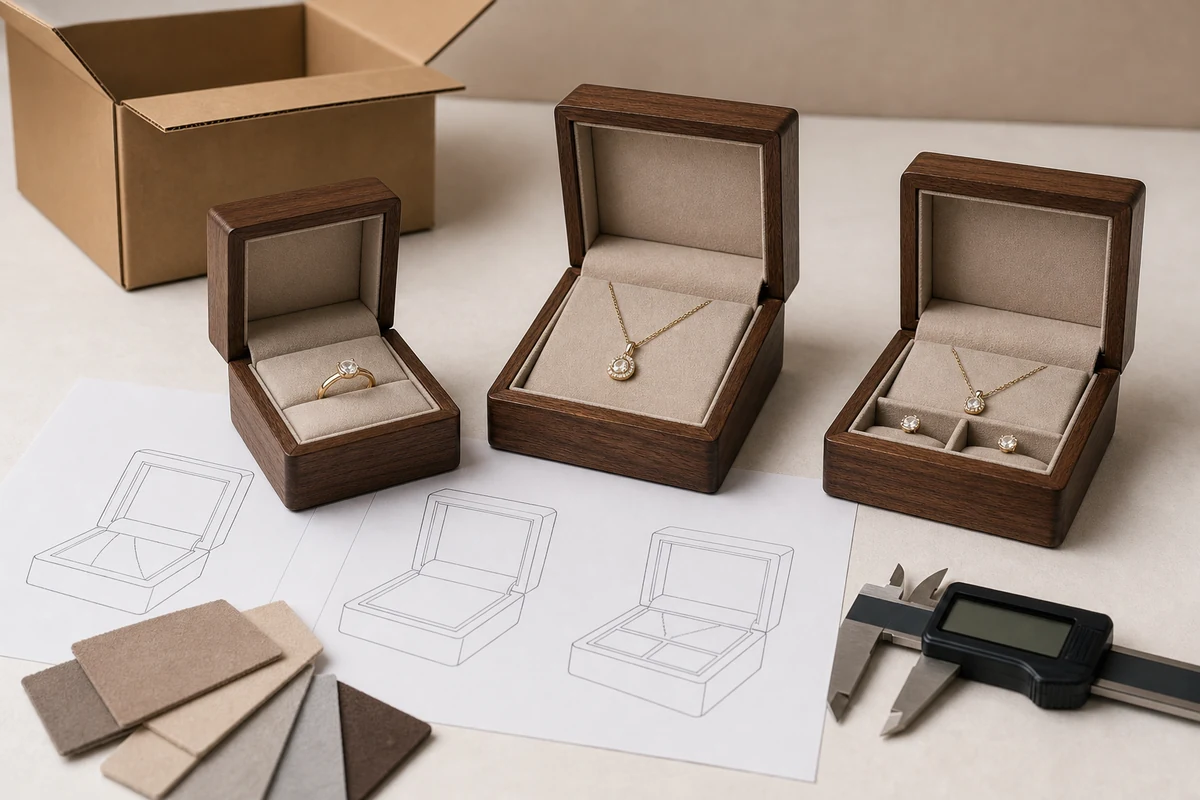
Consistency does not require every item to use the same box dimensions. A practical family system can standardize selected elements while allowing the insert to change:
- wood species or engineered substrate and visible grain direction;
- exterior color, matte or gloss level, and edge treatment;
- hinge, magnet, or hardware color;
- logo method, position, and clear space;
- lining color family and textile direction;
- exterior proportion rules and a small set of footprint modules; and
- artwork, labels, sleeves, and outer-carton identification.
For example, a brand may use a compact square ring box, a shallow rectangular necklace box, and a larger set box with the same walnut tone, metal finish, logo scale, and cream lining. The customer reads them as one collection even though the internal structures are different.
The wooden jewelry box customization page can establish the shared structure and finish language, while the jewelry product archive provides format references.
What Should the Buyer Put in the RFQ?
Send the supplier:
- product drawings, dimensions, weight, photos, and physical samples when available;
- jewelry type, variants, paired items, and collection structure;
- display orientation, protected surfaces, and no-contact zones;
- preferred ring, necklace, bracelet, or set layout;
- opening structure and expected unboxing sequence;
- insert core, visible lining, color, texture, seam, clip, ribbon, and removal requirements;
- exterior dimensions, wood or substrate, finish, hardware, and branding;
- retail, gift, storage, and distribution duties;
- outer shipping-pack and test requirements, if applicable;
- sample approval checklist and approved product range; and
- change-control requirements for product, insert, material, or geometry revisions.
Approve Samples and Control Variants
Load the intended jewelry into the sample and check product identity, position, surface contact, lid clearance, opening motion, removal access, lining workmanship, accessory separation, and closure security. Repeat the fit check with the smallest and largest approved variants.
If comparative measurements depend on environmental exposure, define conditioning. ASTM D4332-22 notes that temperature and relative humidity can change packaging-material properties, especially cellulosic materials, and that specified conditioning supports meaningful and reproducible measurements.
Changes also matter after approval. ISTA’s retesting guidance identifies changes in product configuration, size, weight, center of gravity, interior packaging, materials, and closures as factors that can require renewed evaluation. Even without a formal transport claim, review fit when a jewelry style, insert, or box component changes.
When the product matrix and presentation rules are ready, buyers can send a collection packaging brief for structural review.
Frequently Asked Questions
What is the main difference between a ring box and a necklace box?
A ring box usually presents a compact item in a raised or angled slot, while a necklace box uses a wider flat layout to control the pendant, chain path, clasp, and excess chain. Their clearances and removal motions are different.
Can one jewelry box insert fit rings, necklaces, and bracelets?
It is possible to share an exterior box platform, but one universal insert rarely presents all formats well. Product-specific trays or interchangeable inserts are usually needed to control orientation, contact points, and removal.
When should a brand use a jewelry set packaging box?
Use a set box when several coordinated pieces or accessories must be presented together. Give each item a separate zone, establish a visual hierarchy, and check that hard components cannot contact adjacent jewelry.
Which opening style is best for luxury jewelry packaging?
There is no universal best style. Hinged, magnetic, drawer, and removable-tray structures create different reveals and clearances. Choose after defining the product layout, selling moment, storage needs, and handling duty.
Does velvet lining prevent jewelry from tarnishing?
Not automatically. Velvet describes an appearance and textile construction, not proven tarnish prevention or chemical compatibility. Require material-specific evidence when long-term conservation or tarnish control is part of the brief.
What should brands approve before ordering custom wooden jewelry boxes?
Approve the intended jewelry variants, display orientation, contact zones, insert construction, lining workmanship, lid clearance, opening and removal motion, branding, closure, accessories, and any separate shipping pack or test requirement.