


A cushion that looks suitable when empty may compress a leather strap too tightly, leave a small bracelet loose, place a crown against a divider, or lift the watch into the lid lining. The practical task is therefore to control position and presentation without forcing the watch into an unsuitable geometry.
Define the Protection Duty Before Selecting an Insert
Start by deciding what the wooden box must do. A retail presentation box prioritizes alignment, reveal, quick loading, and clean removal. A collector-style storage box may need repeated access, separation between several watches, and space for different wrist sizes. A gift set may also hold spare straps, tools, documentation, or accessories. A parcel shipment adds drop, vibration, compression, and handling hazards that the presentation box alone should not be assumed to control.
Watch-care guidance helps establish sensible boundaries. Patek Philippe advises avoiding shocks, prolonged vibration, extreme temperature changes, and magnetic fields. This does not prove that a particular insert prevents those exposures. Instead, it supports designing the presentation system to avoid unnecessary movement and making separate decisions about transport validation and storage conditions.
Before requesting a quote, classify the duty as one or more of the following:
- retail-counter presentation;
- gift handover and unboxing;
- home or collector storage;
- travel organization; or
- presentation box inside a separate shipping pack.
Measure the Complete Watch, Not Only the Case Diameter
Case diameter is only one input. Collect dimensions and photographs for the smallest and largest approved variants, preferably supported by physical samples. The measurement set should include:
- maximum case width, including crown and pushers;
- case thickness and any projecting crystal or caseback;
- lug-to-lug length;
- bracelet or strap width near the lugs and at the clasp;
- minimum comfortable closed circumference;
- buckle, deployant clasp, end-link, and bracelet thickness;
- total watch weight;
- permitted display orientation; and
- surfaces or components that should not bear against the insert.
The crown side may determine the true lateral envelope even when the dial and case appear centered. A domed crystal or thick clasp may determine vertical clearance. For a product family, use a controlled range rather than a single nominal watch. Do not assign a universal cavity allowance: lining compression, insert material, finish thickness, product variation, and removal access all affect the final dimensions.
Which Watch Box Insert Architecture Fits the Product?
Different internal structures solve different problems. The best choice depends on strap flexibility, bracelet circumference, display angle, accessory requirements, and how often the product will be loaded.
| Insert type | Suitable use | Main approval points |
|---|---|---|
| Removable cushion | Flexible straps and many conventional bracelets | Cushion circumference, compression, seam position, clasp support, and finger access |
| C-shaped holder | Defined upright presentation with open access below | Holder stiffness, contact zones, strap curve, base retention, and watch-head stability |
| Flat padded tray | Open straps, display samples, travel sets, or accessories | Watch orientation, strap control, recess depth, tabs, and lid clearance |
| Fitted multi-part insert | Premium single-watch gift sets or mixed accessories | Separate zones, loading order, removable layers, and contact between components |
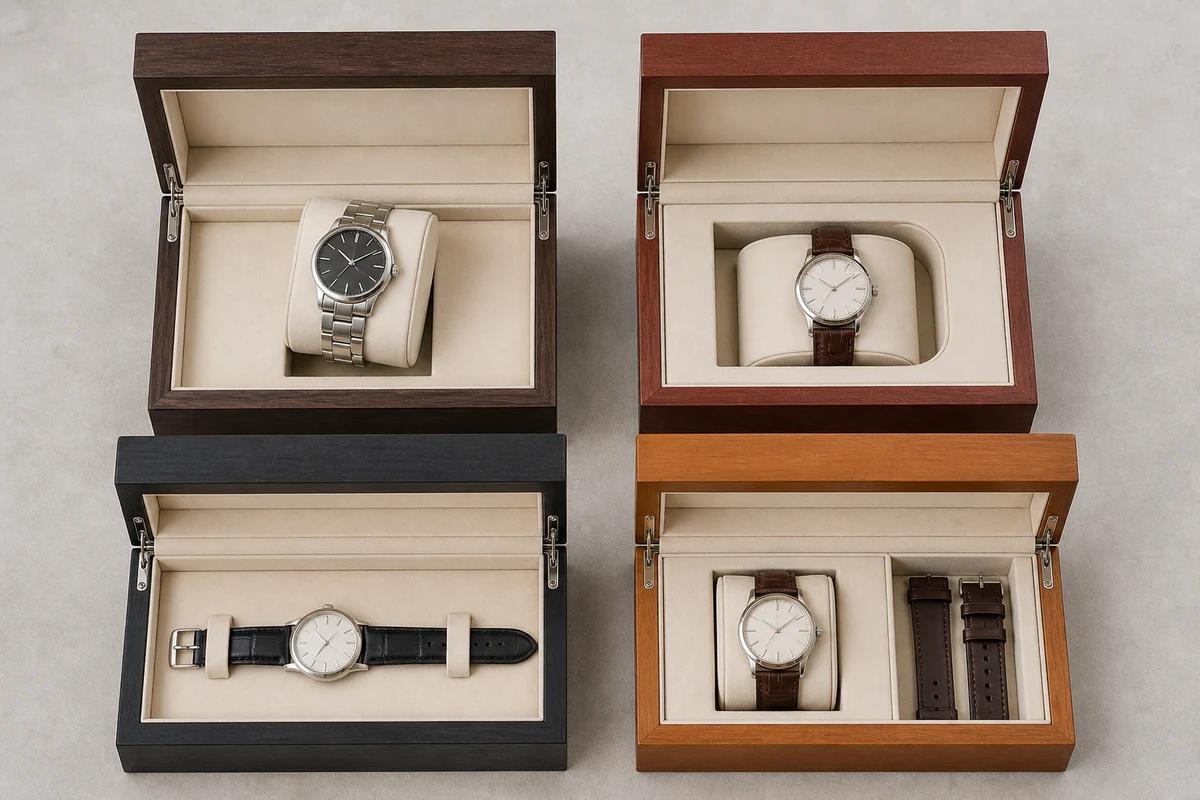
Removable cushions
A removable cushion provides a familiar wrapped-wrist presentation. It can accommodate several watch styles when its circumference and compressibility are specified around the approved range. However, “soft” is not enough. Check whether a small bracelet remains centered, whether a large or stiff strap can close without force, and whether the buckle or clasp forms a high point.
C-shaped holders
A C-shaped holder can keep the watch elevated and make removal intuitive. It may suit an open bracelet or strap, but the curve should not force a leather strap sharply or place the watch head on an unstable top surface. Confirm how the holder is retained in the base and whether it can rotate or lift during normal handling.
Flat trays and fitted assemblies
A flat padded tray can reduce forced curvature and create space for an open strap. Tabs, channels, or shallow recesses may control the strap ends. A fitted assembly is useful when the box also presents spare straps, a tool, a booklet, or another accessory. Each hard component should have its own controlled zone.
Design Single- and Multi-Watch Layouts Differently
A single-watch box can concentrate on one reveal and may use a raised platform, a removable cushion, or an accessory layer. Check that the watch remains centered when the box is lifted and that the lid lining does not approach the crystal, crown, pushers, or clasp.
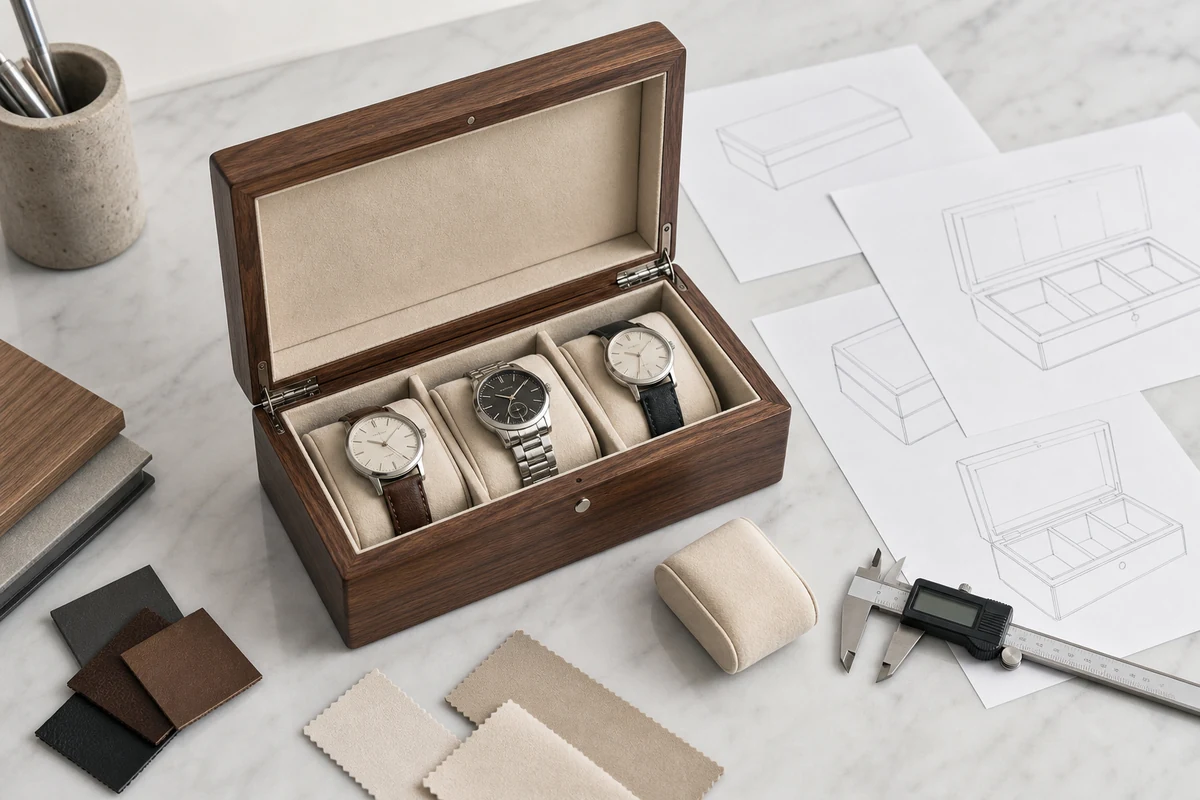
A multi-watch box introduces interaction between products. Divider spacing must account for the widest approved watch and its removal path, not only the cushion width. Crowns, bracelet edges, buckles, and watches on adjacent cushions should not enter one another’s space. If cushions are removable, the user needs enough access to lift one without contacting the next watch.
The divider can be structural, decorative, or both. A low upholstered divider provides visual separation but may not control a tall watch head. A full-height compartment offers stronger positional definition but requires more careful finger access. Use loaded prototypes to choose the height and spacing rather than copying an empty-box layout.
Match Contact Materials to the Watch and Use Environment
The visible lining may be microfiber, woven textile, synthetic suede, velvet-like fabric, leather-like material, or another specified surface over foam, board, or a molded core. Approve the complete construction, including seams, adhesive, exposed edges, dust, odor, color transfer risk, and compressibility. A luxury appearance is not evidence of archival compatibility or a guaranteed anti-scratch function.
Storage conditions also matter. Tiffany & Co. advises keeping leather straps away from water, constant moisture, and prolonged direct sunlight. The Japan Clock & Watch Association advises wiping away sweat, dirt, and moisture before storage and avoiding humid or strongly vibrating locations. A lined wooden box should therefore be treated as one component of appropriate care, not as a substitute for cleaning the watch or controlling the environment.
Do not add magnets near the watch merely because a magnetic closure creates a clean exterior. If magnets are proposed, the buyer should review their location and suitability for the intended watch range. A hinge, mechanical catch, or another closure may be preferable when magnetic exposure is a concern.
Design for Loading, Removal, and Lid Clearance
Evaluate the sequence with the intended watch installed:
- Can the operator load the watch without scraping the case or over-bending the strap?
- Does the cushion or holder remain in its assigned position?
- Can the clasp close without becoming the highest uncontrolled point?
- Is there finger access on both sides or a defined lift point?
- Can the watch be removed without pulling on the crown, bezel, strap edge, or buckle?
- Does the lid close without pressing the crystal, watch head, or clasp?
- Does the watch remain visually aligned after ordinary opening and careful handling?
These are fit and usability checks, not transport-test claims. Record the approved product, insert version, box version, and loading method so production samples can be compared against the same configuration.
Separate Presentation from Shipping Protection
A wooden watch box can protect against ordinary contact and organize the product, but it should not automatically be described as a complete shipping solution. The intended parcel may also require a sleeve, bag, cushioning, corrugated carton, void control, and a defined orientation.
ISTA’s design and testing guidance states that the actual shipping, handling, and storage environment is critical when selecting and interpreting a test. Its test-procedure overview also distinguishes screening tests from simulation tests. Buyers should therefore define the distribution route and required validation rather than asking for a generic “drop-proof” watch box.
If a transport claim is required, test the complete packaged-product configuration: watch, insert, wooden box, accessories, retail wrap, cushioning, and outer carton. A change in any of these components may change the result.
What Should a Buyer Include in the RFQ?
Send the supplier a controlled brief containing:
- watch drawings, maximum dimensions, weights, photographs, and physical samples when available;
- the smallest and largest approved case, strap, and bracelet variants;
- intended box capacity and product arrangement;
- presentation angle and protected or no-contact zones;
- preferred cushion, C-holder, flat tray, or fitted insert concept;
- visible lining, core material, color, texture, seam, and odor requirements;
- loading, clasp, finger-access, and removal requirements;
- wooden box structure, finish, hardware, logo method, and closure;
- accessory zones for spare straps, tools, cards, or manuals;
- retail, gifting, storage, travel, and shipping duties;
- intended outer pack and validation requirement, if any; and
- sample-approval and change-control criteria.
Use the custom wooden watch boxes page to define the main manufacturing direction and the watch packaging product archive to review relevant formats. When the watch range and loading rules are ready, buyers can send the specification for review.
Approve Samples and Control Production Changes
Approve the sample with every boundary product: the largest case, thickest watch, smallest closed bracelet, stiffest strap, and any accessory configuration. Check dimensions, centering, contact zones, lining workmanship, seams, odor, lid clearance, closure, cushion recovery, loading time, and removal motion. If the box will enter a shipping system, approve the complete pack-out and the applicable test plan separately.
For lot inspection, do not use “AQL” as a vague promise. ISO 28590 introduces the ISO 2859 series and explains that an inspection system should be selected for the specific situation. The purchase agreement should define the sampling plan, inspection level, defect classes, acceptance criteria, and approved reference sample where applicable.
Change control should cover the watch range, cushion core, lining, adhesive, divider geometry, hardware, closure, box dimensions, and outer packaging. ISTA notes that changes to components, materials, interior packaging, and closures can be relevant to retesting. Even when no formal transport test is specified, a changed insert should trigger a new loaded-fit review.
Frequently Asked Questions
Should a watch cushion fit tightly inside the bracelet?
It should hold the approved watch securely without forcing the bracelet, clasp, or leather strap beyond the agreed range. Evaluate the smallest and largest approved configurations on physical samples rather than specifying a universal tightness.
Is a cushion or a C-shaped holder better for a wooden watch box?
Neither is universally better. Cushions suit many wrapped-wrist presentations, while C-shaped holders can offer upright display and open access. Choose according to strap flexibility, bracelet circumference, contact zones, removal motion, and the desired reveal.
Can one insert fit several watch sizes?
It can if the product range is defined and the insert is validated against its boundaries. Large differences in case size, bracelet circumference, strap stiffness, or clasp geometry may require multiple cushion sizes or interchangeable inserts.
Are magnetic closures safe for every watch box?
Do not assume so. Watch-care guidance commonly recommends avoiding magnetic fields. If magnets are proposed, review their position and suitability for the intended watches, or choose a non-magnetic closure.
Does a wooden watch box replace shipping packaging?
No. A presentation box may organize and separate the watch, but shipping protection depends on the complete pack-out and the actual distribution environment. Specify the outer carton, cushioning, and validation requirement separately.
What should be checked on a watch box sample?
Check the approved watch range, centering, contact zones, cushion or holder fit, strap curvature, clasp position, lid clearance, finger access, removal motion, lining workmanship, closure, accessory separation, and the intended outer pack.