
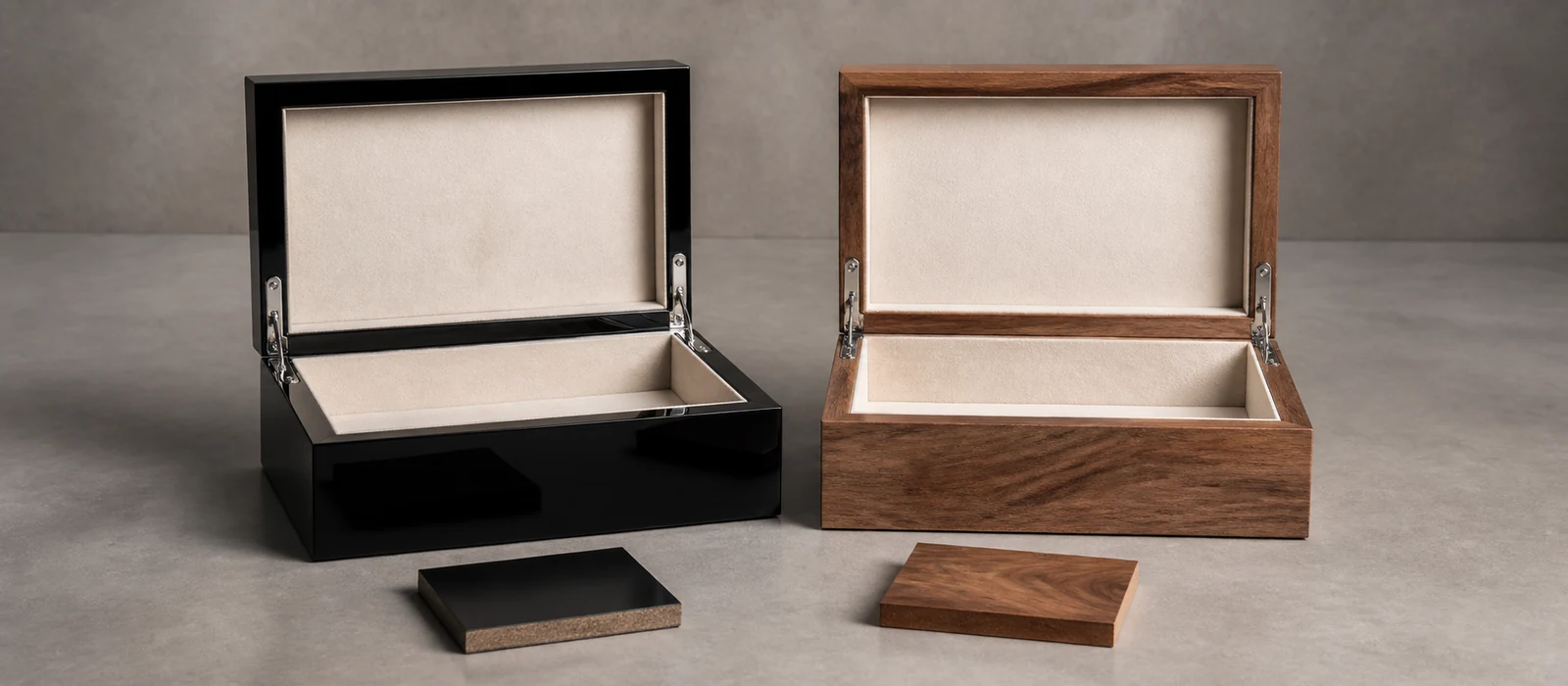

MDF vs solid wood is not simply a choice between “cheap” and “premium.” Buyers who select a substrate from appearance alone can create avoidable problems in machining, paint consistency, grain matching, dimensional stability, compliance documentation, and cost comparison. The right material depends on the box structure, visible finish, target market, order quantity, and the product being packed.
Direct answer: MDF is usually the more predictable substrate for painted, piano-lacquer, wrapped, or veneered wooden boxes with repeatable machining. Solid wood is usually better when authentic grain, species identity, exposed edges, and natural variation are central to the design. Neither is universally superior; many premium projects use a carefully specified hybrid construction.
MDF vs Solid Wood: What Are Buyers Actually Comparing?
Medium-density fiberboard is an engineered panel made from wood fibers combined with a resin or other bonding system under heat and pressure. The Composite Panel Association describes MDF as a composite panel with a flat, smooth, uniform surface and a homogeneous density profile that supports precise machining and finishing.
Solid wood is lumber cut from a tree species and dried for use. It retains natural grain, color variation, growth-ring direction, and species-specific working properties. Those features create visual value, but they also mean that boards cannot be treated as perfectly identical sheets.
An MDF vs solid wood comparison must therefore identify the actual panel grade or wood species, not compare two vague category names.
For a wooden perfume box with an opaque piano finish, the visible result may depend more on substrate uniformity and coating control than on natural grain. For a cigar, wine, watch, or jewelry box intended to display walnut, oak, beech, or another species, real grain may be the main reason to choose solid wood.
The Key MDF vs Solid Wood Differences at a Glance
| Buying factor | MDF | Solid wood |
|---|---|---|
| Visual character | Uniform; normally painted, wrapped, laminated, or veneered | Natural grain, color, pores, and board-to-board variation |
| Material cost | Often more predictable, but grade and thickness matter | Varies widely by species, grade, yield, and sourcing |
| Machining | Consistent for CNC profiles and repeatable components | Depends on species, grain direction, knots, and board selection |
| Dimensional behavior | Engineered panel provides a uniform substrate; grade and environment still matter | Responds to moisture; grain direction and moisture control are important |
| Surface finishing | Strong option for opaque paint, piano lacquer, foil, or veneer | Strong option for clear, stained, oiled, or grain-visible finishes |
| Weight | Depends on panel density and construction | Depends strongly on species and moisture content |
| MOQ influence | Driven by panel grade, thickness, cutting plan, finish, and setup | Driven by species availability, grade, matching, yield, finish, and setup |
| Typical fit | Repeatable luxury painted boxes and veneered constructions | Grain-led premium boxes and designs with exposed natural wood |
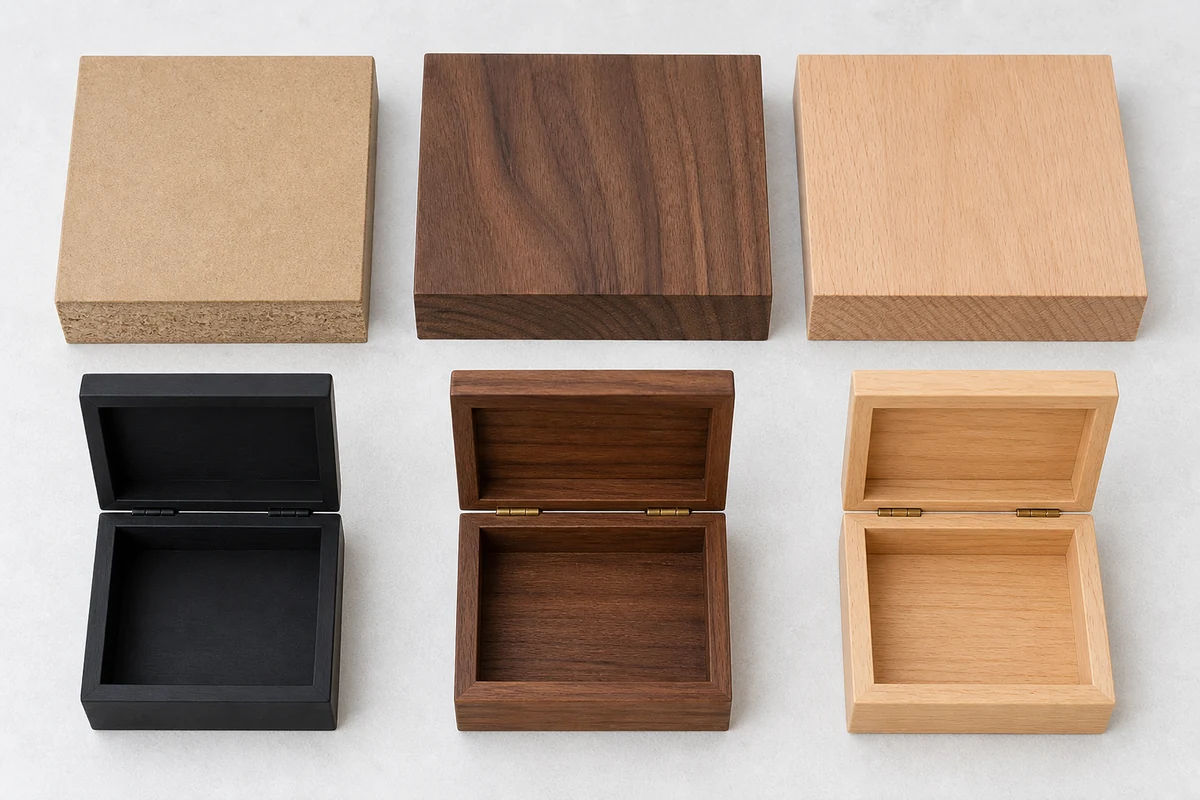
The table is a specification guide, not a universal price or performance ranking. MDF grades differ, and solid-wood species differ even more. A meaningful quotation must identify the actual panel or timber specification.
How Do Appearance and Finish Change the Decision?
MDF has no decorative natural grain of its own. That is an advantage when the design calls for a uniform opaque color, a high-gloss piano finish, a matte painted surface, a decorative foil, or a selected wood veneer. The European Panel Federation notes that MDF’s smooth, stable surfaces are suitable for painting, decorative foils, and veneers.
For an MDF vs solid wood finish decision, start with whether the final design should hide the substrate or celebrate natural grain.
If the design uses a real-wood face over an engineered core, our wood veneer for wooden boxes guide explains veneer cuts, leaf matching, edge treatment, finishing, and sample approval in more detail.
Solid wood is selected when the material itself should remain visible. Clear coating or stain can highlight grain, but buyers must approve the expected variation rather than expecting every box to look identical. Species, cut, grade, color range, grain direction, sapwood policy, defect limits, and matching rules should appear in the specification.
Manufacturer Insight: Specify the visible surface, not only the core
In manufacturing, the phrase “wooden box” does not reveal what the customer will see. An MDF core with walnut veneer, a solid-walnut frame with an engineered base, and a fully solid-wood box can all look like walnut in photographs. The RFQ should identify the core, visible veneer or solid parts, exposed edges, coating, and acceptable grain variation.
Manufacturer Insight: High gloss exposes preparation differences
Piano lacquer magnifies surface preparation, edge sealing, sanding, dust control, coating build, curing, and polishing. MDF is often selected because the base is uniform, but the substrate alone does not guarantee a mirror finish. Buyers should approve the complete coating system on the intended geometry.
Which Material Is More Stable During Manufacturing and Use?
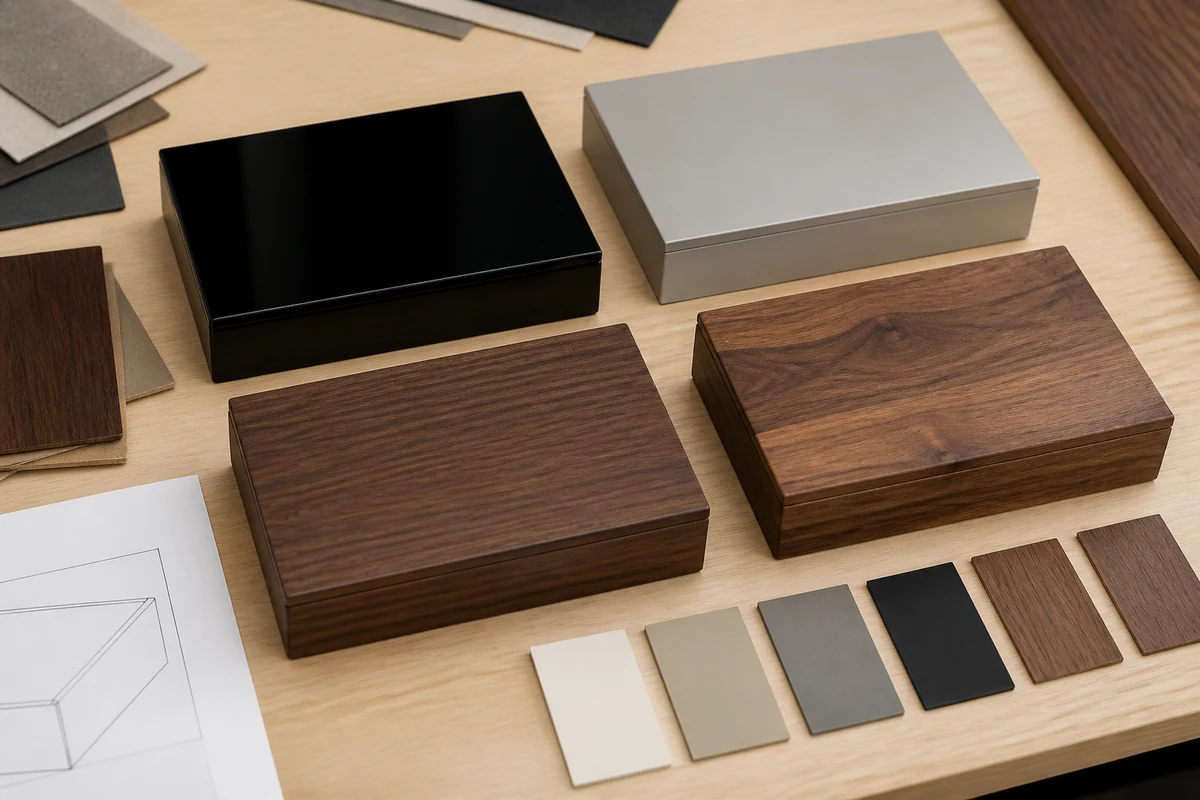
MDF offers a comparatively uniform sheet structure, which helps when factories cut repeated panels, machine grooves, or produce consistent painted components. It is still not immune to moisture, poor storage, unsuitable grade selection, thin sections, or unbalanced finishing.
The stability side of MDF vs solid wood depends on the proposed component geometry and environment, not on a universal ranking.
Solid wood is hygroscopic and changes as moisture conditions change. The USDA Wood Handbook chapter on drying and dimensional change covers moisture control, equilibrium moisture content, shrinkage, and dimensional behavior. For box production, the practical implication is that species, board moisture, grain direction, component width, joint design, finishing sequence, and destination climate must be considered together.
MDF vs solid wood should therefore be evaluated at the component level. A wide solid panel, a narrow frame member, a veneered MDF lid, and a solid-wood trim piece do not create the same risk. Ask the manufacturer to state the proposed construction rather than accepting a single material word.
How Do Machining, Hardware, and Box Structure Affect the Choice?
The USDA Wood Handbook treats wood-based composite panels as a family of products with different properties. For purchasing, that means density, thickness, internal bond, screw-holding needs, edge machining, and finish compatibility must be matched to the component.
In an MDF vs solid wood machining comparison, toolpaths, edge details, hardware loads, and the final coating system belong in the same review.
MDF can support repeatable CNC recesses, profiles, and painted edges when the grade and toolpath are appropriate. Solid wood can also be machined precisely, but tool behavior and surface appearance vary with species and grain. Fine profiles across changing grain may require additional selection, machining, sanding, or rejection criteria.
Hinges, screws, magnets, latches, and stops transfer loads into the box structure. The best substrate for a broad painted panel may not be the best material for a small screw-bearing component. A hybrid design can use an engineered panel where flatness and finish uniformity matter and selected solid wood where edge detail, fastening, or visible grain matters.
Is MDF Always Cheaper Than Solid Wood?
No. MDF often gives a predictable base-material and cutting cost, but the final box price includes machining time, edge preparation, primer, color coats, polishing, veneer, hardware, lining, rejects, packing, and inspection. A demanding piano-lacquer MDF box can cost more to finish than a simpler solid-wood box with a natural clear coat.
This is why an MDF vs solid wood quotation should use the same box dimensions, hardware, insert, logo, finish standard, packing, and quantity.
Solid wood pricing varies by species, grade, thickness, board width, moisture condition, origin, yield, color matching, and defect limits. Tight grain-matching or sapwood restrictions can increase selection loss and labor even when the box dimensions are unchanged.
MOQ is also project-specific. MDF vs solid wood affects raw-material purchasing and cutting yield, but MOQ also depends on box structure, finish, hardware, custom inserts, logo process, sample work, and production setup. Buyers should request quotations against one controlled specification instead of comparing differently defined boxes.
What Compliance and Sourcing Documents May Be Required?
Target market matters. The US Environmental Protection Agency identifies MDF, including thin MDF, among the composite wood products regulated by TSCA Title VI and explains certification and labeling requirements for applicable panels and finished goods manufactured in or imported into the United States. The California Air Resources Board also regulates MDF, particleboard, and hardwood plywood under its composite wood program.
Compliance can change an MDF vs solid wood decision because composite panels, timber species, sourcing claims, and destination markets may create different documentation duties.
Do not turn “E0,” “E1,” “CARB,” “TSCA,” “FSC,” or another label into a generic marketing phrase. State the destination market and ask which requirement applies to the actual panel, finished good, supplier documentation, label, and records. For forest-sourcing claims, FSC explains that chain of custody tracks eligible materials through production and distribution. A raw-material certificate alone does not automatically authorize every finished-product claim or logo use.
Regulatory and certification requirements can change. Confirm the current rules and the buyer’s contractual requirements before production and shipment.
Which Material Fits Different Wooden Box Applications?
| Application direction | Recommended starting point | Reason and buyer checks |
|---|---|---|
| Piano-lacquer perfume or gift box | MDF or veneered MDF construction | Uniform substrate for opaque finishing; verify panel grade, edge sealing, coating sample, and target-market documents |
| Natural-grain wine or cigar box | Solid wood or solid-wood/plywood hybrid | Visible species and grain support the product story; verify species, moisture, grain range, joints, lining, and destination climate |
| Watch or jewelry presentation box | MDF, solid wood, or hybrid | Choice depends on finish, hardware, insert, and visible edges; verify loaded fit, hinge fastening, lid clearance, and surface sample |
| Large painted display box | Engineered construction often preferred | Flat panels and finish consistency may be priorities; verify thickness, reinforcement, weight, handling, and outer pack |
| Veneered premium box | MDF or another suitable engineered core with specified veneer | Controlled geometry with selected grain; verify veneer species, cut, thickness, matching, edge treatment, and coating |
Use this MDF vs solid wood application table as a starting point, then validate the selected construction with the actual product and finish sample.
MDF vs solid wood is therefore an application decision, not a status symbol. A well-specified MDF box can be the correct premium solution for a flawless painted surface. A well-selected solid-wood box can be the correct solution when authentic material character is essential.
What Should Buyers Confirm Before Ordering?
Send the manufacturer a controlled brief covering:
For a comparable MDF vs solid wood proposal, keep all non-material requirements fixed unless the supplier clearly identifies and explains an alternative.
- product dimensions, weight, orientation, and physical sample availability;
- box style, exterior and interior dimensions, lid depth, and opening method;
- MDF grade or solid-wood species, grade, thickness, and visible parts;
- veneer, grain direction, color range, sapwood, knots, and matching rules where relevant;
- painted, piano-lacquer, matte, stained, clear-coated, wrapped, or veneered finish;
- hinge, latch, magnet, screw, and other hardware requirements;
- insert construction, lining, contact zones, and removal access;
- logo method, size, position, color, and approved artwork;
- destination market and required material, emissions, sourcing, labeling, or record documents;
- order quantity, expected MOQ response, packing method, and delivery destination;
- material sample, finish sample, functional box sample, and approval sequence; and
- mass-production tolerances, inspection plan, defect categories, and change-control rules.
The custom wooden packaging boxes page provides the main manufacturing overview, while the product archive shows application directions. Buyers with a defined product, finish, quantity, and destination market can send the specification for a material recommendation.
Frequently Asked Questions
Is MDF or solid wood better for luxury wooden boxes?
Either can be appropriate. MDF is often better for uniform painted, piano-lacquer, wrapped, or veneered surfaces. Solid wood is often better when authentic grain, species identity, and exposed natural edges are central to the design.
Is MDF always cheaper than solid wood?
No. MDF may offer predictable material and machining costs, but complex coating and polishing can dominate the price. Solid-wood cost varies with species, grade, yield, matching, moisture control, and finish. Compare complete specifications, not material names alone.
Can an MDF wooden box have a real wood appearance?
Yes. A specified real-wood veneer can be applied over a suitable engineered core. Buyers should define the veneer species, cut, matching, exposed-edge treatment, coating, and permitted natural variation.
Does solid wood always last longer than MDF?
Not automatically. Service life depends on species or panel grade, structure, joints, hardware, finish, moisture exposure, handling, packed product, and maintenance. Avoid universal durability claims without a defined design and test condition.
What documents should buyers request for MDF boxes sold in the United States?
Confirm whether TSCA Title VI requirements apply to the actual panel and finished good, then request the applicable supplier, certification, labeling, and record information. The importer should verify current EPA requirements for the transaction.
Can MDF and solid wood be used in the same box?
Yes. Hybrid construction can combine an engineered core or panel with solid-wood frames, edges, trims, or hardware-bearing components. The RFQ and sample approval should identify every material and visible surface clearly.