

What each specification actually tells you
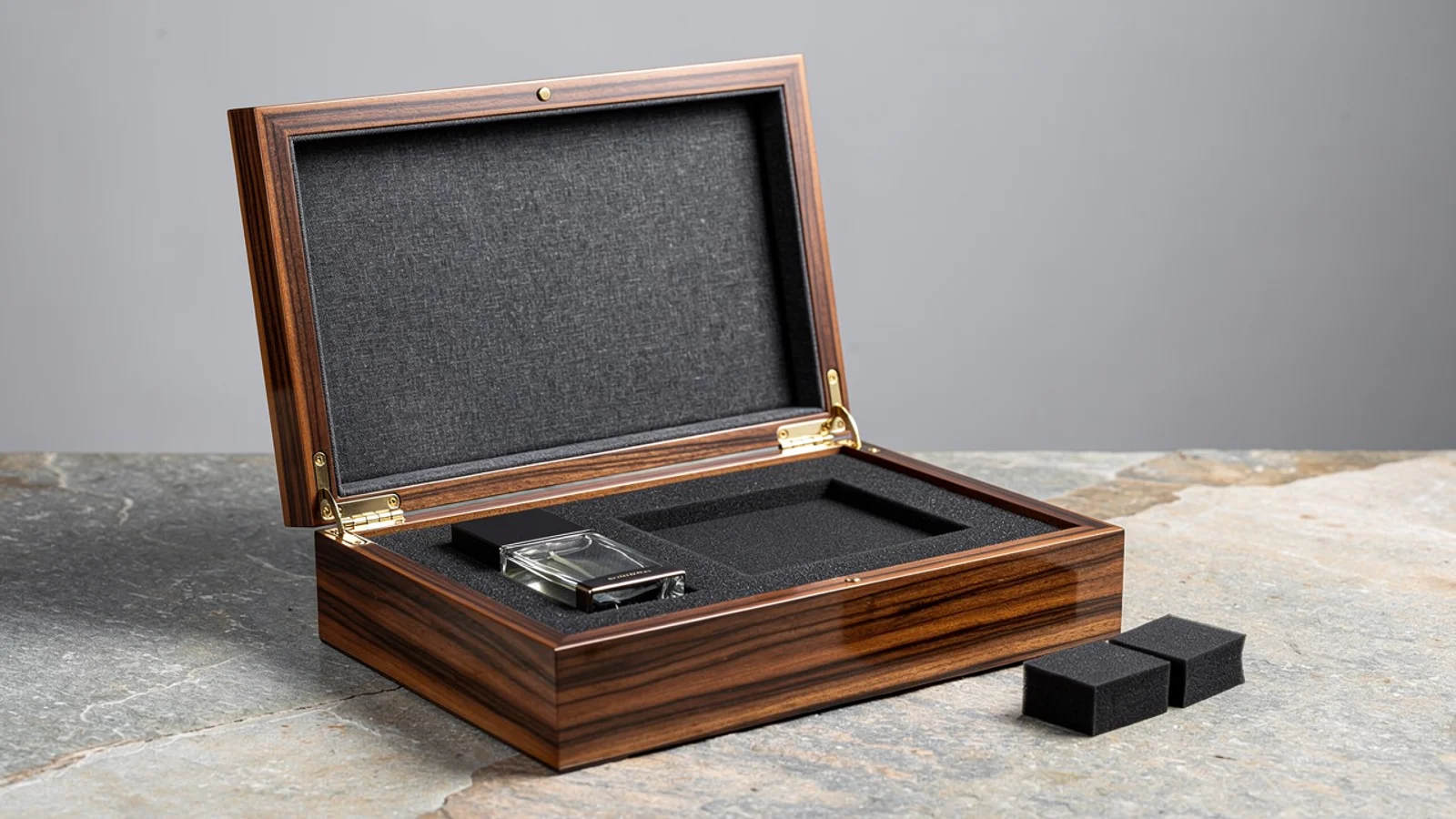
The Polyurethane Foam Association’s foam performance guide distinguishes density, commonly reported in kg/m³ or pounds per cubic foot, from firmness measured by indentation force deflection (IFD). Its explanation specifically allows a higher-density foam to be soft and a lower-density foam to be firm. Here, the evidence concerns flexible polyurethane (PU), not every foam sold for packaging.
| Property | Meaning | Buyer’s next question |
|---|---|---|
| Density | Mass divided by volume | Which foam grade, units and acceptance range apply? |
| Firmness / IFD | Force at a specified indentation | Which method, specimen and deflection were used? |
| Finished insert fit | Interaction of the insert, covering and product | Does the approved product seat and lift out correctly? |
| Shipping performance | Behavior of the complete protective package | What evidence covers the intended distribution conditions? |
Keep these as separate lines in a quotation comparison. A density value cannot fill a blank firmness field. Similarly, “soft,” “medium” and “premium” are descriptions until the parties agree how to assess them. If two suppliers use those words differently, ask for comparable data and samples before selecting on price.
If the broader decision is fabric, suede-like lining or another surface material, use the lining-material selection guide first. This article addresses the foam specification beneath that surface, rather than ranking every insert construction.
Read the firmness result together with its method
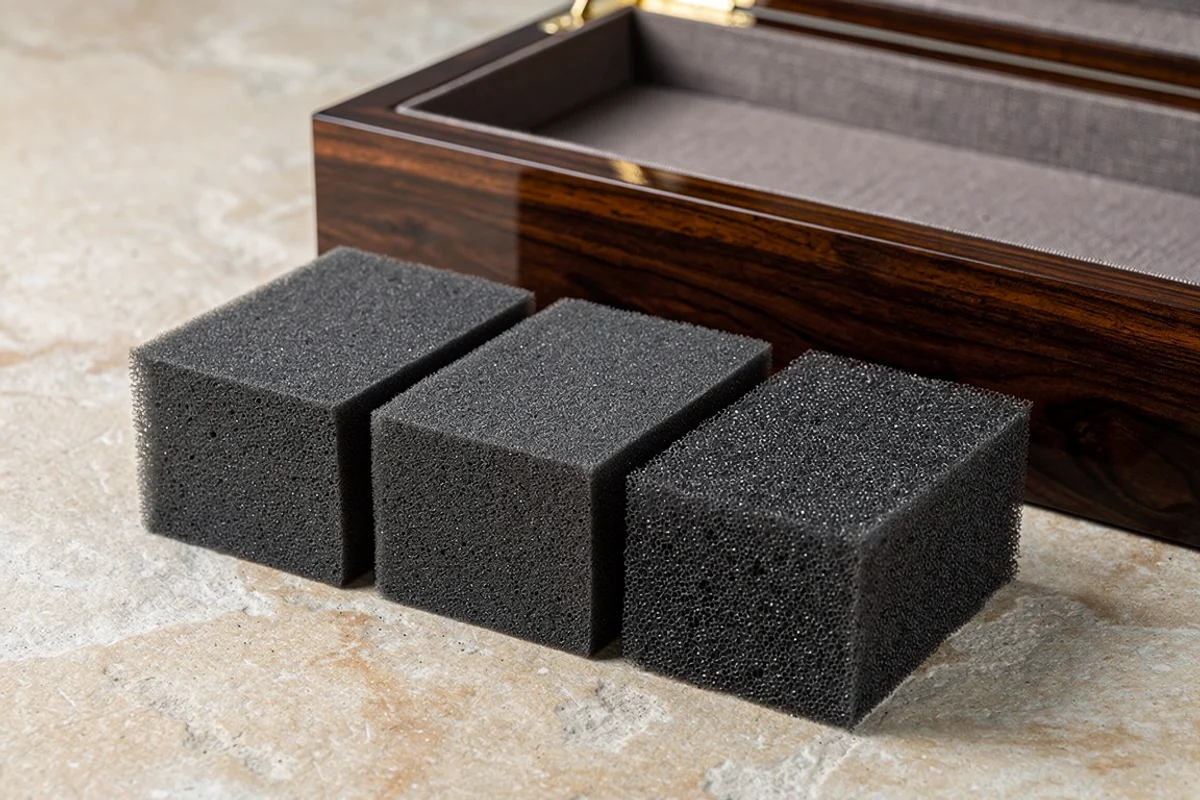
A bare IFD number is incomplete. Ask for the force unit, indentation percentage, specimen dimensions and referenced test procedure. In the common 25% description, the foam is indented by a quarter of its original height; it is not compressed to a quarter of that height. The PFA foam primer also stresses controlled temperature and humidity when measuring physical properties.
The public scope of ASTM D3574-25 covers flexible cellular polyurethane products. It warns that results apply under the particular test conditions and may differ from behavior in use. Referencing that standard is therefore not a finished-package protection rating. Obtain the actual method and report relevant to the offered grade instead of accepting “ASTM tested” as a complete specification.
Use the same discipline when a quote switches to ethylene-vinyl acetate (EVA) or polyethylene (PE). Request the applicable material data rather than copying a PU IFD target across. A matching numeral on a different hardness scale does not establish equivalence. If the reports cannot be compared directly, identify that gap and assess the alternatives as separate proposals.
For the comparison sheet, give unknown fields a clear “not supplied” entry. Do not convert an undocumented supplier grade code into a density or firmness value. Ask the supplier to explain what the code means and whether the data describe the raw foam, a laminated sheet or the finished insert.
Separate the foam sample from the finished insert
A useful sample review has two parts. First, retain an identified foam sample and its technical sheet. Second, check a production-intent insert after cutting, covering and assembly. This is a proposed purchasing workflow, not a claim about an XRX test already performed. It helps make the approval specific enough to repeat.
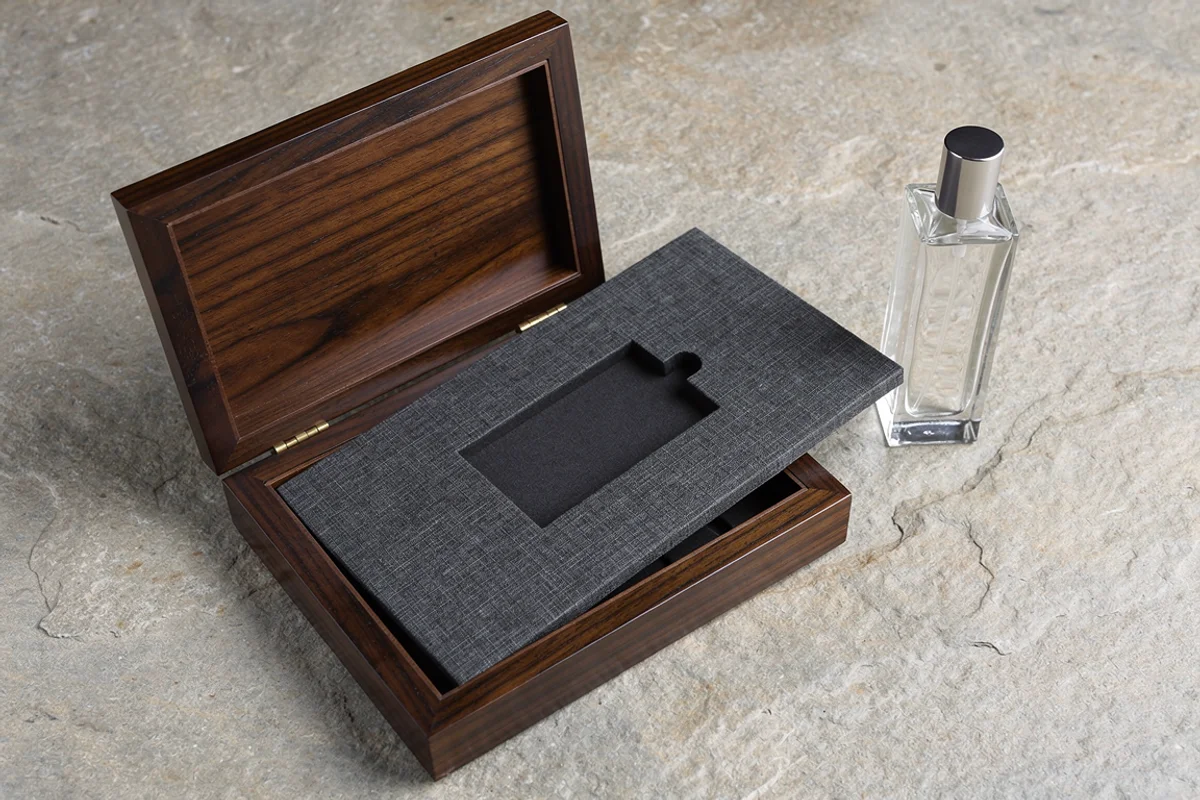
For example, consider a rectangular perfume bottle with a removable cap. The review should identify the intended support surfaces, confirm the bottle seats in the recess and show how the user removes it. If removal requires pulling only on the cap, investigate the access feature or cavity layout. Changing foam density alone is not a complete diagnosis. The perfume insert design guide covers those layout choices in more detail.
Specification insight: distinguish a foam change from a geometry change. If a proposed sample changes both the material and the recess, record both changes. Otherwise, approval of the new feel cannot tell the next supplier which feature must be reproduced.
The Canadian Conservation Institute’s materials guidance identifies compressive strength, support area and thickness as relevant to foam support and cushioning. Its conservation context also cautions against treating PU foam as a default long-term contact material. These are reasons to review the intended use and contact materials separately; they do not establish a universal grade for luxury packaging.
For a keepsake box intended to store a sensitive object for years, add a separate material-compatibility review. A fabric cover and a pleasant hand feel are not sufficient evidence of long-term suitability. Keep that decision distinct from whether the insert looks attractive at initial delivery.
Use a supplier comparison that exposes missing information
Send every supplier the same product drawing or representative product, the same insert layout and the same intended use. Then request the fields below. This avoids comparing a bare foam quote with a covered, assembled insert quote as though they were equivalent.
| Request | Record in the quotation | Approval purpose |
|---|---|---|
| Material identity | Foam family, grade and supplier reference | Track exactly which material is proposed |
| Density | Value or range, units and method | Avoid an undefined “high-density” description |
| Firmness | Result or range, units, method and conditions | Compare the property independently |
| Construction | Foam thickness, recess drawing, backing and covering | Identify the finished configuration |
| Product handling | Seating, removal and visible contact criteria | Make the sample review repeatable |
| Change control | Which substitutions require renewed approval | Keep later orders tied to the agreed version |
Ask for exceptions alongside the quote. A supplier may be able to reproduce the appearance while proposing a different foam or covering. That can be a legitimate alternative, but it needs its own identification and approval. Request the reason for the substitution and the evidence needed to assess it before accepting a cost reduction.
Approval insight: preserve the link between the technical sheet and the finished sample. Record the foam grade on the sample approval sheet, then identify the covering, backing and recess drawing used with it. Identify both in the golden-sample approval record, with the product version used for checking.
Approve presentation and protection as separate outcomes
For presentation, agree a handling sequence: place the product, check its seating, close and reopen the lid, and remove the item using the intended access point. Record any observable issues, such as a displaced covering, a difficult grip or contact at a delicate feature. Describe what happened instead of simply writing “foam too hard.”
For shipping, define the complete packaging configuration and the relevant evaluation separately. The PFA packaging bulletin discusses product fragility, drop conditions and dynamic cushioning data, followed by performance testing of full-scale prototypes with actual objects. A hand squeeze of a foam block does not provide that evidence. Neither does a successful fit check inside the wooden presentation box.
Before an order or substitution is approved, confirm that the material sheet, finished insert drawing and sample record refer to the same version. Keep unresolved shipping or contact-compatibility requirements visible. Do not close those items merely because the insert has the requested density.
When developing custom wooden packaging boxes, bring the product dimensions, weight, contact restrictions, intended use and existing material data to the discussion. Contact XRX to review those inputs and define the insert sample brief.
Frequently asked questions
Does higher foam density mean a firmer insert?
Not necessarily. Flexible polyurethane foam can be made with different firmness levels at the same density. Request density and a separate firmness result with its test method; do not substitute one number for the other.
What does 25% IFD mean?
It is the force measured when a foam specimen is indented by 25% of its original height under specified test conditions. It does not mean that only 25% of the original height remains.
Can polyurethane IFD values be used to select EVA or PE inserts?
Do not treat them as an automatic equivalence. Ask for data appropriate to the proposed material and compare the finished inserts using the same product and acceptance criteria.
Is a softer foam always better for a fragile product?
No. A soft hand feel does not establish shipping protection. Material properties, thickness, support geometry and the complete package need to be evaluated for the intended product and distribution conditions.
Can a supplier replace an approved foam with another of the same density?
Matching density alone is not enough for approval. Review the material identity, firmness data, finished dimensions and covering, then repeat the relevant fit and performance checks before accepting the change.