
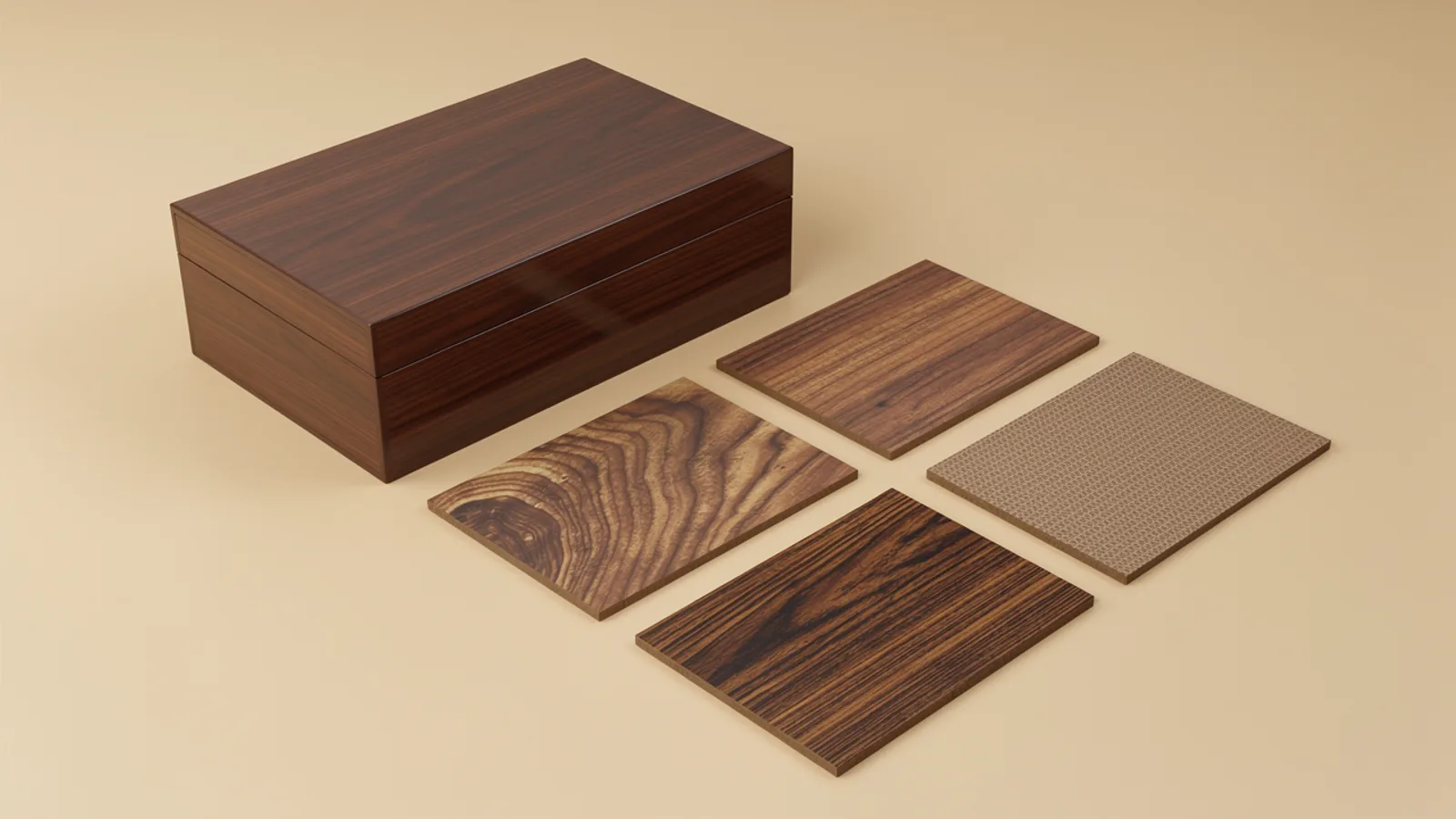

Veneer vs Laminate: Quick Comparison for Box Buyers
| Decision factor | Real wood veneer | Printed decorative laminate |
|---|---|---|
| Material identity | A real wood face over a separately specified core. | A printed decorative surface; identify its construction before comparing. |
| Visual goal | Natural grain character, with an agreed range of variation. | A selected decor and texture; approve repeat placement and batch appearance. |
| Edges and corners | Specify the relationship between face veneer, edge treatment and finish. | Confirm exposed sheet edges, banding or wrapping for the exact system. |
| Logo | Approve artwork on the selected veneer and coating. | Verify process compatibility with the selected decorative layer. |
| Handling performance | Assess the finish and assembled box. | Check the named grade and assembled box; the word “laminate” is insufficient. |
| Price comparison | Include veneer selection, matching and finishing. | Include surface supply, conversion and edge finishing. |
Use this table to choose what to sample, rather than to assign a universal winner. Surface selection and core selection are separate decisions; the wooden box materials guide explains the broader material choices.
First, Identify What the Supplier Means by “Laminate”
Wood veneer is a thin sheet of real wood applied to another surface. Its appearance depends partly on how the wood is cut and matched. This definition is supported by the Decorative Hardwoods Association. An MDF box with a wood veneer face is therefore different from a solid wood box.
“Laminate” can describe several layered products, including constructions containing real wood. In this comparison, it means printed decorative surfacing. Ask suppliers to name the proposed system instead of quoting only “wood-look laminate.”
High-pressure laminate: a separate sheet
High-pressure laminate (HPL) uses resin-treated paper layers, including a decorative layer, consolidated into a sheet that is subsequently bonded to a substrate. Grades differ, including special postforming products. The Composite Panel Association’s HPL overview describes this construction. A supplier offering HPL still needs to confirm how its selected sheet will work with your small panels, corners and lid details.
Thermally fused laminate: decoration fused onto the panel
Thermally fused laminate (TFL) is made by fusing resin-impregnated decorative paper directly onto a panel. It is not simply another name for an HPL sheet. The Composite Panel Association’s TFL guide also notes the need for decorative edge treatment in typical panel applications. For a box, ask which faces will be exposed after cutting and assembly.
Decorative papers and foils: specify the actual product
Paper-based decorative overlays are another family. Their construction, coatings and application methods vary. Some are finished foils; “paper” does not automatically mean an unprotected printed sheet. The Composite Panel Association’s paper and foil guide identifies different grades and explains that substrate quality and the adhesive system affect the result.
These distinctions prevent an easy quotation error: comparing a finished veneer box with an unspecified printed surface, then treating the difference as material cost alone.
Judge Appearance at the Size of the Actual Box
Start with the brand requirement. If the packaging needs to present real wood, specify veneer and identify the species. If the requirement is a particular visual pattern, specify the approved decor and surface texture. A brown woodgrain photograph cannot settle the material identity.
For veneer, review several representative pieces so the approval records an acceptable range, rather than one unusually attractive lid. Decide whether variation between boxes is part of the design or something to limit through selection. For more detail on grain direction and matching, see wood veneer for wooden boxes.
For a printed surface, view the pattern cropped to the actual lid dimensions. Check where prominent knots or dark stripes fall, whether adjacent faces repeat conspicuously, and how the face coordinates with the edge material. A fixed decor code helps identify the product; it does not replace approval of color, gloss and texture.
A useful comparison: request one finished lid-size panel from each proposed route, photographed and reviewed under the same lighting. Keep the intended logo area visible. This is a suggested buying method, not a claim that two sample panels prove production consistency.
Edges and Logos Can Change the Decision
A small presentation box exposes the lid edge, front corners and opening joint at close range. Our recommendation is to approve a face-to-edge junction before choosing the surface solely from a flat swatch.
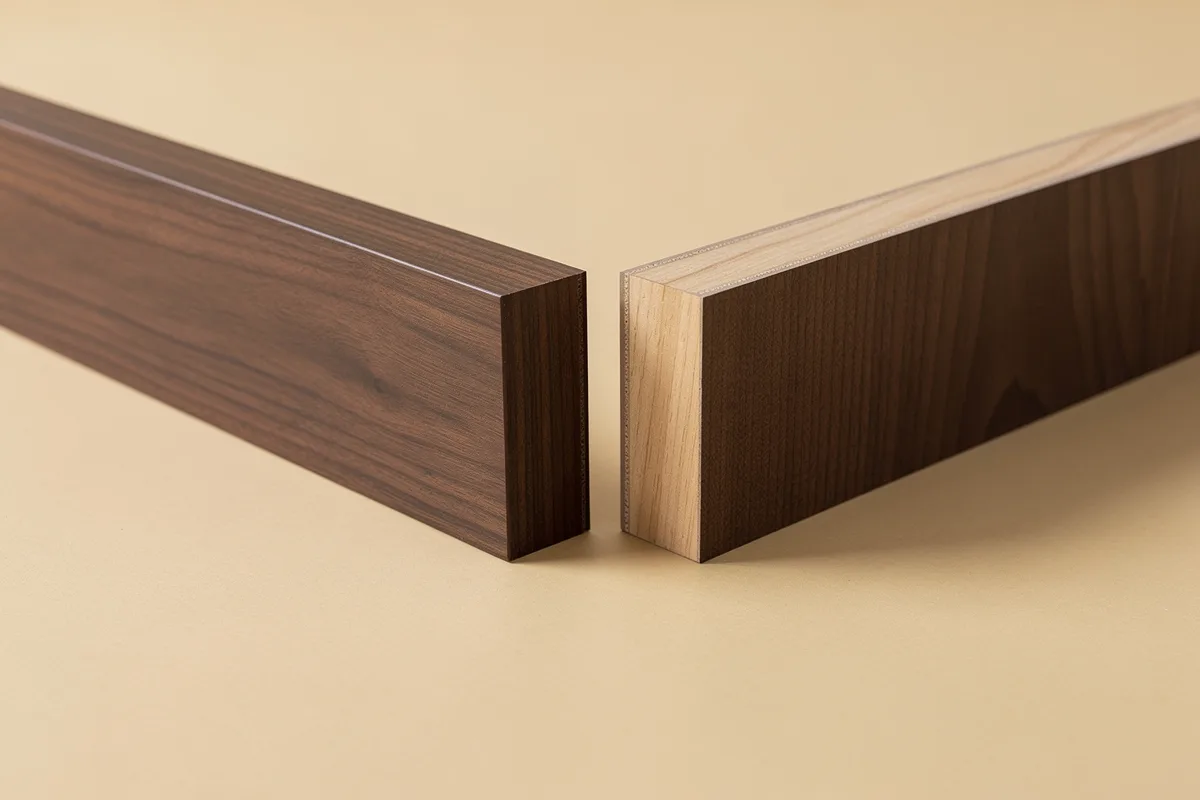
Ask how each visible edge will be finished: matching veneer, a separate edge material, a painted edge or a compatible wrapped treatment. Review the proposed junction from above and from the side. Confirm whether a visible line is an intentional design feature and whether the grain direction changes at the corner.
Then test the actual artwork on the proposed finished surface. A logo sample on bare veneer does not approve the same mark over a coating, and a successful mark on one decorative laminate does not establish compatibility with another. Have the supplier confirm the process before sampling, then assess contrast, fine details and the finished feel.
XRX’s confirmed material options include MDF and natural wood veneer. For a specific HPL, TFL or decorative foil route, request project-specific confirmation of availability and conversion capability before treating it as an offered production option.
Compare Handling Performance and Quoted Scope
A general “more durable” claim is too broad to decide a packaging project. Ask what matters in use: repeated handling, rubbing inside a shipping pack, contact with a cleaning product or occasional spills. Then request evidence relevant to that exposure and the proposed finished box.
For veneer, identify the finish as well as the wood face. For printed surfacing, identify the product and grade. In either case, check the core, edges, joints and adhesive arrangement. A face-sheet result does not automatically establish the performance of the assembled box. Likewise, do not specify sanding or refinishing as a standard repair solution without confirmation for the actual surface construction.
Compare quotations using the same box dimensions, order quantity, interior, hardware, logo and packing. Ask each supplier to itemize what its surface proposal includes. Veneer selection and finishing, or laminate sourcing and edge conversion, may change the quoted work. Neither material name establishes the lower finished-box cost.
Which Surface Should You Choose?
- Choose veneer when real wood is part of the presentation. This is a sensible starting point for a keepsake gift box whose design values natural grain, provided the approved variation range fits the brand.
- Consider printed decorative surfacing when a specified decor leads the design. This may suit a coordinated packaging range, provided the exact surface, texture, edge treatment and supply route are confirmed. Check each box size, since cropping changes the pattern.
- Keep both options open when handling performance or price is the deciding factor. Obtain comparable finished samples and quotations. Select on the documented result instead of assuming that all laminates outperform veneer or that veneer always costs more.
For a practical next step, choose the relevant format from the custom wooden product range, then compare the two surface routes on that same format.
What to Confirm Before Ordering
Include these fields in the sample request so the winning appearance can become a clear production specification:
- Face identity: veneer species and selection, or decorative surface manufacturer, product and decor code.
- Underlying construction: core material and the surfaces to be covered, including the underside and visible interior.
- Appearance reference: color, gloss, texture, grain direction and permitted variation or pattern placement.
- Edge detail: material, color and approved face-to-edge junction.
- Branding: artwork version, process, position and sample on the proposed finish.
- Acceptance and change control: agreed handling checks and written approval before changing the surface, finish, edge material or process.
Once the route is selected, use a golden sample approval record to connect the accepted appearance to the written specification.
To discuss a veneer box proposal, send XRX your box dimensions, quantity, artwork and preferred appearance. If you are comparing a particular laminate alternative, include its product reference so suitability can be checked.
Frequently Asked Questions
Is wood veneer real wood?
Yes. Wood veneer is a thin layer of real wood applied to another surface. A veneered box can have an MDF core, so a real wood face does not mean the whole box is solid wood.
Are HPL and TFL the same material?
No. High-pressure laminate is made as a separate sheet and then bonded to a substrate. Thermally fused laminate is formed by fusing resin-impregnated decorative paper directly onto a panel. Confirm the exact surface system and how the supplier will finish the box edges.
Is a laminate wooden box waterproof?
Do not assume so. The decorative face alone does not establish the water resistance of the assembled box. Ask for evidence covering the specified surface, core, edges and joints under the intended exposure conditions.
Is laminate always cheaper than veneer for custom boxes?
No. Compare quotations for the same box size, quantity, core, edge treatment, logo, interior and packing. Surface availability, conversion work and finishing requirements can change the result.
Can the same logo process be used on veneer and laminate?
Do not assume that a logo approved on veneer will transfer unchanged to a laminate surface. Ask the supplier to confirm process compatibility and produce the artwork on each proposed finished surface before choosing.