
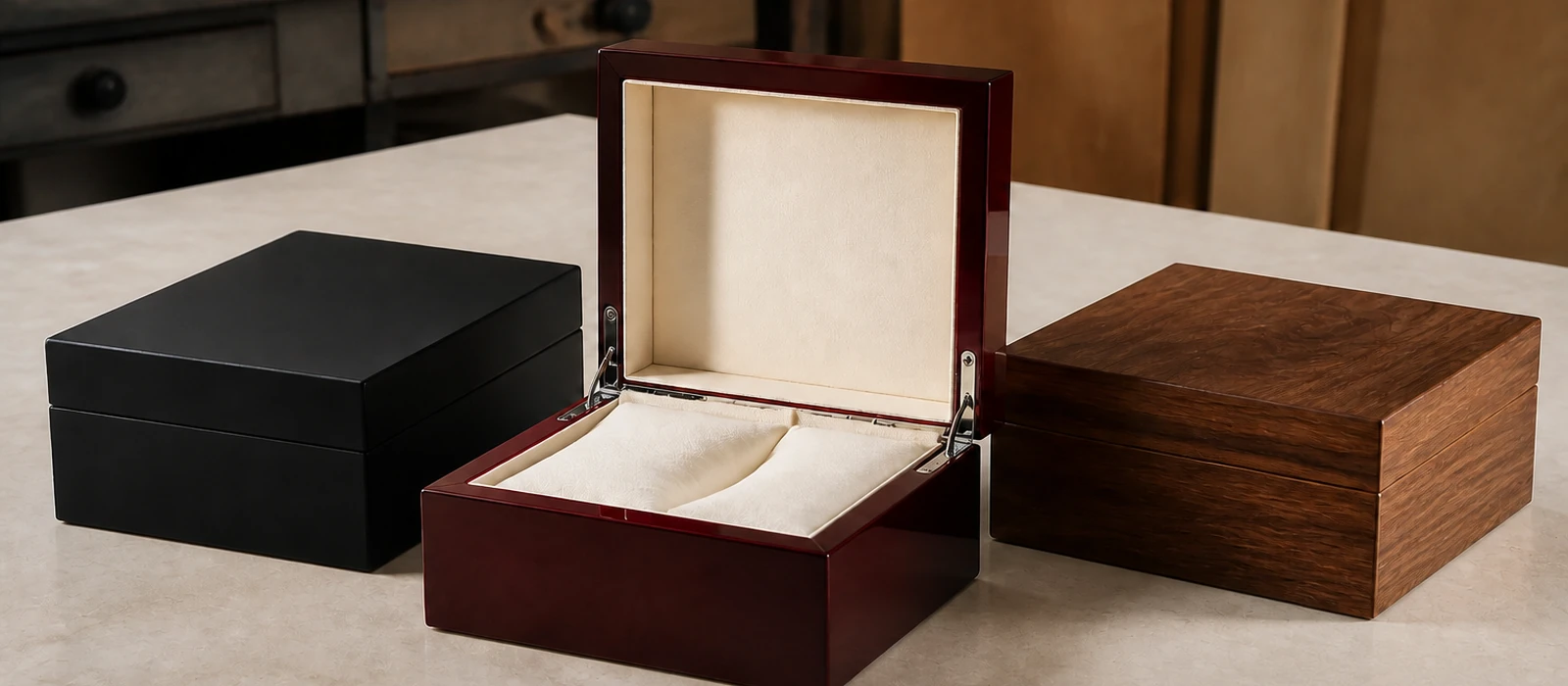

Direct answer: MDF is an engineered wood-fibre panel formed with resin under heat and pressure. For custom wooden boxes, its smooth faces, uniform core and machining consistency make it especially suitable for painted, lacquered and veneered designs. Buyers should still specify the grade, thickness, exposure, finish, hardware, destination-market documents and approved sample.
What Is MDF for Wooden Boxes?
MDF means medium-density fibreboard. The European Panel Federation defines it as a wood-based fibre panel produced through a dry process with adhesive, heat and pressure. Its uniform, close-packed fibre structure differs from the grain, growth rings and localized knots found in solid timber.
That distinction matters in premium packaging. A wooden presentation box is a manufactured system: the substrate creates the body, while paint, lacquer, veneer, lining, hardware and branding create the final visual identity. MDF can remain completely hidden under those finishes and still provide the geometry and surface quality the design requires.
The central buying question is whether MDF for wooden boxes matches the intended appearance, structure, exposure and documentation—not whether MDF is “real wood.”
The USDA Wood Handbook chapter on wood-based composites explains that reducing wood into controlled elements can lessen the influence of localized natural defects. This does not make every MDF panel identical or superior to solid wood. It explains why a specified panel product can be useful when repeatable machining and an even surface are more important than visible natural grain.
Which Types of MDF for Wooden Boxes Should Buyers Consider?
“MDF” is not a complete specification. Panel manufacturers offer different grades, thicknesses and surface constructions. The European Panel Federation’s specialty-grade overview lists standard, thin, moisture-resistant, flame-retardant, high-density and decorative-surfaced directions, among others.
For wooden packaging, the useful selection is usually narrower:
| MDF direction | When it may fit | What the buyer must confirm |
|---|---|---|
| Standard interior MDF | Indoor gift, perfume, jewelry, watch, wine, electronics or display boxes | Panel source, thickness, construction, finish and destination-market documentation |
| Higher-density or machining grade | Detailed routed profiles, thin sections or demanding edge appearance | Supplier specification, machinability, weight, hardware design and sample result |
| Moisture-resistant grade | Defined humid storage or intermittent moisture risk | Actual grade, exposure limit, edge sealing and intended indoor use |
| Low-emission or market-compliant panel | Markets with composite-wood emission requirements | Named rule or standard, panel records, labeling duties and finished-good responsibility |
| Veneered or decorative-surfaced MDF | Natural wood appearance or a defined decorative face | Veneer species, cut, matching, edge treatment, adhesive and top finish |
| Flame-retardant MDF | Only where a genuine fire-performance requirement applies | Code, test method, classification, certificate scope and finish compatibility |
Do not select a specialty grade by board color alone. A green core, darker fibre or supplier nickname is not a substitute for the panel specification and supporting documents. Likewise, a moisture-resistant grade should not be marketed as waterproof unless the complete finished product has evidence for the claimed exposure.
What Are the Main Benefits of MDF for Wooden Boxes?
The strongest case for MDF is not simply price. It is the combination of surface quality, controlled machining and finish flexibility.
Smooth faces for premium opaque finishes
The European Panel Federation’s MDF resource describes smooth, stable MDF faces as suitable for painting, decorative foil and wood veneer. Under an opaque matte or gloss system, there is no natural knot pattern or grain-matching decision to show through the color. This helps a brand focus approval on color, sheen, logo and surface quality.
Uniform material for detailed machining
Close-packed fibres support routed edges, recesses, grooves, lid profiles and CNC-shaped details without revealing the internal void pattern associated with some other panels. For small premium boxes, this can simplify the production of repeated components and clean decorative geometry.
Flexible visual positioning
The same general substrate family can support very different appearances:
- smooth opaque matte paint;
- high-build glossy or polished lacquer;
- natural wood veneer with a clear or stained top finish;
- printed, foiled or laminated decorative surfaces; and
- combinations such as a veneered lid with painted sides.
MDF is therefore not tied to one “cheap” look. The final position depends on proportion, finish build, veneer selection, hardware, lining, logo execution and assembly quality.
Practical use of the project budget
For many indoor gift and presentation boxes, MDF allows buyers to place more of the budget into the elements customers see and touch: finish, hinges, closure, lining, insert and branding. This is a project-level cost decision rather than a universal promise that MDF is always cheaper.
Manufacturer Insight: MDF is XRX’s most frequently selected substrate
In XRX’s current typical order mix, MDF is the most frequently selected substrate for custom wooden-box projects. Buyers commonly choose it because it provides a practical balance of market-appropriate cost, repeatable machining and premium painted, lacquered or veneered presentation. This is an XRX order observation, not an industry market-share percentage.
What Are the Limitations of MDF Box Material?
A credible material guide should state where MDF needs more control.
Edges require proper preparation
Machined edges can absorb sealer, paint or lacquer differently from factory-sanded faces. The EPF’s MDF edge-finishing guidance calls for clean cutting, suitable sanding, edge sealing and compatibility with later coatings. A broad face can look excellent while a poorly prepared corner still reveals sink-in or fibre texture.
Standard MDF is not waterproof
Standard interior MDF can swell or lose performance when exposed to unsuitable moisture. Moisture-resistant grades improve performance for defined conditions, but exposed edges and joints still need appropriate sealing. The grade, finished construction and real exposure must be evaluated together.
Hardware attachment needs design attention
MDF can retain screws in both faces and edges, but the fixing method must match the board. The EPF’s MDF screwing guidance emphasizes screw type, position and correctly sized pilot holes, especially in edges and thinner boards. In a wooden box, hinge performance also depends on panel thickness, fixing position, hardware geometry and expected use. Buyers should approve the assembled sample rather than infer performance from the substrate name.
Weight and structure still matter
MDF can make a compact box feel substantial, which may support a premium presentation. In a large box, the same mass can increase handling and shipping weight. Panel thickness should follow span, joint design, hardware, insert load and overall dimensions—not a habit copied from another box.
Manufacturer Insight: MDF is a substrate, not a finished quality level
From a manufacturing perspective, “MDF box” describes only the core material. Two boxes using MDF can differ greatly because of panel grade, machining, joint design, edge sealing, primer, surface finish, hardware, lining and inspection criteria. Buyers should approve that complete system rather than accept MDF as a quality guarantee by itself.
Where Is MDF Used in Custom Wooden Packaging?
MDF for wooden boxes works best when the project needs controlled geometry and a designed surface rather than exposed solid-wood character. Common applications include:
- perfume and cosmetics boxes with exact brand colors;
- jewelry and watch boxes with fabric-lined interiors;
- wine and spirits gift boxes with painted or veneered exteriors;
- electronics presentation boxes with routed inserts or accessory zones;
- cigar presentation boxes using a project-specific interior lining system;
- corporate gift boxes, sales kits and display cases; and
- multi-component packaging requiring consistent internal layouts.
The XRX Materials Guide provides the broader material hierarchy, while our MDF vs solid wood guide addresses the direct choice between those two substrate families. Buyers can also review the custom wooden products archive to see how material, structure and application interact.
MDF is less appropriate when the brief specifically requires exposed solid timber, strong natural edge character, uncontrolled outdoor exposure, direct water contact or a structural duty the selected panel has not been specified to perform.
How Can MDF Wooden Boxes Be Finished and Branded?
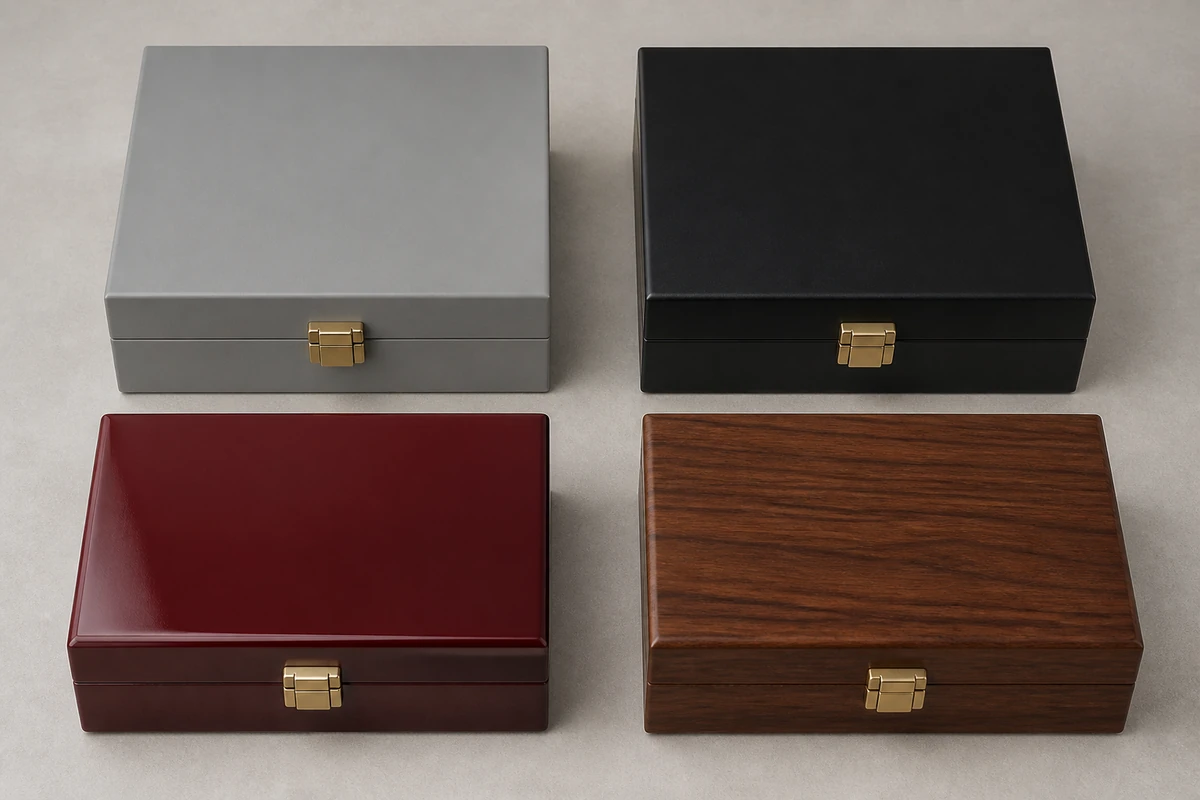
Paint, lacquer and veneer are the main premium directions.
Finishing MDF for wooden boxes begins with the actual face, machined edge and joint design rather than a generic color chip.
For opaque paint, face preparation and sealed edges create the foundation for even color. Matte finishes can reduce reflected glare and suit understated branding; high-gloss systems require more demanding surface preparation because reflected light reveals waves, dust and polishing variation.
For natural wood appearance, veneer places a real wood face over a suitable MDF core. The buyer should define species, veneer cut, grain direction, matching, edge treatment and top finish. Our wood veneer for wooden boxes guide explains those approval decisions in detail.
Common branding methods include metal logo plates, screen printing, foil stamping and selected engraving or routed details. Compatibility depends on the finish and construction. A logo process that works on a matte painted face may not produce the same edge definition or adhesion on polished lacquer or open-pore veneer.
What Should Buyers Specify Before Ordering MDF Wooden Boxes?
Use one controlled RFQ so suppliers quote the same product:
A complete RFQ for MDF for wooden boxes should remove grade, construction and finish ambiguity before sampling.
- product application and destination market;
- finished external and internal dimensions;
- product weight, insert load and presentation orientation;
- box structure, lid type, joints and visible construction lines;
- MDF grade, supplier documentation and proposed thickness;
- painted, lacquered, veneered or laminated surface direction;
- color reference, sheen and acceptable appearance standard;
- edge profile and which internal surfaces are finished;
- hinge, closure, feet, handle or other hardware;
- lining and insert materials, colors and contact zones;
- logo method, size, position and approved artwork;
- expected order quantity and individual/outer packing requirements;
- destination-market emission, labeling or material-document requirements; and
- sample approval, controlled reference sample and bulk inspection criteria.
For the United States, the EPA’s TSCA Title VI consumer guidance identifies MDF among regulated composite wood products and explains certification and labeling duties for regulated panels and finished goods. Other destinations can have different requirements, so the RFQ should name the market instead of requesting a vague “international certificate.”
How Should Buyers Check an MDF Wooden Box Sample?
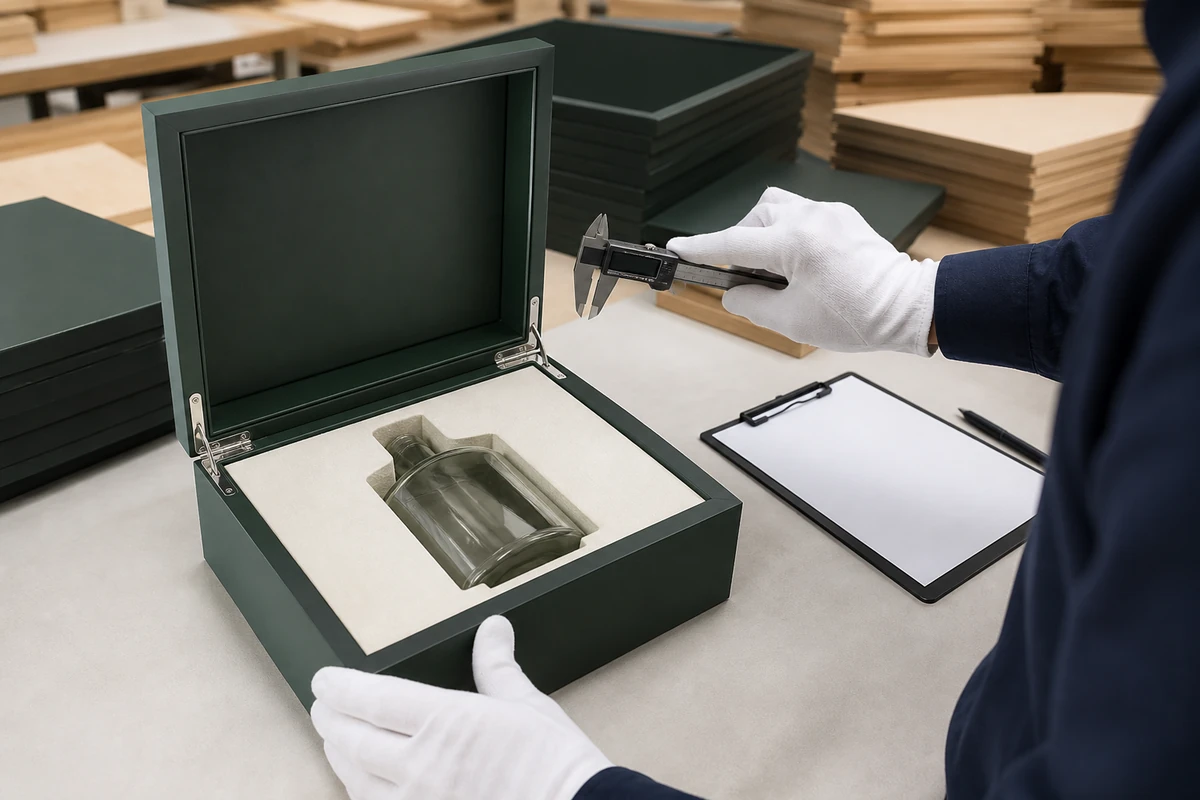
Inspect the complete loaded box, not only a loose MDF swatch.
- Confirm the approved panel specification, thickness and available compliance records.
- Measure the finished box and verify product and insert fit.
- Inspect flat faces, routed profiles, exposed edges, corners and joint lines under agreed lighting.
- Check paint, lacquer or veneer for the approved color, sheen, grain direction and edge treatment.
- Open and close the lid repeatedly during sample review to observe hinge alignment, clearance and closure behavior without inventing an unsupported cycle-life claim.
- Check hardware fixing locations, logo registration, lining contact and insert bonding.
- Confirm whether large surfaces feel excessively heavy or flex under the actual product load.
- Review protective wrapping and outer packing so finished faces do not rub in distribution.
- Record the approved material, construction, finish, hardware and defect limits before bulk production.
To review a project, send the product dimensions, box style, finish reference, logo, quantity and destination market through our contact page. We can then assess whether MDF is the right substrate or whether solid wood, plywood or another construction better fits the brief.
Frequently Asked Questions
What does MDF mean in wooden boxes?
MDF means medium-density fibreboard. It is an engineered panel made from wood fibres and a resin binder consolidated under heat and pressure. In a wooden box, MDF usually forms the concealed structural body beneath paint, lacquer, veneer, lining and hardware.
Why is MDF used for premium wooden packaging?
MDF provides smooth faces, a comparatively uniform core, repeatable machining and broad finish compatibility. These characteristics can support precise geometry and premium painted, lacquered or veneered presentation while keeping project costs practical. Final quality still depends on the full construction and manufacturing process.
Can MDF be painted and veneered?
Yes. MDF is widely used as a substrate for opaque paint, lacquer, decorative foil and natural wood veneer. Machined edges must be prepared and sealed correctly, and the adhesive, primer, coating or veneer system should be approved on the actual sample.
Is MDF waterproof?
No. Standard interior MDF should not be described as waterproof. Moisture-resistant and exterior grades exist for defined conditions, but grade selection, edge sealing, coating, joints and real exposure still determine suitability. Buyers should request the actual specification rather than rely on board color.
Is MDF always cheaper than solid wood?
No. MDF often supports practical cost control, but total box price depends on dimensions, thickness, machining, finish build, veneer, hardware, lining, logo, quantity, quality limits and packing. Compare complete box specifications rather than raw board prices.
What should buyers specify when ordering MDF wooden boxes?
Specify the application, dimensions, structure, MDF grade and thickness, finish, color and sheen, hardware, lining, insert, logo, quantity, packing, destination market, required documents and sample acceptance criteria. These details make quotations comparable and establish the bulk-production reference.