
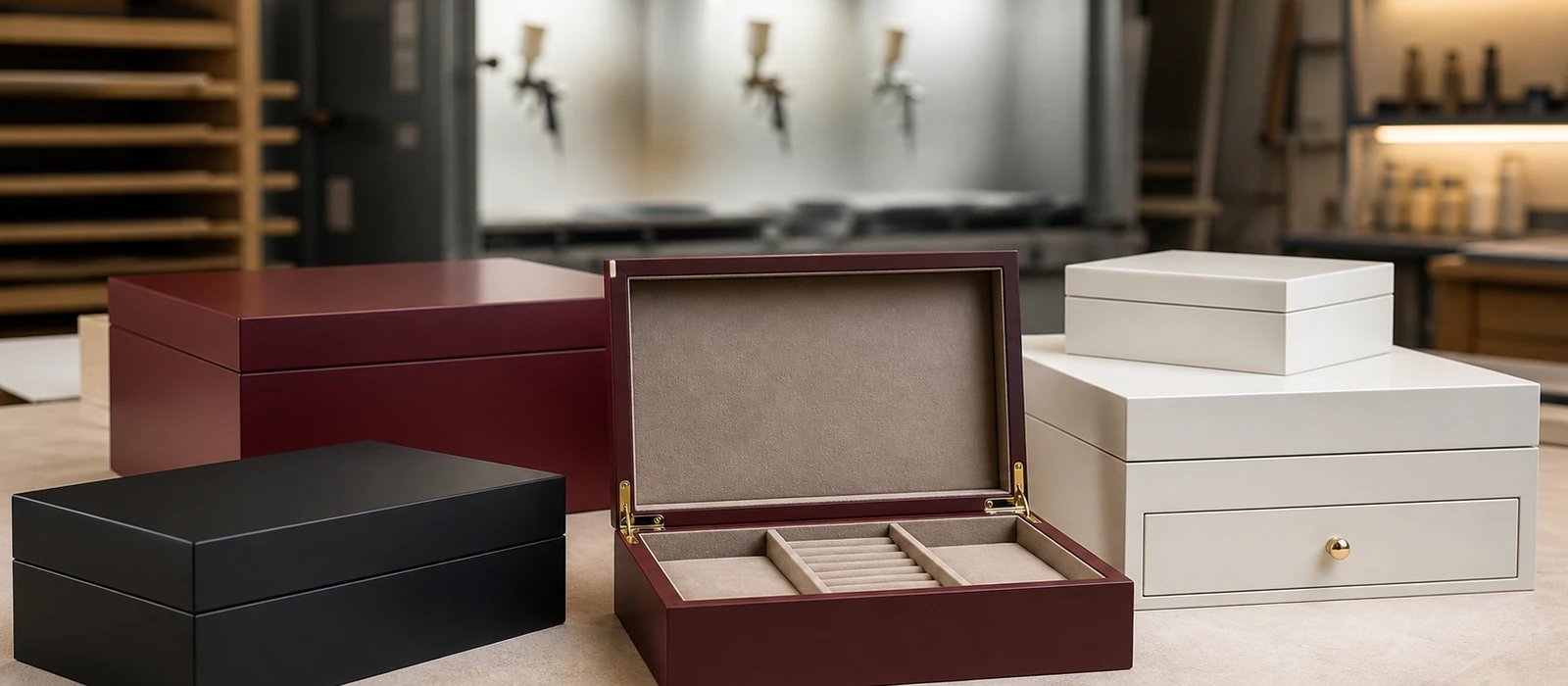

Spray painting for wooden boxes can create a refined matte, satin or high-gloss presentation, but a color name alone does not define the result. If the substrate, edge sealing, primer, sanding, sheen and sample standard are unclear, buyers may receive uneven edges, visible sanding marks or a finish that looks different under another light.
Direct answer: Spray painting for wooden boxes is a controlled finishing system in which prepared components receive compatible sealer, primer, color and, where specified, clear coats. MDF is often the practical choice for opaque premium finishes because its smooth, uniform surface machines consistently and does not introduce natural knots or grain variation. The approved sample still defines the result.
What Is Spray Painting for Wooden Boxes?
Spray painting atomizes liquid coating across prepared box parts to produce opaque color, controlled sheen or a clear protective layer. The visible surface reflects the complete system below it, not only the final spray pass.
The USDA Wood Handbook chapter on finishing explains that finishes contribute appearance, protection and cleanability, and that substrate properties affect application and service life. For indoor presentation boxes, appearance and cleanability may drive the specification, but the exact coating must still match the handling and exposure expected in use.
A typical buyer should define four outcomes before discussing paint layers:
- the color reference and acceptable color variation;
- the target sheen and how it will be assessed;
- the surfaces and edges that must receive the finish; and
- the handling, storage and cleaning conditions the box is expected to face.
Spraying with flammable or combustible materials is also a controlled industrial activity. For example, OSHA 29 CFR 1910.107 addresses spray areas, mechanical ventilation, ignition sources and residue management. That US workplace rule is not a global factory certificate, but it illustrates why a credible spraying operation requires more than a clean-looking sample room.
For buyers, spray painting for wooden boxes should therefore be specified as a repeatable manufacturing process, not just a visual request.
Why Is MDF Often the Smart Substrate for Spray Painting Wooden Boxes?
MDF is an engineered wood panel made from refined lignocellulosic fibres consolidated with adhesive under heat and pressure. According to the European Panel Federation’s MDF technical resource, its uniform, close-packed fibre distribution supports detailed machining on faces and edges, while its smooth, stable surfaces provide a strong base for painting, foil or veneer.
These characteristics are particularly useful for custom wooden packaging:
- Smooth opaque finishes: MDF has no knots and no natural grain pattern that must be visually matched under an opaque coating.
- Repeatable machining: Uniform material supports CNC-cut recesses, routed profiles, lid details and consistent component shapes.
- Design flexibility: The same substrate can support painted, lacquered or veneered directions when the construction and preparation are appropriate.
- Batch consistency: Buyers can approve a controlled color and surface effect without making natural grain variation the central visual feature.
- Practical cost positioning: For many premium gift and presentation boxes, MDF can allocate more of the budget to finish, hardware, inserts and branding instead of to visible solid timber.
Manufacturer Insight: MDF is the most common substrate in our current order mix
In XRX’s current typical order mix, MDF is the most frequently selected substrate for custom wooden boxes. Buyers commonly choose it because it balances market-appropriate cost control, repeatable machining and a premium painted, lacquered or veneered presentation. This is an XRX order observation—not an industry market-share statistic and not a claim that MDF suits every project.
MDF is especially persuasive when the design calls for an opaque brand color, a smooth matte finish, or a built-up glossy surface. A buyer seeking visible natural grain may instead prefer solid wood or a natural veneer over a suitable core. The broader material trade-offs are covered in our MDF vs solid wood boxes guide.
What are the limits of MDF?
MDF does not become premium merely because paint is applied. Machined edges can absorb coating differently from factory faces. The EPF guidance on finishing MDF edges recommends clean machining, sanding, an appropriate sealer and compatibility checks between the sealer and subsequent finish. Edge preparation is therefore part of the appearance specification, not an invisible shortcut.
When MDF is selected for spray painting for wooden boxes, face and edge preparation must be approved together.
Buyers should also confirm the board grade, thickness and intended exposure. Standard interior MDF should not be described as waterproof. Where composite-wood rules apply, documentation must match the destination market and finished product. For the United States, the EPA’s TSCA Title VI information identifies MDF among regulated composite wood products and explains certification and labeling requirements.
How Does the Spray Painting for Wooden Boxes Process Work?
The exact coating chemistry and number of applications vary. A reliable process therefore starts from the coating supplier’s instructions, the substrate, the geometry and an approved sample—not from a universal claim about a fixed number of coats.
| Process stage | What it controls | What the buyer should approve |
|---|---|---|
| Substrate and machining review | Panel grade, component shape, edge quality and joint visibility | Material, construction drawing, exposed surfaces and edge profiles |
| Sanding and cleaning | Tool marks, raised fibres, dust and surface uniformity | Sample surface under agreed lighting |
| Edge sealing and priming | Absorption, pore filling, color base and adhesion foundation | Edge coverage, primer compatibility and acceptable witness lines |
| Color application | Hue, coverage and uniformity across faces, edges and corners | Physical color reference and viewing conditions |
| Clear coat or finish build, if specified | Sheen, depth, cleanability and final appearance | Finish system, target sheen and reference sample |
| Flash-off, curing and intermediate sanding | Solvent or water release, film development and smoothness between stages | Supplier-defined process and when inspection or packing may occur |
| Final inspection and packing | Color consistency, dust nibs, scratches, blocking and contact damage | Defect limits, handling method and protective packing |
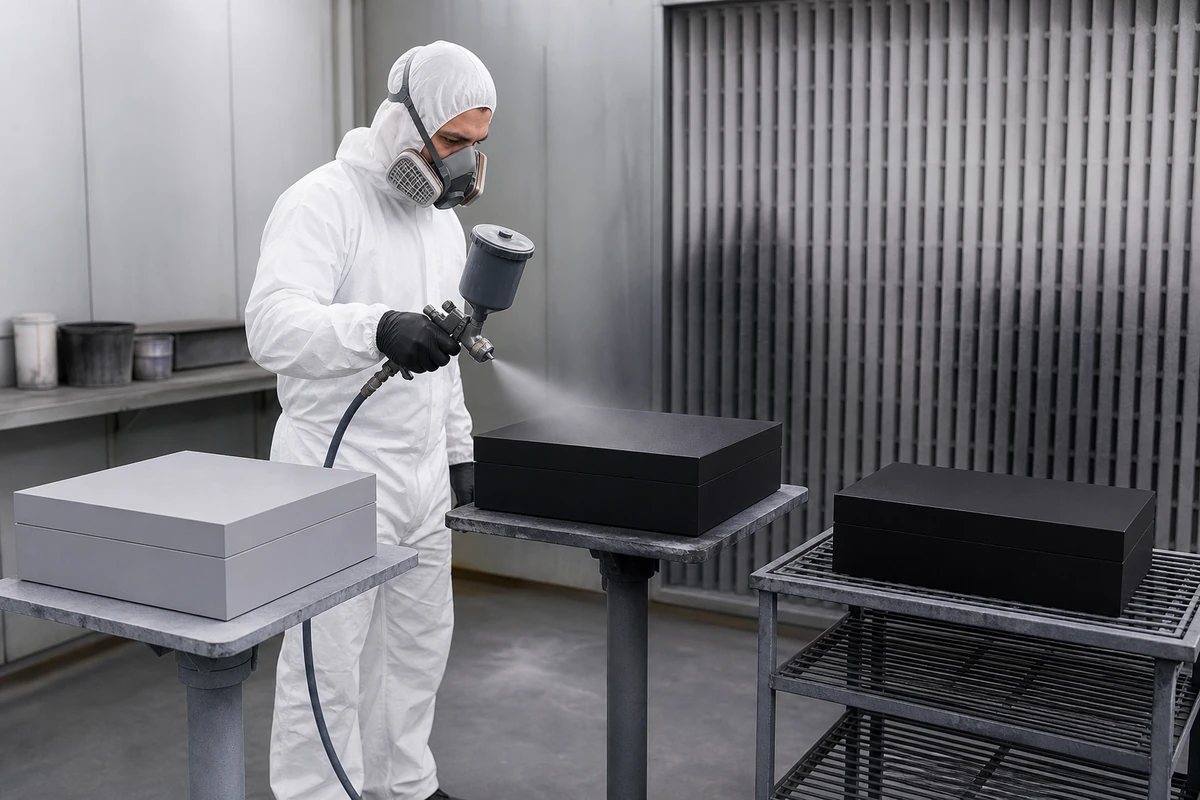
Manufacturer Insight: approve the surface system, not only the top color
From a manufacturing perspective, the most useful approval sample combines the actual substrate, machined edge profile, primer system, color, sheen and branding process. A flat color chip can define direction, but it cannot reveal how an MDF edge, lid joint, routed logo area or curved corner will look after production finishing.
This is also why changing the board, primer, coating chemistry or sheen after sample approval can be consequential. The change may affect absorption, sanding, color appearance, adhesion or cure behavior even when the written color name remains unchanged.
How Do MDF, Solid Wood and Veneer Behave Under Painted Finishes?
Substrate selection should follow the intended visual language. MDF is usually the strongest starting point for a uniform opaque finish; solid wood is valuable when natural material character is part of the design; veneer delivers real wood grain over a panel construction and is normally chosen to show that grain rather than hide it.
| Substrate | Main finish advantage | Main control point |
|---|---|---|
| MDF | Smooth, uniform face; detailed machining; no knots or grain matching under opaque paint | Seal machined edges; confirm grade, thickness and market documentation |
| Solid wood | Authentic grain and material identity; clear or translucent finishes can celebrate variation | Moisture condition, grain, joints and natural color variation |
| Natural veneer over a suitable core | Real wood appearance with controlled panel construction and grain selection | Veneer species, cut, grain matching, edge treatment and adhesive/finish compatibility |
Choose MDF when its smoothness, machining and surface consistency serve the design—not only because its raw panel price looks lower. Use solid wood when its construction or natural character genuinely supports the brief.
What Finish Quality Should Buyers Specify and Measure?
Words such as “matte,” “high gloss,” “luxury black” and “piano finish” are not complete acceptance criteria. Buyers should combine a physical reference sample with written controls.
For spray painting for wooden boxes, those controls should cover both measurable targets and the visual attributes a single number cannot describe.
Color and viewing conditions
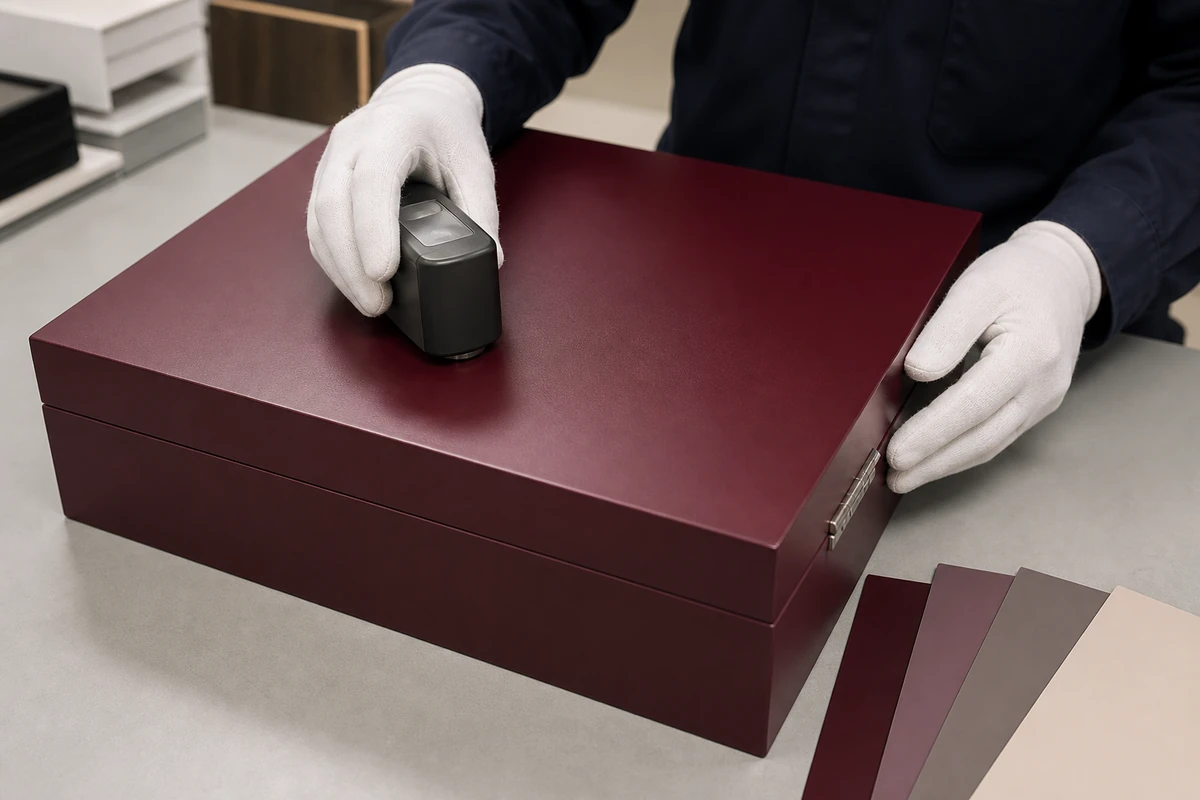
Identify the color system or approved physical swatch, then agree how production parts will be compared. Lighting, angle, surrounding colors and surface texture can change perception. If an instrument tolerance is required, name the measurement method, device conditions and acceptance limit rather than inserting an unsupported number into the RFQ.
Sheen and gloss
ASTM D523-25 measures specular gloss using defined glossmeter geometries. ASTM also notes that gloss readings do not capture every visual property: reflected-image clarity, haze and texture can still change what a buyer sees. For that reason, a numeric gloss target and an approved appearance sample can complement each other.
If the decision is specifically between low-sheen and polished looks, see our piano lacquer vs matte finish guide. This article focuses on manufacturing control rather than declaring one sheen universally better.
Edge coverage and joint appearance
Inspect routed edges, corners, lid gaps, hinge recesses, feet and logo areas. These locations reveal uneven absorption or sanding more readily than a broad flat face. Define which construction lines are normal and which gaps, ridges or paint accumulations are unacceptable.
Coating resistance and test language
A named test is useful only when the method fits the substrate and coating. ISO 2409:2020 provides a cross-cut method for assessing resistance to separation and can be used on wood under the relevant procedure, but ISO explicitly states that it is not a direct measurement of adhesion strength. Buyers should specify the applicable method, conditioning, test location, classification or pass/fail criterion and whether the finished sample may be damaged by the test.
Avoid vague requests such as “scratch-proof,” “waterproof” or “never fades.” Instead, describe actual use and agree a relevant test or inspection method. A presentation box stored indoors, a retail display handled daily and a package exposed to distribution conditions need different evidence.
Which Applications Benefit from Painted MDF Wooden Boxes?
Painted MDF is particularly effective when the brand wants a controlled, repeatable surface rather than prominent natural grain. This makes spray painting for wooden boxes useful across several premium packaging applications:
- perfume and cosmetics presentation boxes in a defined brand color;
- jewelry and watch boxes with coordinated exterior and lining palettes;
- wine and spirits gift boxes using matte, gloss or veneered-and-painted combinations;
- electronics and sales-kit boxes with precise cavities and modern opaque finishes;
- display boxes with routed profiles, layered components or contrasting painted areas; and
- reusable gift packaging where presentation and organized storage are primary duties.
Our custom wooden products archive shows how finish direction can be matched to different box applications and structures.
The XRX wooden-box finishing guide gives a broader overview of finish families. For a spray-painted project, application duty should still lead the choice. A beautiful indoor gift-box finish is not automatically a validated outdoor, chemical-resistant or transport-protection coating.
What Should Buyers Include in a Spray-Painting RFQ?
A complete RFQ for spray painting for wooden boxes should let suppliers quote the same construction and remove ambiguity before sampling:
- product application, box style, finished dimensions and expected quantity;
- MDF grade and thickness, or a request for a justified substrate recommendation;
- destination markets and required composite-wood documentation;
- exposed faces, internal faces, edges and areas that should not be painted;
- color system, physical color sample or approved reference product;
- matte, satin or gloss direction and any instrumental target;
- coating type or performance duty if already specified by the brand;
- logo process, logo position and whether it is applied before or after the final clear layer;
- hardware, feet, lining and insert materials that may contact the finish;
- acceptable construction lines and surface-defect limits;
- sample quantity, approval responsibilities and golden-sample control; and
- individual wrapping, interleaving and outer packing needed to protect finished surfaces.
Do not request a coating recipe solely by copying another project. The manufacturer and coating supplier should match the system to the actual MDF, geometry, color, sheen, branding and end use.
How Should Buyers Inspect the Painted Sample?
Use the loaded, assembled box—not only a detached painted panel.
- Compare color and sheen with the approved reference under the agreed lighting and angle.
- Inspect broad faces, machined edges, corners, lid joints, recesses and the area around hardware.
- Look for visible sanding marks, pinholes, sink-in, dust nibs, orange peel, runs, dry spray or uneven coverage according to the agreed defect standard.
- Open and close the box to check paint clearance, sticking, edge contact and hardware movement.
- Fit the product and inserts, then check whether fabric, foam, accessories or removable trays rub the painted surface.
- Confirm logo color, registration, depth and interaction with the coating.
- Perform only the agreed coating or handling checks using the specified conditioning and acceptance method.
- Record the approved sample, material, coating direction, color, sheen, branding and permitted production tolerances in one controlled specification.
For a project review, send the box dimensions, application, target color, sheen, logo, quantity and reference images through our contact page. The goal is to recommend a manufacturable surface system and a sample standard—not to prescribe MDF when another construction better fits the brief.
Frequently Asked Questions
Why is MDF commonly used for painted wooden boxes?
MDF has a smooth, uniform fibre structure that supports repeatable machining and opaque finishing without natural knots or grain matching. When its faces and machined edges are properly prepared, it offers a practical balance of finish quality, design flexibility and cost control for many indoor presentation-box projects.
Can MDF wooden boxes look premium?
Yes. Premium appearance comes from the complete design and process: proportion, machining, edge sealing, primer, sanding, color application, sheen control, hardware, lining and sample approval. MDF provides a suitable base, but it does not guarantee a premium result by itself.
Is MDF always cheaper than solid wood?
No. MDF often supports practical cost control, but total price depends on box size, thickness, machining, coating build, polishing, hardware, lining, logo, quantity, quality limits and packing. Compare complete specifications rather than raw panel prices.
What should buyers approve on a paint sample?
Approve the actual substrate and construction together with color, sheen, edge coverage, surface texture, visible joint lines, logo, hardware interaction, insert contact, defect limits and packing. Record lighting or measurement conditions when appearance is contractually important.
How are matte and gloss finishes measured?
Specular gloss can be measured with a glossmeter under a named method such as ASTM D523. The agreed geometry, instrument conditions, target and tolerance should be written into the specification. A physical sample remains useful because haze, texture and reflected-image clarity also affect visual appearance.
What causes uneven color or surface defects?
Possible causes include inconsistent sanding, unsealed absorbent edges, dust, incompatible materials, uneven application, insufficient flash-off or cure, polishing variation and handling before the film is ready. The actual cause should be diagnosed from the substrate, coating system, process records and defect location.