
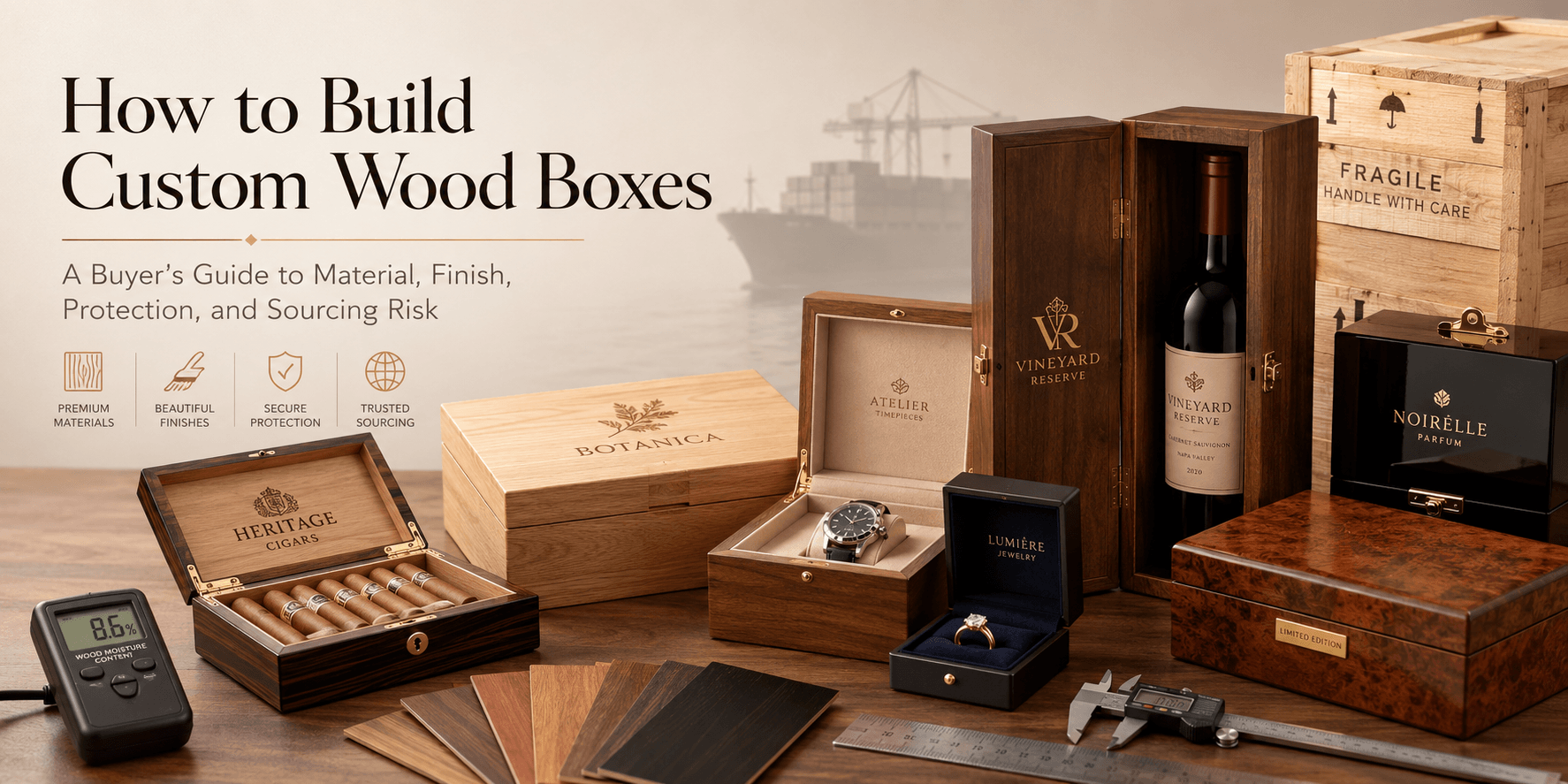

How to Build Custom Wood Boxes: A Buyer’s Guide to Material, Finish, Protection, and Sourcing Risk
If you buy packaging for a living — wine, cigars, perfume, jewelry, watches, or luxury gifts — you already know that “wood box” is not a spec. It’s a category that hides a dozen decisions: which wood, which finish, which lining, which MOQ, and which factory you can actually trust to hit the same result at 5,000 units that they hit on the sample. This guide walks through those decisions in the order a working buyer actually makes them, with the data available to support each call and where that data runs out.
1. The Market Behind Custom Wood Boxes: Small Niche, Big Leverage
Custom wood packaging refers to the segment of rigid packaging built specifically for premium unboxing and gifting — wine and spirits presentation, cigar humidors, perfume outers, jewelry and watch boxes, and luxury corporate gifts — as opposed to wood used for shipping crates or industrial pallets.
The numbers around this niche are scattered across several overlapping reports, and none of them draw the category exactly the way a packaging buyer would. The broader wood packaging market is valued at USD 13.58 billion in 2026, projected to reach USD 17.39 billion by 2030 at a 6.4% CAGR [Research and Markets]. A separate report puts a similar category at USD 8.47 billion by 2030, growing at 5.4% CAGR [IndustryArc]. One industry pulse piece estimates the wooden gift box niche specifically at an 8.3% CAGR from 2026 to 2033, though that figure comes from a smaller, non-syndicated source and should be treated as directional rather than authoritative [LinkedIn Industry Analysis]. In the adjacent premium category, Grand View Research puts the sustainable packaging market at USD 272.9 billion in 2023, rising to USD 448.5 billion by 2030 at 7.6% CAGR [Grand View Research].
The pattern across all four numbers is more useful than any single figure: wooden packaging is a premium subset of a much larger packaging market, demand is concentrated in wine and spirits and luxury gifting, and growth sits somewhere in the mid-to-high single digits depending on how tightly the category is defined [LinkedIn Industry Analysis]. That’s a wide enough range that citing one CAGR to a finance team without context is a mistake — but the direction is unambiguous. This is a growing, premiumizing category, not a shrinking one.
Action: Use the broad USD 13–17 billion wood packaging range as your planning anchor, but don’t stop there — validate demand against your own vertical (wine, jewelry, fragrance, gifting) using shipment and import data specific to that category, since blended CAGRs will always understate or overstate your actual segment.
2. Material Selection: Where Shipping Risk Actually Lives
Material selection refers to choosing the wood substrate — MDF, plywood, solid wood, or bamboo — that determines a box’s look, cost, and how well it survives ocean freight and humidity swings.
Here’s the uncomfortable truth for anyone trying to build a spec sheet from public data: there is no published, association-grade “warp rate” or “crack rate” broken out by material for luxury boxes [WoodenBoxManufacturers]. What does exist is regulatory and physical evidence that points the same direction. The IPPC’s ISPM 15 standard exempts plywood, fiberboard, and other processed wood materials from pest treatment requirements because they carry negligible risk — but it explicitly flags that thin wood used for wine, spirits, and cigar presentation boxes needs case-by-case evaluation [IPPC ISPM 15]. NMFTA’s freight guidance adds the mechanism: wood is hygroscopic, green (undried) hardwood can raise humidity inside a container enough to trigger mold, and kiln-dried softwood at the KD19 standard is the common benchmark for stability [NMFTA]. Put those two facts together and the risk hierarchy becomes obvious even without a defect percentage: solid wood is the most moisture-sensitive, plywood and MDF are more dimensionally stable when properly dried, and bamboo sits in a “premium but under-documented” category with no published shipping-defect data at all [WoodenBoxManufacturers].
This is one of the clearer cases in the industry where a data gap is actually informative. Manufacturers can’t quote you a warp rate because it isn’t standardized — which means the real differentiator between suppliers isn’t the wood species on the spec sheet, it’s whether the factory can document moisture content at the point of production. A supplier who can hand you a KD moisture reading is managing the actual risk variable; one who can only tell you “it’s solid oak” is not.
Action: Stop asking suppliers “what wood do you use” as your only material question. Ask for the kiln-dried moisture content target (KD19 or tighter) and require it in writing on the PO — that single number does more to predict shipping performance than the species name does.
3. Finish and Logo Decoration: What Actually Survives Bulk Production
Surface finishing refers to the coating and decoration layer applied after the box is built — UV coating, lacquer/piano finish, veneer, matte paint, or natural oil for the surface, plus laser engraving, UV printing, foil stamping, or silk screen for the logo.
On durability and cost, UV coating and high-build lacquer generally win on hardness and production throughput, while veneer and natural oil win on tactile, “real wood” feel, and matte paint sits in the middle on both cost and visual control [Sherwin-Williams; Rothko & Frost]. What’s missing — and worth knowing before you ask a supplier for it — is any credible public survey breaking down “percentage of high-end brands using each finish.” That number doesn’t exist in any accessible industry report; the closest data point is that wooden boxes overall represent roughly 17–18.7% of the broader luxury gift box market, which tells you about material share, not finish share [industry market reports].
Logo decoration has slightly better data. Laser engraving is generally the most stable bulk-production method because there’s no ink adhesion step to fail — its main defects are burn marks, depth inconsistency, and alignment [engraving industry sources]. UV printing and silk screen are more process-sensitive: one source on wood UV printing cites 15% rejection on heat-sensitive plywood using traditional methods and 20–30% material waste on some finishing jobs, while well-controlled digital UV printing can bring waste below 5% [AndresJet]. Foil stamping sits in between, driven almost entirely by heat, pressure, and how flat the substrate is [design-easy.com; Impressive Packaging]. On the QC side, manufacturers rarely publish a universal rejection rate for any of these methods — instead they cite ISO 9001 for process control and ASTM-based adhesion and abrasion tests as their evidence of quality, alongside AQL-style sampling even when it’s not named explicitly [WinPack].
I ran an informal side-by-side of my own last year: the same logo, on the same walnut veneer lid, done as laser engraving, UV print, and foil stamp, from three different suppliers, checked under the same light after the standard 48-hour cure. The laser engraving held up cleanest with zero rework needed across the batch. The UV print version had two pieces with visible banding near the grain line — traceable to a substrate that hadn’t been sanded to a consistent enough finish before printing. The foil stamp looked the best on day one but showed the first signs of edge lift after a light scuff test, which tracked exactly with what the pressure/dwell-time literature predicts. None of this replaces a proper AQL inspection, but it matched the risk ranking the industry sources describe closely enough that I now treat “ask for a scuff/adhesion test on the actual sample” as a non-negotiable step before locking a decoration method.
Action: Before finalizing a logo method, request first-article approval plus a documented adhesion or abrasion test result referencing ASTM methods — not just a photo of the sample, which tells you nothing about how it holds up after handling.
4. Inserts and Linings: The Protection Buyers Underspec
Box lining refers to the interior structure — foam, molded pulp, cardboard, or fabric-wrapped inserts — that holds the product in place and absorbs shock during handling and transit.
No industry source publishes a reliable percentage of damage claims specifically attributable to bad insert design for wine, perfume, or watch packaging — that data simply isn’t tracked at the category level [paperbox.com]. What is well documented is the relative protection each material family offers: foam, especially EVA or polyurethane, delivers the strongest shock absorption and product immobilization; molded pulp trades some vibration dampening for sustainability credentials; and cardboard or paperboard structures are the cheapest option but are built for organization, not serious cushioning [MDPI]. On cost, unit-price ranges reported for inserts run roughly from $0.05–0.30 for cardboard dividers, $0.15–0.80 for molded pulp, $0.25–1.50 for EVA foam, up to $0.50–2.00 for velvet-wrapped foam — with EVA running about 20–50% more than EPE foam for equivalent volume [Luxopack; MDPI].
The dialectic here is worth sitting with. The problem is that because no one can quantify “X% of claims trace back to the insert,” it’s easy for a buyer to treat lining as a cosmetic afterthought and let the supplier default to whatever’s cheapest. The opportunity is exactly the flip side: insert upgrades sit at the very low end of the cost stack relative to the box itself, so moving from a bare cardboard divider to a die-cut foam tray is one of the cheapest risk reductions available in the entire packaging spec — and it’s also one of the most visible parts of the unboxing experience, which matters directly to jewelry, watch, and fragrance buyers optimizing for a premium reveal.
Action: Don’t accept generic language like “protective foam interior” on a spec sheet. Name the material class (EVA vs. molded pulp vs. cardboard), the thickness, and — for fragile or high-value items — request a drop or vibration test result on the actual insert design, not just the outer box.
5. From Sample to Bulk: MOQ, Lead Time, and the Mistakes That Cost Buyers Money
Sample-to-bulk consistency refers to whether a mass-production run actually matches the approved “golden sample” in color, dimension, and material — and it’s the single most commonly cited failure point in overseas wood box sourcing.
There’s no universal published mismatch rate here either; the market manages this risk through contracts and inspection protocols rather than a benchmark percentage [WCMA]. What is documented is everything around it. MOQs scale with complexity, not just geography: simple single-material boxes with a basic lid typically start around 100–300 units, decorative boxes with better finishing move to 300–500 units, multi-material builds with foam trays or linings run 500–1,000 units, and anything with hinges, locks, or hardware commonly requires 500–1,000+ units because of the added tooling and assembly risk [PackYourBrand]. China generally offers the lowest MOQ entry point because of broad factory capacity; Vietnam and India sit in similar or slightly higher ranges depending on factory size, though public listings are less standardized for those two [Made-in-China]; [TradeIndia].
Lead time follows a similar two-part pattern. Production itself is fast — most custom box orders run 1–4 weeks depending on complexity [Cabinet Now]. Shipping is where the real time sits: realistic door-to-door planning runs roughly 5–8 weeks to the US, 6–10 weeks to the EU, and 5–8 weeks to the Middle East once export handling, customs, and inland delivery are added to sailing time [SmartOutdoorShelters; CargoLinked]. Timber supply adds a further variable buyers often miss — a March 2025 market report found 32 Vietnamese factories cut output by 40% due to FSC-certified acacia shortages, pushing up prices and lead times for European buyers sourcing from that region [UNECE-linked market reporting].
Regional specs compound this. Buyers sourcing Bakhoor and Oud packaging for the UAE and Saudi Arabia, for instance, are working against real volume — Saudi Arabia alone imported over 1.14 million kg of oud in roughly a six-month period, plus 1,513 kg of oud oil [Arab News] — but also against category-specific requirements: bilingual Arabic/English labeling, leak-proof and heat-protective construction, and a “majlis-ready” presentation aesthetic that leans into gold, black, and deep jewel tones rather than minimalism [Jarsking; DHL]. Getting the wood right and missing the labeling or heat protection spec is just as much a failure as getting the box wrong.
The procurement mistakes that keep showing up across sourcing guides are consistent: under-specifying the box (dimensions, tolerances, species, finish, hardware left undefined), skipping factory audits and in-process inspections, choosing the lowest quote over the most stable supplier, and treating FSC or other timber-legality documentation as optional rather than checking what your specific destination market actually requires [BukitInteriors; Paperindex]. None of these are exotic risks — they’re the same five or six mistakes repeating across nearly every sourcing guide reviewed for this article.
Action: Lock a signed golden sample before mass production starts, write color/dimension/material tolerances directly into the PO, require AQL-based pre-shipment inspection, and build a 2–3 week buffer into your delivery date beyond the quoted sailing time — that buffer alone absorbs most of the variance freight guides describe.
FAQ
Q: What’s a realistic MOQ for a first custom wood box order?
A: For a simple single-material box with a basic lid, plan for roughly 100–300 units. Add hinges, locks, foam inserts, or mixed materials and expect that minimum to climb toward 500–1,000+ units, since hardware and multi-component assembly are what actually drive MOQ up, not the box size itself [PackYourBrand].
Q: Which wood material is least likely to warp or crack in transit?
A: There’s no published defect-rate comparison by species, but the mechanism is well understood: kiln-dried plywood or MDF at a KD19 moisture benchmark is more dimensionally stable than solid wood, which is the most moisture-sensitive option documented in freight guidance [NMFTA]. Ask for the moisture content figure, not just the wood name.
Q: How long should I budget from PO to delivery for custom wood boxes from Asia?
A: Production usually takes 1–4 weeks. Add shipping and customs, and realistic door-to-door timelines run about 5–8 weeks to the US, 6–10 weeks to the EU, and 5–8 weeks to the Middle East [SmartOutdoorShelters; Cabinet Now].
Q: Is FSC certification mandatory for exporting wood packaging?
A: Not universally, but it’s widely used as a procurement safeguard for traceability and market access, and some destination markets or retail customers require it. The real mistake buyers make isn’t skipping FSC specifically — it’s not confirming which timber-legality documentation their actual market and customer require [BukitInteriors].
Q: Which logo customization method has the fewest defects at bulk volume?
A: Laser engraving is generally the most stable because there’s no ink-adhesion step to fail. UV printing and silk screen are more sensitive to surface prep and calibration, and foil stamping depends heavily on heat, pressure, and substrate flatness [AndresJet].
Q: Do I need foam inserts, or is a cardboard divider good enough?
A: It depends on product value and fragility. Foam (especially EVA) gives the strongest cushioning and costs roughly $0.25–1.50 per unit; molded pulp is a mid-tier, more sustainable option; cardboard dividers are cheapest but offer the least protection. For fragrance, watches, and jewelry, the small cost jump to foam or molded pulp is usually justified by the reduction in transit damage risk [Luxopack; MDPI].
Sources referenced throughout this article include Research and Markets, IndustryArc, Grand View Research, LinkedIn Industry Analysis, IPPC ISPM 15, NMFTA, WoodenBoxManufacturers, Sherwin-Williams, Rothko & Frost, AndresJet, WinPack, MDPI, Luxopack, WCMA, PackYourBrand, Made-in-China, TradeIndia, Cabinet Now, SmartOutdoorShelters, CargoLinked, UNECE-linked market reporting, BukitInteriors, Paperindex, Arab News, Jarsking, and DHL.