
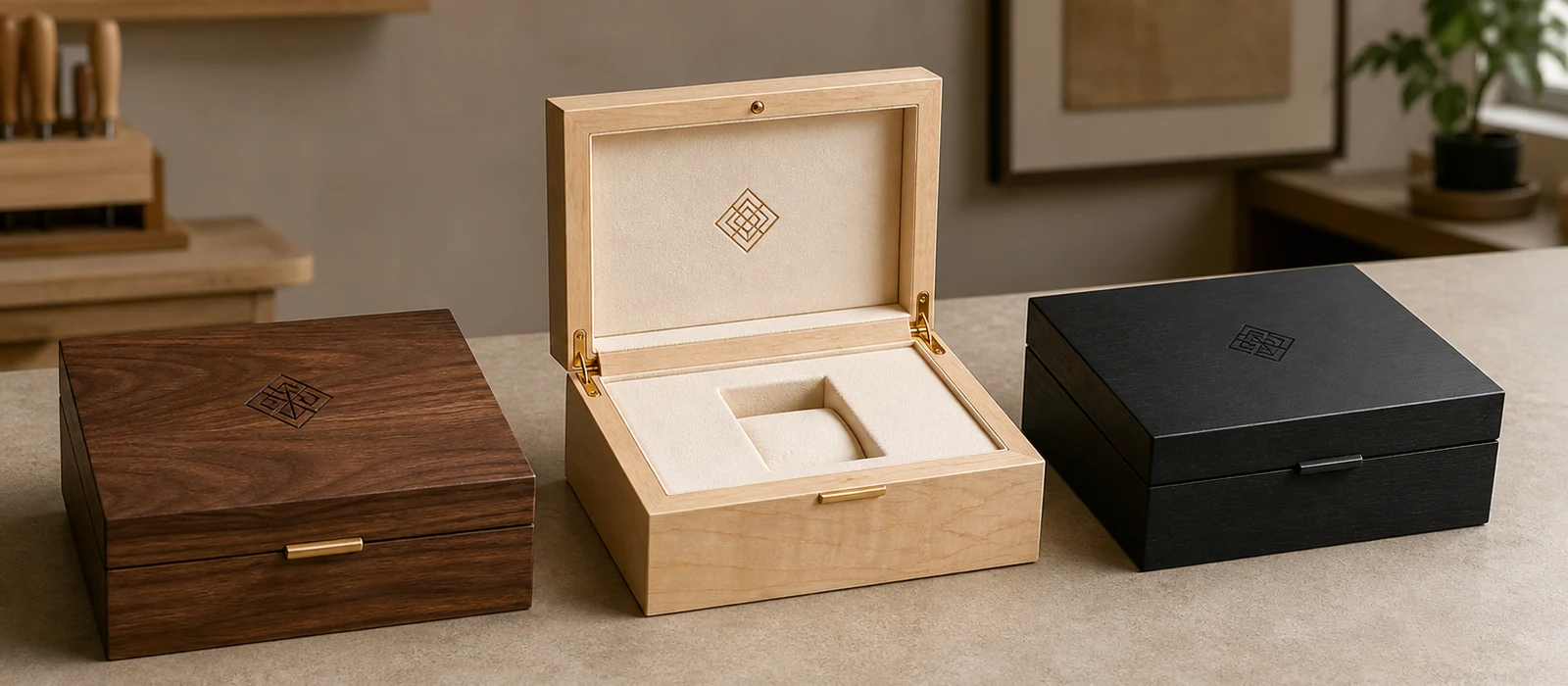

Laser engraving on wooden boxes can look precise in a rendering yet turn inconsistent when the wood species, veneer, coating, artwork, machine settings, or positioning method changes. If buyers specify only “engrave our logo,” they may receive an unexpected tone, shallow detail, smoke staining, poor small text, or placement that varies from the approved design.
Direct answer: Laser engraving uses a controlled beam to alter or remove material at selected areas of a wooden box. It is well suited to logos, names, line art, serial information, and decorative patterns when buyers approve the actual substrate and finish. The final contrast, depth, edge quality, and color must be confirmed by sample.
What Is Laser Engraving on Wooden Boxes?
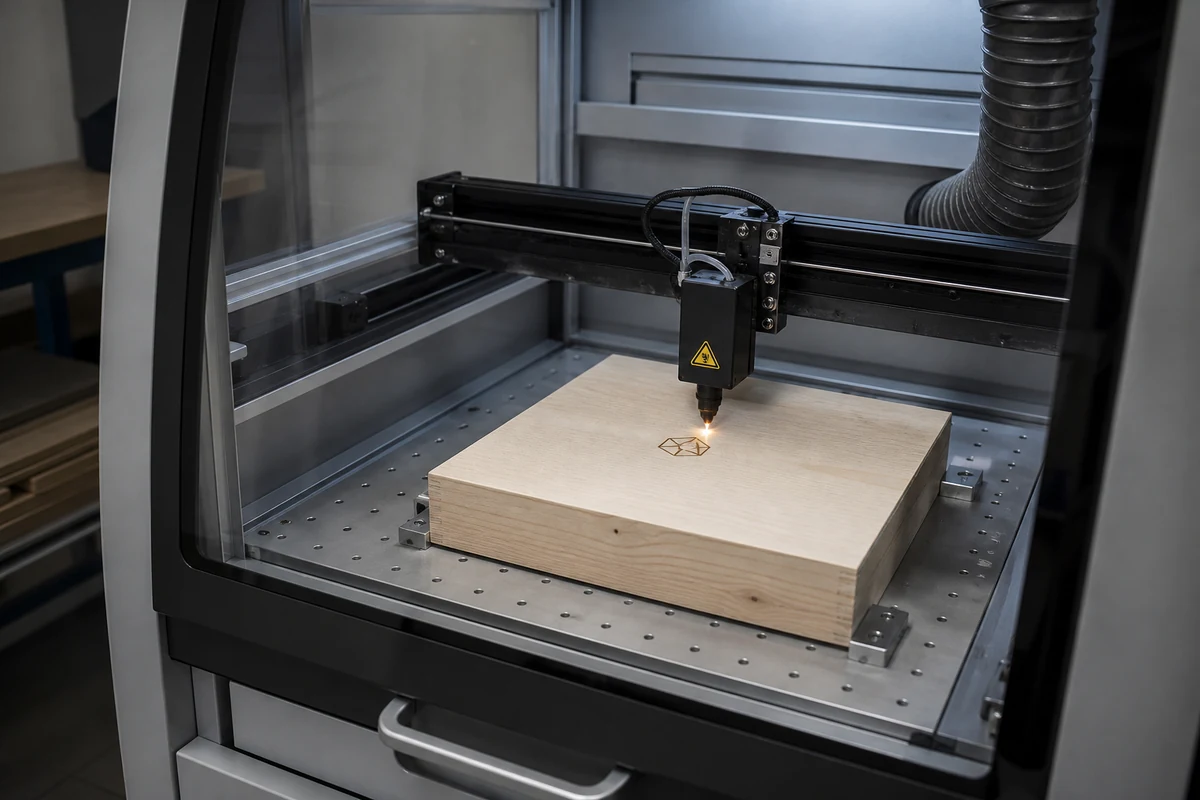
Laser engraving on wooden boxes is a computer-controlled marking process. Artwork directs the laser across the box surface, where concentrated energy changes or removes a shallow layer of wood or coating. The US FDA includes engraving and marking among material-processing laser applications.
For packaging buyers, the important distinction is between the process and the appearance. “Laser engraved” identifies how the mark is made; it does not define one brown color, a universal depth, a fixed resolution, or a guaranteed level of durability. Pale maple, dark walnut, veneered MDF, stained wood, and painted MDF can respond differently even when the same artwork is used.
Laser engraving is commonly considered for perfume boxes, jewelry boxes, watch boxes, wine boxes, cigar boxes, corporate gift boxes, and presentation cases. It can place a discreet logo on a lid, create an all-over pattern, add product identification, or expose a contrasting layer beneath an opaque coating.
How Does the Laser Engraving Process Work?
For laser engraving on wooden boxes, a repeatable production route normally follows these stages:
- confirm the box substrate, veneer or solid-wood species, coating state, component construction, and intended engraving face;
- review vector or raster artwork, minimum features, dimensions, orientation, and placement datum;
- create test pieces using the proposed material and finish system;
- select compatible machine, focus, speed, power, resolution or line settings, and extraction conditions;
- fixture the box so every lid or panel begins from the same physical reference;
- engrave the trial, then clean residue with a method compatible with the surface;
- inspect contrast, depth, edge definition, smoke marks, fine details, position, and surrounding finish;
- approve a physical sample and retain the production settings and reference sample; and
- monitor the process by lot and control any material, coating, artwork, or equipment change.
Equipment suppliers publish starting parameters, but these are not purchase-order guarantees. The Taiwan Forestry Research Institute study demonstrates that physical and software settings can change engraving depth and color difference. The correct production settings should therefore be established on the actual box construction.
Manufacturer Insight: Engraving should be tested at the correct production stage
Engraving raw wood and engraving a sealed, stained, lacquered, or painted surface are different routes. If the logo is engraved before finishing, later sanding or coating may soften its edges or change its contrast. If it is engraved after finishing, the laser may remove or discolor the coating and expose the substrate. Specify the sequence before sampling, then keep that sequence for production.
Manufacturer Insight: A fixture is part of logo quality
Perfect artwork does not guarantee perfect placement. Hinges, lid overhangs, curved tops, assembled-box variation, and inconsistent loading can move the logo. A production fixture and a stated datum—such as the lid edge or centerline—make position measurable. Buyers should approve both the artwork size and its distance from defined box features.
Which Wood and Surface Types Are Suitable?
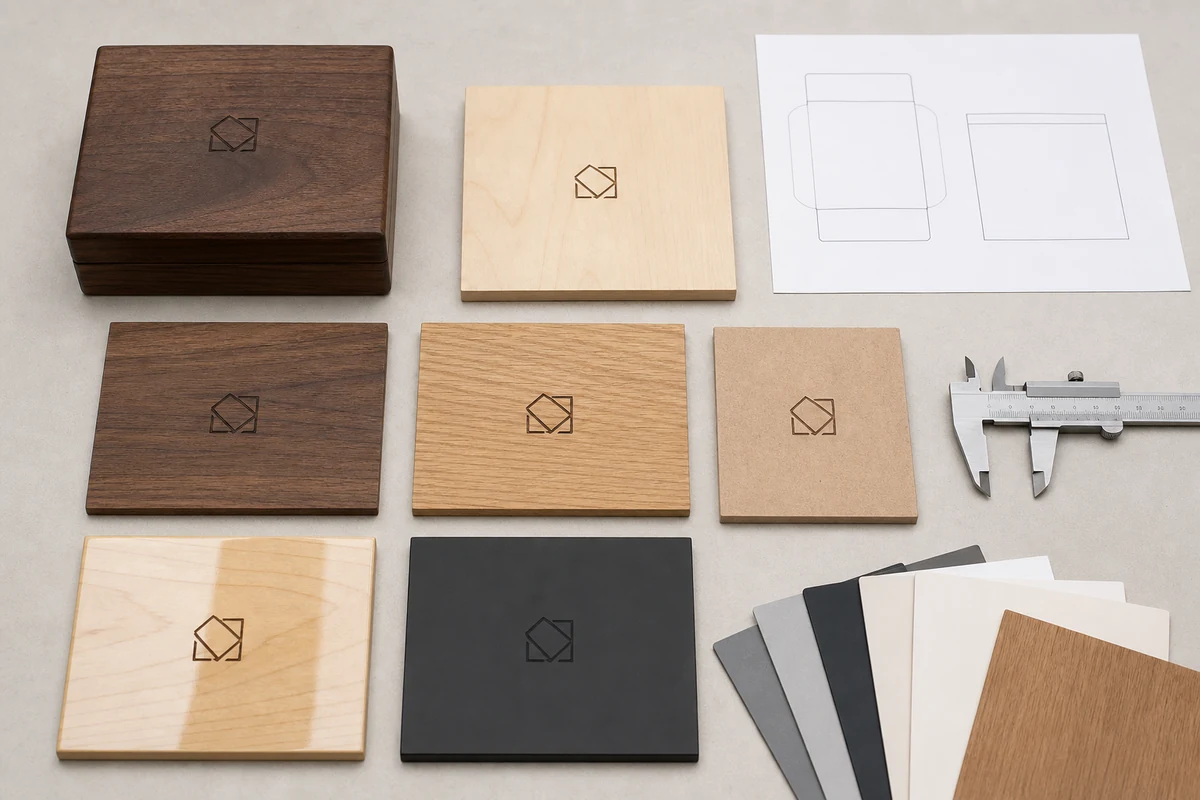
Material selection for laser engraving on wooden boxes begins with the real production substrate. Trotec’s material guide identifies solid wood, MDF, plywood, veneered wood, and other wood products as laser-processable categories. That broad compatibility does not mean they produce the same visual result.
| Material or surface | Expected engraving character | Buying consideration |
|---|---|---|
| Pale solid wood | Natural darkened contrast may be easy to see | Grain, knots, density, resin, and color variation can change the mark |
| Dark solid wood | Engraving may be subtle without added contrast | Approve legibility under target lighting and at final logo size |
| Veneered MDF | Can combine a real-wood face with a stable panel | Confirm veneer species, thickness, sanding, glue system, and edge construction |
| Raw MDF | Usually gives a uniform industrial substrate | Appearance is less grain-led; confirm sealing and any later coating route |
| Stained or clear-coated wood | Laser may interact with both coating and wood | Identify every coating layer and approve the engraving sequence |
| Opaque painted surface | Laser can remove or discolor the coating | Confirm exposed layer, edge cleanliness, residue, and color contrast |
Wood is a variable biological material. A study published by the Taiwan Forestry Research Institute found that power, feed speed, printing density, software color settings, and material density affected engraved depth or color difference in the tested wood-based materials. A separate peer-reviewed study of CO2 laser engraving on oak also evaluated how laser parameters changed the engraved surface.
These findings support a practical purchasing rule: do not approve laser engraving from artwork alone. Approve it on the real material and define how much natural variation is acceptable across the visible production lot.
How Does Laser Engraving Affect Appearance and Quality?
Quality approval for laser engraving on wooden boxes must consider both artwork and material. The process can reproduce crisp line art without adding a metal plate, transfer film, or printed ink layer. It also follows the surface beneath it, which makes material selection part of the graphic design. Grain can run through the logo; darker earlywood and lighter latewood may react differently; a veneered surface can produce a different tone from a solid-wood edge.
Fine text and thin negative spaces require special attention. Details that look clear on a screen may close up, weaken, or become irregular when reduced. Buyers should provide vector artwork where possible, outline fonts, identify minimum readable elements, and approve a full-size physical proof rather than a magnified photograph.
Laser engraving on wooden boxes does not automatically supply an exact Pantone color. If the brand requires a controlled gold, white, red, or other color, evaluate color filling, screen printing, foil stamping, a metal logo, or a combined process. Laser engraving can create the recess or natural contrast, while another process supplies the specified color.
| Branding method | Visual result and use | Main limitation to confirm |
|---|---|---|
| Laser engraving | Material-led recessed or discolored mark for understated monochrome branding | Tone and depth vary with substrate and settings |
| Screen printing | Applied flat color for brand colors and larger graphics | Ink adhesion, opacity, registration, and rub performance require approval |
| Foil stamping | Metallic or pigmented transfer for premium highlights | Tooling, heat, pressure, surface flatness, and foil compatibility matter |
| Metal logo | Separate three-dimensional emblem for a strong luxury statement | Attachment, thickness, edges, weight, and finish add complexity |
No method is automatically superior. The right choice depends on brand color, tactile effect, artwork detail, substrate, order quantity, budget, and the box’s handling environment.
What Safety and Process Controls Should a Manufacturer Use?
When laser engraving on wooden boxes is performed in production, laser safety is primarily a factory responsibility, but buyers can still evaluate whether a supplier understands the process. The OSHA Technical Manual explains that many industrial systems contain a higher-class source within a properly interlocked protective enclosure and calls for adequate ventilation where laser target interactions produce potentially hazardous fumes or vapors.
The laser system, extraction, fire controls, operating procedures, maintenance, material identification, and worker training should match the equipment and local requirements. A professional laser-system user guide warns against leaving laser processing unsupervised, notes the ignition risk of combustible material, and requires extraction of smoke and fumes. It also recommends obtaining safety information for materials being processed.
Buyers should disclose coatings, adhesives, veneers, fills, protective films, and other layers rather than calling the part simply “wood.” Unknown or incompatible surface chemistry is a reason to stop and verify, not to guess a machine setting.
Where Is Laser Engraving Most Useful?
Laser engraving on wooden boxes works especially well when the brand wants the mark to feel integrated with the material rather than attached to it. Common applications include:
- a centered logo on a perfume, watch, jewelry, wine, or cigar box lid;
- names, editions, dates, or serial information for controlled personalization;
- line-art patterns around a lid border or across a presentation panel;
- interior messages on a flat wooden lid panel;
- small product or compliance identifiers where the approved artwork remains legible;
- alignment marks or discreet assembly identification outside the visible presentation area; and
- engraving through an opaque coating to reveal a contrasting layer after sampling.
Large filled areas, photographic gradients, very small reversed text, highly curved faces, and variable dark grain can require more trials. For full-color graphics or a mirror-metallic effect, laser engraving may be only one part of the branding solution.
What Should Buyers Confirm Before Ordering?
Provide the manufacturer with a complete brief for laser engraving on wooden boxes:
- box type, external dimensions, construction, and quantity;
- exact wood species, veneer, MDF grade, coating layers, and finish sequence;
- engraving face and whether the box is engraved before or after assembly;
- vector artwork, outlined fonts, final logo dimensions, and orientation;
- placement datum and acceptable position tolerance agreed from the sample;
- target contrast and depth described by an approved physical reference, not adjectives alone;
- critical small text, line width, negative spaces, and any personalization data;
- requirement for natural variation, color fill, cleaning, sealing, or protective packing;
- sample stages, signed approval sample, and change-control rules;
- inspection method, viewing conditions, defect criteria, and sampling plan; and
- requested MOQ, quotation quantity tiers, individual-name data handling, and delivery requirements.
MOQ is project-specific. It can be influenced by box construction, material preparation, fixture setup, artwork versions, personalization, finishing, inspection, and packing—not by the laser process alone.
The XRX finishing guide provides related surface and branding context, while the wooden product archive shows packaging formats that can use controlled logo customization. Buyers can send the artwork, box dimensions, material, finish, and quantity for review.
Frequently Asked Questions
Is laser engraving on wooden boxes suitable for every wood species?
Many woods and wood-based panels can be engraved, but they do not produce identical contrast, depth, or edge quality. Grain, density, resin, veneer, adhesive, stain, and coating can affect the result. Approve the actual production material.
Can laser engraving reproduce an exact logo color?
Not by itself. The natural engraving tone depends on the wood or coating response. If an exact brand color is required, consider color filling, printing, foil stamping, a metal logo, or a combined process and approve a physical sample.
Should wooden boxes be engraved before or after finishing?
Either sequence can work, but it changes the result. Engraving before finishing may later be softened or coated; engraving after finishing can remove or discolor the coating. The factory should test and lock the intended production sequence.
What artwork file is best for a laser-engraved logo?
Vector artwork is usually the safest starting point for logos and line art. Convert fonts to outlines, provide final dimensions, identify critical small details, and include a reference image. Raster artwork may be used for photographic or tonal engraving after testing.
Does laser engraving have a fixed MOQ?
No universal MOQ applies. The commercial minimum depends on the box, material, fixture, artwork versions, personalization, finish, inspection, packing, and factory scheduling. Request a quotation for the actual specification and quantity.
What should buyers inspect on the approval sample?
Inspect logo size, position, orientation, contrast, depth, edge definition, fine text, smoke or residue marks, surrounding finish, natural grain variation, cleaning result, and protective packing. Retain the signed sample and approved artwork for production control.