
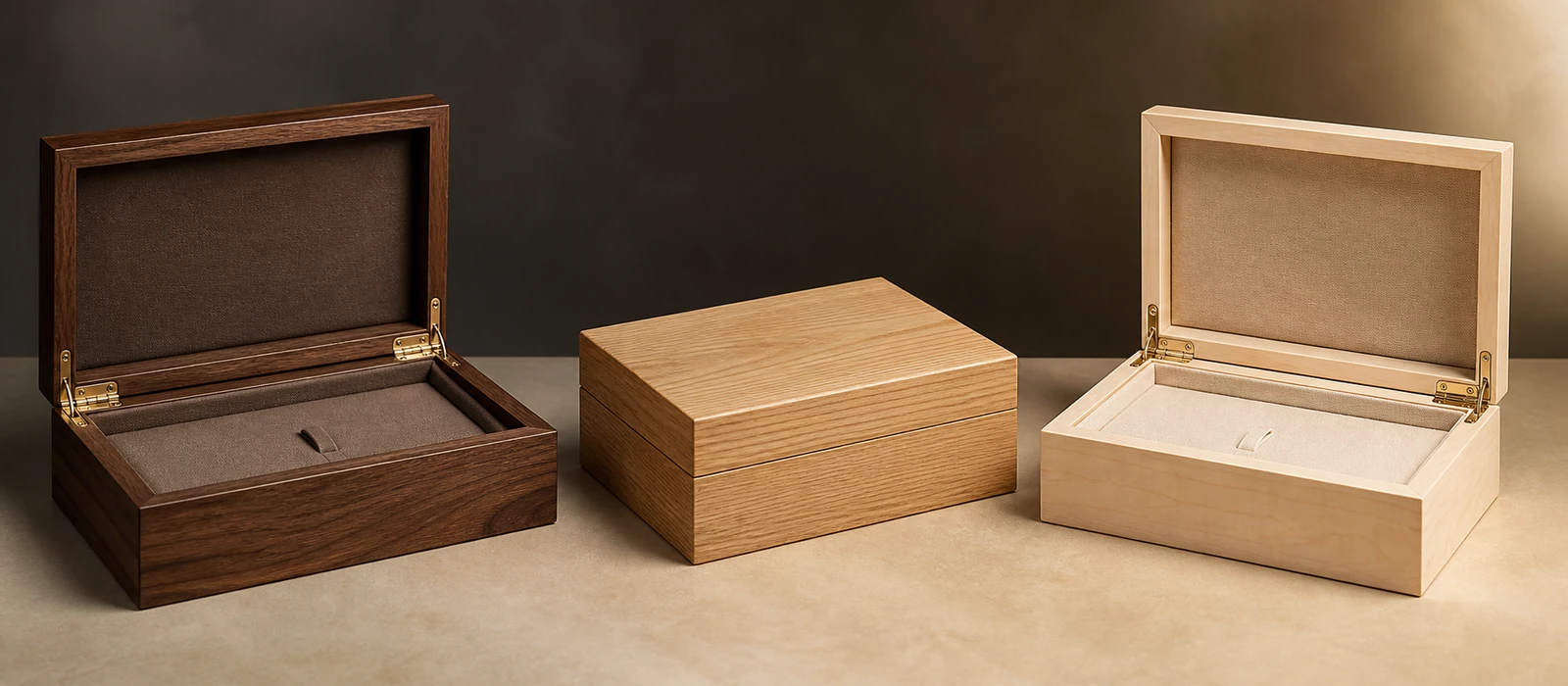

Wood veneer for wooden boxes is often selected from a small color image, yet the delivered box can look different when the species, veneer cut, leaf matching, substrate, edge treatment, stain, or production lot changes. If a buyer specifies only “walnut veneer,” the quotation may not define the grain layout, visible joints, core material, or approval standard.
Direct answer: Wood veneer is a thin layer of real wood applied over a substrate such as MDF or another panel. It gives a wooden box a natural-grain face while allowing the underlying structure to be engineered separately. Buyers should specify species, cut, matching, substrate, edges, finish, acceptable variation, documentation, and a physical approval sample.
What Is Wood Veneer for Wooden Boxes?
The Decorative Hardwoods Association describes veneer as an extremely thin sheet of hardwood that is cut and matched before being applied to another surface. In a presentation box, the veneer supplies the visible species, grain, figure, and much of the color direction; the substrate supplies the core shape and machining base.
This means a “wood veneer box” is not one material. It is a layered construction that may include a face veneer, MDF or another substrate, adhesive, balancing material on concealed faces, edge treatment, stain or sealer, topcoat, hardware, and lining. A reliable RFQ identifies the system rather than using veneer as a decorative adjective.
Common decorative species include walnut, oak, maple, cherry, ash, alder, and poplar. Species name alone is not enough. Two logs of the same species can differ in color and figure, while different slicing methods can create very different patterns.
Which Types of Wood Veneer for Wooden Boxes Change the Appearance?
For buyers, “type” is best divided into four decisions: species, cut, leaf matching, and substrate.
| Veneer decision | Main options | What it changes |
|---|---|---|
| Species | Walnut, oak, maple, cherry, ash and others | Base color, pore character, grain and natural figure |
| Cut | Plain/flat sliced, quarter sliced, rift cut, rotary and specialty cuts | Cathedral, straight, striped, open or irregular grain appearance |
| Leaf matching | Book, slip, random, balance or special pattern | Symmetry, joint visibility, grain flow and reflected-light variation |
| Substrate | MDF, plywood or another approved core | Flatness, edge construction, machining, weight and compliance route |
The Decorative Hardwoods Association’s veneer-cut guide identifies six principal cutting methods. Plain slicing often creates cathedral grain mixed with straighter areas. Quarter slicing produces a straighter stripe direction and can reveal ray figure in species such as oak. Rift cutting is used to emphasize a more linear grain in oak, while rotary cutting produces a broad continuous sheet with a different, often more open pattern.
These descriptions are starting points, not a substitute for actual veneer samples. The box scale matters: a dramatic cathedral that looks attractive on a large panel may be cropped unpredictably on a small lid.
Manufacturer Insight: Specify the visible face, not just the species
From XRX’s confirmed manufacturing capability, MDF veneer and natural wood veneer constructions are available for custom wooden boxes. From a manufacturing perspective, the RFQ should identify which faces receive veneer—the lid, sides, base, interior rim, or all visible surfaces. Otherwise, suppliers may quote different edge and concealed-face solutions even when both quotations say “walnut veneer.”
Manufacturer Insight: Edge treatment must be decided before finishing
A veneered face ends at every corner, recess, hinge pocket, logo cutout, and opening. The design must decide whether edges are wrapped, separately banded, made from solid wood, painted, or intentionally left as another material. XRX’s confirmed process coverage includes veneering, laminating, hot pressing, sanding, and surface finishing, but the correct route still depends on the box geometry and approved appearance.
How Do Book Match, Slip Match, and Random Match Differ?
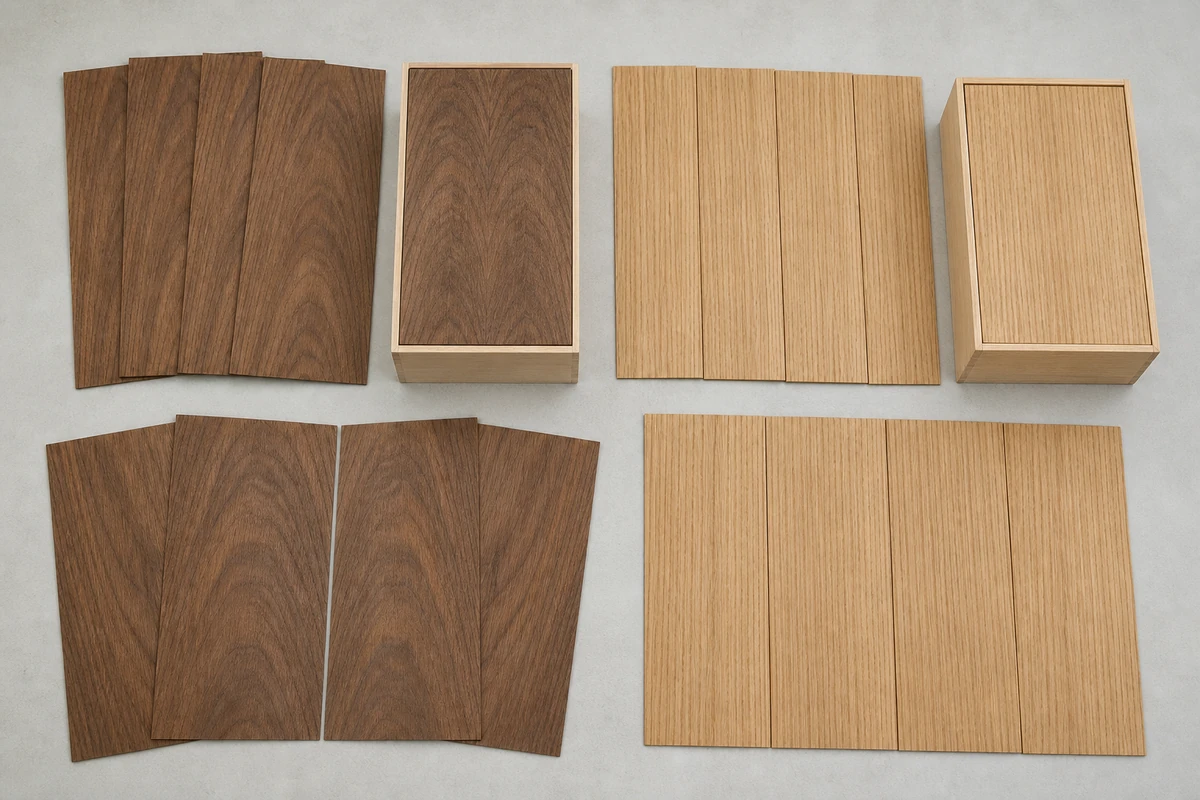
The Architectural Woodwork Standards veneer guide explains that leaf matching changes the appearance where adjacent pieces meet.
- Book match: every other leaf is turned over, producing a mirrored pattern at the joint.
- Slip match: sequential leaves are placed side by side without alternating faces, repeating the grain direction without a mirror effect.
- Random match: leaves are selected without a continuous matching sequence, producing a more board-like appearance.
- Balance or center-balance match: leaves are arranged to create a symmetrical face; this may affect material yield and cost.
Book matching can look formal and symmetrical, but alternating leaf faces may reflect light or accept stain differently. The resulting light-dark “barber-pole” effect is a natural visual characteristic, not automatically a finishing defect. Slip matching may reduce that mirrored reflectance while creating a different joint rhythm.
For a small wooden box, buyers should mark the desired joint direction and centerline on the drawing. If the design requires one uninterrupted grain face, ask whether the selected veneer width and box dimensions make that possible rather than assuming there will be no joint.
What Is the Difference Between Veneer, Solid Wood, and Wood-Look Finishes?
Wood veneer for wooden boxes provides a real-wood face without requiring every component to be solid wood. It should not be confused with printed grain, decorative film, or a painted imitation.
| Material direction | Visible surface | Structural basis | Main buying question |
|---|---|---|---|
| Natural veneer over MDF | Real wood grain | Engineered fiberboard core | Which species, cut, match, edge and MDF grade are specified? |
| Veneer over plywood/other panel | Real wood grain | Layered or approved panel core | How will core edges, movement and component thickness be handled? |
| Solid wood | Real wood through the component | The species itself forms the part | How will grain, joints, movement and machining affect the box? |
| Printed or film grain | Reproduced visual pattern | Depends on the underlying panel | Is the goal repeatable graphics rather than natural wood variation? |
| Opaque paint | Grain is hidden | MDF, solid wood or another prepared substrate | Are color, sheen and surface quality more important than wood identity? |
The USDA Wood Handbook chapter on wood composites explains how properties of reconstituted materials are controlled through fibers, particles, flakes, or veneers. For packaging procurement, the useful conclusion is limited: the face and the core perform different roles, so a beautiful species name does not define the complete box construction.
MDF is commonly evaluated as a veneer substrate because it has a smooth, uniform surface. The European Panel Federation notes MDF’s suitability for decorative finishing. Buyers must still specify grade, thickness, edge design, moisture exposure, destination-market documentation, and the complete adhesive/finish system.
How Should Wood Veneer for Wooden Boxes Be Finished and Approved?
Clear coating can retain a natural color direction, while stain can shift the tone and increase or reduce contrast. Matte and gloss topcoats also change how grain and leaf matching appear under light. A digital color reference cannot reliably show pore texture, chatoyance, joint reflectance, or the range across a veneer lot.
The USDA report on hardwood veneer quality notes that attributes such as exceptional color, texture, and figure can be highly discriminating yet poorly defined. Convert those adjectives into approval tools:
- approve the species and cut on physical veneer leaves;
- approve the grain-match layout at the actual lid size;
- approve stain and topcoat on the actual substrate and adhesive system;
- mark the signed master sample and acceptable range samples;
- identify critical faces and the permitted natural features;
- retain veneer lot, finish formula, and change-control records; and
- compare bulk samples under agreed lighting and viewing conditions.
Do not demand that natural veneer look identical across every box unless the selection, cutting, matching, and acceptance plan makes that expectation realistic. Define what must be consistent—species, overall tone, layout, workmanship—and what natural variation is accepted.

What Compliance Information May Buyers Need for Wood Veneer Boxes?
Requirements depend on destination market, product construction, end use, and the regulated component—not simply on the word veneer. For the United States, the EPA’s current TSCA Title VI guidance identifies hardwood plywood, MDF, and particleboard as regulated composite wood products and describes certification and labeling obligations for covered panels and finished goods.
Buyers should tell the manufacturer the destination market and request documentation that matches the actual core and supply chain. Do not assume that a natural-wood face proves the substrate or adhesive is compliant, and do not turn one market’s rule into a global certification claim.
Which Projects Suit Wood Veneer for Wooden Boxes?
Wood veneer for wooden boxes is a strong starting direction when a project needs recognizable natural grain across broad, controlled faces while using an engineered substrate for the box form. It can suit wine and spirits boxes, perfume boxes, jewelry and watch boxes, cigar presentation packaging, corporate gifts, display cases, and premium multi-product sets.
It may be less suitable when the design depends on deeply rounded solid profiles, exposed carved edges, heavy mechanical wear, outdoor moisture exposure, or a claim that every component is solid wood. In those cases, solid wood, hybrid construction, paint, laminate, or another surface system may be more appropriate.
What Should Buyers Specify Before Ordering?
For comparable quotations, provide:
- product and box dimensions, weight, structure, opening method, and quantity;
- veneer species, natural or other approved veneer category, and supplier/sample reference;
- veneer cut, leaf match, joint direction, centerline, and grain orientation;
- substrate material, grade, thickness, component construction, and destination-market documentation;
- visible faces, concealed faces, balancing construction, edge and corner treatment;
- stain/color direction, pore expectation, sheen, coating system, and signed finish sample;
- logo process and its interaction with veneer grain, joints, stain, and topcoat;
- acceptable natural variation, critical faces, defect criteria, and viewing conditions;
- sample stages, master sample, range samples, bulk change control, and inspection plan;
- inner lining, hardware, packing protection, cleaning, and handling requirements; and
- MOQ, quantity tiers, SKU count, target date, delivery destination, and required documents.
XRX’s Materials Guide provides the broader substrate context, while the materials customization page and product archive show related options and formats. Buyers can send the box drawing, veneer reference, finish target, quantity, and market requirements for review.
Frequently Asked Questions
Is wood veneer for wooden boxes real wood?
Yes. Natural wood veneer is a thin real-wood layer applied to a substrate. The complete box is not necessarily solid wood, so the RFQ should name both the veneer face and the underlying core.
Is a veneer box lower quality than a solid wood box?
Not inherently. They are different constructions. Veneer can provide selected natural grain over an engineered substrate, while solid wood provides wood throughout the component. Quality depends on specification, material selection, manufacturing, finishing, and inspection.
Which veneer cut is best for a luxury wooden box?
There is no universal best cut. Plain slicing can provide cathedral grain, while quarter or rift directions can look more linear. Choose according to the box scale, brand style, species, matching method, and approved physical sample.
Why can book-matched veneer look light and dark on adjacent leaves?
Book matching alternates the face of sequential veneer leaves. The two faces can reflect light or accept stain differently, creating a natural alternating effect. Evaluate it on a finished sample under the intended lighting.
Can wood veneer be applied over MDF?
Yes. Veneer over MDF is a common construction direction for decorative surfaces. Buyers should specify the MDF grade, thickness, veneer and adhesive system, edge treatment, finish, destination-market documentation, and sample standard.
What should be checked on a veneer-box sample?
Check species, cut, grain direction, leaf joints, symmetry, color range, stain, sheen, edge treatment, corners, bubbles or lifting, sanding, glue marks, logo, hardware, lining, box operation, and protective packing.