
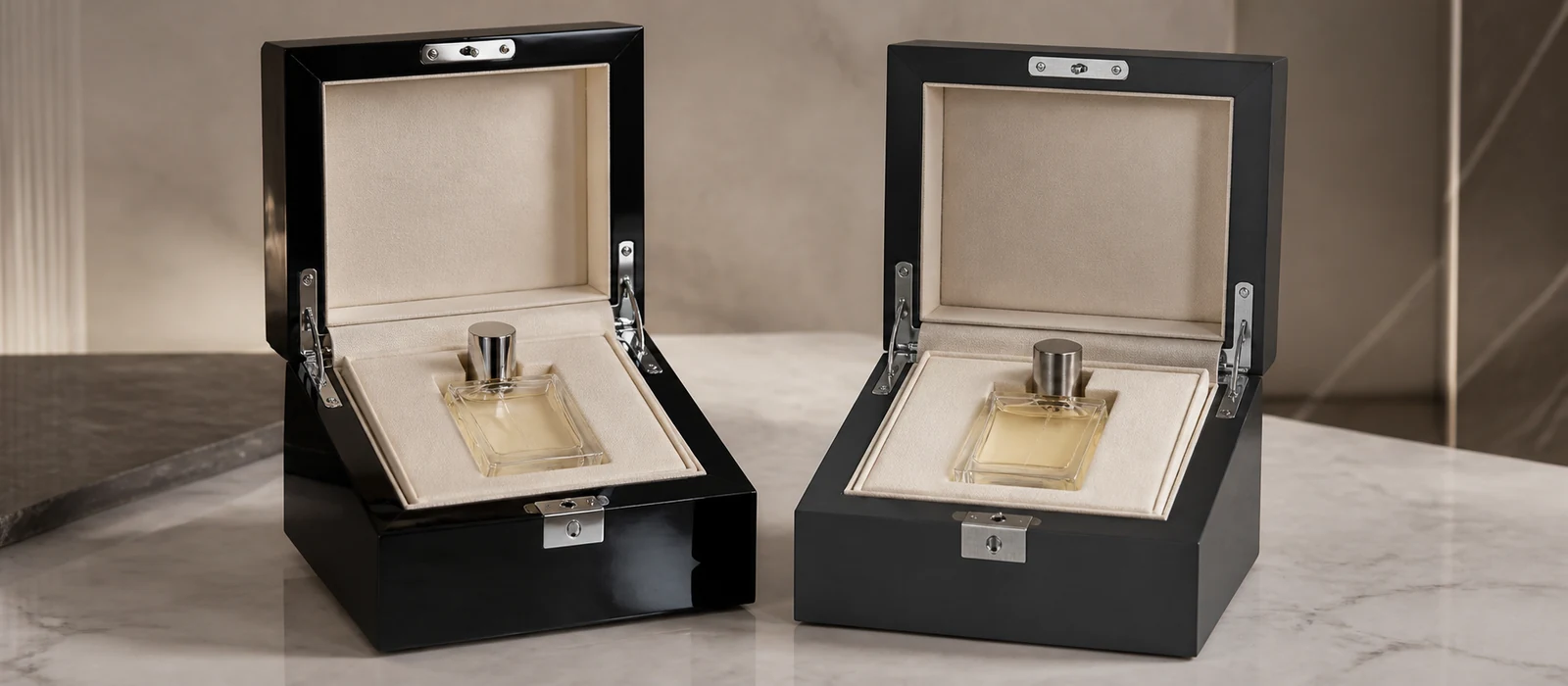

Piano lacquer vs matte finish is a high-impact decision for wooden perfume boxes because the surface changes how buyers perceive color, shape, hardware, fingerprints, defects, and brand positioning. Choosing from a small digital rendering can lead to mismatched gloss, visible surface preparation, an unsuitable substrate, or samples that cannot be reproduced consistently in production.
Direct answer: Choose piano lacquer when the perfume presentation depends on a deep, reflective, highly polished color surface and the project can support stricter preparation and handling. Choose matte finish when the desired language is restrained, tactile, and less reflection-led. Approve the actual substrate, color, gloss, texture, logo, hardware, and lining together.
Piano Lacquer vs Matte Finish: What Do These Terms Mean?
In custom wooden packaging, “piano lacquer” usually describes a multi-stage high-gloss coating result with a deep, leveled, polished appearance. It is a visual and process target, not one universal resin formula or a guaranteed number of coats. The supplier should state the proposed substrate, sealer, color system, clear or topcoat system, curing method, and final approval standard.
A matte finish reduces specular reflection and creates a softer visual field. It may be achieved with different coating chemistries and textures, so “matte” alone is incomplete. One supplier’s matte can look like another supplier’s satin or low gloss. Define it with an approved physical sample and, when useful, an agreed gloss-measurement method.
ISO 2813 specifies gloss measurement at 20°, 60°, and 85° for suitable non-textured coatings on plane, opaque substrates. ASTM D523 also explains that gloss measurement does not capture every appearance attribute: reflected-image clarity, haze, and texture can influence what the eye sees. A gloss number should therefore support—not replace—the approved perfume-box sample.
How Does Piano Lacquer vs Matte Finish Change the Brand Appearance?
Piano lacquer creates strong reflections, saturated-looking color, and a jewelry-like presentation. It works naturally with polished metal logos, bright hinges, mirror-finish plaques, and interiors designed for a dramatic reveal. It can suit prestige, collectible, limited-edition, and display-led perfume projects.
In a piano lacquer vs matte finish comparison, matte absorbs more visual noise and can make the box feel architectural, contemporary, soft, or understated. It pairs well with restrained typography, laser engraving, subtle foil, brushed hardware, and neutral microfiber or fabric inserts. Dark matte colors can still look luxurious without trying to imitate a reflective piano surface.
| Buying factor | Piano lacquer | Matte finish |
|---|---|---|
| Visual effect | Deep reflection, saturated color, polished presentation | Low reflection, quieter color field, restrained presentation |
| Surface preparation | Very demanding because reflections reveal waviness and defects | Still requires controlled preparation; lower reflection may make minor visual variation less dominant |
| Handling appearance | Fingerprints, dust, swirl marks, and polishing variation can be visually prominent | Fingerprints may be less visually dominant, but oils, scuffs, burnishing, or uneven sheen can still appear |
| Logo pairing | Polished metal, crisp screen print, foil, or a controlled contrasting mark | Brushed metal, engraving, foil, print, or tone-on-tone branding |
| Typical brand direction | Dramatic, formal, collectible, display-led | Contemporary, tactile, understated, lifestyle-led |
| Cost influence | Often higher because leveling, coating build, curing, sanding, polishing, and rejection control may increase | Often simpler, but special textures, soft-touch systems, difficult colors, or tight sheen control can still add cost |
| Approval focus | Reflection quality, haze, dust, polishing, edge build, color, handling marks | Uniform sheen, texture, color, rub or burnish marks, edge consistency |
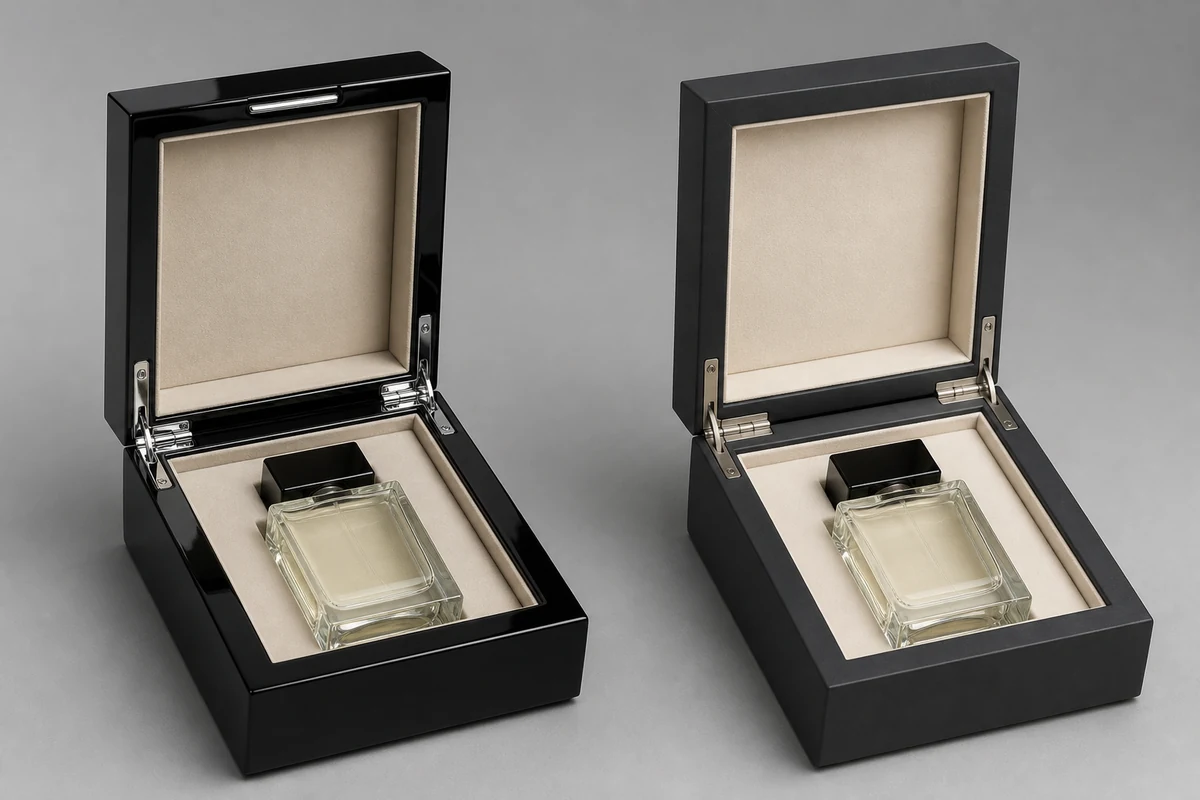
Neither finish is inherently more luxurious. Luxury comes from a coherent system: proportion, substrate, coating, hardware, insert, logo, opening action, and consistency.
Which Substrates Work with These Perfume Box Finishes?
For piano lacquer vs matte finish projects, MDF is frequently considered for opaque painted boxes because it provides a uniform surface and can be machined into repeatable profiles. The European Panel Federation describes MDF’s smooth surface as suitable for painting and decorative finishing. The specific panel grade, edge preparation, moisture exposure, compliance documents, and component design still need approval.
Solid wood can be painted, but natural grain, pores, joints, and dimensional behavior may show through or influence the surface. If the purpose of using walnut, oak, or another visible species is to celebrate real grain, a clear, stained, or lightly pigmented finish may be more logical than burying it under a mirror-black coating.
Hybrid construction can use MDF or another engineered panel for broad opaque surfaces and selected solid-wood details where edges, fasteners, or material character matter. The RFQ should identify every substrate and visible face rather than stating only “wooden perfume box.”
Manufacturer Insight: High gloss makes preparation part of the design
With piano lacquer, the factory is not simply spraying a shinier topcoat. Flatness, filled joints, sealed edges, primer build, sanding, dust control, curing, polishing, and careful handling all influence the reflection. Sherwin-Williams’ surface-preparation guidance emphasizes clean, sound, dry, smooth preparation and testing the selected system. A glossy coating cannot reliably hide a poorly prepared box.
Manufacturer Insight: Matte must be approved under controlled light
Matte surfaces can shift visually with texture, spray pattern, color, viewing angle, and lighting. Approve a physical color-and-sheen sample, then compare production samples under the same lighting and orientation. A verbal label such as “luxury matte” is not a measurable acceptance criterion.

What Are the Main Production Steps?
Exact processes vary by coating system and factory, but a piano lacquer vs matte finish RFQ should account for the following controlled sequence:
- confirm the substrate, component construction, moisture condition, joints, and edge design;
- machine, assemble, fill, and sand the box to the required surface standard;
- clean the surface and apply the specified sealer or primer system;
- sand and inspect the sealed surface, repeating preparation where the approved system requires it;
- apply and cure the specified color and topcoat layers under controlled conditions;
- for piano lacquer, level and polish the cured surface as required by the approved sample;
- inspect color, sheen, reflection, edges, dust inclusions, adhesion, and visible workmanship;
- install hardware, logo components, and lining using protected handling methods; and
- clean, protect, pack, and retain an approved reference sample for production control.
Do not write a fixed coat count or curing time into the purchase order unless it belongs to a validated coating specification. The desired result, compatible system, application conditions, and acceptance criteria matter more than a marketing claim about “many layers.”
How Should Buyers Evaluate Quality and Durability?
Quality control for piano lacquer vs matte finish starts with visual criteria that match the box’s purpose: approved color, gloss or matte level, surface texture, reflected-image quality where relevant, dust and pinhole limits, edge consistency, joint visibility, polishing marks, handling marks, and logo alignment. Define viewing distance, lighting, and which surfaces are critical.
When instrumental gloss is required, identify the method, geometry, measurement locations, sample conditioning, and acceptable range. Do not mix readings from different geometries or compare textured and flat areas as though they were equivalent.
Coating adhesion can be evaluated through an agreed method, but method scope matters. ASTM D3359 states that substrate and surface preparation strongly affect adhesion and that its tape method has limits; it does not provide an absolute bond-force value or distinguish every higher adhesion level. ASTM D3363 describes pencil hardness as a rapid comparative film test and notes that pencil source and laboratory practice affect reproducibility.
Only specify adhesion, hardness, abrasion, chemical resistance, or rub testing when the intended use justifies it and the complete method, substrate, coating, conditioning, acceptance value, and reporting format are agreed. A “scratch-proof” claim is not an acceptable substitute.
Which Finish Fits Different Perfume Packaging Projects?
| Perfume project | Recommended starting direction | Buyer checks |
|---|---|---|
| Collectible or limited-edition presentation | Piano lacquer | Reflection, color depth, metal logo, protected handling, display lighting |
| Minimal contemporary fragrance | Matte finish | Sheen uniformity, tactile expectation, subtle logo, scuff or burnish appearance |
| Bright fashion color | Either, after sampling | Color under target lighting, coating compatibility, hardware and lining contrast |
| E-commerce gift set | Matte or practical semi-matte often worth evaluating | Handling marks, outer protective pack, insert fit, repeated opening |
| Retail display centerpiece | Piano lacquer can create visual impact | Dust visibility, cleaning method, store lighting, reflection quality |
| Natural-material brand story | Clear or stained grain-visible finish may be better than either opaque option | Species, grain range, color variation, finish sample, sourcing claim |
Piano lacquer vs matte finish should always follow the intended customer experience. A reflective black box may overpower a soft botanical brand, while a muted matte box may underdeliver for a theatrical collector launch. The finish should support the fragrance, bottle, campaign, and retail environment.
What Should Buyers Confirm Before Ordering?
For comparable piano lacquer vs matte finish quotations and reliable sample approval, provide:
- perfume bottle dimensions, filled weight, orientation, photos, and a physical sample when available;
- box structure, exterior and interior dimensions, opening angle, and closure;
- substrate for every component and any target-market material documentation;
- exact color reference plus piano-lacquer, gloss, satin, matte, texture, or other surface target;
- an approved physical finish sample and any agreed instrumental measurement method;
- logo process, size, position, color, relief, and artwork;
- hinge, latch, magnet, plaque, and other hardware finish;
- insert material, lining color, contact zones, and bottle-removal method;
- visible defect criteria, critical surfaces, lighting, viewing distance, and inspection plan;
- required functional tests with complete methods and acceptance values;
- order quantity, MOQ response, sample stages, change control, packing, and delivery destination; and
- cleaning, protective film, tissue, bag, sleeve, carton, and handling requirements.
Coating operations may also face market- and facility-specific environmental rules. The US EPA describes hazardous-air-pollutant requirements for applicable major wood-coating sources. Buyers should ask the manufacturer which coating documentation and destination-market obligations apply rather than assuming a finish name proves compliance.
The wooden perfume box customization page provides the main structure and manufacturing context, while the perfume packaging product archive shows relevant formats. Buyers with a bottle sample, finish direction, quantity, and target market can send the project brief for a finish recommendation.
Frequently Asked Questions
Is piano lacquer more durable than matte finish?
Not automatically. Durability depends on the complete coating chemistry, substrate preparation, film build, curing, handling, environment, and test method. A high-gloss appearance does not prove superior scratch, abrasion, chemical, or adhesion performance.
Is piano lacquer always more expensive than matte finish?
It often costs more because surface preparation, leveling, curing, sanding, polishing, handling, and rejection control can increase. However, special matte textures, soft-touch systems, difficult colors, or tight sheen tolerances can also be costly. Compare approved specifications.
Can solid wood be used under piano lacquer?
Yes, but grain, pores, joints, and dimensional movement can affect the finished surface and preparation effort. MDF or a hybrid construction is often evaluated when a uniform opaque result is the priority. Approve the exact substrate and finish system together.
Does matte finish hide every scratch and fingerprint?
No. Lower reflection may make some marks less visually prominent, but matte surfaces can still show oils, scuffs, scratches, polishing, or local burnishing. Evaluate handling on the approved color and coating sample.
How should buyers define gloss in a piano lacquer vs matte finish specification?
Use an approved physical sample first. If instrumental control is needed, specify the agreed standard, measurement geometry, locations, conditioning, lighting, and acceptable range. A term such as matte or high gloss is not sufficiently precise by itself.
What should be checked on a finished perfume box sample?
Check color, gloss or matte uniformity, texture, reflections, dust and surface defects, edges, joints, logo, hardware, lining, bottle fit, lid clearance, opening action, odor requirement, cleaning method, and the complete protective pack.