
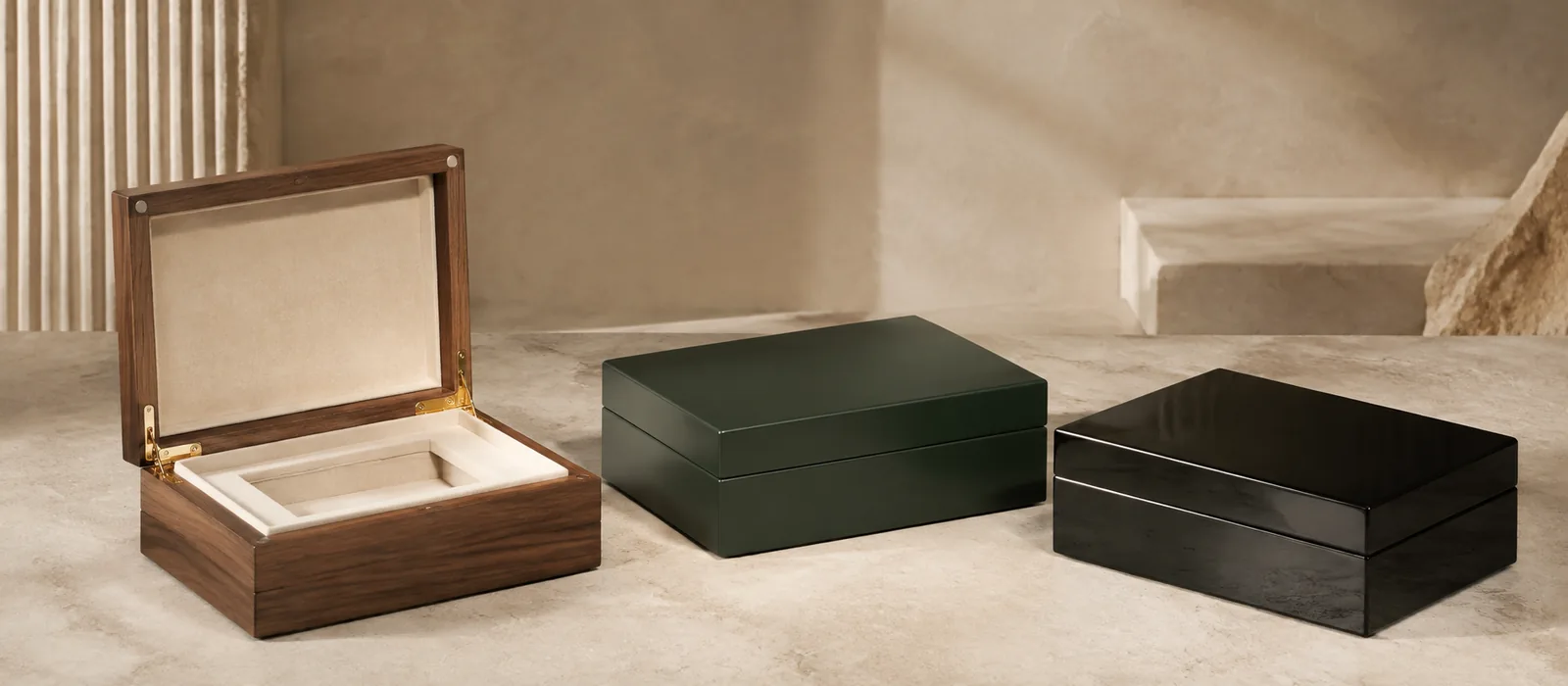

The short answer: compare the specification before the unit price
Two boxes can look similar in a small image while requiring different substrates, wall build-ups, machining, coating work, hardware fitting and interior assembly. Even the same exterior size may hide a different usable internal space. That is why a credible manufacturer normally asks questions before confirming a final quotation.
Use a cost map instead of asking for one generic number:
| Cost area | What the buyer should define | Why it changes the quote |
|---|---|---|
| Size and layout | Outside size, usable inside size, packed-product dimensions and orientation | Changes material use, machining and carton efficiency |
| Material construction | MDF, veneered MDF, solid wood or a mixed construction | Changes sourcing, preparation, machining and finishing route |
| Structure | Hinged, lift-off, sliding, drawer or multi-level design | Changes parts, joinery, fitting and assembly |
| Finish and color | Clear, stained, matte, gloss, piano lacquer or veneer finish | Changes surface preparation, coating and approval work |
| Interior | Lining, insert core, cavities, trays and dividers | Changes material, tooling, wrapping and hand assembly |
| Branding and hardware | Logo method, hinge, latch, magnet, handle or metal plate | Adds components, positioning and installation work |
| Commercial scope | Quantity per SKU, sample rounds, packing and delivery term | Changes setup allocation and what the quoted price includes |
This approach also makes value engineering more disciplined. A buyer can simplify one cost area without accidentally removing a function the package still needs.
1. Box dimensions affect more than material consumption
Start with the product, not the outside of the box. The factory needs the maximum dimensions of the item, the required orientation, clearance for removal, and space for inserts or accessories. A bottle shoulder, watch crown, jar lid or cable bundle can determine the internal profile even when it is not the widest part in a front-view photo.
Dimensions influence panel size, wall thickness, lid depth, machining time, insert volume and master-carton layout. Reducing a few millimeters is useful only when the packed product still fits and the box still performs its presentation and handling role. ISO 18602 describes packaging optimization as reducing weight or material volume while remaining consistent with the required functions of the packaging system. That principle is more useful than making a box smaller without a fit test: ISO 18602:2013 packaging-system optimization.
For quotation, provide both the product dimensions and the desired usable internal dimensions. If the design is still open, ask the factory to propose the outside size after the insert concept is defined.
2. Material means a complete construction, not only a wood name
“Walnut box” can mean solid walnut, walnut veneer over MDF, or another substrate with a walnut-look finish. Those are different constructions and should not be compared as if they were interchangeable.
XRX works with MDF, natural wood veneer and specified solid woods such as walnut, beech, rubber wood, oak, pine and birch. Material availability, grade, origin and exact build remain project-specific. In XRX’s current typical order mix, MDF is the most frequently selected substrate because buyers often use it for smooth painted, lacquered or veneered presentation boxes. This is XRX production experience, not a claim that MDF is best or cheapest for every project.
When you compare material quotations, ask suppliers to state:
- the structural substrate;
- the visible surface material or veneer;
- which components are solid wood;
- the proposed wall and lid construction;
- the finish applied over that construction.
The wooden box materials guide explains the broader selection logic. In a live quotation, the approved sample should settle the exact combination.
3. Opening style and structure change the production route
A lift-off lid, sliding lid, hinged lid, drawer and multi-level chest do not use the same number of parts or assembly sequence. A design with internal trays, removable layers or display supports also adds fit relationships that must work together.
Structure affects cutting, CNC machining, routing, drilling, sanding, trial assembly and final alignment. Hinges and latches need stable positions. Drawers need usable clearance. Magnets must be located consistently and oriented correctly. None of these details should be inferred from a beauty image.
Before requesting prices, define the opening action and the user experience: how the item is presented, how it is removed, whether accessories stay in the same plane, and whether the box will be opened repeatedly in retail, gifting or display use.
4. Surface finish can add preparation and approval work
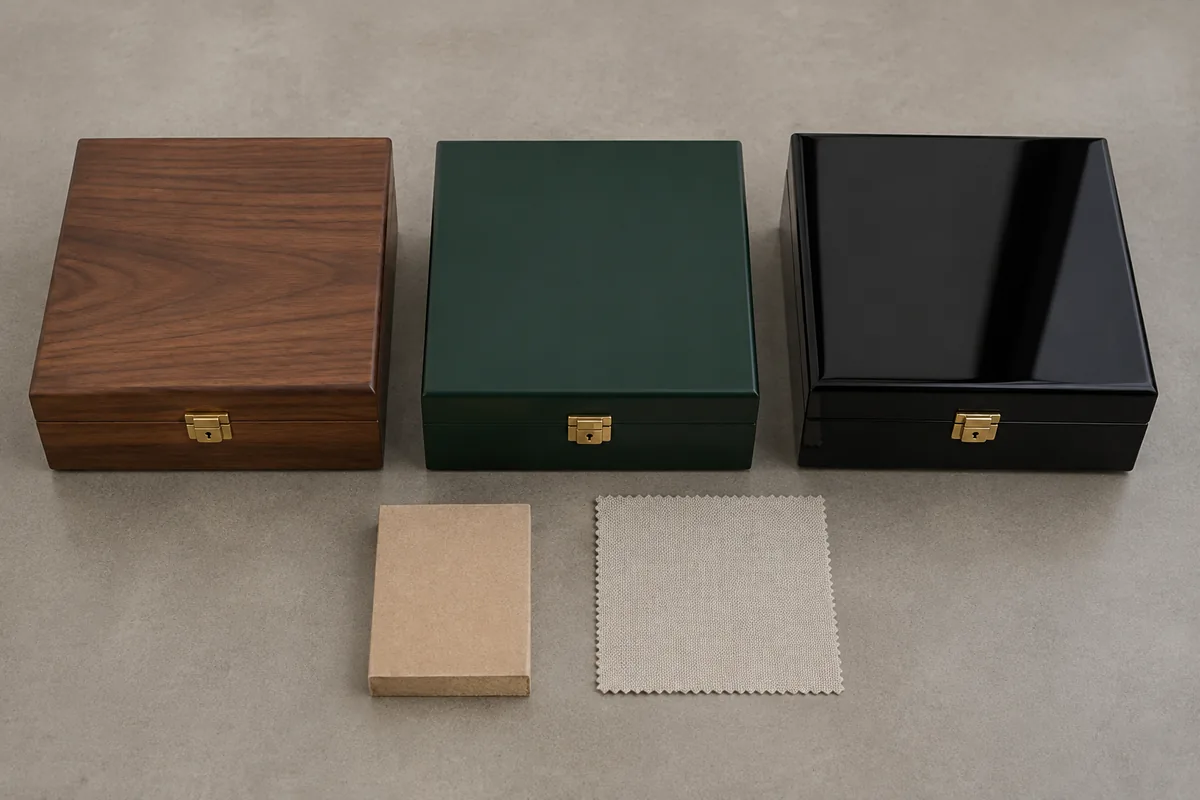
Finish is not merely a color name. A clear or stained wood-grain appearance follows a different route from an opaque matte paint or a high-gloss piano lacquer. The required surface preparation, edge treatment, coating sequence, drying time, polishing and defect sensitivity can therefore differ.
XRX’s confirmed capabilities include matte and glossy painting, clear varnish, piano lacquer and wood-veneer finishing. The exact color, sheen, coating system and visual standard require sample approval. Buyers should provide a color reference and describe whether the reference controls hue, gloss, visible grain, texture or all four.
If cost must be reduced, do not simply request “fewer coating steps.” First decide which appearance is essential to the brand. The wooden box surface finishes page shows the decisions that should be aligned before sampling.
5. Inserts and linings can become a second product inside the box
An insert may need to locate the item, present it at a chosen angle, separate accessories and allow easy removal. That can require an EVA or sponge core, a wrapped surface, several cavities, finger notches, ribbons, removable trays or wooden dividers.
XRX supports velvet lining, EVA inserts, sponge inserts, leather-like lining and custom molded inserts. Exact composition, density, tolerance and performance must be specified for the project. A simple flat lining and a multi-component wrapped tray should not appear under the same one-line description in competing quotes.
Provide physical products or accurate models when fit matters. At sample review, check movement, removal force, contact points, cavity depth and the appearance of wrapped edges. A photo can show style, but it cannot confirm fit.
6. Logo methods and hardware should be itemized
Laser engraving, silk screen printing, hot stamping, a metal logo plate, and a debossed or painted logo create different preparation and positioning requirements. The same applies to hinges, latches, locks, magnets and handles.
Send vector artwork when available and specify the logo size, position and color. For hardware, provide a reference finish and the expected opening action. If the supplier proposes an alternative, the quotation should state the alternative clearly. This prevents a low quote based on a standard component from being compared with a quote based on a custom-plated or specially sized part.
7. Quantity and SKU split must be stated together
Order quantity affects how design review, material preparation, machine setup, color matching and production control are allocated. But the total order quantity is not enough. Five finishes of 100 pieces each are not operationally identical to one finish of 500 pieces.
XRX’s regular MOQ is 500 pieces for custom production, while the workable quantity depends on dimensions, material yield, finish, hardware, inserts and packing requirements. Ask for pricing by quantity per design, color and logo version. If several SKUs share the same box construction, identify which components are common and which change.
Larger volume may improve unit economics, but it does not guarantee the same percentage reduction for every design. Material yield, special hardware, manual work and packing can remain limiting factors.
8. Sampling, revisions and approval scope affect project cost
A sample is where the buyer confirms structure, dimensions, finish, logo, hardware and insert fit before bulk production. XRX’s usual sample time is 7–15 days, depending on the project. Bulk production is usually 35–65 days after the required approvals, depending on structure, finish and quantity; these are planning ranges, not guaranteed deadlines.
Clarify whether the quotation includes one sample, freight for the sample, revised samples, color panels or material swatches. Also define what happens when the buyer changes the size, finish or insert after approval. A controlled revision may require new material, programming, artwork setup or another physical sample.
The existing custom wooden box RFQ checklist can help you prepare the complete brief before this stage.
9. Export packing changes both factory price and freight exposure
Individual protection, inner cartons, master-carton strength, corner protection, palletization and labeling all affect the pack-out. A delicate piano-lacquer box may need a different protection plan from an unfinished pine crate. The factory quote should state the proposed number of units per carton and the included packing materials.
Carton dimensions and shipment weight also affect logistics. Packaging optimization should not remove the protection necessary for the distribution route. Instead, review the retail box, individual protection and transport carton as one system.
10. The trade term determines what the price includes
An EXW price, FOB price and delivered price are not the same commercial scope. The International Chamber of Commerce explains that Incoterms® rules allocate obligations, risk and costs between seller and buyer, including responsibilities related to carriage, insurance, customs formalities and delivery: ICC explanation of Incoterms® and commercial contracts.
Every quote comparison should therefore include the named Incoterms rule and named place or port. Also separate the product price from sampling, tooling when applicable, freight, insurance, duty, tax and destination handling. A lower factory price may still lead to a higher landed cost, but that cannot be known until both quotes use the same delivery basis.
11. Schedule and late changes can alter the workable solution
A compressed schedule may limit time for material sourcing, color approval, sample revision or complex finishing. It may also change the packing or shipping route. Buyers should state the required arrival date, not only the desired factory completion date.
Cost control is easier when the team freezes the product dimensions, structure, finish, logo, hardware and insert before bulk material preparation. If a change is unavoidable, record the new revision and ask the supplier to confirm its effect on price, sample status and schedule before proceeding.
How to reduce cost without making the box look generic
Value engineering works best when it protects the main buying reason. Start by ranking the brief into three groups: required function, required brand cues and negotiable details.
Practical options include:
- Keep the visible premium surface but review the hidden substrate and internal construction.
- Standardize one hinge, latch or magnet across several SKUs.
- Use one box body with different inserts for products that share compatible dimensions.
- Reduce unnecessary empty volume after a physical fit test.
- Limit colors or logo variations in the first production run.
- Replace an elaborate multi-part insert with a simpler structure that still locates and presents the product.
- Choose one critical finish reference and approve it before bulk production.
Each option changes the specification. Ask for a revised drawing or sample rather than assuming that the visual result will remain identical.
How to compare two wooden-box quotations fairly
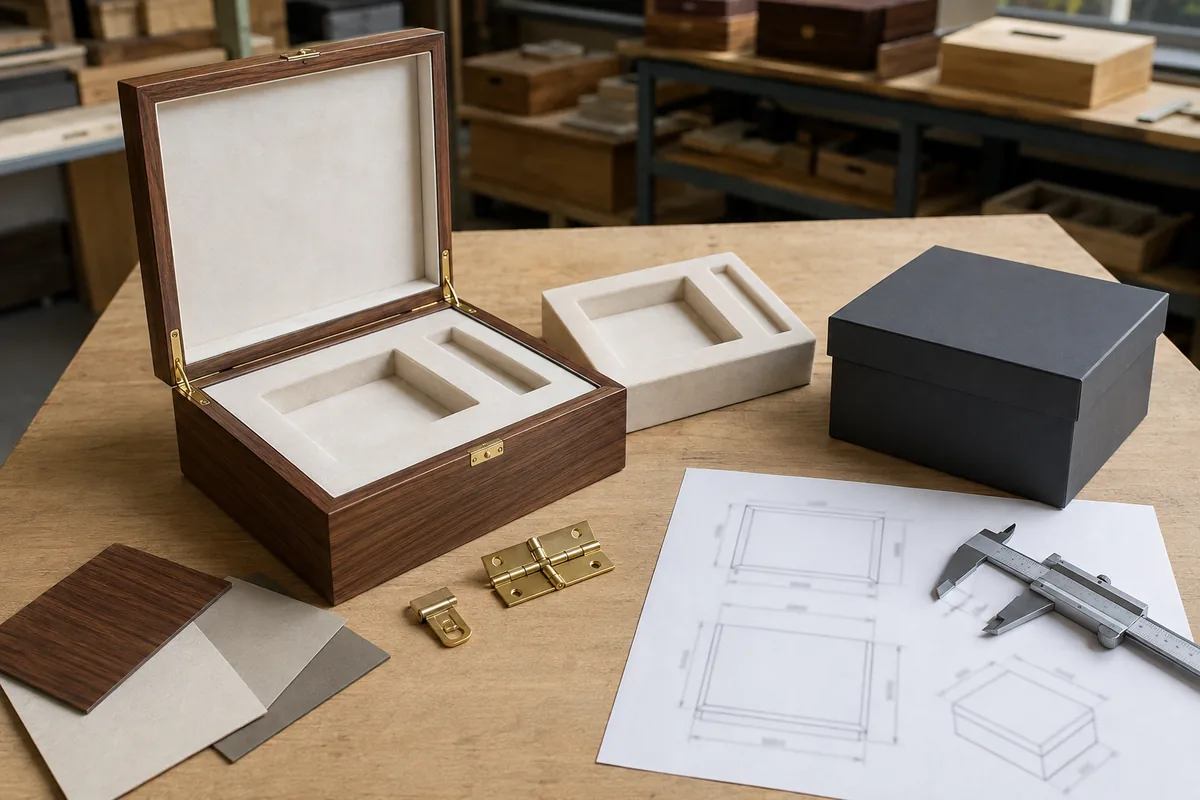
Create a line-by-line comparison rather than placing two unit prices side by side.
| Comparison field | Quote A | Quote B |
|---|---|---|
| Outside and usable inside dimensions | ||
| Substrate, veneer and solid-wood components | ||
| Opening structure and wall build | ||
| Finish, color reference and gloss target | ||
| Logo method, size and position | ||
| Hardware specification | ||
| Insert core, surface and cavity layout | ||
| Quantity per SKU | ||
| Sample and revision scope | ||
| Individual and export packing | ||
| Incoterms rule and named place | ||
| Production timing and validity period |
If a field is blank, request clarification. The cheaper quotation may be fully suitable, but first confirm that it is pricing the same box.
What should you send for a useful quotation?
At minimum, prepare:
- packed-product dimensions, weight and photos;
- desired quantity for each SKU;
- preferred box structure and approximate outside size;
- material or appearance direction;
- finish and color reference;
- logo artwork, size and position;
- hardware preference;
- insert layout and accessory list;
- individual and export packing needs;
- delivery destination, trade term and required arrival date.
If the design is still conceptual, mark uncertain items instead of inventing specifications. A manufacturer can then propose a practical route and show which decisions are still provisional. The custom wooden box buying guide provides more context for moving from concept to sample.
Frequently asked questions
Why can’t a manufacturer confirm custom wooden box cost from one photo?
A photo rarely defines usable internal dimensions, substrate, wall construction, coating system, hardware specification, insert fit, quantity or export packing. The manufacturer can discuss a direction from a photo, but a final comparable quote needs a written specification.
Does a higher order quantity always reduce the unit price?
It can spread project-specific setup and approval work over more units, but there is no universal discount curve. Material yield, manual assembly, finish complexity, special components and the number of SKUs can limit the reduction.
Is MDF always cheaper than solid wood?
Not automatically. Price depends on the complete construction, surface treatment, size, machining, material grade and sourcing conditions. Specify the substrate, visible surface and finish before comparing an MDF construction with a solid-wood construction.
How much do custom inserts add to the price?
There is no reliable generic amount. A flat lining, die-cut cavity, wrapped EVA tray, multi-level insert and custom molded component require different materials and labor. Send the product dimensions and required presentation so the insert can be quoted as a defined structure.
Should sample cost be included in the unit price?
Ask the supplier to show the sample, revision, tooling and sample-freight scope separately. This makes it easier to understand one-time development costs and compare the mass-production unit price on the same basis.
What is the fastest way to receive a more accurate quote?
Send the product dimensions, quantity per SKU, box structure, material direction, finish, logo, hardware, insert, packing, destination and target date in one brief. If any item is undecided, label it clearly and ask for an option rather than leaving it hidden.
Build the quote around the product you actually need
A useful custom wooden box cost comparison begins with a shared specification, not a target number copied from another project. Define the packed product and required presentation, then make material, finish and structural choices visible in the quote. This gives buyers a clearer basis for value engineering, sampling and supplier comparison.
When your brief is ready, send the dimensions, reference images, artwork and estimated quantity through Contact XRX Wood Box for a project-specific review.