
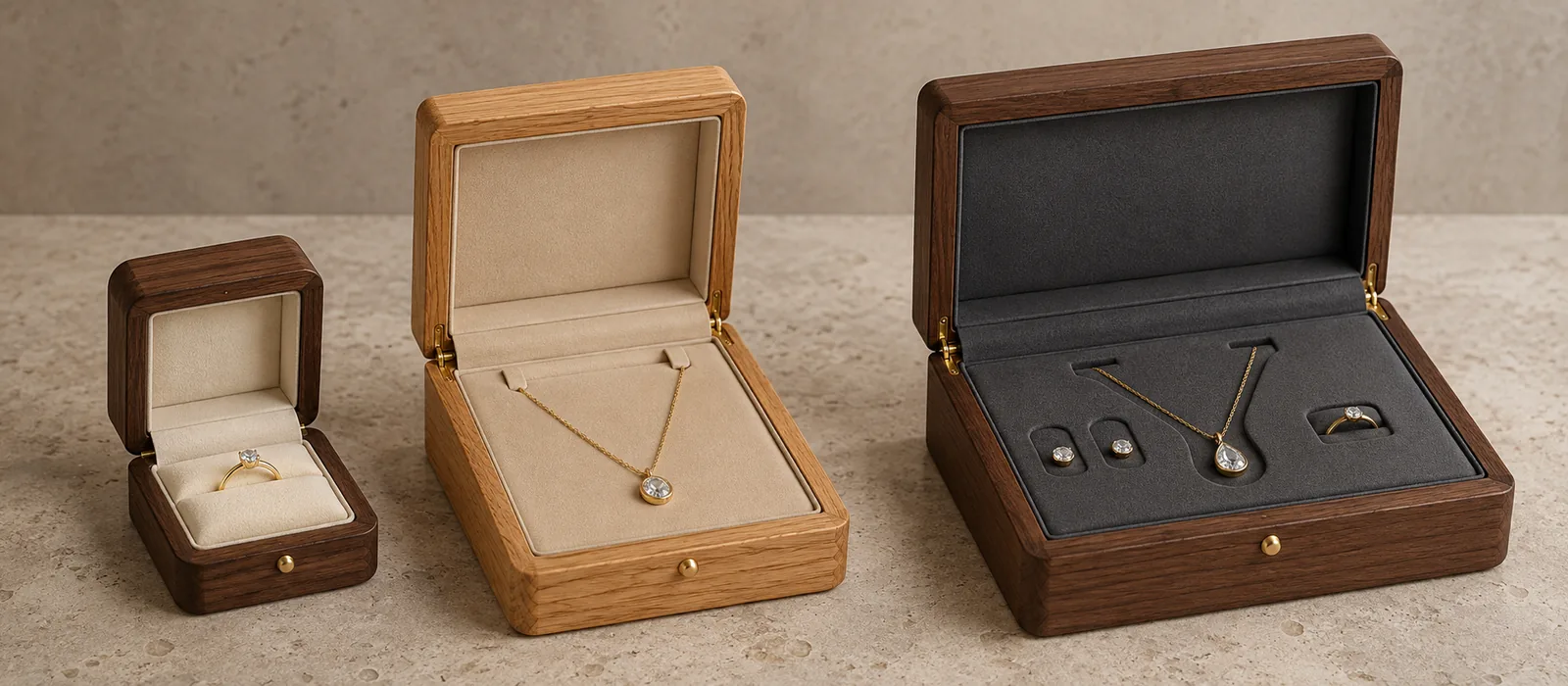

For a custom wooden box project, begin with the jewelry and the intended sales channel. Then approve the loaded insert—not an empty box or an isolated fabric sample.
The Short Answer: Specify the Insert in Three Layers
A useful RFQ separates the insert into three functional layers:
| Layer | Main job | What the buyer should specify |
|---|---|---|
| Visible contact layer | Presentation, touch and the immediate contact surface | Textile type or approved sample, fiber composition when known, color, pile or texture direction, gloss, backing and seam limits |
| Shaped support core | Creates cavities, slots, pads, channels and resistance | Material family, thickness, firmness or approved reference, cut profile, compression zones and replaceability |
| Assembly base | Keeps the insert flat and locates it inside the wooden shell | Board or tray material, thickness, edge treatment, fixing method, finger access and removal requirement |
This three-layer description is more reliable than asking for a “velvet insert.” The same visible fabric can be wrapped over a soft pad, a firm foam, a shaped board or a multi-part tray. Those constructions will feel, fit and assemble differently.
Start Jewelry Box Lining Materials with the Product
Before selecting a textile or foam, record the exact jewelry configuration. Include overall dimensions, weight, raised stones, prongs, clasps, posts, chain length, flexible sections and the smallest and largest approved variants. Identify the intended display face, no-contact zones and the direction in which the user should remove the product.
The insert must support the product without turning a delicate detail into a load-bearing point. A ring slot should control the shank while leaving clearance around the setting. A necklace panel needs a defined chain path and a place for excess chain. Earrings require controlled post or clip locations. A set box needs separate zones so hard components do not move into one another.
The existing XRX guide to custom jewelry box types compares ring, necklace and coordinated set structures. This article goes one level deeper: it explains how to specify the materials and build-up inside those structures.
Compare Jewelry Box Lining Materials at the Visible Contact Layer
Buyers comparing jewelry box lining materials often begin with velvet, microfiber, suede-like fabric or satin because the visible surface strongly affects the reveal. That is a valid design decision, but the trade name or visual description is not a complete technical specification.
Velvet and short-pile textiles
Velvet gives a directional pile and a deep, soft appearance. The pile can also change how a color looks under different viewing angles. Approve the actual production-facing sample under the lighting used for review, and define which way the pile should run on the lid panel, base and removable pads.
Ask whether “velvet” identifies a fabric construction, a flocked surface or a supplier-specific commercial name. Also define the backing, wrap method, exposed-edge rule and acceptable seam locations. These details influence how neatly the material follows small radii, slots and corners.
Microfiber-like and suede-like surfaces
Smooth, low-pile surfaces can give a quieter appearance and make small components easier to see. However, a visual label such as “microfiber” or “suede-like” does not establish exact composition, coating, backing, colorfastness or compatibility with every metal and finish. Keep the approved physical swatch with the sample record and specify the side that faces the product.
Satin and reflective textiles
Satin-like surfaces create more directional reflection. They can work on lid panels or broad presentation areas, but folds, adhesive marks and surface waviness may be easier to see. Evaluate the material on the intended geometry rather than approving it only as a flat swatch.
Across all jewelry box lining materials, review loose fibers, dust, odor, wrinkles, adhesive bleed-through, edge exposure and visible shade variation. These are sample-approval points—not universal claims about a textile category.
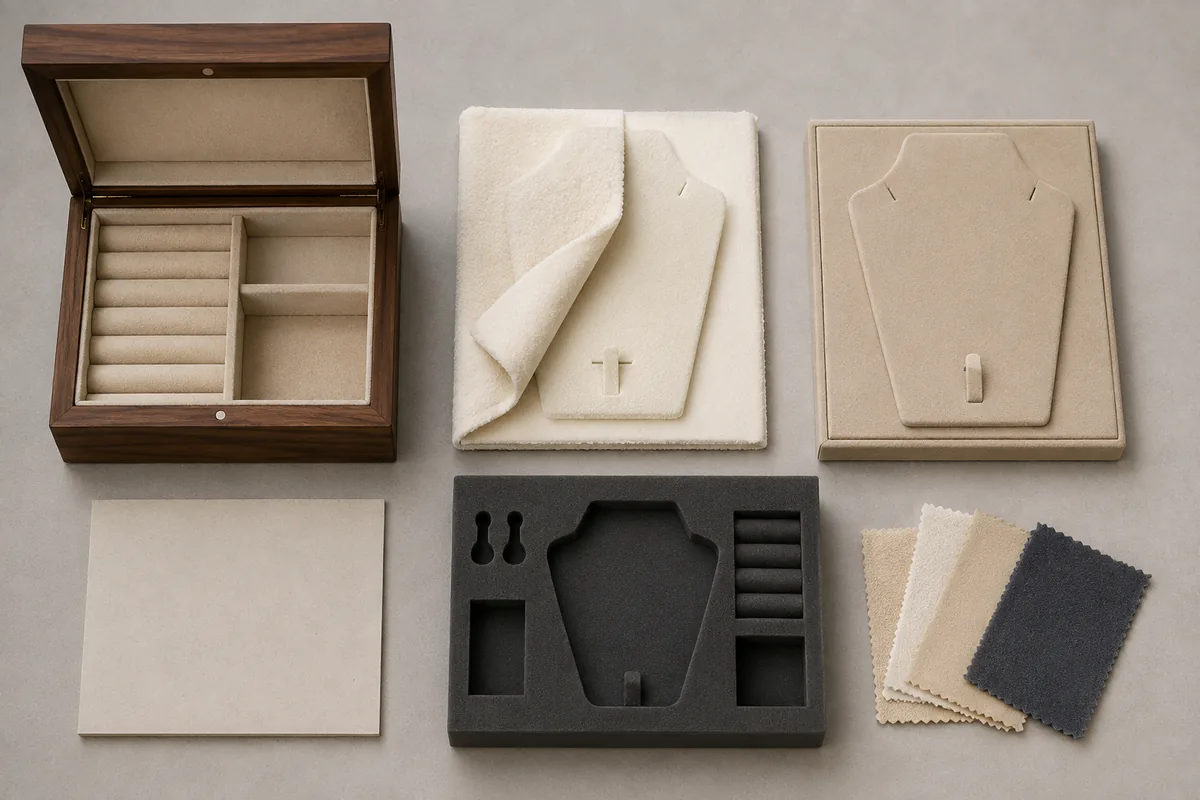
A clear specification separates the visible lining, shaped support and assembly base instead of naming only the top fabric.
Choose the Core Beneath Jewelry Box Lining Materials
The core underneath the visible surface forms the slot, cavity, pad or platform. When buyers specify jewelry box lining materials, common core discussions may include EVA, polyethylene foam, sponge or polyurethane foam, rigid paperboard and mixed constructions. These names cover broad material families. Density, thickness, cell structure, additives, surface skin, cutting method and supplier formulation can change the result.
Do not rely on a universal statement that one foam is always “premium,” “soft” or “protective.” Ask the manufacturer to propose a construction for the actual product, then approve its resistance and recovery with the intended jewelry loaded.
The Canadian Conservation Institute explains that foams vary in density, hardness and compressive strength, and that adequate support area is needed to avoid crushing. It also notes that a newly cut foam surface can be too abrasive for very delicate objects, in which case an appropriate soft lining can provide an interface. This museum guidance is not a commercial jewelry-box certification, but it supports an important procurement principle: evaluate the complete contact surface and support construction, not the foam name alone. See the CCI review of products used for display, storage and transportation.
For an RFQ, define:
- the jewelry weight and occupied envelope;
- required cavity depth and lid clearance;
- whether the product should sit flush, recessed or raised;
- desired insertion and removal force;
- whether the insert is fixed, removable or interchangeable;
- the approved firmness reference or sample;
- exposed cut-edge and dust requirements; and
- the retail, gift, storage and transport duties of the complete pack.
The core should be deep and firm enough to locate the product, but not so tight that loading or removal places uncontrolled pressure on prongs, chains, clasps or polished surfaces.
Match Jewelry Box Lining Materials to Each Jewelry Format
Material choice and geometry must be developed together. A single textile color can unify a collection, while the support architecture changes by SKU.
Rings and earrings
A ring insert may use parallel wrapped rolls, a cut slot, a removable cushion or a shaped holder. Approve the shank range, setting height, viewing angle and finger access. For earrings, define post length, butterfly or clip storage and whether the pair must stay aligned when the box is tilted.
Necklaces and pendants
A necklace panel should control the upper chain points, pendant position, clasp and excess chain. Specify whether the chain passes through tabs, enters a rear pocket or sits in a routed channel. Check that the lid lining does not press on the pendant or a raised clasp.
Bracelets, bangles and coordinated sets
Flexible bracelets, rigid bangles and watches do not share the same occupied shape. A curved cushion, flat recess or removable block should be selected from the product geometry. In a multi-piece set, maintain clear separation between hard elements and define the loading order.
The Wooden Jewelry Boxes pillar page shows the wider exterior, finish, branding and insert customization context. The jewelry product archive can be used for format references, but the final insert still needs a product-specific drawing or sample.
Set Compatibility Boundaries for Jewelry Box Lining Materials
Commercial presentation packaging and museum conservation have different purposes, but conservation guidance highlights why buyers should be careful with broad claims about jewelry box lining materials.
The Canadian Conservation Institute states that sulfur-containing gases can tarnish silver, copper and copper alloys. Its metal-care guidance advises reviewing cloth, felt, adhesives, paint, gaskets and other materials used inside enclosed spaces. It also identifies rubber products and some other materials as possible sources of harmful emissions. Read the CCI guidance on caring for metal objects.
The British Museum describes the Oddy test as a method conservators use to assess whether a specific material may release chemicals that could damage objects in storage or display. That does not mean every commercial jewelry box requires museum testing. It means words such as “velvet,” “foam,” “acid-free,” “anti-tarnish” or “archival” should not be converted into a performance guarantee without product-specific evidence and an appropriate test scope. See the British Museum overview of the Oddy test for storage and display materials.
For ordinary retail presentation, the practical approach is to document the supplied materials, approve contact surfaces and avoid unsupported long-term conservation claims. If a brand requires anti-tarnish performance, chemical compatibility, archival storage or a defined service life, put that requirement in writing and agree on the material documentation and validation method before production.
Approve Jewelry Box Lining Materials and Workmanship Together
A finished insert can look different from the approved loose swatch. Stretching changes pile and reflection. Wrapped edges create extra thickness. Adhesive coverage can affect flatness. Multiple panels may show directional color differences. Tight internal corners may expose cuts or produce wrinkles.
Create an approval board that identifies:
- the exact face material and approved color sample;
- pile or texture direction;
- core material, thickness and firmness reference;
- backing board or tray;
- seam and joint locations;
- permitted exposed edges;
- adhesive and fixing method where documentation is required;
- loaded product orientation; and
- workmanship views for corners, slots, pockets and removable parts.
Color evaluation should use agreed lighting and an approved physical reference. A screen image can help communicate direction, but it should not be the only production standard.
Test Jewelry Box Lining Materials in the Loaded Sample
Place the intended jewelry variants into the sample and review the complete wooden box in the order a user will experience it. Jewelry box lining materials should be approved in their finished, assembled state. Check initial presentation, product centering, clearance, contact points, loading and removal, closure movement, insert lift, exposed seams, loose fibers and movement during normal handling.
Repeat the review with the smallest and largest approved SKU. A cavity that works for the nominal product may be loose for one variant or place pressure on another. If one box platform uses interchangeable trays, verify tray identification and orientation so the correct insert cannot be loaded incorrectly.
Transport evaluation belongs to the complete pack-out. The presentation box, product, insert, accessories, protective wrap, inner carton and shipping carton work as one system. ISTA advises that test selection should reflect the actual distribution environment, and its retesting guidance identifies changes to the product, package configuration, interior packaging, materials or closures as reasons to reconsider prior results. Do not claim that an insert “passes shipping” unless the agreed packaged-product configuration and test protocol support that statement.
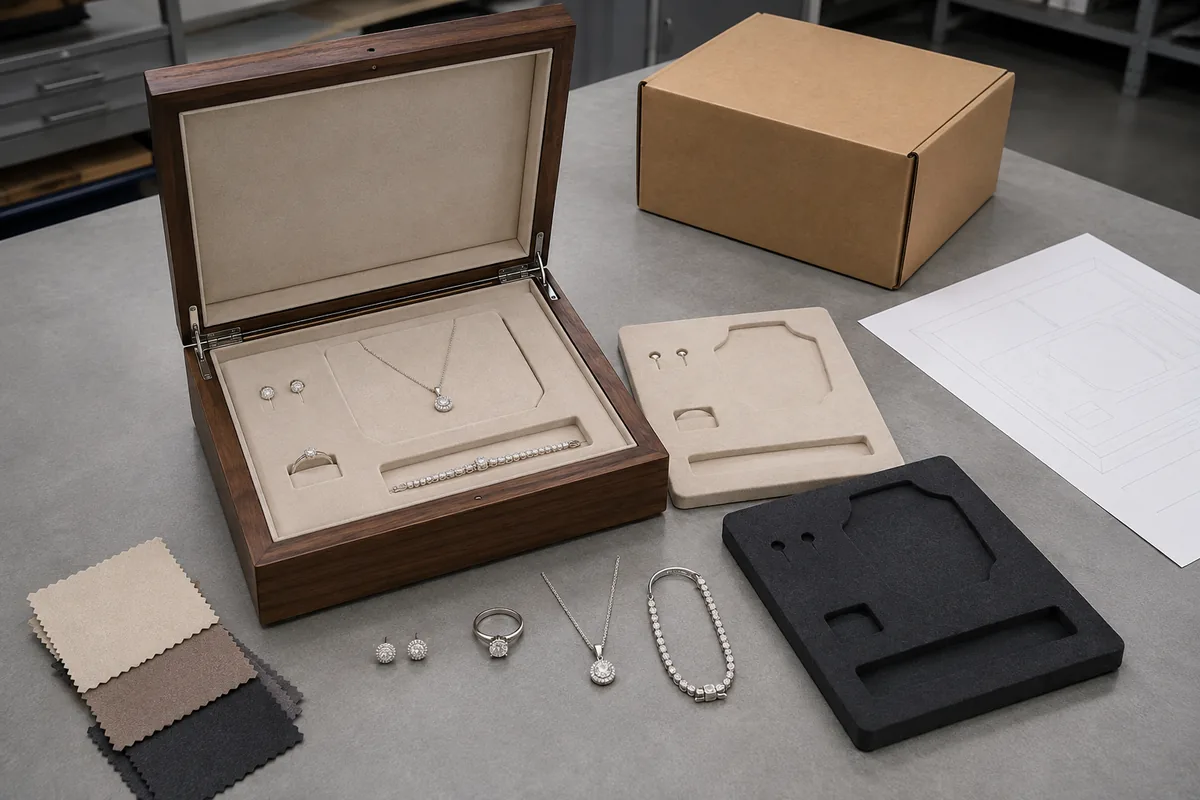
Approve product fit, contact points, removal, workmanship and the complete pack-out with the actual SKU range.
What to Include in a Jewelry Box Lining Materials RFQ
Send one controlled brief containing:
- jewelry drawings, dimensions, weight, photos and physical samples when available;
- SKU range and quantity per SKU;
- display face, orientation and no-contact zones;
- desired cavity, slot, cushion, panel or compartment layout;
- visible lining reference, composition when known, color and texture direction;
- core material direction, thickness, firmness and replaceability;
- base board or tray construction and fixing method;
- lid clearance, loading and removal requirements;
- approved box structure, internal dimensions, finish and hardware;
- retail, gift, storage and shipping use;
- any material documentation or special performance requirement; and
- sample checklist, approval authority and change-control process.
The custom wooden box RFQ checklist covers the broader quotation package. For a jewelry project, add the product-contact and insert details above so suppliers quote the same construction.
When your product matrix, jewelry samples and desired presentation direction are ready, send XRX a jewelry packaging brief for a custom wooden box and insert review.
Frequently Asked Questions
What are the main layers in a jewelry box insert?
A practical insert has a visible contact layer, a shaped support core and an assembly base or tray. Some designs combine layers, but the RFQ should still identify what touches the jewelry, what creates the geometry and what locates the insert inside the box.
Is velvet always the best jewelry box lining material?
No single surface is best for every product. Velvet can provide a rich pile appearance, while smoother microfiber-like or satin-like surfaces create different reflections and wrapping behavior. Approve the actual material, construction, jewelry fit and workmanship rather than choosing by name alone.
What is the difference between EVA and sponge inserts?
Both names cover broad material categories and do not define exact firmness, density, thickness, formulation or recovery. The supplier should propose a grade for the geometry and product weight, and the buyer should approve a loaded sample and the recorded production specification.
Can a soft lining prevent scratches or tarnish?
A suitable interface can reduce direct hard contact, but “soft” is not a complete performance claim. Surface condition, seams, dust, movement, pressure and material chemistry all matter. Tarnish prevention or long-term compatibility requires a defined claim, supporting documentation and an appropriate validation method.
Should the same insert be used for every jewelry SKU?
Only when the approved size range, contact points and presentation remain acceptable. A shared exterior box can use product-specific or interchangeable inserts so rings, necklaces, earrings and bracelets keep the same brand language without forcing different geometry into one cavity.
What should be checked on the pre-production sample?
Check the actual jewelry variants, presentation angle, contact zones, lid clearance, loading and removal, insert retention, seams, wrinkles, fibers, odor, shade, opening motion and the intended shipping pack. Record the approved materials and construction so later changes can be reviewed.