
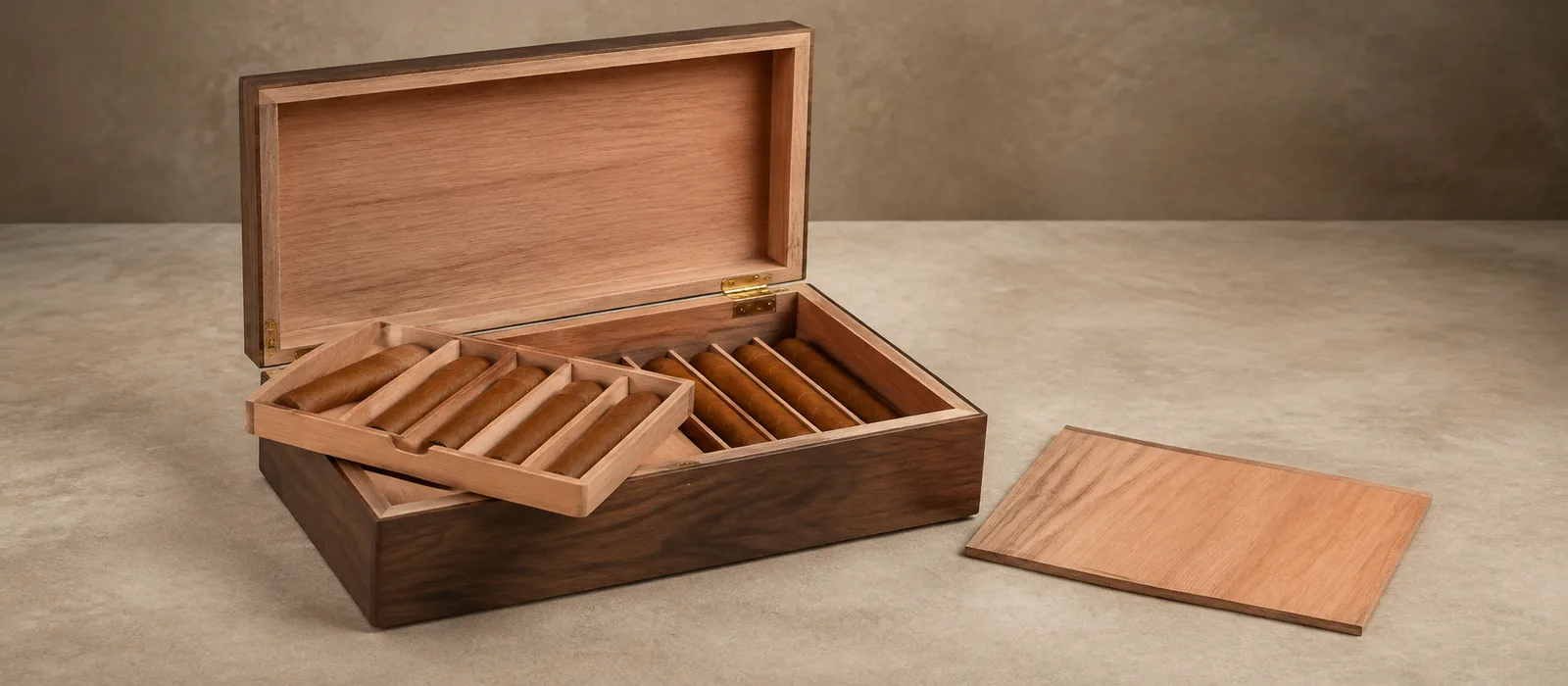

For most B2B packaging projects, cedar is worth specifying when the interior appearance, traditional cigar presentation, exposed wood surface or removable organization system matters to the brand. If the requirement is controlled storage, the buyer must define a complete enclosure, closure, humidification method, measurement plan and test conditions instead of relying on the lining name.
The Short Answer: Specify the Role, Not Just the Wood Name
For a Spanish cedar cigar box project, use this decision rule before requesting a quote:
| Project requirement | Practical cedar specification | What still needs approval |
|---|---|---|
| Premium retail or gift presentation | Cedar lining on visible interior faces | Species/source record, coverage, thickness, grain, color range, joints and finish boundary |
| Organized cigar set | Removable cedar tray and dividers | Cigar sizes, cavity layout, clearances, lifting method and loaded fit |
| Cedar visual accent with lower material use | Cedar veneer or selected cedar panels | Substrate, veneer thickness, edge treatment, grain matching and surface sample |
| Solid-wood construction feature | Selected solid cedar parts | Part dimensions, movement allowance, machining, joints and approved sample |
| Defined storage or humidity performance | A separately engineered and validated enclosure system | Target conditions, instruments, test duration, loading, closure, humidification component and acceptance criteria |
If a supplier quote says only “cedar cigar box,” two factories may price different constructions. One may line an MDF shell; another may propose a solid-wood body; a third may use cedar only for the tray. A comparable RFQ identifies every layer.
Why Spanish Cedar Is Associated with Cigar Boxes
Spanish cedar has a real historical connection to cigar packaging. A 1964 USDA Forest Products Laboratory research note records that the cigar industry demanded Spanish cedar for packing cigars during the nineteenth and early twentieth centuries, and that fragrant cigar boxes were once common. That history explains why buyers still associate the material with traditional cigar presentation. See the USDA profile of Spanish-cedar, Cedrela spp..
History, however, is not a modern performance specification. It does not establish a target relative humidity, storage duration, pest-control result, mold resistance or flavor outcome for a new package. Those claims require their own defined evidence. In a Spanish cedar cigar box purchasing document, use the historical association to guide aesthetics and material choice—not as a substitute for measurable requirements.
The name also needs care. Spanish cedar belongs to the Cedrela genus and is not simply a generic name for any reddish or aromatic “cedar.” If botanical identity, sourcing or trade controls matter to the project, request the scientific name and supporting supply information rather than approving only a color chip or common-name label.
Choose the Construction of a Spanish Cedar Cigar Box
The most useful design conversation separates four possible uses of cedar.
Cedar lining over an engineered outer shell
A stable MDF or other engineered-wood shell can carry the exterior geometry, veneer and decorative finish, while cedar panels create the visible interior. This approach allows the outside and inside to perform different jobs. The shell supports consistent machining and a premium exterior finish; the lining establishes the interior material language.
Specify whether cedar covers the base, four walls, lid panel or only selected faces. Record panel thickness, joint style, corner treatment, grain direction and whether the exposed cedar remains unfinished. The supplier also needs an agreed method for fixing the panels and managing accumulated thickness at the rim, tray and closure.
Removable cedar trays and dividers
A tray can organize several cigar formats without making the whole box from cedar. Define the number of cigars, ring-gauge range, length range, orientation and whether accessories are included. Then approve divider position, wall height, finger access, lifting clearance and movement when the loaded box is handled normally.
Do not approve a tray from an empty photograph. Load the smallest and largest intended cigars and verify that bands, wrappers and ends are not forced against hard edges. If the project has multiple SKUs, decide whether one flexible layout or separate trays will be more reliable.
Cedar veneer as a visible surface
A veneer can communicate the appearance of cedar with a different substrate below it. The RFQ should say “cedar veneer over [approved substrate]” rather than “solid cedar.” Agree on veneer thickness, grain selection, edge construction, sanding and finish. Veneer used decoratively is not the same thing as a thicker exposed lining or removable tray.
Solid cedar components
Solid cedar may be appropriate for selected frames, dividers, trays or an entire construction when that is genuinely required. Solid wood also moves as its moisture content changes, so part size, grain direction, joining method and manufacturing condition matter. A solid label alone does not prove dimensional stability or storage performance.

A comparable quote separates the exterior shell, visible cedar lining, removable organization parts and decorative surfaces.
A Spanish Cedar Cigar Box Is Not Automatically a Humidor
Wood is hygroscopic: it exchanges moisture with the surrounding environment. The USDA Wood Handbook explains that this exchange depends on relative humidity, temperature and the wood’s current moisture condition. It also explains why moisture changes affect wood properties and dimensional behavior. Review USDA Wood Handbook Chapter 4 for the underlying wood–water relationship.
That behavior does not mean a cedar lining selects, creates or maintains a target storage condition. A Spanish cedar cigar box without a defined humidification method, closure performance and verification plan should be sold and specified as a presentation or packaging box, not represented as an automatically functioning humidor.
If controlled storage is a real project requirement, the brief should define:
- the target condition and permitted range;
- the temperature and test environment;
- cigar load and starting condition;
- enclosure construction and closure details;
- the humidification component, if any;
- sensor location, measurement interval and instrument accuracy;
- test duration and opening cycle; and
- pass/fail criteria plus retest triggers.
This whole-system boundary protects both buyer and manufacturer. It prevents a subjective material preference from becoming an unsupported storage guarantee.
Check Species, Source and Trade Requirements Before Ordering
Species and origin information should enter a Spanish cedar cigar box project before sampling, not after the purchase order. The CITES appendices checked for this article list Neotropical populations of Cedrela spp. in Appendix II under annotation #6; that annotation identifies logs, sawn wood, veneer sheets and plywood. The CITES listed-species database and its timber guide provide the official starting points.
Do not turn that paragraph into a universal shipping answer. Applicability can depend on the botanical identity, geographic origin, material form, exporting and importing countries, route, national measures and the rules in force when the shipment moves. A finished cedar-lined box should not be assumed to require the same treatment as raw boards, and it should not be assumed exempt without checking either.
For a cedar-related RFQ, record:
- botanical name when known;
- supplier-stated common name;
- country of origin;
- whether the item is solid wood, sawn part, veneer, plywood or finished component;
- source and purchase documentation expected from the supplier;
- destination market and route; and
- the person responsible for checking current export and import requirements.
This is a procurement control, not legal advice. Recheck the live CITES database and the relevant national authorities for the actual shipment.
What to Put in a Spanish Cedar Cigar Box RFQ
A strong Spanish cedar cigar box RFQ makes every supplier quote the same design. Include the following fields:
- Purpose: retail presentation, corporate gift, collector set, secondary packaging or a separately defined storage system.
- Outer construction: MDF, plywood, solid wood or another approved substrate; exterior veneer or coating; wall and lid structure.
- Cedar role: lining, lid panel, base panel, walls, tray, divider, veneer or solid part.
- Material identity: requested common and botanical name, source information and acceptable natural color/grain range.
- Coverage and dimensions: panel locations, thicknesses, grain direction, joints and exposed edges.
- Interior finish boundary: faces that stay unfinished and faces that receive any coating; prohibited overspray or adhesive marks.
- Product load: cigar count, diameter or ring-gauge range, length range, accessories and loading direction.
- Clearance: around cigars, under the lid, beside dividers and beneath removable trays.
- Hardware and closure: hinge, stop angle, latch or magnet, rim fit and opening sequence.
- Branding: logo process, location, artwork, color reference and sample standard.
- Pack-out: protective wrap, inner carton, master carton and distribution route.
- Approval and change control: signed sample, material swatches, drawing revision, responsible approver and changes requiring re-approval.
The broader custom wooden box RFQ checklist covers quantities, artwork, timing and shipping information. Add the cedar-specific fields above so a material substitution or construction shortcut cannot pass unnoticed.
Approve the Loaded Sample, Not a Cedar Swatch
A loose cedar sample can confirm general color, grain and surface direction, but it cannot demonstrate fit. Approve the completed Spanish cedar cigar box with the intended contents and exterior finish.
Review the sample in a repeatable sequence:
- confirm the approved outer substrate and cedar component locations;
- compare cedar color and grain with the agreed natural-variation range;
- inspect panel coverage, corner joints, gaps, exposed edges and grain direction;
- check flatness, splits, raised fibers and sanding quality;
- look for adhesive squeeze-out, staining, finish overspray and unwanted odor from the assembled pack;
- load every approved cigar format and accessory;
- verify tray lift, divider retention, lid clearance and removal access;
- operate hinges, stops, latches or magnets through normal opening and closing;
- inspect the complete protective and export pack-out; and
- sign and date the approved construction record.
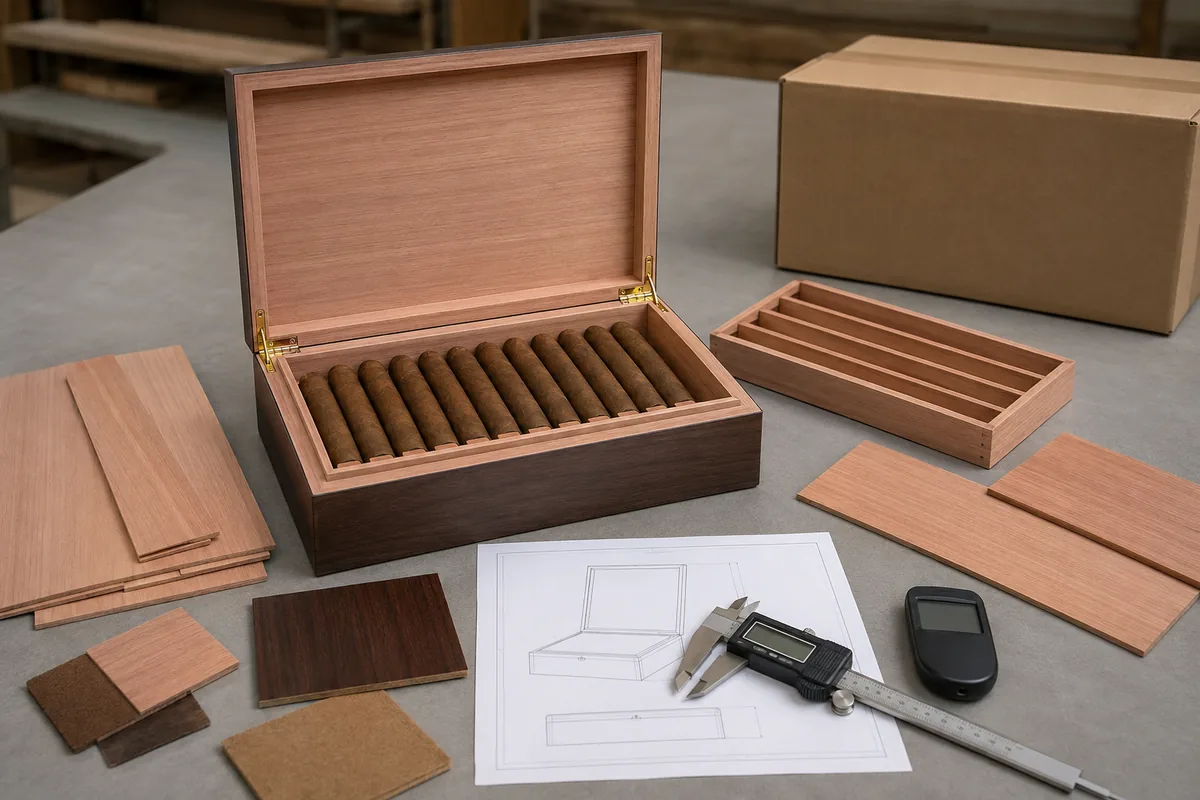
The Spanish cedar cigar box approval record should connect the loaded product, cedar components, outer shell, workmanship and export pack-out.
If the product, lining thickness, supplier, adhesive, closure, internal packaging or distribution method changes, review whether the sample or test plan must be repeated. ISTA’s packaged-product retesting guidance treats changes to products, packages, materials, components and processes as reasons to reconsider previous results. This does not imply that a particular XRX box has passed an ISTA test; it establishes a useful change-control principle.
Common Misconceptions About Spanish Cedar Cigar Boxes
| Misconception | Better purchasing rule |
|---|---|
| “Spanish cedar” means the whole box is solid cedar | State the material of the outer shell and every cedar component separately. |
| A cedar liner makes any box a humidor | Use presentation-box language unless the complete storage system has defined and validated performance. |
| Any aromatic reddish cedar is equivalent | Request botanical identity and an approved physical sample when identity matters. |
| A beautiful empty sample confirms fit | Approve the smallest and largest intended cigars, accessories and complete pack-out. |
| CITES rules are identical for every cedar product | Check species, origin, material form, route, destination and current official rules. |
| The first approved sample controls future changes automatically | Record the approved revision and define which substitutions require re-approval or retesting. |
The Wooden Cigar Boxes pillar page shows how a Spanish cedar cigar box can fit within the wider range of exterior structures, finishes, branding and inserts. The cigar product archive provides format references. For the important storage distinction, also read cigar box vs humidor.
When you have cigar dimensions, annual quantity, destination market and the intended cedar construction, send XRX your packaging brief for a manufacturability and sampling discussion.
Frequently Asked Questions
Does a Spanish cedar cigar box have to be made entirely from cedar?
No. Cedar can be specified as an interior lining, removable tray, divider, veneer or selected solid component while the outer shell uses MDF, plywood or another approved wood construction. The RFQ and quotation should name each layer so material and price remain comparable.
Is a cedar-lined cigar box the same as a humidor?
Not automatically. A liner is one material component. A humidor claim requires a defined complete enclosure, closure, humidification approach, measurement conditions and acceptance criteria. Without those requirements and supporting validation, describe the product as a cigar presentation or packaging box.
What does a buyer need to specify about the cedar lining?
Specify the cedar’s role, requested identity and source information, panel locations, thickness, grain direction, joint treatment, natural-variation range, finish boundary, fixing method and interaction with trays, hardware and closure. Approve these details on a loaded sample.
Should Spanish cedar remain unfinished inside the box?
Many projects request an exposed wood interior, but the correct finish boundary depends on the design and intended use. Mark every coated and uncoated face on the drawing, then approve appearance, sanding, odor and assembly workmanship on the finished sample rather than relying on an assumed rule.
Does every finished cedar-lined box need CITES paperwork?
There is no safe universal answer. Requirements can vary with species, origin, material form, countries, route and current rules. Record the supply information and confirm the actual shipment with the live CITES resources and relevant national authorities.
What should trigger a new sample approval?
A change to cedar identity or source, thickness, coverage, tray layout, adhesive, finish, outer substrate, closure, product load, pack-out or distribution plan should be reviewed. The project team should decide whether the change requires a new physical sample, documentation or performance test before production continues.