

Where the Product Boundary Actually Sits
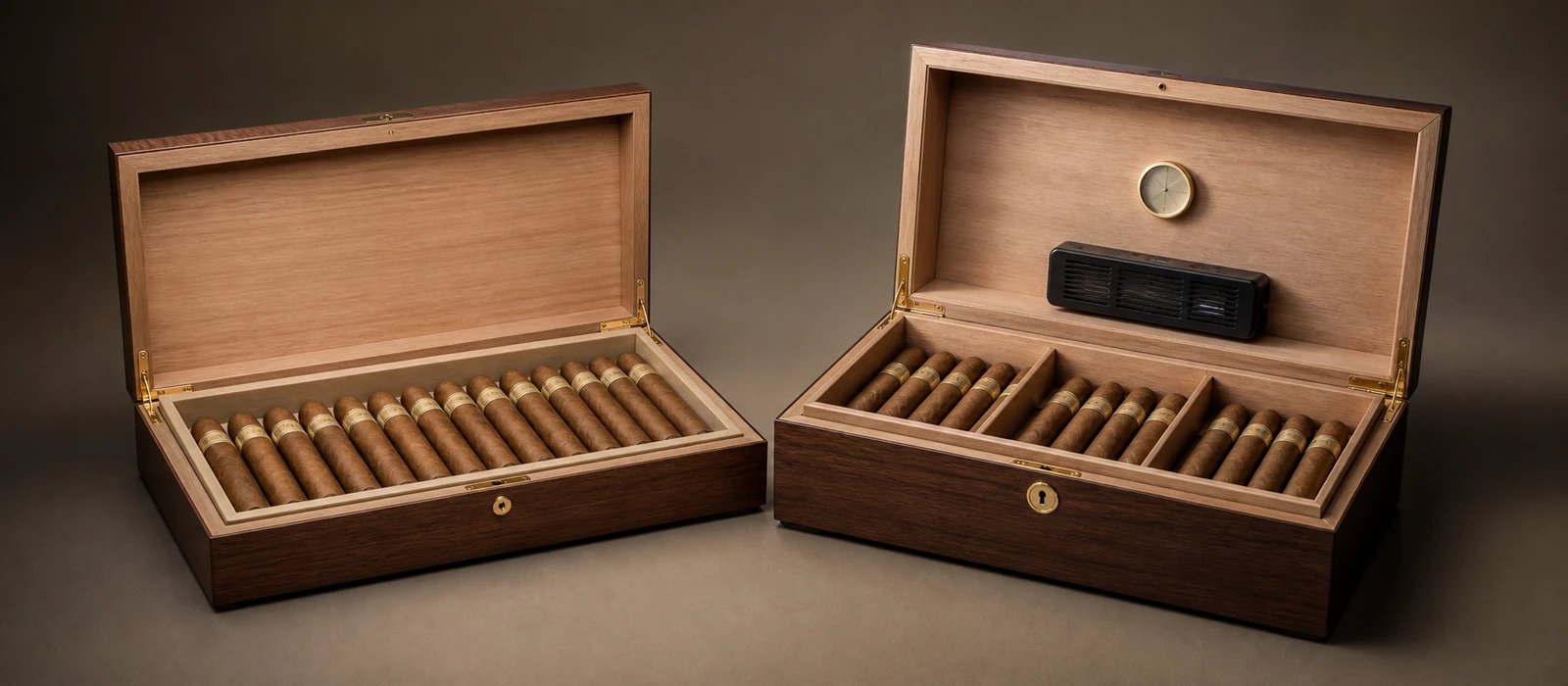
The buyer should classify the project before discussing wood species, hinges, finishes, or accessories. A wooden cigar packaging box and a humidor can look similar in a photograph, yet three practical brief types place different responsibilities on the supplier:
- Packaging-only: The box protects the cigars physically, presents the brand, carries the approved artwork, and supports retail or gift distribution. Approval focuses on fit, construction, finish, branding, and pack-out.
- Humidity-managed storage: The enclosure, closure, humidity source, air path, measurement method, instructions, and acceptance test form one system. Evidence for an approved performance claim applies to that exact configuration.
- Hybrid: A branded sales box may contain a humidity component, or the original box may be intended to sit inside a separately controlled cabinet. The brief must state which enclosure is responsible for humidity performance.
Likewise, “long-term storage” is not a measurable requirement until the buyer defines the period, external conditions, load, opening schedule, and acceptance criteria.
Humidity management can be passive or active. A documented passive pocket-humidor design combines a closure, humidifying element, airflow openings, and liner. An active atmospheric-control design adds sensors, control logic, circulation, humidification, and temperature-control components. These patents illustrate two architectures, not current product standards or proof that another configuration will perform the same way.
At XRX, we treat this distinction as a specification decision before a drawing is approved. We can manufacture the confirmed structure, but a humidity claim needs buyer-approved conditions, equipment, and acceptance evidence; it should not be inferred from a product name or appearance. Our wooden cigar box structures and customization options can help define the physical starting point, but the functional claim still needs its own specification.
Cigar Box vs Humidor: A Buyer’s Comparison
The following table separates the minimum packaging brief from the additional specification and validation required by a humidity-managed claim. It is a procurement framework, not a universal humidor standard.
| Decision field | Cigar packaging box | Humidor or humidity-managed storage |
|---|---|---|
| Primary duty | Containment, presentation, identification, physical protection, and distribution | Storage under buyer-defined internal conditions for a stated use and period |
| Product fit | Cigar count, actual dimensions, layout, clearances, inserts, and pack-out | The same fit data, plus intended storage load and its effect on the tested configuration |
| Enclosure and closure | Structure, opening feel, hardware alignment, durability, and appearance | Defined closure geometry plus retention and recovery acceptance criteria |
| Interior | Liner, tray, divider, and finish chosen for presentation, fit, and sourcing requirements | Species, thickness, exposed area, preconditioning, layout, and finish frozen as test variables |
| Humidity system | Not part of a packaging-only approval unless separately specified | Device or control method, capacity basis, location, air path, protection against direct product contact, refill or replacement access |
| Humidity measurement | Not required for a packaging-only claim that makes no humidity assertion | Built-in or external sensor, position, verification method, tolerance, and data record |
| Approval evidence | Dimensions, construction, finish, artwork, assembly, and pack-out sample | All packaging checks plus a defined whole-system protocol and time-series results |
| Change control | Changes are reviewed against the approved packaging sample | Changes to the closure, liner, device, sensor, or instructions require documented performance review |
Count alone is not enough to define fit. The FDA cigar product-identification appendix uses package type and quantity, cigar length, and diameter among the attributes that distinguish cigar products. In an RFQ, actual dimensions are more useful than asking a box supplier to infer capacity from a product name.
What Spanish Cedar and the Closure Can—and Cannot—Do
Closure performance matters because external air exchange is one of the loads the humidity system must handle. That does not make “airtight” a useful stand-alone requirement. The standards and technical sources reviewed for this article did not yield a universal leakage threshold for this product category. Define an outcome instead: the tested configuration should remain within the buyer-defined band under stated external conditions and recover according to an agreed opening schedule. Without that protocol, “airtight” is an adjective rather than a measurable acceptance point.
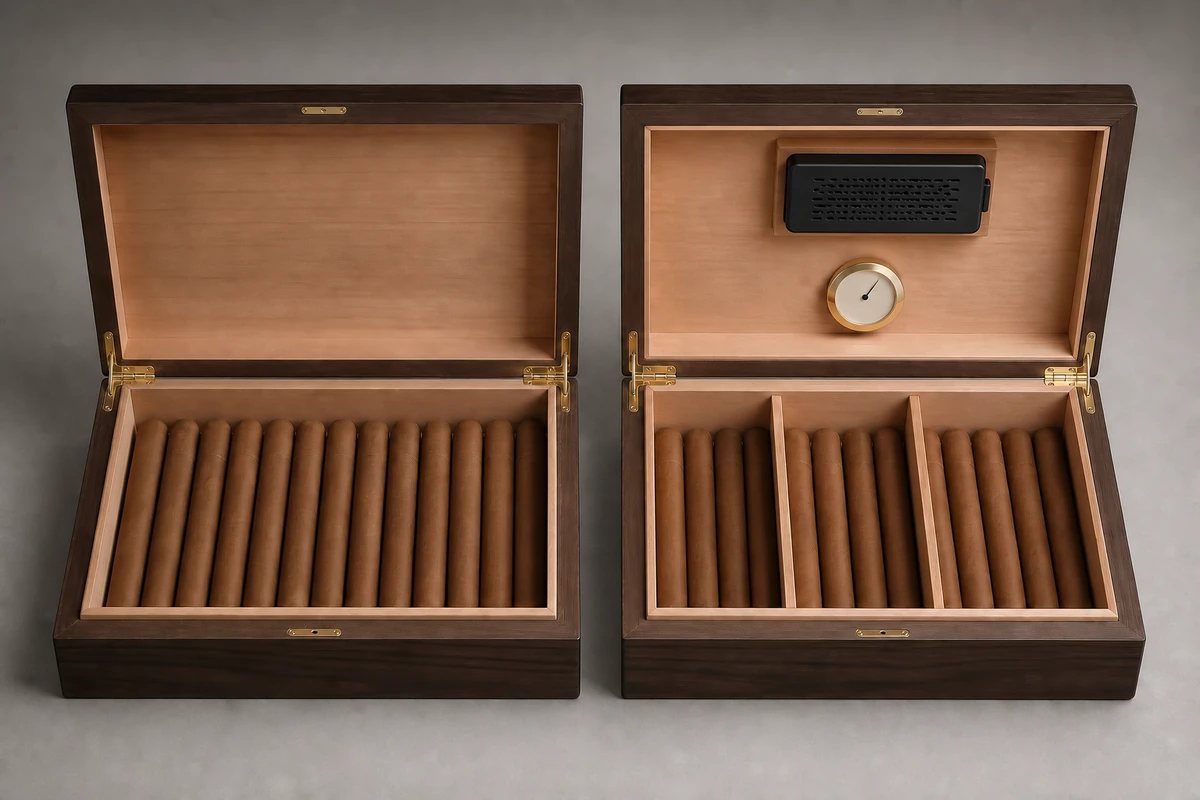
Spanish cedar also needs a narrower claim. A USDA Forest Products Laboratory research note documents its historical use for cigar packing, explaining why the material remains closely associated with cigar boxes. History is not a performance certificate. The USDA Wood Handbook chapter on moisture relations explains that wood exchanges moisture with surrounding air according to relative humidity (RH), temperature, its current moisture state, and its moisture history. It also states that varnish, lacquer, or paint can retard moisture-content changes but cannot prevent them.
For procurement, freeze the botanical species, liner thickness, exposed area, preconditioning state, and finish coverage in the approved sample. If Spanish cedar is specified for an international shipment, begin with the CITES species database and applicable national sources. Check the actual species, origin, product form, route, and rules in force for that shipment. The CITES Appendices dated 7 February 2025 list Neotropical populations of Cedrela spp. with Annotation #6, which identifies specific wood product forms. That dated example does not determine the documentation needed for every finished box or shipment, and the trade name alone is not enough to decide it.
A Humidor Sample Needs a Defined Test, Not a Label
One acceptable reading does not establish stability, retention, recovery, or storage duration. Sample approval should separate the physical product, preconditioning, measurement verification, and whole-system performance.
- Freeze the configuration and claim. Record the enclosure, closure, liner, finish, trays, dividers, humidity device, sensor type and position, instructions, intended load, and the exact claim to be approved. A later component substitution needs a documented change review.
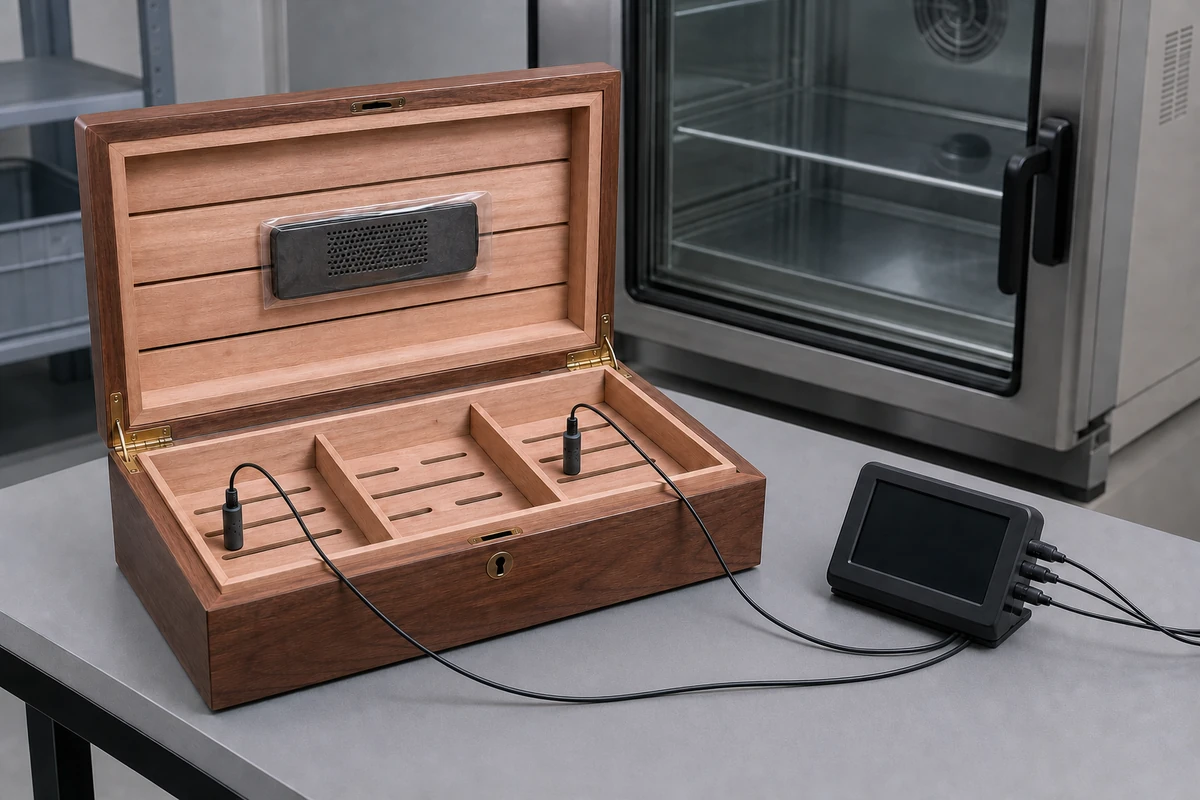
- Define preconditioning and measurement. Packaging materials and cigar specimens are not the same test object. The public scope of ASTM D4332-22 explains why packages—especially cellulosic ones—are conditioned in a specified atmosphere before reproducible physical testing. CORESTA CRM 46 addresses an atmosphere for conditioning and testing cigar samples. Neither is a humidor certification. The reference logger or built-in sensor also needs an appropriate verification method. NIST’s explanation of hygrometer calibration describes comparison with air of accurately known moisture content in a controlled chamber. This does not mean every project must use NIST’s calibration service; it means the project should state the reference, verification points, tolerance, and record.
- Run and approve the whole-system protocol. State the external temperature and RH, intended load or agreed surrogate, device condition, sensor locations, logging interval, duration, opening schedule, and pass/fail criteria. A peer-reviewed RSC Advances study illustrates the principle: its reported humidity result is tied to a particular composite, cigar-box setup, hygrometer, controlled external chamber, and test duration. That result cannot be transferred to a different box or commercial humidity device.
Laboratory conditions improve comparison, but they do not reproduce every warehouse, shop, home, or transport environment. The approval report should therefore say exactly what was tested and avoid expanding the result beyond those conditions.
What Buyers Should Put in the RFQ
Start the RFQ with intended function. “Premium wooden cigar box” describes an appearance, but it does not assign a storage duty. Tell the supplier whether the project is retail packaging, a gift presentation box, humidity-managed storage, or a package intended for another controlled enclosure.
Include the following information:
- intended use and the exact humidity or storage claim, if any;
- destination market and the party responsible for regulatory approval;
- cigar count, actual length and diameter, layout, and pack-out;
- external size limits and internal clearances;
- substrate, visible wood or veneer, liner species, liner thickness, and exposed area;
- lid structure, closure geometry, hinges, lock or other hardware;
- finish system, interior finish coverage, branding method, and approved artwork;
- humidity device or active-control system, capacity basis, position, consumables, power, and service access;
- measurement method, sensor position, verification record, logging format, and user instructions; and
- sample protocol, acceptance criteria, approved equivalents, and change-control rule.
Artwork should not be finalized before the destination-market review. FDA’s current cigar-label status page is a useful warning against relying on old summaries: it records that the cited U.S. cigar health-warning requirements were vacated while FDA continued to enforce other requirements. This article is not legal advice; the brand or importer should obtain current review for each market.
Use cigar-sector product examples to shortlist a physical format, then replace the catalog name with the function, evidence, and acceptance fields above.
The Practical Decision Rule
- Choose a cigar packaging box when the approved duty is presentation, physical protection, identification, and distribution.
- Specify a humidor system when the product itself carries a humidity-management or storage-performance claim.
- Use a hybrid brief when the branded box and the controlled storage enclosure are separate, and state which system is responsible for each claim.
If a supplier cannot tell which of these three briefs you are requesting, the quotation is premature. When the intended duty and approval evidence are clear, you can send a function-first brief without asking appearance to stand in for performance.
Frequently Asked Questions
Can a regular cigar box be used as a humidor?
Possibly, but not by name or appearance alone. To assess a regular box for humidity-managed storage, define its closure, humidity source, air path, measurement method, intended load, and instructions. Then test the complete system against the buyer’s acceptance criteria.
Does Spanish cedar make a cigar box a humidor?
No. Spanish cedar is historically associated with cigar packing and, like other wood, exchanges moisture with surrounding air. It can be part of the approved system, but it does not select or maintain a target humidity by itself.
Does a humidor have to be airtight?
The standards and technical sources reviewed for this article do not establish one “airtight” threshold for every cigar humidor. Specify measurable retention and recovery outcomes under defined external conditions, load, device state, duration, and opening schedule instead of approving the adjective alone.
Does every humidor need a hygrometer?
Not necessarily a built-in hygrometer, but a humidity-performance claim needs a defined way to measure and verify internal conditions. An external reference logger may serve that role if its position, verification method, tolerance, and data record are part of the protocol.
How should a buyer test a humidor sample?
Freeze the exact configuration, define material and specimen preconditioning, verify the reference instrument, and log the complete system under stated external conditions. Include the intended load, humidity device, sensor positions, opening schedule, duration, and pass/fail criteria. Review any later component change before applying that result to the changed configuration.
What should a buyer specify when comparing a cigar box vs humidor?
State the intended use, cigar count and dimensions, structure, liner, closure, finish, artwork, destination market, and physical approval checks. For a humidor, add the humidity system, measurement method, instructions, test conditions, acceptance criteria, evidence format, approved equivalents, and change-control rule.