
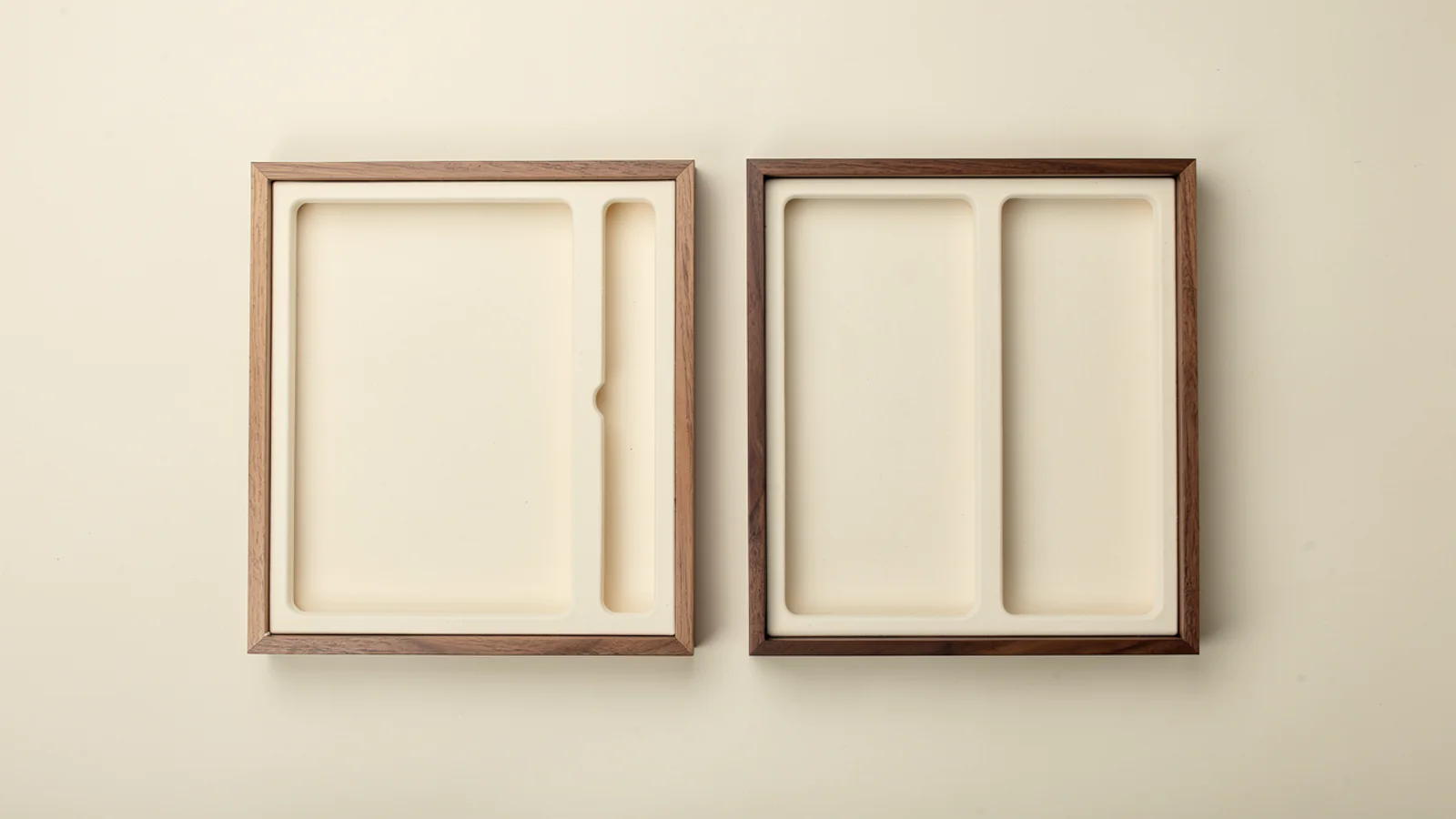

Start Corporate Gift Packaging Design with the Kit Family
A recurring program might offer a stationery kit, a notebook-and-tumbler kit, and a larger appreciation set. Treat them as related configurations, each with its own contents, rather than as one box with optional objects added later.
Separate three decisions: the external brand appearance, the usable space inside the wooden shell, and the support required for each product. Matching colors and lid artwork can create a family even when its boxes have different dimensions. Conversely, matching exterior dimensions do not establish internal compatibility.
List the actual product references, including retail sleeves, caps, clips and printed materials. Note which items are stable across orders and which the gift buyer expects to substitute. A familiar product name such as “notebook” leaves its thickness, closure and presentation orientation unresolved.
The wooden gift boxes page covers the broader manufacturing options. This guide focuses on choosing what to share across repeat kit versions. For recipient allocation and a fixed event deadline, use the separate event gift box design guide.
Choose Between a Shared Insert, a Shared Shell and a Separate Box
Use the following as a proposed selection framework. These are conditions to verify with samples, not claims that a particular XRX model already supports every combination.
| What changes between versions? | Configuration to consider | What decides the choice? |
|---|---|---|
| Only a card, or an already approved equivalent item | Shared shell and insert | The complete contents still fit, remain identifiable and can be removed as intended. |
| Product shapes or placement, within a workable common box size | Shared shell with dedicated inserts | Each insert seats correctly and the loaded kit closes and handles properly. |
| Required depth, footprint or handling duty exceeds the common design | Separate shell and insert | The larger or differently supported kit needs its own complete packaging review. |
Consider an illustrative brief: Kit A contains a notebook and pen; Kit B contains a notebook and a compact tumbler. They are candidates for a shared shell with different inserts. Kit C introduces a larger handled mug. Its handle and required orientation may make a separate shell more appropriate. The names of the gifts alone cannot settle the choice.
Do not enlarge every box automatically to accommodate Kit C. First compare the smaller kits inside that proposed larger case. Check the presentation, support, packing space and finished shipping package. An additional shell size may be a reasonable tradeoff when a universal case makes the other versions unnecessarily bulky.
UPS’s US package guide explains that dimensional weight can affect shipping costs for packages that are large relative to their weight. Apply the actual carrier and service rules to the outer shipping package; the wooden presentation box alone is not the final parcel.
Define the Interface That Makes Inserts Interchangeable
A removable insert is not automatically interchangeable with every shell of the same advertised size. For a shared-shell proposal, define the surfaces and spaces where the two components meet.
- Seating footprint: the insert’s outside outline, corners and the usable inside shape of the shell.
- Vertical position: how the insert is supported and where the loaded products sit relative to the lid.
- Retention and removal: whether the insert is bonded, retained or intended to lift out, and how it is handled.
- Contact layers: the finished covering and support construction used in the approved combination.
These are engineering review points. A thicker covering, a changed support platform or a different lid lining can affect the assembled relationship even when the listed exterior dimensions stay the same. Agree project-specific dimensions and acceptance criteria instead of applying a universal clearance.
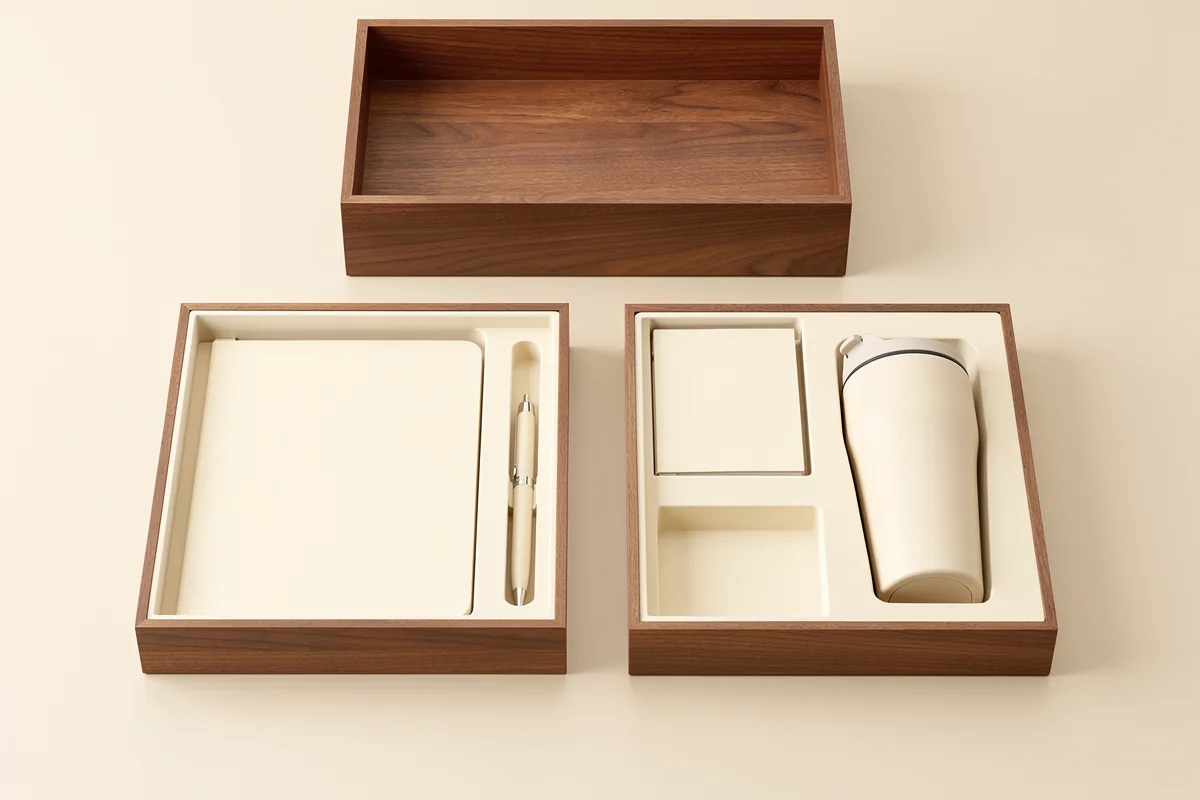
Ask who changes the insert. A removable tray assembled by a fulfillment team has a different use sequence from a permanently fitted interior. If swapping is intended, rehearse removal and installation in the finished shell and check that the correct orientation is obvious. Describe a permanently bonded interior as a dedicated version, rather than implying it can be swapped later.
XRX supports custom wooden box structures and inserts. Discuss the proposed interface through the logo and insert customization options; confirm compatibility for the actual project rather than assuming a universal modular system.
Keep the Brand Finish Consistent While Controlling Revisions
The shared design needs a material and finish reference as well as an outline. Record the shell construction, lining, finish and branding process for the versions intended to share components. A repeated wood tone or paint color does not identify the underlying shell revision.
Give the shell, each insert and each complete kit separate references. A simple internal example is shell S1 with insert A1 for the stationery kit, and shell S1 with insert B1 for the tumbler kit. These are illustrative internal identifiers, not a barcode standard or a required software format.
Make a change decision explicit. If a new notebook fits the existing approved arrangement, record the accepted substitution. If a new insert is needed, identify which shell revision it works with. If the shell changes too, decide whether old stock remains usable for any kit before placing a repeat order.
A useful approval question: can the new insert be used in retained shells from the previous order? Test that combination if it is part of the replenishment plan. A new insert fitting only the newly supplied sample shell does not answer the question.
Count Complete Kits, Not Just Empty Wooden Boxes
The design decision affects what the buyer needs to hold in stock. Shared shells may be allocated across versions, but each finished kit still needs its correct insert and gifts.
Shopify’s official bundle inventory guidance calculates available bundles from component quantities, using the lowest complete-set result. That is platform documentation. The following manual example adapts the component-counting principle to a physical gift program; it is not a software setup instruction or an XRX inventory record.
Assume Kit A needs one shell, one A insert, one notebook and one pen. Kit B needs one shell, one B insert, one notebook and one tumbler. All quantities below are hypothetical usable, uncommitted stock.
| Component | Available quantity | Required by |
|---|---|---|
| Shared shell | 100 | A and B |
| Shared notebook | 80 | A and B |
| Insert A | 70 | A |
| Pen | 100 | A |
| Insert B | 50 | B |
| Tumbler | 30 | B |
Considered independently, the stock supports up to 70 A kits or up to 30 B kits. Those figures cannot be added to promise 100 kits: both calculations use the same 80 notebooks. If the buyer allocates 60 notebooks to A, only 20 remain for B. That mix produces 80 complete kits and leaves 20 shells unused.
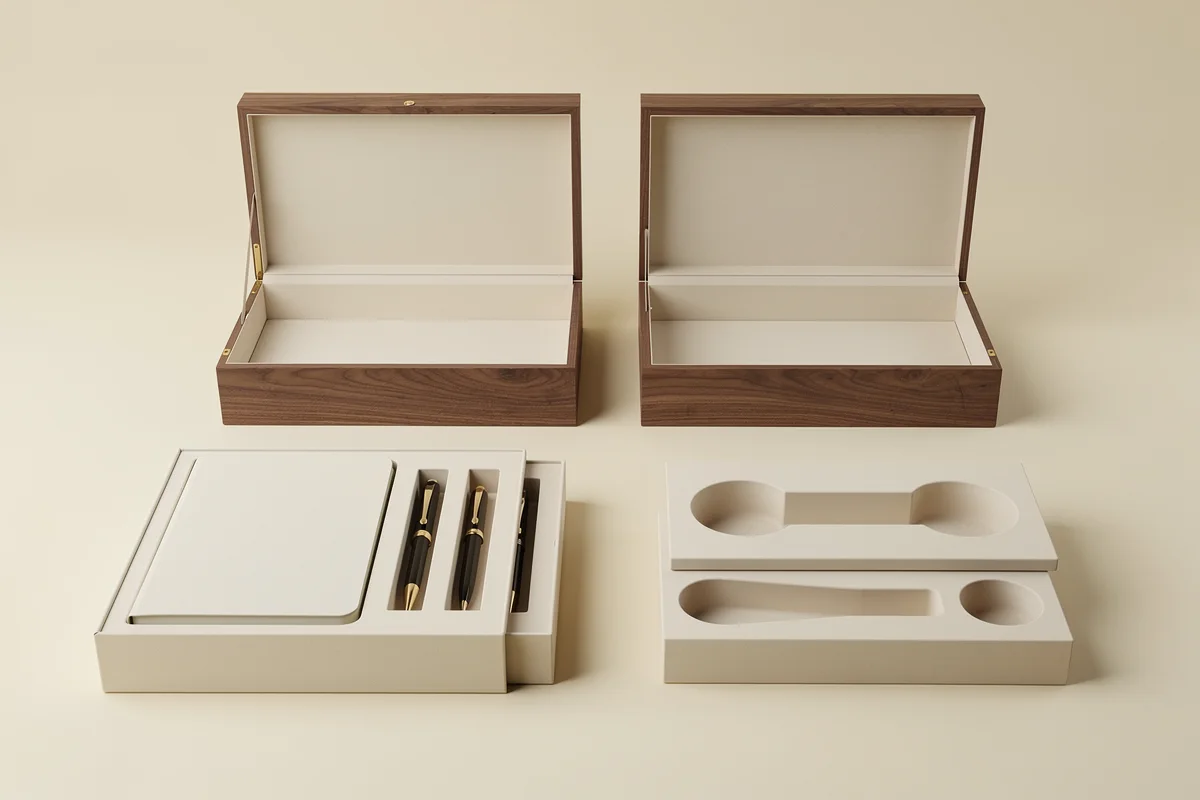
This arithmetic assumes the listed components are compatible and available for that order. Exclude damaged pieces, incompatible revisions, reserved components and stock that cannot reach the assembly location when needed. Agree who updates the allocation when the kit mix changes.
Reordering only shells would not resolve the notebook shortage in this example. Review the limiting components first, then order the appropriate mix of shells, inserts and gifts from the responsible suppliers.
Compare Quotations for the Planned Mix
Ask for a proposal based on quantities by kit version, including which components are common and which are separate. Clarify whether quoted quantities and minimums apply to a shell design, an insert version or the finished kit. Do not assume all versions can be pooled into one manufacturing quantity.
For a shared-shell option, identify any extra assembly, component storage and insert replacement work. For separate shells, compare the complete packed sizes and the stock commitments for each version. Keep the gifts, printed items and fulfillment work clearly assigned to their suppliers.
A common shell may simplify part of the purchasing process, but it does not establish a saving by itself. Use the actual proposals and your expected version mix; the wooden box cost guide explains the wider quotation factors.
Approve the Combinations You Intend to Reorder
Prepare a compatibility record showing each kit, its shell revision, insert revision and accepted contents. Have the sample review cover every intended combination, including old-shell/new-insert combinations if replacements will be supplied.
Review seating, product support, lid closure, item removal and the planned assembly sequence. A configuration that passes a tabletop review still needs the transport evaluation appropriate to its actual packed contents and distribution route. Do not extend one configuration’s result to all versions without a review of the differences.
Keep those records with the approved sample reference. Before requesting a quote, prepare the current kit list, likely substitutions, quantities by version and which components you intend to reorder separately. Send that brief to XRX to review the shared-shell and separate-shell options.
FAQ
Can different corporate gift kits use the same wooden box?
Yes, if each complete configuration fits the approved shell and meets its own support, access and closure requirements. A shared exterior does not prove that the same insert will work. Review each proposed shell-and-insert combination with its actual contents.
Does every kit version need a different insert?
No. A change limited to a card or an item with an already approved equivalent shape may retain the insert after review. A different product shape, orientation or support requirement may need another insert. Record which contents are approved for each insert revision.
When should a kit use a separate box size?
Use a separate size when the common shell cannot accommodate the complete contents with suitable support, removal access and lid clearance, or when enlarging every box creates an unacceptable tradeoff. Compare the actual packed proposals before choosing a shared shell.
Can replacement inserts be ordered for existing wooden boxes?
They can be proposed, but compatibility with the existing shell revision must be confirmed. Supply the shell reference, insert drawing and actual samples where possible. Check the replacement in retained boxes before treating old and new components as interchangeable.
How should buyers count stock for multiple gift kit versions?
Count usable, uncommitted components by reference and revision, including shared shells, version-specific inserts and gifts. Each kit is limited by the components it needs. Allocate shared stock once across the planned mix; do not add independent kit totals that rely on the same items.