
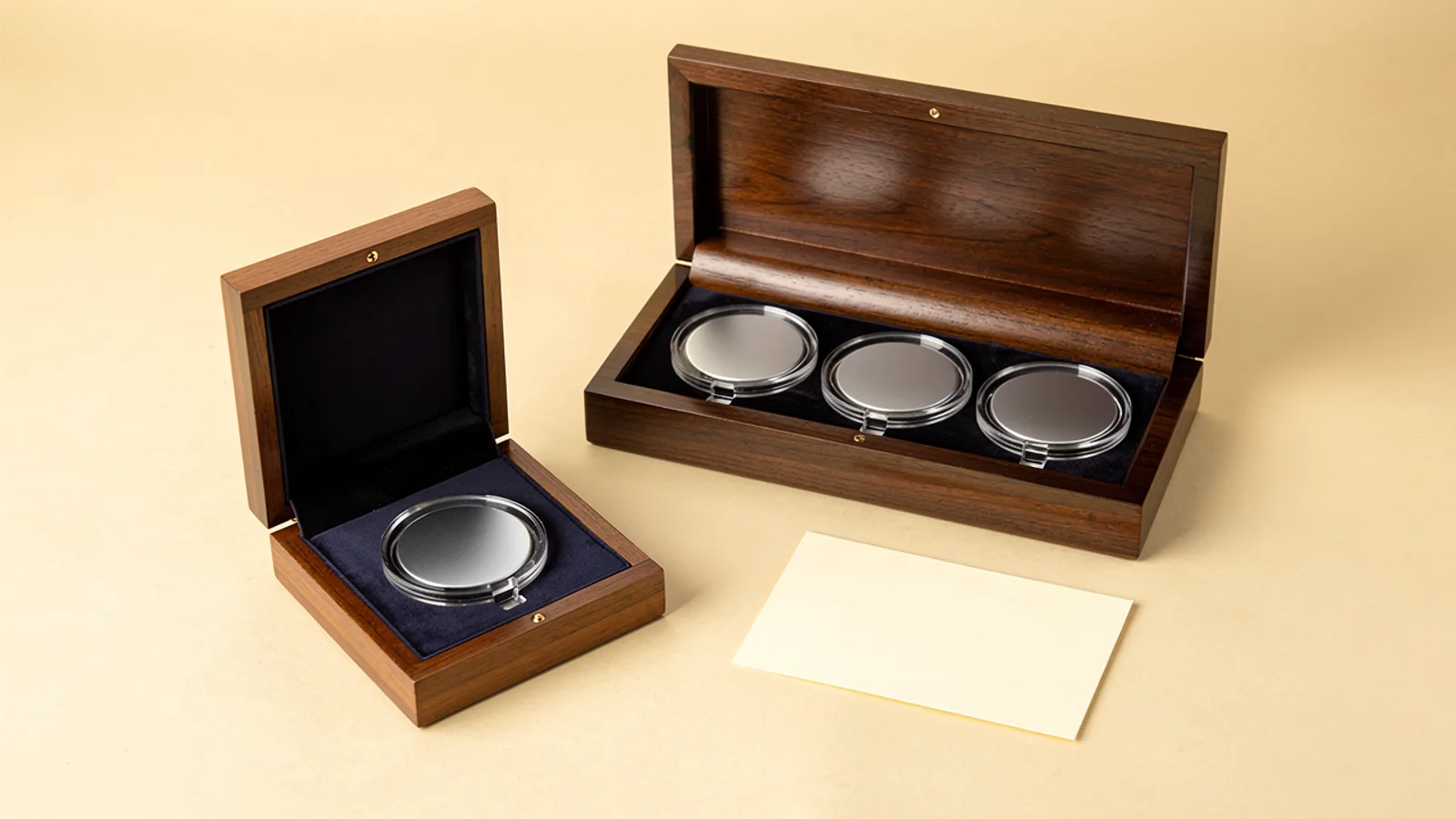

Single Coin Box vs Coin Set Box: Quick Comparison
Here, a single coin box means a presentation case for one coin or encapsulated medal. A coin set box brings a defined group into one case. The comparison concerns presentation packaging for a new collector program; bulk coin storage has different priorities.
| Decision factor | Single coin box | Coin set box |
|---|---|---|
| Unit handed to the recipient | One independently presented coin | A defined group, or a clearly described collection in progress |
| Release schedule | Each release can have its own package | Decide whether the case ships with the full set or an earlier release |
| Change to a future coin | Its own case specification can be reviewed separately | Check the change against a layout that may already be in collectors’ hands |
| Documentation | Allocate the information intended for that individual product | Distinguish set-level information from any documents for individual coins |
| Quotation basis | Count all individual cases needed for the collection | Include the shared case and any separate packaging for later deliveries |
Choose around the handover: three related designs do not necessarily need one case if recipients buy them separately. Conversely, three separate release dates do not rule out a shared case if the program deliberately supports gradual completion.
Decide What Counts as a Complete Package
Write a one-sentence contents description before drawing the box. For example: “One encapsulated anniversary medal and one information card are presented at each ceremony.” That describes an independent handover and points toward a single case.
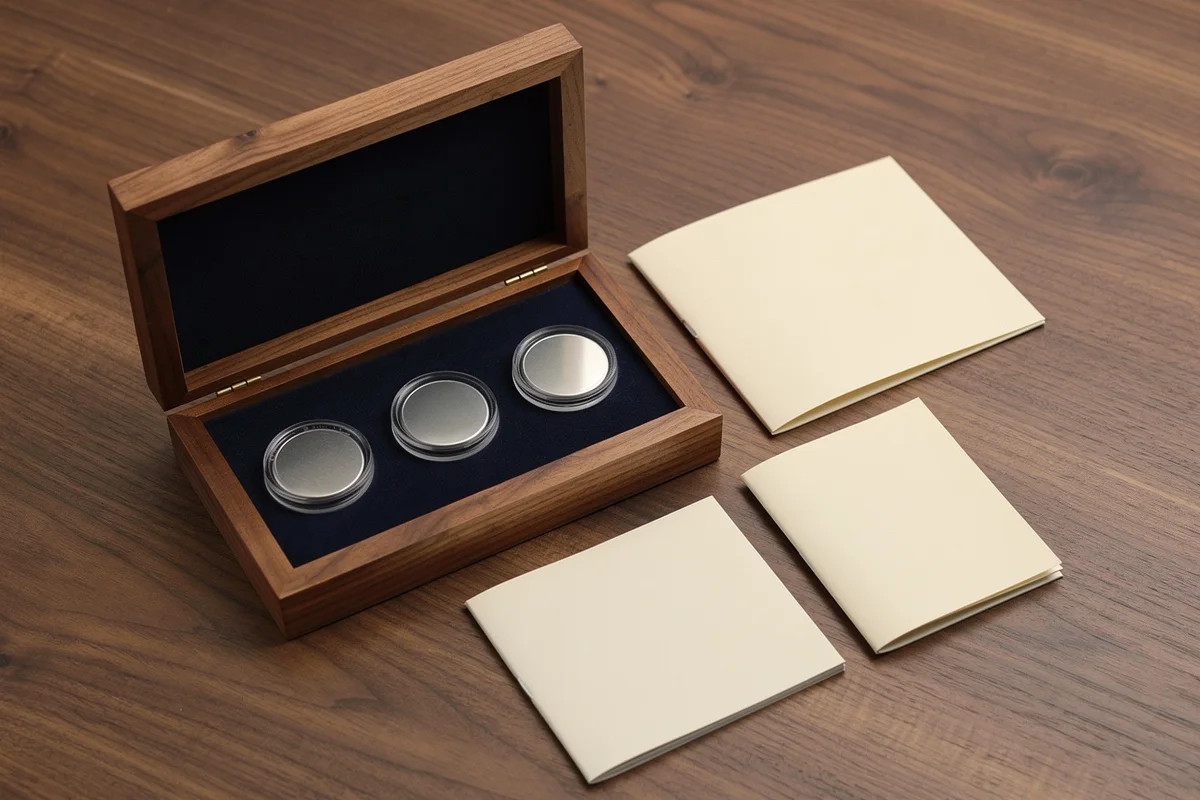
“Three commemorative coins and one collection booklet are delivered together” points toward a set case. The booklet belongs to the collection, and the layout should let the recipient understand the group without unpacking several unrelated presentations.
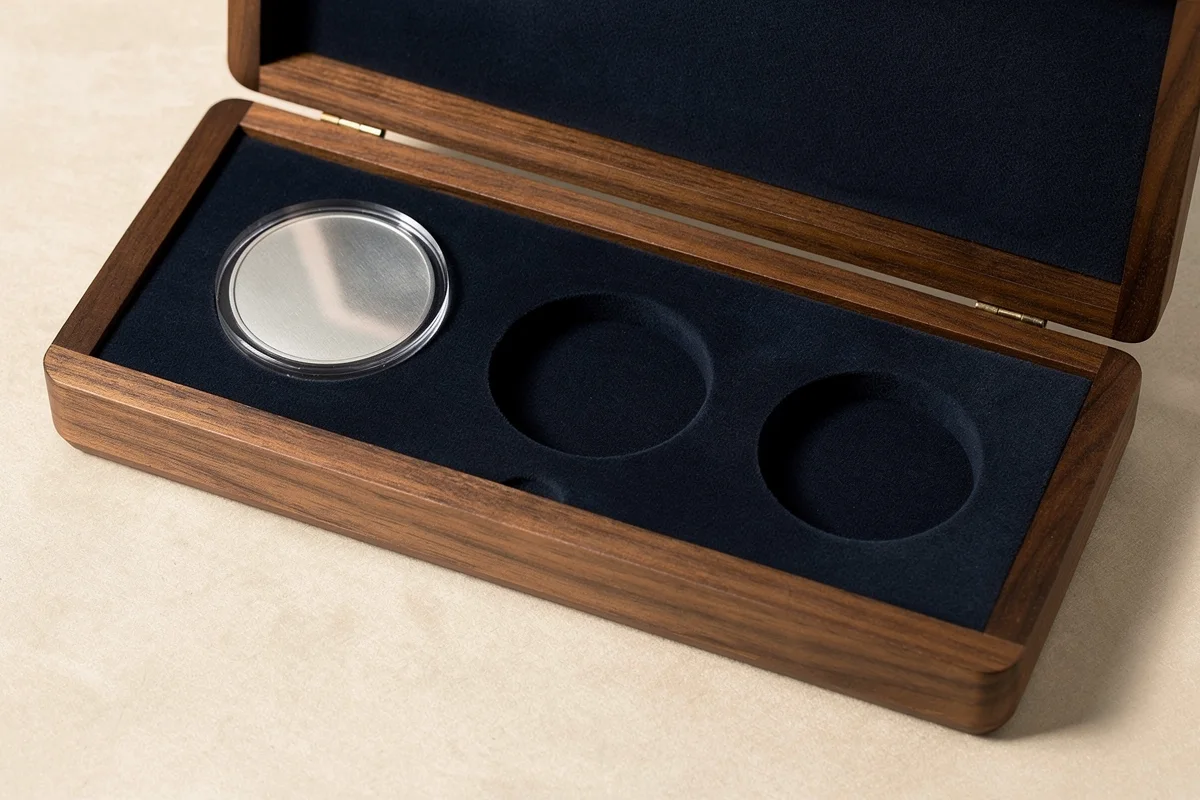
A third description needs more work: “The first coin arrives in a case with two reserved spaces.” The empty positions are intentional, but the recipient still needs to understand what is included today. Specify that condition on the approved contents list and customer-facing packaging information. A photograph of the completed collection alone cannot explain an incomplete first delivery.
For an overview of case formats, see XRX’s wooden coin boxes. The next decision is how the chosen format works across your actual release schedule.
Compare Three Ways to Package a Phased Coin Series
Consider a hypothetical program with three planned coin releases: Launch, Heritage, and Finale. These are illustrative names, not an XRX customer case. The buyer can compare three routes without assuming that all collectors purchase every release.
| Route | What happens at each release | Decision to settle before sampling |
|---|---|---|
| Independent single cases | Each purchased coin arrives in its own presentation box. | Will the program offer a separate collection case later, and is it optional? |
| Complete set at the end | The shared case is supplied with all three coins once the set is available. | Is this a separate set offer, or does the program intend to consolidate earlier purchases? |
| Shared case at launch | The first delivery includes the case and first coin; later purchases add the remaining coins. | Who qualifies for the case, how are empty positions explained, and how will later coins arrive? |
Choose independent cases when future participation is uncertain
If recipients may select only one theme, a single case gives that purchase a complete presentation. It also allows the buyer to review a later coin’s packaging independently if its format changes. Specify how the series should look together, but avoid making an unconfirmed future case part of the initial packaging promise.
Choose a complete set when the group is the product
A fixed set case suits a program that will hand over the whole collection together. Confirm the final contents before locking the layout. If buyers can also purchase individual releases, treat the individual and complete-set offers as separate packing configurations, even when they use the same coin designs.
Choose a launch case when gradual completion is deliberate
A case supplied at launch makes the future arrangement visible immediately. It also commits the project to a case the collector already owns. Confirm the planned coin and capsule formats, position sequence, and document allowance before that case enters production. If later specifications are unresolved, reserve the decision instead of describing the case as universally expandable.
Decide whether later coins require only delivery packaging or their own presentation boxes as well. Otherwise the quotation may include one shared case while the fulfilment plan quietly assumes additional cases for every release.
Match Certificates to the Product They Describe
Do not start with a standard “numbered certificate pocket” on every drawing. The United States Mint’s product FAQs explain that not all of its products have a Certificate of Authenticity (COA), and some have COA language on the packaging itself. Documentation requirements therefore need to come from the issuer’s actual product specification.
A set-level example is the Perth Mint’s 2025 Year of the Snake silver proof three-coin set, whose official description pairs the set with a numbered COA and display case. That example establishes how this particular product is packaged; it does not establish a certificate requirement for every collection.
For your project, map the document to the object it describes. An individual-coin certificate may need to remain identifiable when that coin leaves the set. A collection booklet may stay with the shared case. If there is a set-level serial number, define the issuer’s matching rule; do not assume each coin carries that same number.
Put a document sample in the packaging sample. Check that the recipient can retrieve it, distinguish separate documents, and return them without covering the intended display. Artwork approval should cover the actual launch contents, including any wording that explains reserved positions.
Compare Costs Across the Same Delivered Collection
One larger case is not automatically cheaper than several small cases. Compare both proposals against the same purchasing and delivery scenario. A quotation for one empty set case is not directly comparable with three individual cases that include cards, protective sleeves, and assembly.
Ask suppliers to separate the case, inserts, artwork, document accommodation, and individual protective packaging in the quotation scope. Then account for assembly and dispatch in your own fulfilment plan. For a phased series, include the packaging used for each later coin, even if those packages are purchased elsewhere.
Also define the replacement unit. If one outer case is damaged, is the service team replacing an empty case, a case with documents, or a complete packed set? That is a proposed service decision, not a reason to duplicate issuer-controlled certificates. Confirm document replacement rules with the issuer.
This comparison gives the buyer a usable cost basis without inventing a standard saving, minimum quantity, or production time.
Approve the Handover Condition Before the Finish
The most useful sample review for this decision is a packing rehearsal. Give the reviewer the approved contents list and the sample in the condition the recipient will receive. Ask them to identify what belongs in that delivery before showing them the completed collection drawing.
- Independent release: confirm which coin, information, and outer label identify that package.
- Complete set: check the intended sequence and that set-level and individual documents can be distinguished.
- Launch case: check the first-delivery state and the final planned state separately; record which empty positions are intentional.
- Later release: rehearse adding the new coin and its documents to the previously approved case configuration.
- Specification change: identify which existing packaging version must be checked if a future coin, capsule, or document changes.
Keep detailed cavity dimensions and capsule retention in the separate coin box insert specification. This article’s decision is which delivery configurations need approval. Once selected, connect those configurations to the approved golden sample so a later revision is not accepted against the wrong arrangement.
Before requesting a quotation, prepare the planned release list, contents per delivery, document samples, and whether the case is supplied once or with every purchase. Share those details with XRX to discuss the wooden case configuration for your program.
FAQ
When should a buyer choose a single coin box?
Choose a single coin box when each coin is sold, awarded, or delivered independently. It lets each handover have its own presentation package. If a complete collection will be offered later, specify that set package separately instead of assuming the individual boxes must fit inside it.
Is a coin set box suitable for a series released over time?
It can be, provided the launch contents, future coin formats, reserved positions, and later delivery method are defined. Decide who receives the case and when. If later formats remain undecided, individual boxes can avoid committing the initial case to an unconfirmed layout.
Does every coin box need a numbered certificate?
No. Documentation depends on the issuer and the product. Specify whether the package includes no certificate, an individual-coin certificate, a set-level certificate, or information printed on the packaging. Include serial-number matching only where the issuer requires it.
Is one set box cheaper than several single coin boxes?
There is no universal cost advantage. Compare quotations for the same delivered collection, including the cases, documents, assembly, protective shipping packaging, and any later dispatches. A larger shared case and several individual cases create different cost structures.
What should be approved before ordering a coin set box?
Approve a contents list and a physical sample showing the actual handover condition. Identify each coin position, document location, outer-package label, and any intentional empty space. For phased releases, also confirm the final planned arrangement and how later changes will be reviewed.