
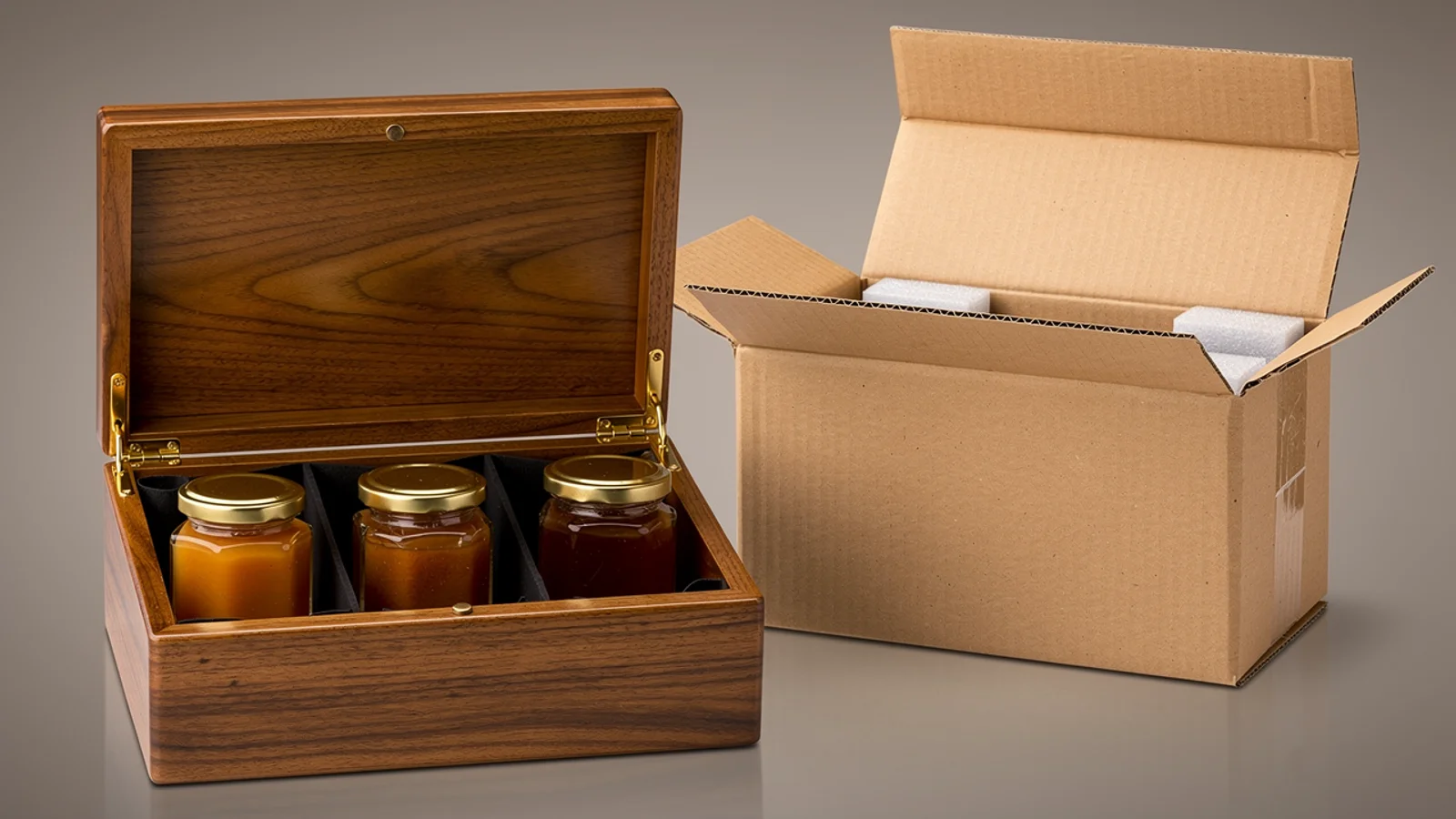

How to Ship Glass Jars: The Gift-Set Packing Sequence
- Confirm the filled jars. Use the actual jar, cap, label and filled weight, with the product owner’s closure requirements.
- Approve the loaded presentation box. Check separation, restraint and closing clearance with every intended item present.
- Protect the finished wood. Select a compatible wrap or sleeve and identify exposed edges or projecting hardware.
- Fit the outer shipping protection. Specify the carton and cushioning around the complete gift box, including top and bottom protection.
- Close and identify the shipping unit. Use the agreed carton-closing method and record the final contents and package configuration.
- Evaluate and release the complete pack. Check both product condition and presentation quality against criteria agreed before the evaluation.
This workflow addresses sealed products already suitable for their intended shipping conditions. It does not select food-preservation methods or temperature-controlled packaging. For the interior supports themselves, use the separate guide to food gift box inserts; the decisions below concern what surrounds that approved presentation unit.
Define What Actually Leaves the Warehouse
Start the packaging brief with a shipping unit, not simply “one wooden box.” A gift set sent individually, several sets inside a master carton, and cartons carried on a pallet are different configurations. Record where the load will be opened, split or repacked before it reaches the recipient.
| Delivery arrangement | Specify before sampling | Question to resolve |
|---|---|---|
| One gift set sent as a parcel | Loaded gift box, surface protection, cushioning, carton and closing method | Does the individual shipping pack protect the complete set? |
| Several gift sets in one master carton | Count, arrangement, separation between boxes and protection around the group | Can boxes move against each other or load a neighboring finish or fitting? |
| Cartons transported on a pallet | Carton pattern, pallet support, load restraint and later handling stages | Will the load stay together, or will individual cartons enter another delivery system? |
| Bulk delivery followed by individual fulfillment | Incoming configuration plus the outgoing parcel packing method | Who supplies and approves the protection added after the bulk pack is opened? |
Consider a gift program delivered in bulk to a fulfillment warehouse and then sent to separate recipients. Protection used between sets in the incoming carton may be discarded during unpacking. The outgoing parcel therefore needs its own defined protection. This is an illustrative workflow, not an XRX shipment case.
A master carton describes a grouping, not a transport mode: it can itself travel as a parcel or as part of a larger load. Avoid selecting a test or carton specification solely because someone called the package “bulk.”
Confirm the Jars and Closures Before Adding Outer Protection
Record each jar’s filled weight, outside profile, cap and label version. Use representative filled packs when reviewing the complete shipment. Empty jars or dimension-only substitutes can leave the real loading condition unresolved.
Ask the product owner to define closure and leakage acceptance. Do not assume that an upright display layout will remain upright throughout delivery: ISTA’s design and testing guidance notes that orientation is not guaranteed in single-parcel delivery. Protective material outside the wooden box cannot correct an unsuitable jar closure.
Keep glass separated from neighboring jars and hard contact points within the approved interior. If loading requires extra wrapping around individual jars, include that wrapping in the fit review. Adding it after approving tight cavities can change how the set closes. Keep this interface under review without redesigning the entire insert each time an outer-carton option changes.
Protect the Lacquered Surface and the Complete Box
For an upscale gift set, the wooden box is part of what the recipient receives. Its finish deserves an acceptance criterion alongside the glass. XRX’s confirmed finish capabilities include clear varnish, wood-veneer finishing and painted or lacquered surfaces; the protection should be selected for the actual approved finish.
Separate surface protection from cushioning. A soft sleeve may prevent direct rubbing against another material, but its presence does not establish shock protection. Likewise, a cushioning end cap can support a package while still creating an undesirable mark at a contact point. Check the selected wrap, support and finish together after the agreed handling and storage conditions.
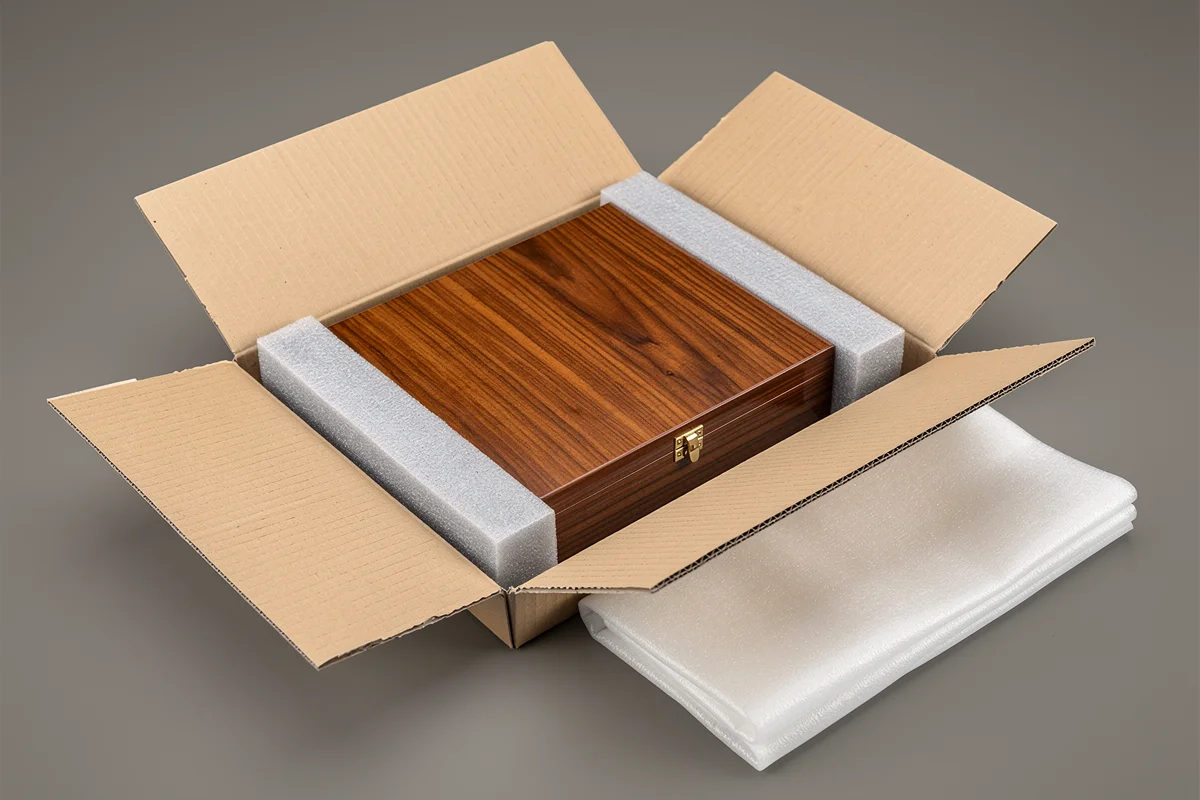
FedEx’s US guidance for packing breakables recommends a weight-appropriate box, room for cushioning, movement control and double-boxing for fragile items. Apply the carrier’s guidance to the complete shipment. Do not convert its general packing dimensions into a universal insert clearance or assume any wooden box automatically qualifies as the inner protective package.
Ask the packaging provider to define cushioning on every relevant face, including beneath the box and above the closed lid. Review where pressure reaches the wooden shell. A projecting clasp, hinge or decorative edge should not silently become the point that carries force from the outer pack.
Specify the carton rather than ordering by inside dimensions alone. Give the provider the final packed weight and the intended route so the board construction, cushioning and closure can be selected together. For a standard corrugated carton, FedEx illustrates H-pattern taping; confirm the appropriate closing method for the actual carton design.
Compare Shipping Proposals on the Same Basis
An outer-pack quotation should identify the number of gift sets, carton specification, protective components, material quantities and packing method. It should also say who supplies the finished jars, loads the wooden boxes, assembles the shipping pack and checks it before dispatch.
Compare the final outside dimensions and packed weight, together with the handling steps required. A smaller carton is not automatically a better option if it removes space needed by the proposed protection. A larger carton is not automatically safer if the box can move inside it.
Ask what changes when the order contains fewer sets than the usual carton quantity. Leaving unused positions empty changes the arrangement. Define a partial-carton configuration instead of allowing packers to improvise with whatever filler is available. If the pack is assembled by another warehouse, provide component references and photographs showing their positions.
Evaluate the Packed Gift Set Before Releasing It
The sample sent for evaluation should include the actual combination intended for dispatch. Identify the jar and closure versions, interior arrangement, wooden-box construction and finish, protective materials, carton and quantity per shipping unit.
ISTA distinguishes early screening procedures from simulations associated with particular distribution environments in its test-procedure overview. Have a qualified test provider select the current procedure and scope for the route. “It passed a drop” does not tell the buyer what was tested or whether it represents the intended shipment.
ISTA also recommends representative product and packaging samples and defining damage and package-degradation criteria before testing. For this gift-set project, agree separately what condition is acceptable for the jars, labels, presentation box and disposable outer pack. A scuffed shipping carton and a scuffed lacquered gift lid need not have the same commercial consequence.
Record results against the approved configuration and sample approval reference. A different jar weight, carton count, cushioning material or closing method requires review of the affected evidence. The buyer’s release record should identify the configuration covered; it should not become a blanket performance claim for every wooden gift box.
Inspect Delivery Results in Layers
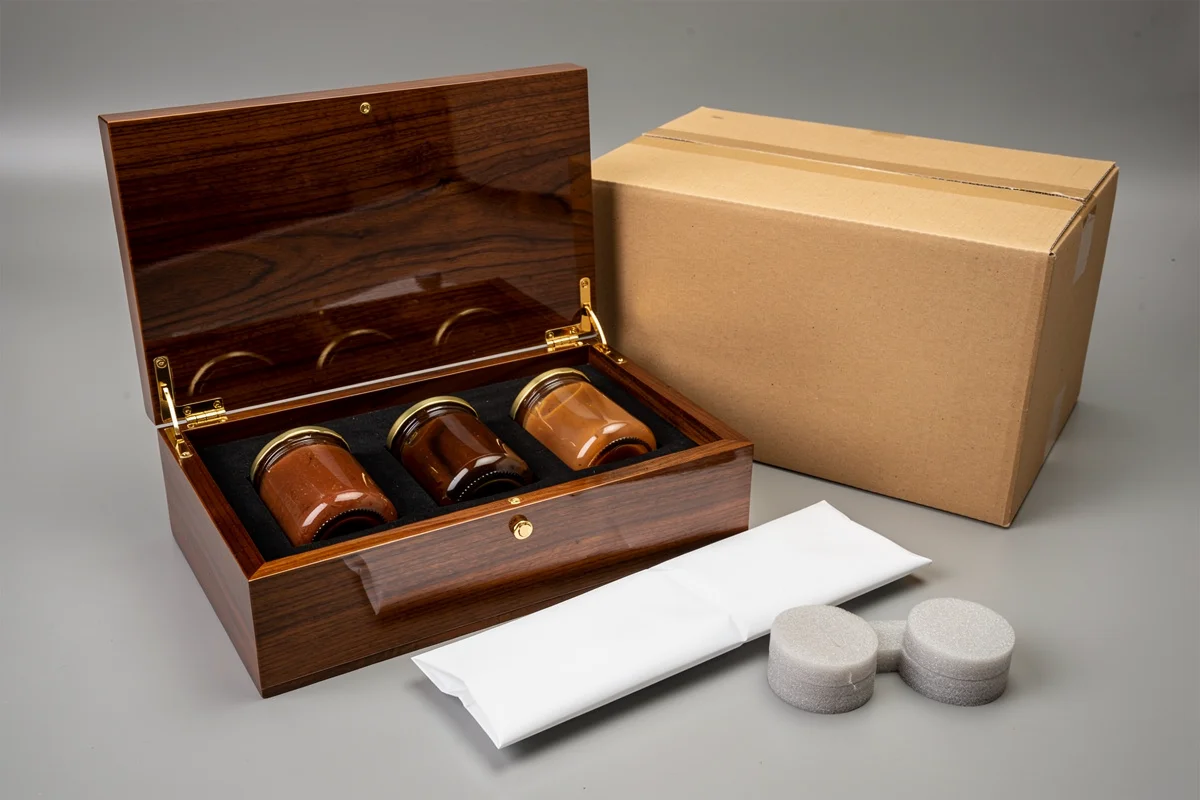
At receipt, photograph the outer pack before removing protection, then record where each protective component sits. Inspect the presentation box and jars in sequence. These observations can help compare the received pack with the approved packing method; they do not by themselves establish who caused damage.
| Observed condition | What to inspect next | What not to conclude from appearance alone |
|---|---|---|
| Glass remains intact but the wood finish is marked | Wrap contact, trapped debris, movement and contact with adjacent boxes or fittings | That the pack is acceptable merely because nothing broke |
| Leakage with no visible glass break | Jar closure, seal condition and the received packing arrangement | That the outer carton or wooden shell alone caused the leak |
| Jars or supports are displaced | Compare component positions with the packing reference and inspect attachments | That adding loose filler necessarily fixes the problem |
| Outer-carton damage | Inspect the protective layers, wooden box and contents against the agreed criteria | That all contents are damaged, or that an intact-looking box proves they are sound |
Agree the receiving record and review contact before dispatch. Keep component identification with the observations so a corrective action can address the relevant jar, presentation box or shipping-pack decision. Use actual results to refine the specification rather than treating a photograph of a damaged pack as a complete diagnosis.
What to Include in the Shipping-Pack Brief
Provide the filled jar details, loaded gift-box dimensions and weight, finish reference, units per shipping package, delivery route, any repacking stage, proposed protective materials and responsibility for packing. Add the agreed appearance and functional acceptance criteria, evaluation scope and packing instructions.
The wooden food packaging boxes overview covers XRX’s presentation-box scope. To discuss that part of your project, send XRX the jar and gift-set brief together with the outer-packing plan. Coordinating the interfaces early makes the sample review more useful than approving an empty wooden shell on its own.
Frequently Asked Questions
Can I put a shipping label directly on a wooden gift box?
Do not treat the wooden gift box as a ready-to-ship parcel unless the complete pack has been designed and accepted for that route. A separate shipping carton can accommodate cushioning and protect the presentation surface. Confirm the final configuration with the packaging provider and carrier.
Do glass jars still need protection inside a rigid wooden box?
Yes. A rigid shell does not establish that the jars are adequately separated, restrained or protected from transport shocks. Review the filled jars, their supports, the wooden box and the outer shipping protection together.
How much cushioning should surround a wooden gift box?
There is no single allowance established for every wooden gift set. Cushioning depends on the packed weight, geometry, protective material and distribution route. Follow applicable carrier guidance and have the actual configuration specified and evaluated; do not guess the allowance from the empty box.
Can the same packaging be used for a parcel and a master carton?
It may share components, but each shipping configuration needs its own review. Record the number of gift sets, their positions, separating protection and outer packaging. If a warehouse removes a gift set for individual delivery, define the outgoing parcel pack as well.
What should buyers check after a shipping evaluation?
Assess the agreed criteria for the complete gift set: glass condition, leakage, jar closures, labels, wooden-box finish, joints, hardware and interior movement. Also record the condition of the outer carton and protective parts. Unbroken jars alone do not establish that a premium gift set is acceptable.