


Separate product SKUs from packaging configurations
A stock keeping unit, or SKU, is an internal reference used to distinguish an inventory item. Your product list and the factory’s packaging specification list do not necessarily divide the order in the same way. Two product references might use an identical box; one product might need different boxes for separate market or gift editions.
Create a packaging configuration reference for each finished combination you want quoted. Include the shell drawing, material, finish, artwork, hardware, insert and packing revision. Then map your product SKUs to those references. This is a proposed purchasing method, not a barcode rule or a requirement to buy new software.
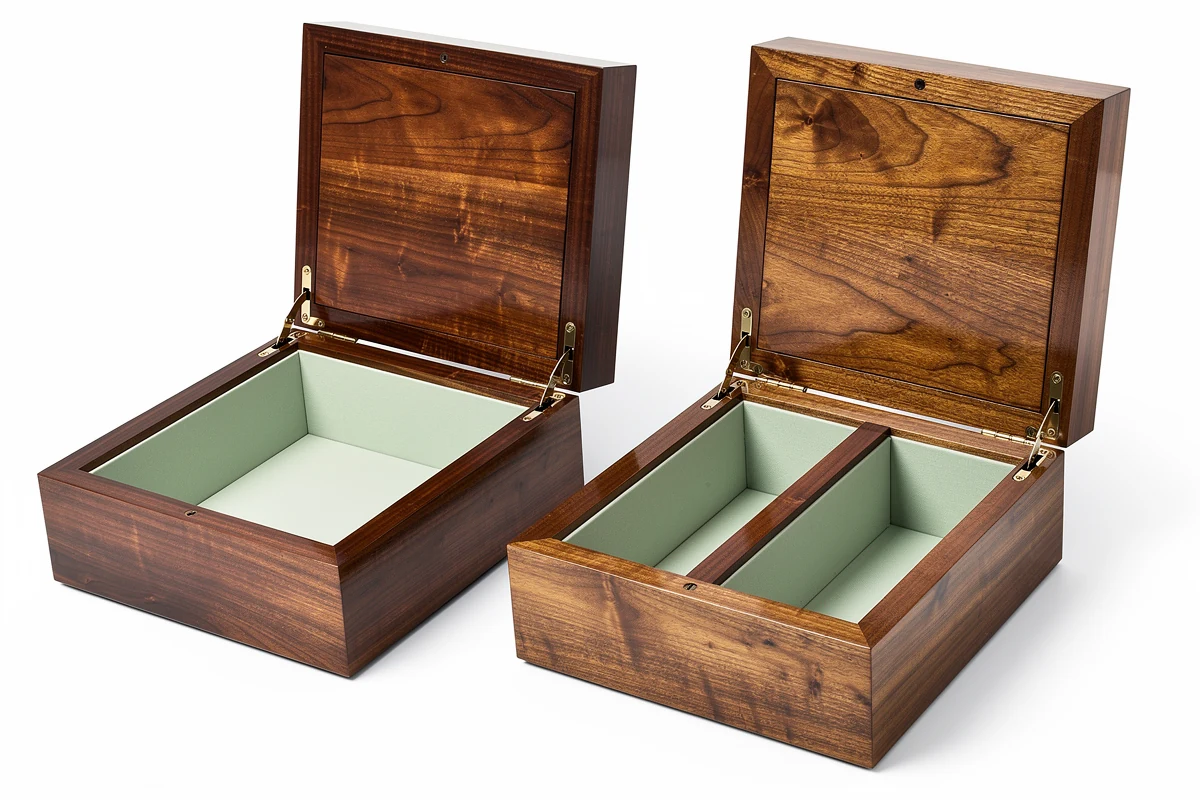
Do not decide that two configurations are identical from the exterior photograph. A different lining color, bottle cavity or carton label can remain invisible in that image. Show the difference so the supplier can decide whether it changes production grouping, setup, purchasing or assembly.
The custom wooden packaging page describes the broader product options. This guide focuses on quantity commitments after the proposed configurations have been identified.
Ask which operation sets the custom packaging MOQ
MOQ is a commercial condition to clarify, not a manufacturing formula that can be calculated from a lid size. Ask the supplier to explain the limiting scope instead of requesting a lower number without changing anything else.
| Proposed difference | Ask the supplier to review | Quantity decision to record |
|---|---|---|
| Dimensions or opening structure | Separate parts, machining and assembly requirements | Which shell references can count together? |
| Substrate or visible wood finish | Material purchase and finishing requirements | Is grouping possible at any common stage? |
| Paint color or surface specification | Preparation, color matching and production changeover | Does each finish need its own run quantity? |
| Artwork or logo method | Artwork preparation, tooling where applicable and decoration setup | Which charges or minimums apply per version? |
| Insert or lining | Core, covering, cavity layout and assembly | What is the quantity requirement for each interior? |
| Hardware or packing | Component availability and packing instructions | Are there separate component commitments? |
These are questions, not claims that every difference creates a new MOQ. A supplier may agree a shared run for some work and separate quantities for other work. The quotation needs to state the accepted arrangement.
NIST’s explanation of quick changeover concerns reducing the transition between acceptable output from one run and acceptable output from the next. It supports treating setup as real production work; it does not prescribe a minimum quantity for wooden boxes or show that a particular supplier has eliminated setup costs.
XRX’s confirmed approach aligns structure, material, finish, logo, hardware and lining before bulk production. For quantity planning, use those same fields to identify what changes between your configurations. List the actual revision references so the supplier can distinguish an identical component from a visually similar one.
Build a quantity matrix before negotiating
Consider an illustrative order for 600 boxes. The quantities and references below are invented solely to demonstrate the purchasing method; they are not an XRX offer or an accepted mixed order.
| Configuration and allocation | Required units | Difference to flag |
|---|---|---|
| P1 for product A | 300 | Ivory shell, artwork R1, insert I1 |
| P2 for product B | 180 | Same proposed shell and artwork, insert I2 |
| P3 for product C | 120 | Teal finish, artwork R2, insert I2 |
The finished total is 300 + 180 + 120 = 600. If each box takes one insert, the proposed insert totals are 300 of I1 and 300 of I2. The ivory decorated shell requirement is 480; the teal decorated shell requirement is 120. Those component totals reveal the purchasing questions concealed by “600 boxes.” They do not prove that any stage qualifies for pooled pricing or MOQ.
Ask the supplier to return the matrix with each line marked accepted, conditional or requiring a revised quantity. For a conditional line, request the condition explicitly: for example, a shared material purchase, a separate setup charge or a change to the proposed specification. These are possible negotiation topics, not services presumed available from XRX.
Keep forecast quantities separate from quantities you are authorizing. A planned repeat order is not the same as a purchase commitment, and an informal annual forecast should not silently become permission to make stock.
If the physical shared-shell concept remains undecided, resolve it with the multi-version gift packaging design guide. Quantity negotiation does not establish that the products fit the same box.
Compare three ways to buy the required mix
First request the exact demand mix as the baseline: 300 P1, 180 P2 and 120 P3 in the example. Ask for accepted quantities, unit prices, sampling, setup, packing and delivery scope. If the supplier cannot accept the mix, ask which configuration or component prevents it.
Second, request a simplified specification as an alternative. For example, the buyer could consider one exterior finish and one artwork revision while keeping the necessary inserts. This changes the design brief. Record the proposed changes and approve their brand and functional effects before comparing the quotation with the original requirement.
Third, if it suits the purchasing plan, ask whether a larger production commitment with staged delivery is available. Specify the entire committed quantity and the first delivery quantity separately. Confirm payment, storage, release deadlines and responsibility for unused stock. A smaller first shipment does not automatically mean a smaller order obligation.
Compare all three against the same business need. Do not call a quotation cheaper when it removes an insert, changes the finish, excludes protection or supplies quantities the buyer cannot use. The wooden box cost guide covers the wider cost factors; here the decision is how much of each approved configuration to commit to.
Calculate the stock consequence of a lower unit price
Use two views: total purchase commitment and immediate usable quantity. A larger order may have a lower price per box while requiring more cash and leaving stock tied to a slow-moving version. Avoid distributing surplus evenly across SKUs simply to make a supplier’s quantity ladder fit.
For a second hypothetical example, assume you need 500 units of one unchanged configuration. Offer A is 500 units at $12; Offer B is 800 units at $10. The product charges are $6,000 and $8,000 respectively. Offer B reduces the quoted unit price but adds $2,000 of product spending and 300 units beyond immediate demand. Neither amount includes freight, setup, tax or storage.
That arithmetic does not make Offer B wrong. It identifies the questions the buyer must answer: whether the extra 300 units are likely to be used, whether the specification will remain current and whether the complete cost comparison supports the commitment. Substitute actual quotations and demand estimates before deciding.
The EPA’s JIT/Kanban guidance discusses reducing overproduction and inventory, while noting that an incomplete supply-chain implementation can move inventory upstream. Applied to this decision, supplier-held stock should remain visible in the commercial comparison. It has not disappeared merely because it is outside your warehouse.
Put residual components and reorders in writing
If a proposed arrangement requires a component purchase larger than the finished order, ask what remains after assembly. Identify the component, quantity, revision, owner, location and agreed disposition. Confirm whether the price includes those remaining parts or whether a separate charge applies. Do not treat them as usable stock until their condition and compatibility are known.
Ask the same questions for dedicated tooling or artwork preparation: what is being paid for, which configuration it serves, and what can be reused in a later order. Reusing a file or tool does not confirm material availability, current pricing or the next minimum run.
For a reorder, send the previous approved references and the new quantity split. Highlight changes in product dimensions, decoration, lining, hardware and packing. Request confirmation of current minimums and any storage or component balance before assuming the earlier mixed-order arrangement still applies.
To obtain a useful proposal, send XRX your configuration matrix, firm quantities, separately labeled forecast, acceptable simplifications and required delivery scope. Contact XRX to review that specific mix. A written answer for each configuration is more actionable than a general assurance that the total quantity is sufficient.
Frequently asked questions
What is XRX’s regular MOQ for custom wooden boxes?
XRX’s regular MOQ is 500 pieces. Confirm how that applies to the proposed structure, finish, artwork, inserts and quantity split. The regular figure alone does not establish that different configurations can be combined into one minimum.
Can several product SKUs count toward one packaging MOQ?
Only when the supplier confirms the grouping for the actual packaging specifications. Map each product SKU to its shell, finish, artwork, insert and packing reference. Identical packaging and visually similar packaging should not be treated as the same case without review.
Does changing only the insert create another MOQ?
It can change the quantity or setup requirements for the interior, but there is no universal rule. Ask whether the shell quantity can be shared and what minimums, material commitments or charges apply to each insert configuration.
Does a smaller first delivery reduce the total order commitment?
Not automatically. A supplier may produce or reserve a larger agreed quantity for staged delivery. Confirm the full purchase commitment, payment, storage, release schedule and responsibility for unused stock separately from the first shipment quantity.
Is the lowest unit price the best MOQ option?
Compare total spending and usable stock as well as unit price. Include the required configuration mix, setup, packing, delivery and any storage commitments. Extra units are useful only if demand and the approved specification make them usable.